Key takeaways
- AI driven fitness applications improve retention by adapting workouts, goals, and recommendations to each user over time.
- The most valuable features include personalized plans, wearable integrations, progress tracking, recovery insights, and real-time feedback.
- For most businesses, a focused MVP with one strong use case is more effective than launching a feature-heavy fitness product too early.
- Cost depends on feature depth, wearable integrations, video analysis, security requirements, and the level of personalization built into the app.
- Strong UX, privacy planning, and clear product-market fit matter more than adding advanced functionality too soon.
The market for fitness apps has increased a lot in the last several years, but that doesn’t mean they’re all successful. Most fitness apps still have the same basic problem: people download them, use them for a few weeks, and then stop. Static workout libraries and generic routines just don’t keep people’s attention long enough to build habits that stay or get results that can be measured.
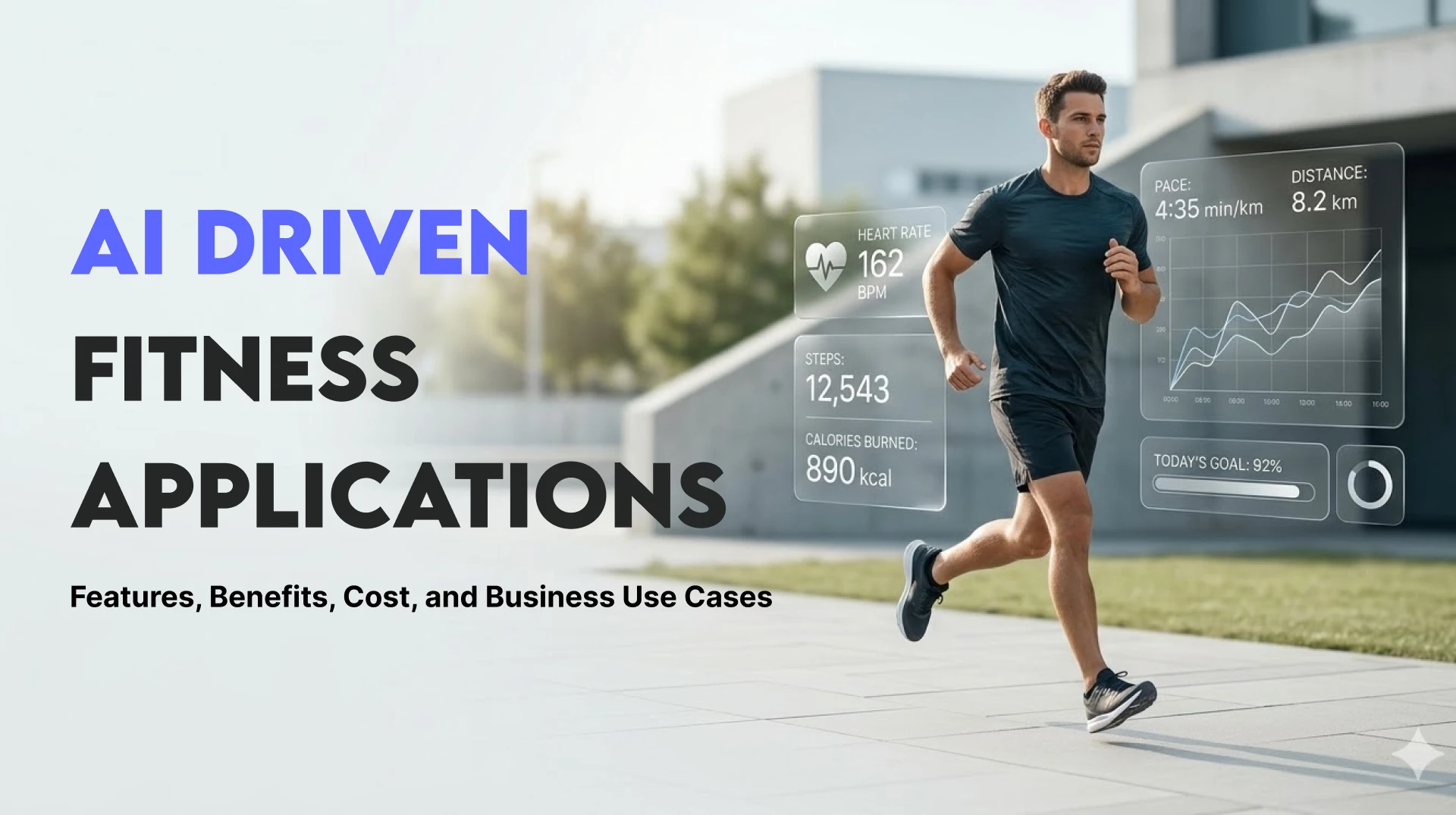
AI driven fitness applications solve this problem by constantly learning. These platforms don’t give everyone the same plan. Instead, they change based on each user’s behaviours, goals, and successes. The end result is a solution that seems less like software and more like a personal trainer who recalls what you did last Tuesday.
From our perspective, the real challenge is not adding more features. It is building a product that stays useful as user needs change over time.
If a business is thinking about making a new fitness product or improving an old one, the question is: What characteristics really matter? How much does it cost to build? Who should put money into something and when? This post answers all of those questions and more. If you’re working with a mobile app development company or looking into mobile app development services for a fitness product, the following breakdown can assist you make a better choice.
What Are AI Driven Fitness Applications and Why Are They Growing?
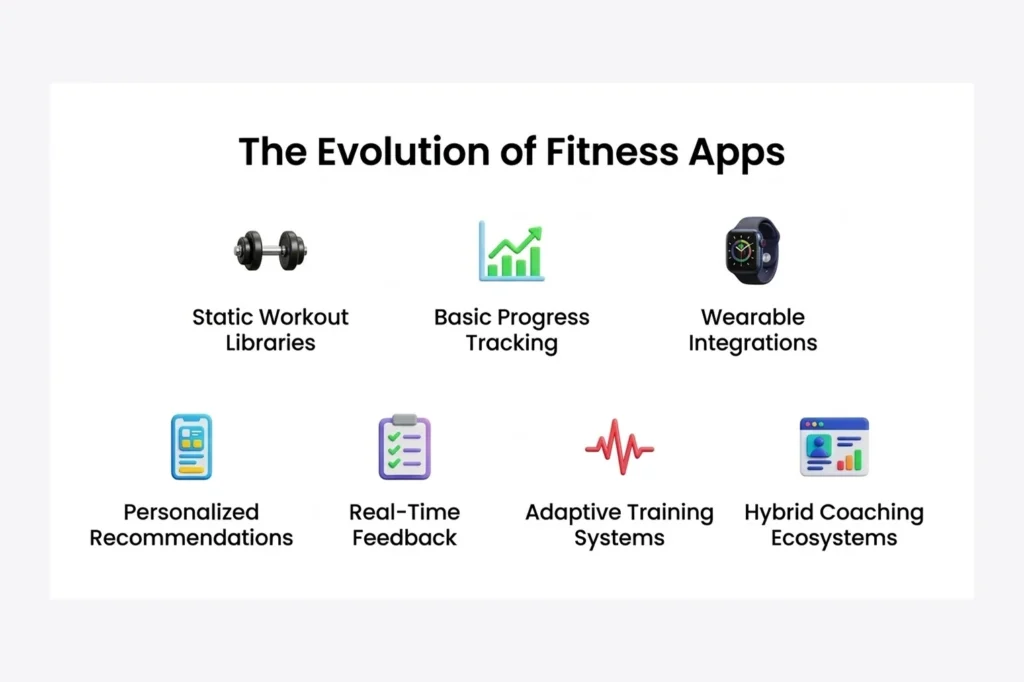
How modern fitness applications went from being just workout libraries
In the beginning, fitness apps were just digital pamphlets. You chose a program, stuck to the timetable, and hoped it was right for your level of fitness. There was no way to give input, change things, or make things truly personal. Users either finished the program or they didn’t.
The change occurred when developers began adding machine learning models that could analyze user behaviour, find patterns over time, and make suggestions based on real usage data. Fitness apps suddenly have access to real-time physiological information including heart rate, sleep quality, exercise levels, and recovery metrics. This was made possible by the rise in popularity of wearable devices.
This changed the whole category of products. An AI driven fitness application now works more like a smart coaching system that changes with the user than a simple tool.
Why people increasingly expect digital fitness devices to be personalized
People today want their software to know them. People have learned to anticipate relevance by default because of recommendation systems on streaming services and online stores. If a fitness software gives someone who has been strength training for two years a generic novice squat plan, that person will go. Maybe for good.
Personalization is no longer a special feature. This is what you should expect. Users are much more likely to stick with platforms that give flexible workout routines, behavioural nudges based on context, and feedback based on their goals than those that offer inflexible programs. For startups, gym chains, and wellness brands pursuing custom mobile app development, building personalization infrastructure from the start is far more efficient than retrofitting it later. The ecosystem of mobile app development company in India has also grown a lot in this area. They now offer extensive technical knowledge in developing fitness products that use machine learning at prices that are competitive.
Key Features That Make AI Driven Fitness Applications Valuable
Training regimens that are tailored to you, measuring your progress, and coaching that changes as you do
A well-designed fitness software has more features than most first-time founders think. At the heart of it all, you need goal-based onboarding that collects enough information to create a useful starting point. After then, the product needs to change. The next week, a user who has missed three strength sessions in a row should get a different plan than a user who has completed five strength sessions in a row with high effort.
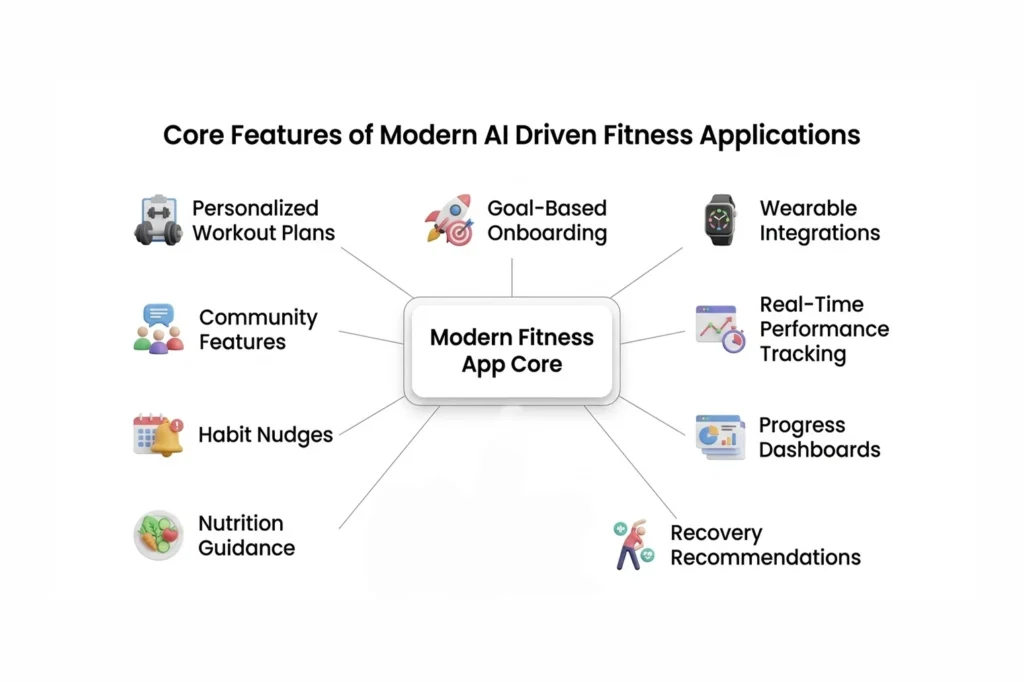
When creating an AI driven fitness applications, you should think about these important things:
- Personalized workout plans calibrated to fitness level, goals, and schedule
- Goal-based onboarding flows that separate users in a meaningful way from the start
- Integrating wearable devices to constantly collect health data
- Real-time performance tracking tied to adaptive difficulty adjustment
- Progress dashboards that show improvement measures in a visible way
- Recovery recommendations linked to sleep, effort, and past load
- Nutrition suggestions aligned with workout goals and caloric activity
- Gamification and streak systems to help people build good habits
- Features for community or responsibility that help people stay on track
When planning this feature set, it’s important to work with mobile app development companies who have a lot of experience and know the whole app development lifecycle. It’s not often a good idea to try to develop all of this at once. It’s really important to prioritize based on your individual user group.
Feedback in real time, fixing forms, and suggestions based on habits
Real-time analysis is one of the most advanced technical capabilities of modern fitness apps. Using cameras or motion sensors on a device to improve form gives consumers feedback during an exercise, not after it. This is especially helpful for people who work out at home and don’t have access to live coaching.
Habit-based recommendation systems work in a different way. They don’t just respond to one session; they look for patterns across sessions and deliver nudges at times when they can have a big impact, such when a user’s performance metrics show they’re overtraining or when they usually train.
Because of these features, you need to carefully plan the backend and keep adjusting the model. That’s why it’s just as important to work with teams that are good with technology as it is to have a clear product vision.
Business Benefits of AI Driven Fitness Applications for Startups and Fitness Brands
How fitness apps help keep customers, sell more, and make more money over time
Retention is the most important measure for fitness products that are subscription-based. An app that keeps users interested for six months makes a lot more money per acquisition than one that loses users after three weeks. AI-driven fitness applications improve retention by reducing the relevance gap, which is when a consumer thinks the product no longer meets their needs.
Churn goes down when a platform changes to fit the user’s progress, timetable, and changing goals. Users that are engaged are also more likely to respond to premium tier offers, equipment recommendations, and extra coaching goods. The upsell path is easier to follow because the platform already knows what the user is doing.
For companies that are thinking about Mobile App Development for Startups or Building MVP Mobile Apps in the health area, the business case usually depends on three main points:
- Higher subscription stickiness driven by adaptive personalization
- Conversion to the premium tier over time by showing value
- Cross-selling chances for nutrition products, coaching, classes, and equipment
Where these goods add value to the product over time
AI fitness platforms collect significant product assets over time, in addition to direct revenue. Anonymized behavioural data, combined workout habits, and outcome correlations build a learning loop that makes the platform smarter and tougher to copy. When a product is made to learn from its users, first-mover advantages in a certain niche, like women’s strength training, geriatric mobility, or corporate wellness, can add up quickly.
This is important for gyms, wellness SaaS platforms, online coaching brands, corporate wellness providers, and organizations that are close to telehealth and are adding fitness to their health management services.
Common Types of AI Driven Fitness Applications in the Market
Apps for tracking diet, workout coaching, and recuperation
Businesses may figure out where their product fits and how it needs to stand out by looking at the category landscape. It’s better to know the main sorts of products than to look at specific brands:
- Workout coaching applications that make personalized routines and keep track of how well you follow them
- Apps for running and endurance planning that change the training load based on race goals
- Form analysis apps that use camera-based motion detection for real-time correction
- Strength training companion applications that keep track of progressive overload
- Nutrition and calorie intelligence apps that connect food logging to fitness outcomes
- Recovery and sleep-linked fitness apps that use wearable data to optimize training schedules
- Corporate wellness fitness apps made to help with staff health programs
Each type has a different set of features that are most important, a different data architecture, and a different way to make money. The companies that make the best AI driven fitness apps usually start out small, do well in one category, and then grow slowly.
When you hire the best mobile app company for your product type, you need look at more than just their technical skills. You should also look at their expertise in your field. Knowing the benefits of hiring a mobile app development company that has worked on fitness apps before might save a lot of time during the planning and design stages.
Wearables, coaching, and analytics all work together on hybrid systems.
The part that is expanding the fastest is hybrid platforms that combine wearable data, human coaching, and AI-generated suggestions. These products are harder to make, but they provide you a better product position. Users who have linked a platform to their wearable device, nutrition tracker, and coaching program have much greater expenses for switching than users of standalone workout apps.
The Differences Between AI-Driven Fitness Apps and Regular Fitness Apps
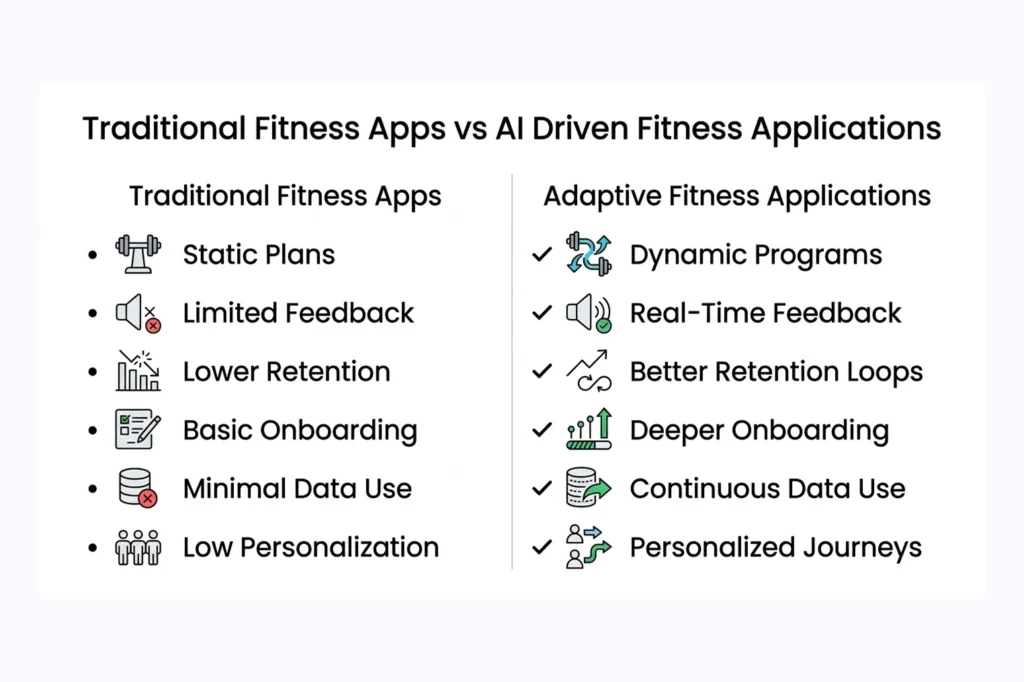
Static plans vs. adaptive user journeys
It’s not just the features that set regular fitness applications apart from AI-powered ones. It’s all about the basic model of the product.
| Dimension | Traditional Fitness Apps | AI Driven Fitness Applications |
| Personalization | Generic or preset plans | Adaptive based on behavior and data |
| Feedback quality | Post-session, manual | Real-time, automated |
| User engagement | Decreases after novelty | Maintained through adaptation |
| Subscription retention | Higher churn after 30 days | Improved through relevance loops |
| Onboarding depth | Basic goal selection | Multi-point data collection |
| Wearable integration | Limited or absent | Central to recommendation logic |
| Data usage | Minimal | Continuous and bidirectional |
| Coaching scalability | Manual or static | Automated with optional hybrid coaching |
| Privacy responsibility | Lower data sensitivity | Higher – health data requires robust compliance |
This contrast is in line with what has been said about ai chatbots vs traditional chatbots in the broader context of software product development. The pattern holds: rule-based systems work until users need something that the rules didn’t expect. Adaptive systems deal with change better.
Why personalized involvement affects retention rates
The structural advantage of adaptive products is that they keep people. A static app runs out of useful content. An adaptive platform never gives the same experience twice since the user is continually changing. Did you finish your best? The plan goes up. Did you miss a week because you were travelling? The system is reset. These small changes add up to a product relationship that people find hard to break.
Using mobile app UI/UX design tips that show how users modify their journeys, such dynamic homescreens, progress-aware dashboards, and contextual push alerts, makes this retention loop even stronger at the interface level.
Challenges and Risks in Building AI Driven Fitness Applications
Concerns about user trust, data privacy, and health accuracy
Fitness applications keep track of private information including your weight, activity levels, menstrual cycles, heart rate variability, and sleep habits. This information is both useful and important. Any compromise or exploitation puts your reputation and compliance at risk. It is not optional to follow the rules for protecting data, and the rules vary depending on where you are, who uses the app, and if it connects to medical-grade wearable data.
Accuracy is also a big deal. An AI recommendation engine that routinely suggests training loads that are too much for a user’s actual ability will increase the danger of injury and damage trust. Important design rules include careful model validation, suitable disclaimers, and cautious defaults. By starting from scratch and not just adding mobile app security best practices as an afterthought, you can greatly lower your risk in both of these areas.
There are many other hazards, such as:
- Wearable data dependency creating friction for users without devices
- Device fragmentation is making hardware performance inconsistent.
- Bias in training recommendations if model training data is not representative
- Regulatory and disclaimer considerations for health-related advice
Why bad UX can make people less likely to use a product even if it has great features
If the onboarding process is complicated or the UI is cluttered, a technically brilliant recommendation engine won’t keep users. One of the most prevalent reasons why feature-rich fitness applications fail is that users leave off during complicated onboarding processes. Investing in mobile app performance optimization and rigorous usability testing before launch reduces this risk substantially.
At the MVP stage, it’s nearly always preferable to build with fewer, better-designed features than to launch with too many features that customers can’t easily find their way around.
How Much Does It Cost to Build AI Driven Fitness Applications?
Cost factors based on feature depth, integrations, and product stage
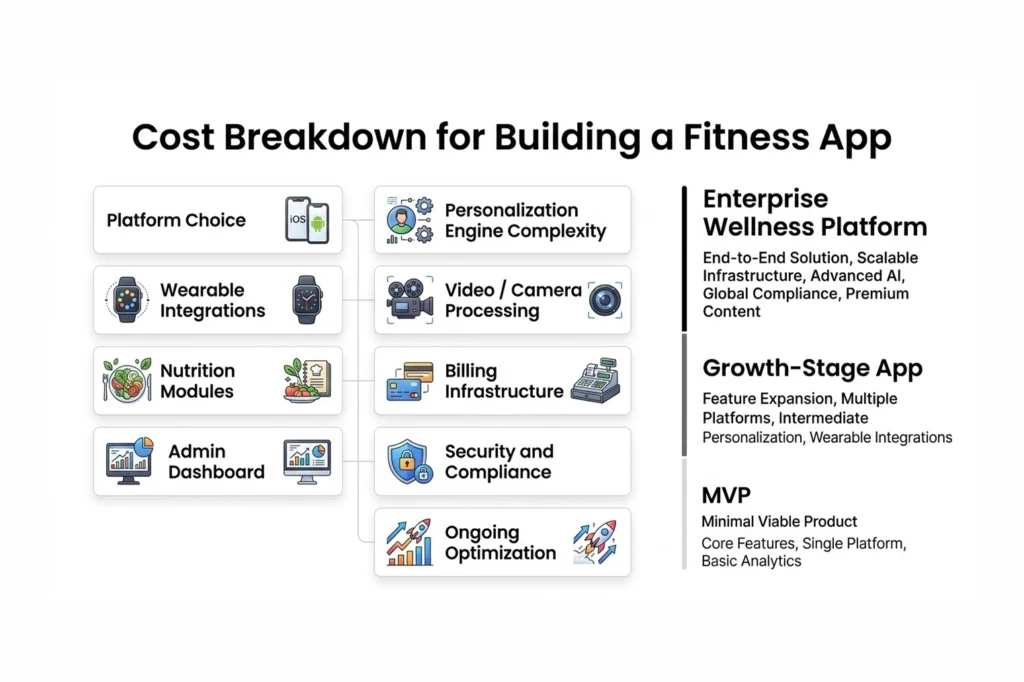
The cost of building AI-driven fitness applications can vary greatly based on the project’s size, the team structure, and the technology used. Important factors that affect costs are:
- Choosing a platform: only iOS, exclusively Android, or development on both platforms
- Personalization engine complexity: rule-based logic is cheaper; ML model development is more expensive
- Wearable integrations: every new device API adds to the work of developing and maintaining the system.
- Processing video or camera: real-time form analysis is hard on computers and needs particular development.
- Nutrition and recommendation modules: using third-party datasets or your own customized ones
- Subscription billing infrastructure: managing in-app purchases and billing logic
- Admin dashboard: for managing content, dividing users into groups, and seeing analytics
- Security and compliance work: particularly important for health data
- Ongoing model tuning: After an AI system is launched, it needs to be constantly tested and improved.
Looking into app development cost benchmarks by feature category is a good way to start if you want to get a full breakdown of the costs for your application. Knowing how to choose mobile app development company partners who are transparent about scope and cost estimation is equally important.
Budgeting for fitness startups: MVP vs. advanced platform
You can build a lean MVP that includes individualized training regimens, basic progress monitoring, and a smooth onboarding process for a lot less money than a full-featured platform. Before adding advanced features like camera-based form analysis or nutrition AI, most fitness firms should focus on an MVP that proves one basic user behaviour, like completing sessions consistently.
Things to think about when investing:
- MVP: Basic notifications, workout delivery, core customisation, and progress tracking
- Version for the growth stage: wearable integrations, nutrition module, premium tier features, and community functions
- Enterprise wellness platform: advanced analytics, employer dashboard, tools for compliance, and options for white-labeling
There are significant differences in the technical needs and ongoing maintenance expenditures at each step.
How to Build AI Driven Fitness Applications for Your Business
A step-by-step plan for the product from discovery to launch
A structured build process lowers risk and makes the product match the market better. This is what a proven plan for making a fitness app looks like:
- Define your audience and fitness niche, since generalist apps compete against well-funded incumbents, whereas niche products build loyal communities.
- Validate the problem statement through user interviews, waitlist signups, and competitor gap analysis before writing a line of code.
- Pick the MVP features, which are the fewest features that nevertheless give the main value.
- Map user journeys, covering everything from the first open through habit formation and subscription conversion.
- Plan device and wearable integrations by deciding which integrations are MVP-critical versus post-launch.
- Plan onboarding and habit loops because the first week of a user’s experience will decide how long they stay.
- Build a scalable backend and analytics, ensuring that the behavioral data architecture is planned from the start.
- Launch a beta with early cohorts so real usage data can reveal issues that internal testing misses before the public launch.
- Measure retention and feature adoption, focusing on metrics like session frequency, completion rates, and subscription conversion.
- Expand into premium modules by adding features that respond to demonstrated user demand.
Picking the right partner for development and the correct way to launch
The design layer of a fitness software needs just as much money as the engineering layer. Bad UI and UX design can ruin good technical work. Working with a company that offers both user experience design and development services makes guarantee that the product looks and works great.
For fitness companies that are just starting out, collaborating with a product design agency for startups that knows how health and wellness users behave might help them find the right market for their product faster. A ui ux design business for tech companies that has worked with data-heavy interfaces and adaptive content delivery is a better fit for platforms that are further along and have more complicated technical needs.
How Agentic Systems Will Change the Future of Fitness Apps
From suggestions based on rules to digital aides that may change with you
Most fitness apps these days work on pretty straightforward logic: if a user does three workouts beyond their target heart rate, they should make the next week’s workouts harder. This rule-based method works well for big groups of users, but it doesn’t function as well when there is a lot of individual difference.
Agentic systems, on the other hand, are AI architectures that can take actions in several steps, keep track of context across interactions, and work with little help from people. These systems make things more flexible in a new way. An agentic layer can proactively reschedule a session depending on a user’s calendar, change a nutrition plan based on a missed workout, or suggest a recovery plan based on sleep and activity data combined. This is different from reacting to events that have already happened.
For teams exploring this architecture, engaging an experienced ai agent development company or reviewing Agentic AI Development Services helps establish whether this level of complexity is justified for your current product stage. Looking at the top AI development companies in India and the best AI tools for integrating fitness products will also help you figure out what is technically possible and cost-effective right now.
When advanced decision layers are useful in fitness products
Agentic features make sense when your users have consistently used the basic features and your data architecture can handle context management reliably. Adding a complicated agentic system to a product that doesn’t get many sessions completed doesn’t fix the problem.
Begin with a small personalized loop. Check to see if retention has improved. Once your product has acquired the confidence of users and data, you can look into more advanced decision-layer architecture.
Who Should Invest in AI Driven Fitness Applications Today?
The best business concepts for health and fitness products
Not every firm is ready for a high-tech AI fitness product. The best fits are:
Good options for investment:
- Fitness startups with a validated niche and an audience willing to pay for personalized digital coaching
- Gym chains that want to keep their members interested between visits
- Online coaching brands seeking to scale their coaching methodology beyond one-to-one delivery
- Wellness SaaS platforms incorporating fitness as a way to keep customers using a larger health product
- Sports performance products targeting athletes who want data-driven training optimization
- Women’s health fitness communities where personalization around hormonal cycles, recovery, and goal specificity is high-value
- Corporate wellness platforms where B2B retention depends on observable engagement metrics
- Insurance-linked wellness ecosystems where improved health outcomes reduce claims costs
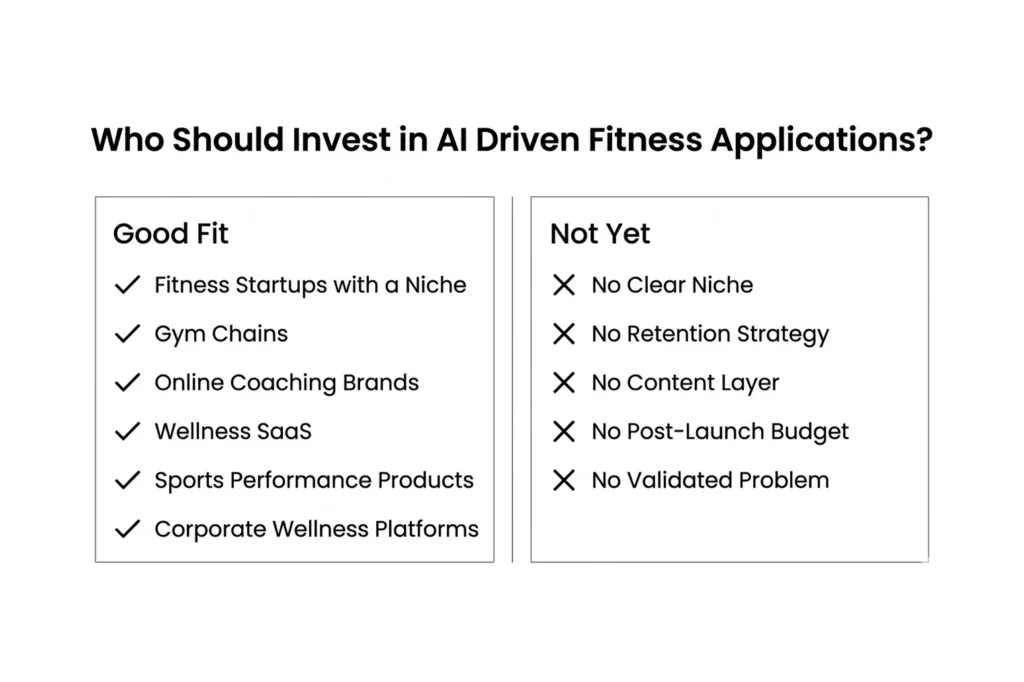
When you should wait to invest:
- No distinct user group or recognized niche
- No content or coaching layer to make customisation work
- No plan for keeping users beyond the app itself
- No budget for post-launch iteration and model improvement
It only makes sense to look at ai agent development companies and mobile app development services again when the basic questions about product-market fit have been answered. One of the most common and costly mistakes in making fitness apps is adding complex functionality without a clear customer need.
Final Thoughts on Building AI Driven Fitness Applications
The chance to make money in AI fitness is great, but so are the risks. There is a conflict between privacy and personalization. More data, for instance, means better recommendations, but it also means more responsibility for compliance. Advanced features, on the other hand, make it more likely that people would use the product, but they also make it harder to design and cost more to maintain. It is possible to keep users, but only if the basic user experience is good enough to keep them coming back.
Most firms will have the clearest way forward if they start small, test one fundamental behaviour, and then develop from there based on what real users say. Pick a specific group of users, figure out a measurable result that important to them, then make an MVP that always gives them that result. Once the product has earned users’ confidence, everything else, such nutrition AI, wearable connections, community features, and agentic layers, can come next.
Put UX, retention mechanics, and privacy architecture at the top of your list from the start. You can’t add these functionalities later. They are the base that decides if your product will last through its first three months of practical use.
If you’re ready to start planning a fitness app, the next step is to look at custom mobile app development solutions that are right for your level. Knowing the benefits of hiring a mobile app development company that has worked with health or fitness tech can help you choose the right partner before you start building.
Feature lists don’t always show which fitness items are the best. They win by how effectively they integrate into a user’s life and how often they give results that are worth paying for.
Frequently Asked Questions About AI Driven Fitness Applications
1. What are fitness apps that use AI?
AI driven fitness applications are software platforms that combine machine learning, behavioural data, and real-time input to create individualized workout regimens, give health advice, and coach people. They change over time based on how each user uses them, unlike static fitness apps. Check out our Mobile App Development Company page for additional information on how to make one.
2. What makes AI-powered fitness apps distinct from normal fitness apps?
Fitness apps that are more traditional have set plans that don’t adapt dependent on how users act or do. AI-powered platforms change all the time, give real-time feedback, and leverage data that has been collected over time to make recommendations more relevant.
3. Are fitness apps that use AI good for new businesses?
Yes, but the scope is important. A startup in its early stages should focus on a small niche and make a simple MVP that tests how users behave before adding more powerful AI features. At the MVP stage, the goal is to keep customers and make sure the product fits the market, not to add all the features.