
Key Takeaways
- Choosing the right Custom Software Development Company in Chennai helps businesses build software tailored to their unique workflows and long-term goals.
- Custom software improves operational efficiency by replacing manual processes and integrating disconnected business systems.
- Evaluate development partners based on industry expertise, technology stack, security practices, and post-launch support rather than price alone.
- Development costs vary depending on project scope, complexity, integrations, and scalability requirements.
- Investing in scalable, well-planned custom software provides greater flexibility, ownership, and long-term business value.
Most businesses don’t set out to build custom software. They start with spreadsheets, a couple of SaaS tools, maybe a WhatsApp group for coordinating between departments. It works, until it doesn’t. Orders get missed because two systems don’t talk to each other. A finance team spends three days every month reconciling numbers that should have matched automatically. Someone leaves the company and takes undocumented process knowledge with them.
That’s usually the point where our company enters the conversation, not because custom software is trendy, but because generic tools have hit a ceiling the business can’t grow past. Off-the-shelf software is built for the average user. Your operations, pricing logic, compliance requirements, and customer journey are rarely average.
This guide walks through what custom software actually involves, what it costs in the Chennai market, how to evaluate a development partner, and where businesses commonly go wrong. It’s written for founders, CTOs, and IT managers who need a clear-eyed view before signing anything, not a sales pitch dressed up as an article.
Why Businesses Choose a Custom Software Development Company in Chennai
Chennai has quietly become one of India’s stronger software delivery hubs, backed by a deep engineering talent pool from institutions across Tamil Nadu and a mature IT services ecosystem going back decades. But talent availability isn’t the only reason businesses look locally. It’s usually a specific, painful problem that triggers the search.
Common Business Challenges That Generic Software Cannot Solve
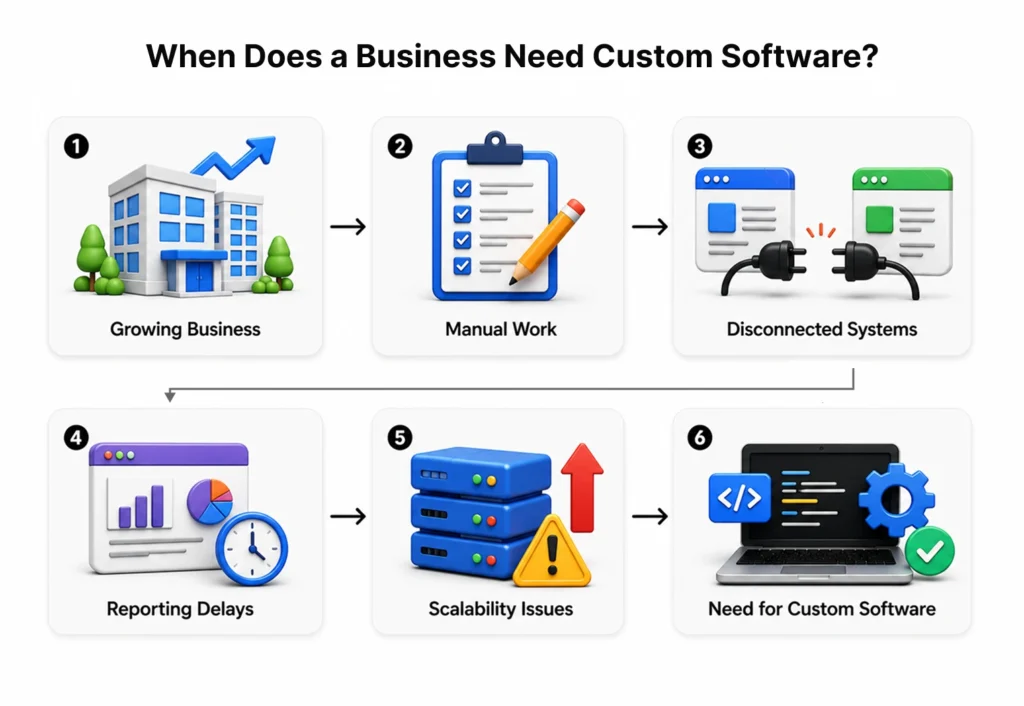
A few patterns show up again and again in discovery calls with growing businesses:
- Workflow inefficiencies: a process that takes six manual steps because no single tool covers the full sequence
- Multiple disconnected tools: a CRM that doesn’t sync with the accounting software, which doesn’t sync with inventory
- Manual operations: data re-entered by hand across three different systems, with errors compounding each time
- Scalability issues: software that worked fine at 50 orders a day and falls apart at 500
- Department-specific requirements: sales needs one workflow, operations needs another, and no off-the-shelf product satisfies both
None of these are exotic problems. They’re the ordinary friction of running a business that has outgrown its early tooling. A website development company in chennai can sometimes patch the surface-level symptoms, but when the problem lives in backend logic and data structure, custom website development or full application development becomes the more honest fix.
What Custom Software Development Actually Includes
“Custom software” is a broad term, and it helps to be specific about what falls under it.
Different Types of Business Software
Depending on the business model, custom development can mean building:
- ERP systems that unify finance, inventory, procurement, and HR under one data layer
- CRM platforms tailored to a specific sales cycle rather than a generic pipeline
- Inventory and warehouse management systems
- HRMS platforms for attendance, payroll, and performance tracking
- Billing and invoicing systems with compliance built in for GST and other regional requirements
- Healthcare software, covering patient records, appointment systems, and lab integrations
- Manufacturing software for production planning and shop-floor tracking
- Logistics software for fleet, route, and delivery management
- Customer portals for self-service account management
- Internal management systems built around a company’s specific approval chains
Each of these solves a narrow, real problem. A hospital doesn’t need generic project management software; it needs something that understands patient intake, doctor scheduling, and insurance workflows.
Software vs Web Applications vs Mobile Applications
These terms get used loosely, and the difference matters when planning a budget.
Software, in the traditional sense, often refers to a self-contained system, sometimes desktop-based and sometimes a hybrid, built for internal operations. A web application runs in the browser and is accessible from anywhere, which makes it the default choice for most SaaS products and internal dashboards today. A mobile application is built specifically for iOS or Android, useful when the primary users are in the field, driving, or otherwise away from a desk.
A logistics company tracking delivery drivers probably needs a mobile app for the drivers and a custom web application development for the dispatch team managing routes from an office. A retail brand selling B2B might only need a web portal. There’s no universal answer; the right format depends on where the user actually is when they need the software, and a Mobile App Development Company will usually ask that question before recommending a platform.
Benefits of Hiring a Chennai-Based Custom Software Development Company
Working with a local team changes the collaboration dynamic in ways that are easy to underestimate until you’ve dealt with the alternative.
Time zone alignment means a bug reported in the morning can be fixed the same afternoon, not overnight through an offshore handoff. Chennai’s developer ecosystem is also large enough that finding people with specific stack experience, such as Java, .NET, React, or Flutter, rarely takes long, which keeps project timelines realistic. Operational costs in Chennai remain lower than in Bangalore or Hyderabad for comparable talent, and that difference often gets passed on to clients as more competitive project pricing.
There’s also a softer advantage: shared context. A web development company in chennai working with other regional businesses tends to understand local compliance nuances, vendor ecosystems, and market behavior that a distant team would need to learn from scratch. None of this replaces due diligence, so reviewing a shortlist of Top Software Development Companies in Chennai is still worth doing, but proximity genuinely does reduce friction on communication and long-term support.
Features Every High-Quality Custom Software Should Have
It’s easy to focus on what the software should do and forget to specify how it should be built. Both matter equally.
Scalability and Security
A system built for 10 users behaves very differently at 1,000. Look for:
- Modular architecture, so new features don’t require rebuilding the whole system
- Role-based access control, limiting what each user type can see or change
- Regular, automated data backups
- Performance that holds up under real transaction volume, not just demo conditions
- API integrations that let the software connect with existing tools instead of replacing them outright
Future Expansion
Software that can’t grow with the business becomes a liability within two or three years. Cloud readiness, support for multiple concurrent users, built-in reporting, and the ability to plug in third-party services later are the difference between a five-year asset and a two-year patch job. Businesses planning for scale often look at an enterprise saas platform model from the start, and pairing that with a devops consulting company in india early on tends to prevent painful re-architecture down the line.
Technologies Used by Chennai Software Development Companies
The technology stack should follow the project’s requirements, not the other way around. That said, certain combinations show up repeatedly across Chennai’s development landscape because they’re proven and well-supported.
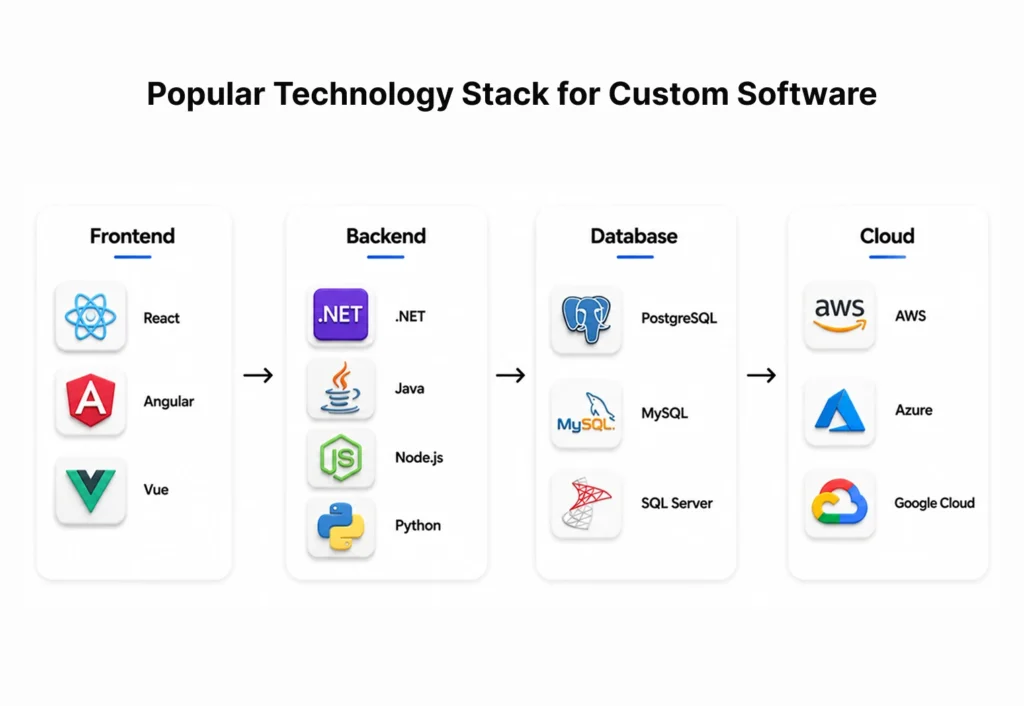
On the backend, .NET and Java remain common choices for enterprise systems, while Node.js and Python are frequently used for faster-moving products and APIs. PHP still has a place, particularly for content-driven platforms. On the frontend, React leads adoption, with Angular and Vue used depending on team preference and project complexity. Database choices generally come down to PostgreSQL or MySQL for most applications, with SQL Server showing up in enterprises already invested in the Microsoft ecosystem.
Mobile development typically splits between Flutter for cross-platform efficiency and native Android or iOS development when performance or platform-specific features are critical. Cloud infrastructure is dominated by AWS, with Azure and Google Cloud used depending on existing enterprise relationships.
Newer architectural patterns, including event-driven systems, microservices, and API-first design, are becoming standard for businesses planning serious scale, even outside of any AI-specific use case. The stack matters less than whether the team chose it deliberately, based on the problem at hand, rather than defaulting to whatever they know best.
How to Choose the Right Custom Software Development Company in Chennai
This is where most of the real risk in a project gets decided, well before a single line of code is written.
Questions to Ask Before Signing a Contract
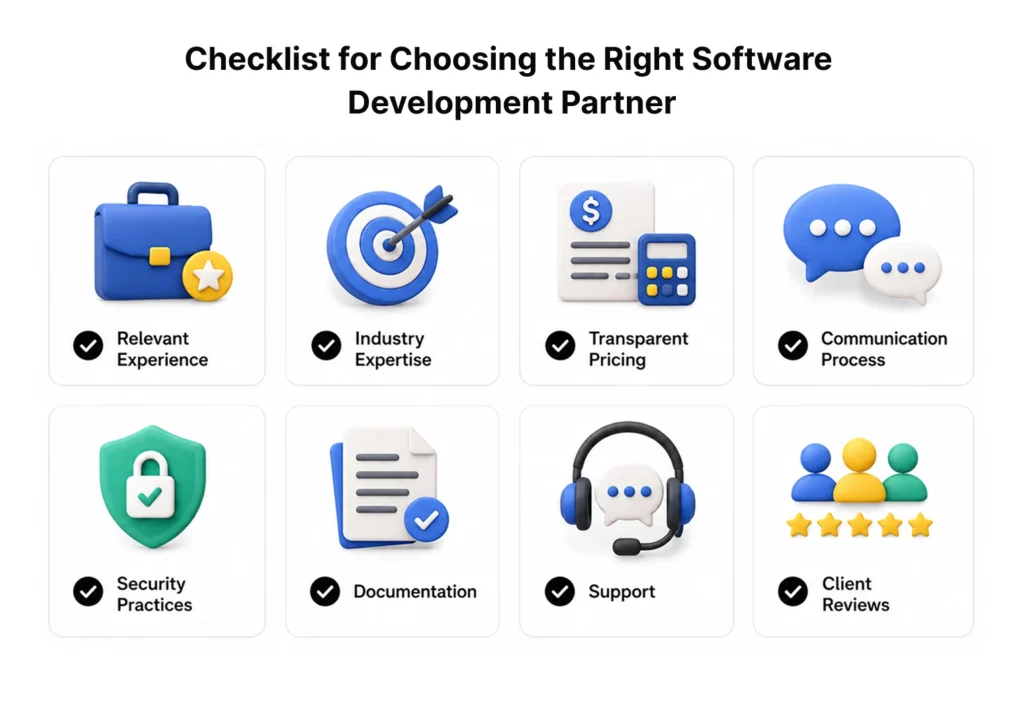
- Do they have direct experience in your industry, or will you be funding their learning curve?
- Can they show a portfolio of comparable projects, not just logos on a website?
- What does their communication process look like: weekly updates, a dedicated project manager, or direct developer access?
- What security standards do they follow for data handling and code storage?
- What does post-launch support actually include, and for how long?
- What delivery methodology do they use: Agile sprints, fixed milestones, or something else?
- Who owns the source code once the project is complete? This should be explicit in the contract, not assumed.
- Will they provide technical documentation, or does institutional knowledge live only in their developers’ heads?
Reviewing detailed comparisons, such as a breakdown of the Top 10 Enterprise Application Development Companies in Chennai, can help shortlist vendors before these conversations even start. Some businesses are also exploring Agentic AI Development Services as part of a broader enterprise innovation roadmap, a trend worth being aware of, even if it isn’t the core focus of a given project.
Red Flags to Watch
A quote significantly lower than every other bidder usually means corners will be cut somewhere, often in testing or documentation. Other warning signs include vendors who can’t clearly explain their maintenance plan, who avoid discussing documentation practices, who have no defined testing strategy, or who can’t provide references from past clients willing to speak candidly. None of these alone is disqualifying, but two or three together are worth taking seriously.
Cost of Custom Software Development in Chennai
Pricing in custom software is notoriously hard to pin down in general terms, because it depends on so many variables specific to the project.
Pricing Factors
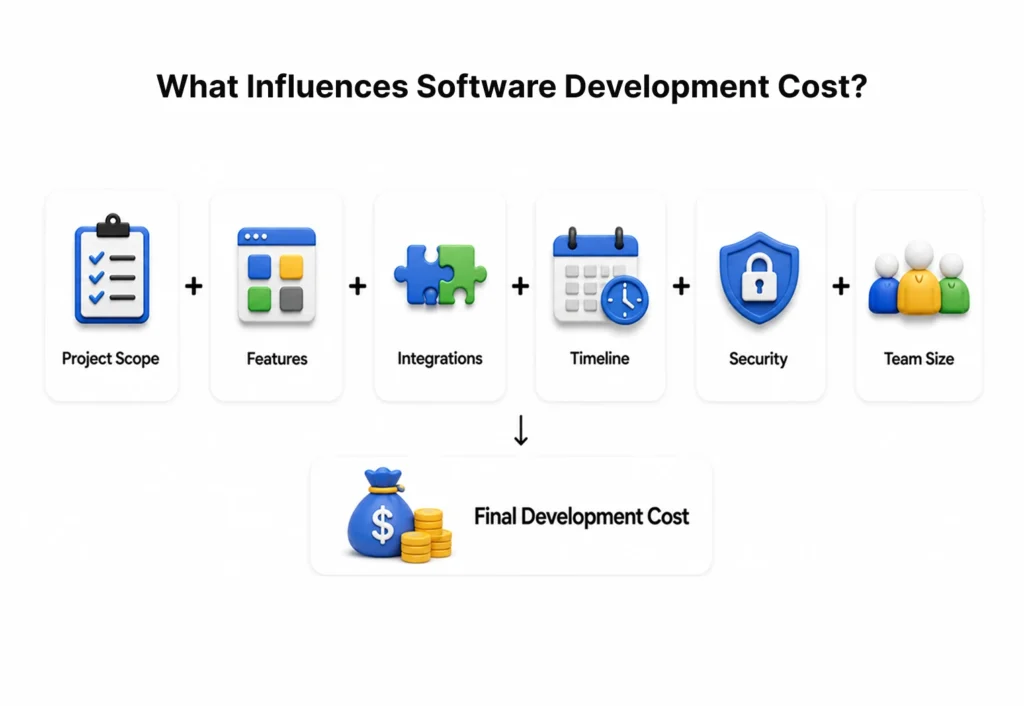
The main drivers of cost are feature scope, technical complexity, the number of third-party integrations required, team size and seniority, project timeline, ongoing maintenance needs, and security or compliance requirements; healthcare and fintech projects, for instance, typically cost more due to regulatory overhead.
Estimated Cost Table
| Project Type | Estimated Cost |
| MVP | ₹5L–12L |
| SME Software | ₹10L–30L |
| ERP | ₹20L–60L |
| Enterprise Platform | ₹50L+ |
These figures are indicative, not quotes. Two ERP projects can differ by 3x in cost depending on the number of modules, integrations, and users involved. Treat any number here as a starting point for budgeting conversations, not a final figure; a proper estimate only comes after a scoping exercise with a development partner.
Common Mistakes Businesses Make When Hiring Software Development Companies
A retail business once picked the lowest bidder for an inventory system, only to discover six months in that the vendor had skipped load testing entirely. The system crashed during their first festive sale spike, exactly when it mattered most. That’s the pattern worth avoiding: choosing based on price alone, without weighing what’s actually being sacrificed.
Other recurring mistakes include ignoring scalability during initial planning (assuming today’s user count is the ceiling), rushing through requirement gathering because it feels like a delay rather than the most important phase, skipping post-launch planning entirely, accepting a project with no documentation, and agreeing to unrealistic timelines that later get blamed on the development team rather than the schedule itself.
Industries That Benefit Most from Custom Software
Some industries have workflows too specific for generic tools to handle well.
Healthcare needs patient data systems that meet compliance requirements no general CRM was built for. Manufacturing needs production tracking tied to actual shop-floor conditions. Logistics needs real-time routing that adapts to traffic and driver availability. Retail needs inventory systems synced across online and offline channels. Finance needs audit trails and security that off-the-shelf accounting software often can’t guarantee at scale. Education platforms need to manage cohorts, assessments, and content delivery together. Real estate and construction need project tracking across long timelines with multiple stakeholders. Hospitality needs booking systems integrated with guest experience data. SaaS businesses need infrastructure built to scale from day one. Professional services firms need client and project management tailored to billing models that vary case by case.
In each case, the common thread is the same: a workflow specific enough that a generic tool forces the business to adapt to the software, instead of the other way around.
Why Custom Software Is a Long-Term Business Investment
Custom software costs more upfront than a SaaS subscription. That’s the honest trade-off, and it’s worth saying plainly rather than glossing over. But the calculation changes over a three-to-five-year horizon.
Recurring per-user licensing fees disappear. The business owns the system outright, rather than renting access to someone else’s roadmap. Operational efficiency compounds; a workflow that saves two hours a day adds up to hundreds of hours a year. And a system built around the business’s actual processes becomes harder for competitors to replicate than a strategy built on the same generic tools everyone else uses. Integrations become easier because the software was designed with the company’s existing tech stack in mind, not retrofitted around it.
none of this guarantees ROI automatically. A poorly scoped custom system can be just as wasteful as an ill-fitting off-the-shelf tool. The difference lies entirely in execution, which is why choosing the right custom software development company in Chennai matters more than the decision to go custom in the first place.

Conclusion
The decision to invest in custom software should start with business goals, not technology preferences. The right stack, the right architecture, even the right development partner, all of that comes second to a clear understanding of what problem the software needs to solve and how the business plans to grow around it. Chennai offers a strong, cost-effective talent pool for this kind of work, but a good location doesn’t substitute for due diligence. Ask hard questions, check for documentation and testing discipline, and treat the relationship with a custom software development company in Chennai as a long-term partnership rather than a one-off transaction. That mindset, more than any single technical decision, is what determines whether the investment pays off.
Frequently Asked Questions
1. What is custom software development?
Custom software development is the process of designing, building, and maintaining software tailored specifically to a business’s workflows, rather than adapting the business to fit a generic, pre-built product.
2. How much does custom software development cost in Chennai?
Costs typically range from ₹5L for a basic MVP to ₹50L or more for enterprise-grade platforms, depending on complexity, integrations, and team size. Exact pricing requires a scoping conversation with a development partner.
3. How long does it take to build custom software?
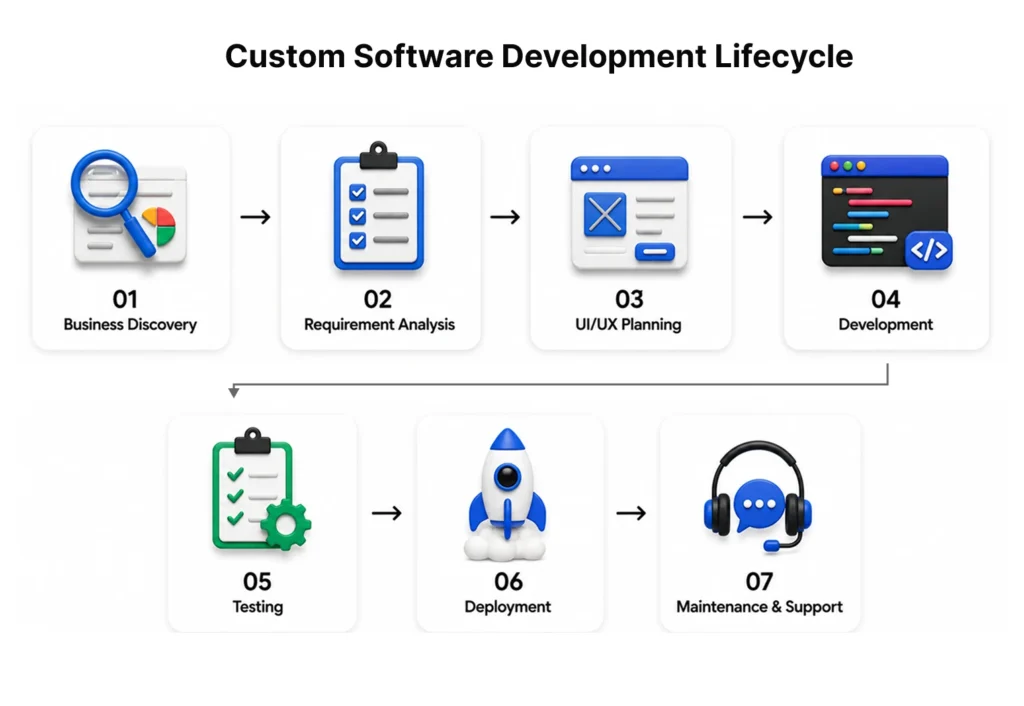
Timelines vary by scope. A simple MVP might take 2–4 months, while a full ERP or enterprise platform can take 8–18 months, including testing and deployment phases.
4. What technologies do Chennai software companies commonly use?
Common choices include .NET, Java, Node.js, and Python for backend development; React, Angular, and Vue for frontend; PostgreSQL, MySQL, or SQL Server for databases; and AWS, Azure, or Google Cloud for infrastructure.
5. Is custom software better than off-the-shelf software?
It depends on the use case. Off-the-shelf software is faster and cheaper to deploy for standard needs. Custom software makes sense when workflows are specific enough that generic tools create ongoing inefficiency or force awkward workarounds.
6. Which industries benefit the most from custom software?
Healthcare, manufacturing, logistics, finance, retail, education, and SaaS businesses tend to see the strongest returns, largely because their workflows are too specific for generic platforms to handle well.
7. How do I choose the best custom software development company in Chennai?
Evaluate industry experience, portfolio depth, communication practices, security standards, documentation quality, and post-launch support commitments, and be direct about who owns the source code before signing anything.