Key Takeaways
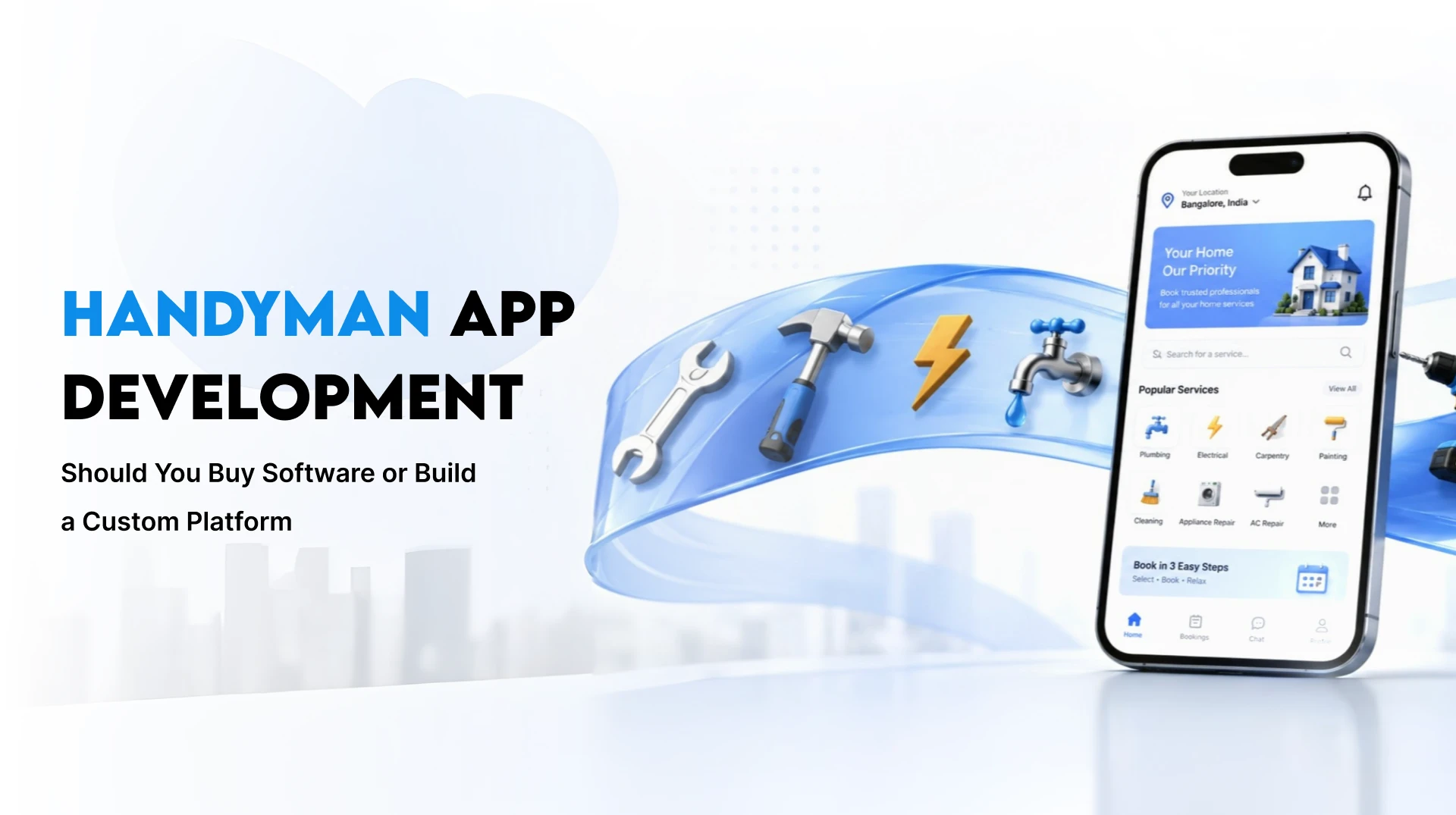
- Handyman app development is the right choice when your business needs a scalable platform instead of basic field service software.
- Compare ready-made software, clone solutions, and custom handyman app development before making an investment.
- The cost of handyman app development depends on your platform scope, features, and long-term business goals.
- A successful handyman app development project should support provider management, customer bookings, and secure payment workflows.
- Choosing the right handyman app development approach early helps reduce future costs and supports long-term business growth.
More home service businesses are investing in dedicated digital platforms. This is especially true for companies managing independent technicians instead of a single in-house crew. A basic website is no longer enough. A simple reality drives this shift: clients expect to request a service, receive an estimate, and book it online within minutes. Businesses that fail to deliver this experience often lose bookings to competitors.
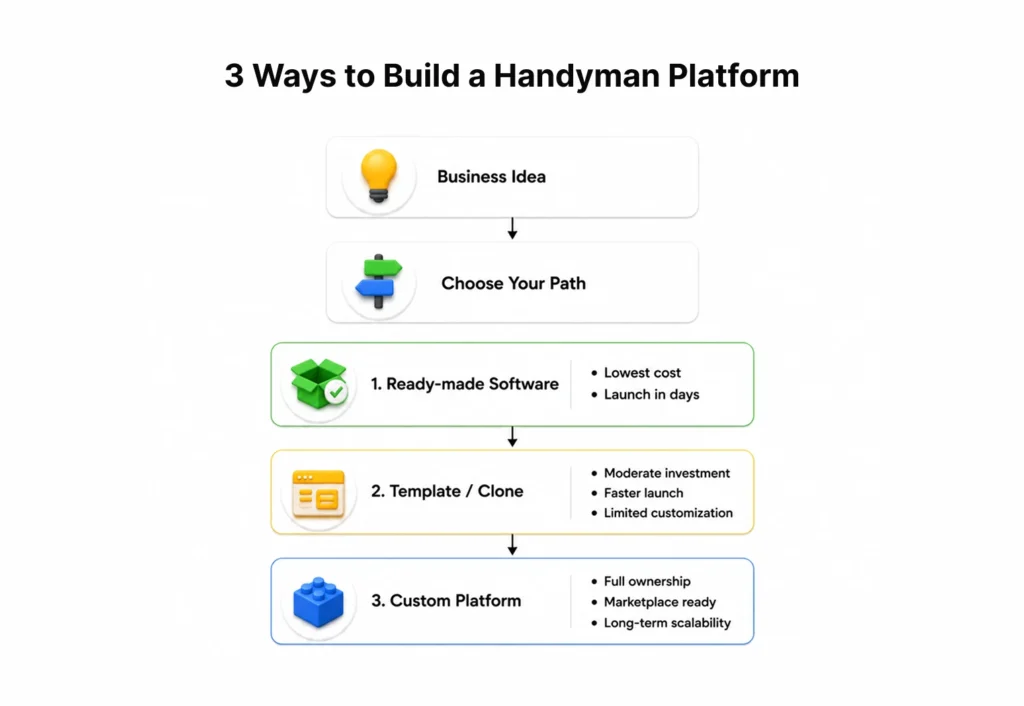
Most business owners already know they need to go digital. The real question is which approach fits their business. Should you buy existing field service software? Or should you invest in a custom platform built around your workflow? A clone or template solution offers a third option between the two.
This guide walks through all three approaches to handyman app development, buying ready-made software, building from a template, or investing in a fully custom platform, and how to know which one actually fits your business. Our own approach at Code Neptune, when a custom platform is the right call, is to build the client experience, the provider-facing tools, and the operational engine as one connected system from day one, not stitched together after launch.
Learn more about our broader capabilities as a Mobile App Development Company, if you’re evaluating a fully bespoke build.
Understanding Your Options for Handyman App Development
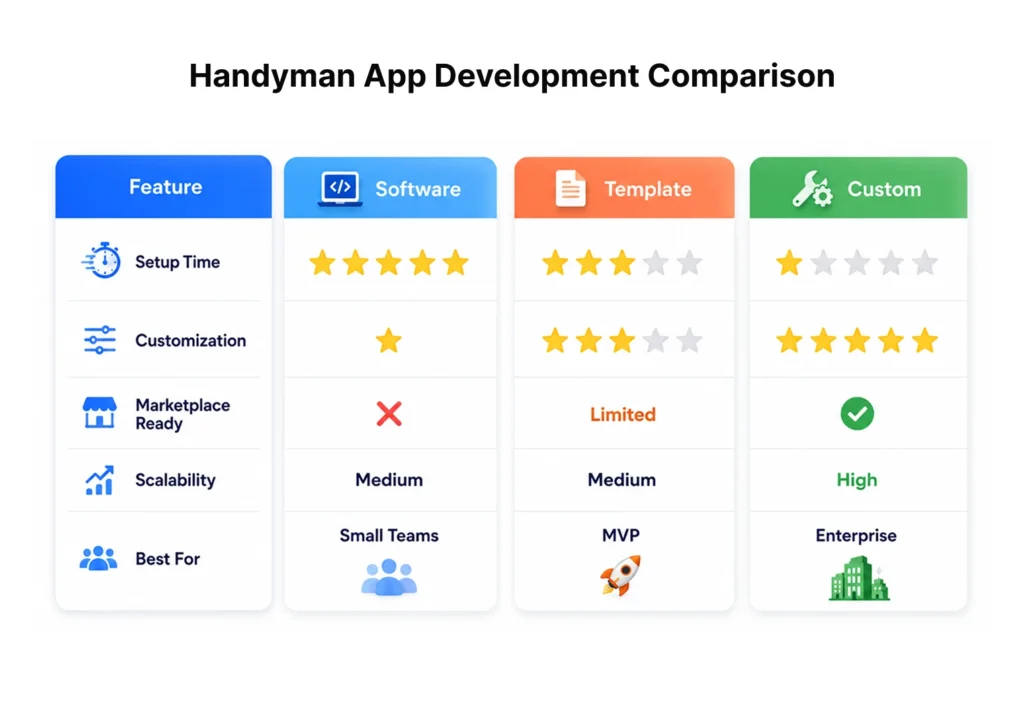
Anyone researching handyman app development eventually runs into the same three options, usually without anyone laying them side by side honestly. Here’s the comparison most guides in this space skip.
Buying Ready-Made Field Service Software
Software providers design off-the-shelf solutions for businesses that manage their own crews. You’re not connecting outside providers with clients, you’re scheduling your own technicians, sending invoices, and taking payments. These platforms are mature, priced simply on a monthly basis, and require no development time at all.
Choosing a Clone or Template Solution
A clone or template build takes an existing booking-and-dispatch pattern and reskins it for your brand. It launches faster than custom development. It also helps you validate demand before making a larger investment. The tradeoff is that you inherit someone else’s assumptions about assignment, pricing, and provider workflow, and you can’t easily bend the platform to fit a genuinely different business model.
If you’re weighing this route, it’s worth understanding the App Development Lifecycle Explained so you know exactly which stages a template shortcuts, and which ones it doesn’t.
Essential Features of a Custom Handyman Platform
Custom development starts from your actual business model instead of a template. It costs more and takes longer, but it’s the only path that gives you full control over how clients and handymen are matched, how pricing and payouts work, and how the platform scales as your network grows into new service categories or regions.
At a real production standard, a custom platform is a specific set of capabilities working together, not just “an app with booking and payments”:
- Multi-trade service architecture: cleaning, plumbing, electrical, carpentry, painting, pest control, and any category your network covers, each with its own structured booking path instead of one generic form
- Instant estimate engine: a client gets a real, structured estimate immediately based on job type and scope, not a placeholder number they have to call in for
- Tiered service packages: clearly defined package tiers within each category, so clients know exactly what’s included before booking, and you control positioning and margin at the package level
- Verified-professional profiles: credentials and verification status visible to the client before the first job even starts
- Transparent performance signals: completed-job counts and satisfaction data displayed honestly, not vanity numbers with nothing behind them
- Structured, categorized support: FAQs and help content organized by topic instead of one long undifferentiated list
- Lead-recovery capture: a structured callback or follow-up flow for the client who isn’t ready to book instantly, so the lead doesn’t go cold
- Automation built into the core: smart job assignment, automated dispatch, and AI-assisted quoting engineered into the architecture from day one, not retrofitted after launch
We don’t design this architecture in a proposal deck and hope it holds up in production. Before we bring this system to a client, we build and stress-test the same core, the instant-estimate logic, the tiered-package structure, the verified-provider workflow, the assignment and payout engine, ourselves, in working reference platforms. What you get isn’t a first attempt priced as if it were routine. It’s a proven pattern, refined through real engineering, applied to your specific business.
For a closer look at how we scope early-stage builds, see Building MVP Mobile Apps.
Comparison Table
| Off-the-shelf software | Clone/template build | Custom platform | |
| Best for | Single crew, standard workflows | Fast market test, low differentiation needs | A managed network of independent handymen you want to run as a real client pipeline |
| Investment level | Low, ongoing subscription | Moderate, one-time | Scoped to your network size and ambitions, discussed on a call |
| Time to launch | Days | A matter of weeks | Scope-dependent, discussed on a call |
| Control over assignment and pricing logic | None, fixed to the platform’s rules | Limited, inherits the template’s logic | Full, built around your actual business model |
| Fit for managing independent handymen and client payments centrally | Not designed for this | Limited | Built for exactly this |
| Right choice if | You manage your own crew, not a network of independent providers | You want to validate demand cheaply before investing further | Your business model depends on assignment, pricing, or provider logic no off-the-shelf tool supports |
When Off-the-Shelf Software Makes More Business Sense
This is the section most handyman app development guides skip entirely, for an obvious reason: agencies selling custom development don’t have much incentive to tell you not to buy custom development.
Businesses That Benefit Most
If you’re running a single crew, a handful of technicians handling a fairly standard mix of plumbing, electrical, carpentry, and general repair work, in one region, off-the-shelf field service software is very likely the right call. Jobber and Housecall Pro already solve scheduling, dispatching, invoicing, and payments well. Housecall Pro reports helping service pros grow monthly revenue by an average of 35% or more, and both platforms come with a mobile app included, so “we need an app” doesn’t automatically mean “we need a custom platform.”
The businesses that benefit most share the same profile: small operations, single crews, tighter budgets that favor a fast, low-commitment deployment, and workflows simple enough that operational simplicity matters more than differentiation. A modest monthly subscription that’s live in a matter of days gets you scheduling, invoicing, client communication, and payment processing without a single line of code written on your behalf. If you’re weighing this path early, it’s worth reading Mobile App Development for Startups before committing either way.
Where Existing Software Starts Falling Short
Where off-the-shelf tools start to break down is the moment your business stops being “my crew” and becomes “a network of independent handymen I coordinate but don’t directly employ.” That’s a fundamentally different workflow: handyman onboarding, verification, payout handling after your fee is deducted, and trust signals that work in both directions. That’s the point where a general-purpose field service tool starts to feel like it’s being stretched past what it was designed for.
If you’re not sure which category you’re in, a good gut check is this: are you scheduling your own employees, or are you capturing client requests and assigning them out to independent handymen who work for themselves? The first is a Jobber or Housecall Pro problem. The second is a custom platform problem. For a deeper look at how that distinction plays out technically, see Cross Platform App Development Explained.
When Custom Handyman App Development Is Worth the Investment
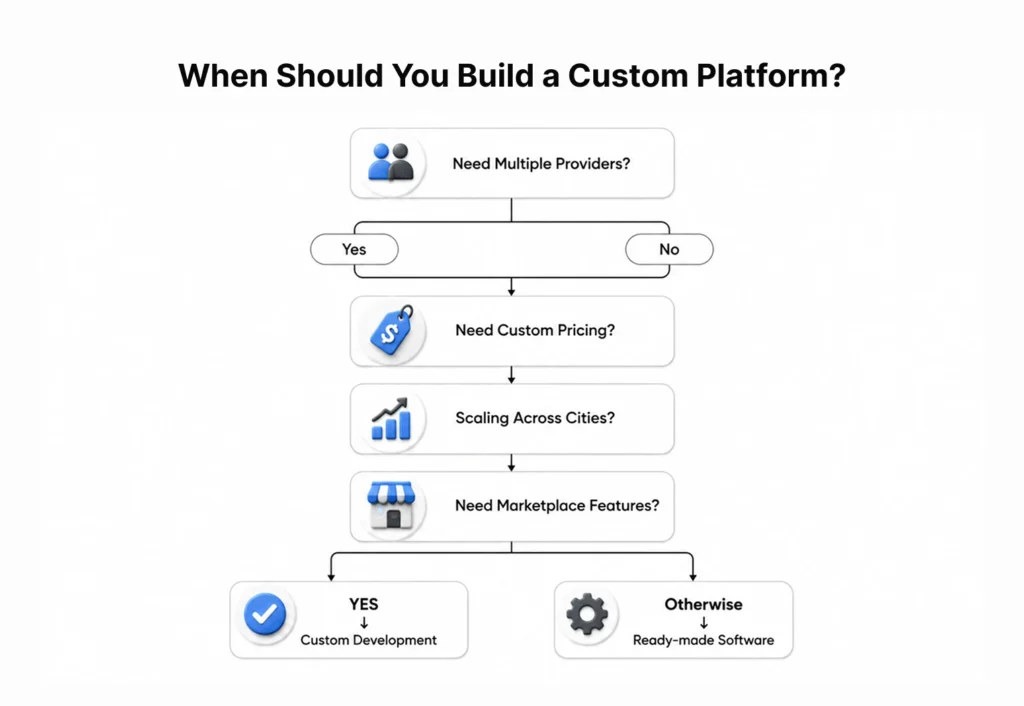
A custom platform earns its cost back in one specific situation: you’re managing a network of independent handymen, capturing client requests centrally, assigning jobs, and handling payment collection and payout, and the business logic that makes that work is something a general-purpose tool simply wasn’t built to support.
Marketplace Businesses
That shows up clearly once you’re running something closer to a marketplace model than a single crew:
You need assignment logic that’s specific to your business. Off-the-shelf tools route jobs based on simple availability. A custom platform can weight assignment by which handyman actually shows up on time, does quality work, and gets requested again by the same client, not just who happens to be geographically closest.
You need pricing logic beyond a flat rate card. Estimating based on job complexity, service category, or regional cost differences requires a platform built around your specific pricing model, not a generic invoicing feature.
You’re managing a network of independent handymen, not a single crew. The moment you’re capturing client requests, assigning them to handymen who run their own businesses, collecting payment, and paying out after your fee, you need onboarding and verification workflows, a payout system separate from payroll, and trust mechanisms, ratings, background checks, dispute resolution, that work in both directions. This is architecturally different from scheduling your own employees, and it’s the single clearest signal that a custom platform is the right call.
Long-Term Growth Considerations
You want automation built into the core product. Smart job assignment, automated dispatch as your network scales past what a person can coordinate by phone, and AI-assisted quoting that gives clients a real estimate in seconds instead of a callback. These aren’t features you retrofit easily onto an off-the-shelf tool or even a cloned template; they need to be part of the original architecture, because they’re what keeps a growing network coordinated without a proportional increase in headcount.
You’re planning to scale across service categories or regions. A platform built to expand from one city and one service category into multiple regions and categories needs infrastructure decisions made early, not patched in after the fact once growth demands it.
You need the platform itself to be a competitive differentiator. A business running on the same off-the-shelf tool as every competitor down the street has nothing structurally different to offer. A custom platform, built around your specific network and pricing model, is a business asset, not just an operational tool.
If two or more of these describe your business, a custom platform is very likely worth the investment. If none of them do, revisit the previous section before committing budget to a custom build. For more on what full custom ownership looks like end to end, see Custom Mobile App Development and our work as a Custom Software Development Company in Chennai.
Handyman App Development Cost Breakdown
Most agencies in this space publish a wide price range that tells you almost nothing about what you’d actually get. We take the opposite approach on purpose: we won’t quote a generic figure here, because your platform isn’t generic, and a number without context tends to do more harm than good, either scaring off a business that would have gotten strong long-term value, or setting an expectation that doesn’t match the scope you actually need. Engagements are scoped in three broad tiers.
MVP Platform
A focused platform for a single service area and a defined handyman network: client booking, job assignment, and payment collection built around your current scale. The right starting point for a business validating this model before expanding further.
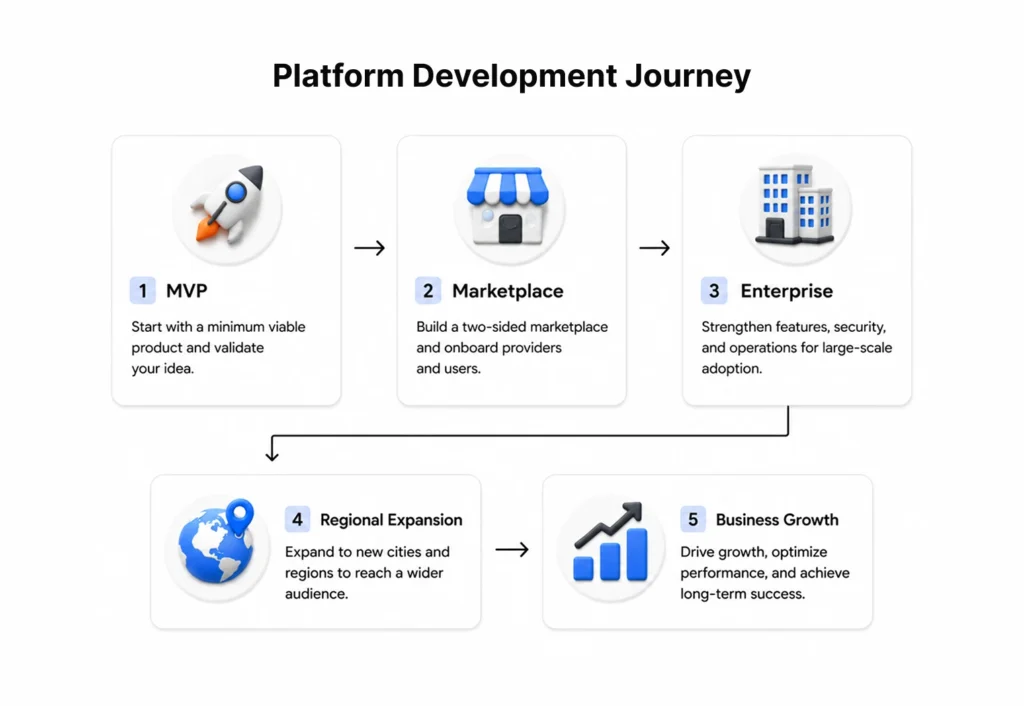
Multi-Service Marketplace
The full system: client experience, handyman portal, and admin dispatch panel working together, multiple service categories, automated assignment, and the analytics your team needs to manage a growing network with confidence.
Enterprise-Level Solution
Everything in the Multi-Service Marketplace tier, plus advanced automation, multi-region support, deeper integrations with payment and verification providers, and infrastructure built to scale as your network and client volume grow well beyond where you’re starting today.
Cost Comparison Table
| MVP Platform | Multi-Service Marketplace | Enterprise-Level Solution | |
| Service scope | Single service area, one core category | Multiple service categories, full network | Multiple categories, multi-region |
| Core components | Client booking, job assignment, payment collection | Client experience, handyman portal, admin dispatch panel | All Multi-Service components plus advanced automation and integrations |
| Automation included | Basic assignment logic | Automated assignment and dispatch | Predictive assignment, dispatch, and quoting at scale |
| Best for | Validating the model in one market | Running a genuine, growing network | Scaling across regions and categories |
| Investment | Scoped to your specific launch, discussed on a call | Scoped to your specific launch, discussed on a call | Scoped to your specific launch, discussed on a call |
A note on hidden scope. If a quote you’re evaluating only covers a client-facing booking screen, you’re likely looking at a fraction of what a real platform requires. The handyman portal, the admin dispatch panel, payout logic, and verification workflows are the parts that get treated as “extras” after the fact by agencies that scoped only the visible half of the project. Ask what’s included before comparing any two quotes.
Every engagement begins with a scoping call, not a quote pulled from a form. We walk through your current network size, service area, and how much automation you want built in from day one, and give you a precise, tailored figure specific to your business, not a range copied from a template.
Biggest Challenges in Handyman App Development
This is the single biggest gap in nearly every piece of content written about handyman app development, and it’s the one that actually determines whether a platform succeeds or quietly stalls within months of launch.
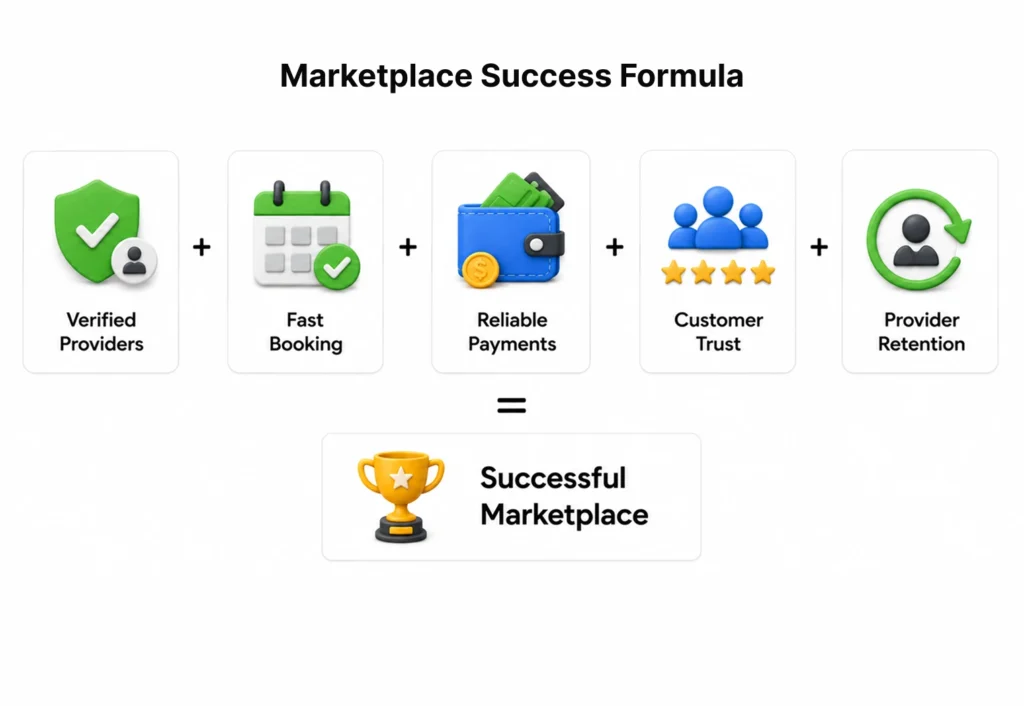
A platform with plenty of client demand but too few available handymen is useless. A platform with a strong handyman network but no client demand is just as dead. Solving both sides at once, not just designing a polished booking screen, is the actual project.
Growing Providers for a Handyman Marketplace App
A platform can have a flawless booking flow and still fail if there aren’t enough verified handymen to answer a request within a reasonable window. The businesses that grow well in this space win by building real coverage in one service area first, then repeating that same disciplined process market by market, rather than by launching everywhere at once with thin coverage.
Trust is the actual product here. A stranger is walking into someone’s home. That single fact shapes almost everything a serious platform needs: background checks, verified handyman profiles, honest and visible performance data, and a payment system that holds funds safely until a job is confirmed complete. Strong provider verification builds customer trust to add in version two, it’s close to the entire value proposition of the platform. Our approach to this is covered in more depth under Mobile App Security Best Practices.
Why Provider Retention Matters in Handyman App Development
A handyman who waits weeks for a payout doesn’t stay active on your platform, no matter how good the client-side experience is. Fast, fair, and transparent payouts are one of the highest-leverage things a platform can get right early, because handyman churn quietly kills coverage before you notice it’s happening.
Prioritize handyman onboarding speed and payout reliability at least as highly as the client booking experience when scoping your platform. Most first-time platform builders overweight the client side because it’s the part they see and interact with daily, and underweight the handyman side because it’s less visible, right up until it becomes the reason the platform can’t fulfill bookings.
Handyman App Development Readiness Checklist
Use this checklist as a quick gut check before committing budget to a custom platform. You’re likely ready for a custom build if:
Team Structure
Manage multiple independent service providers instead of relying only on an in-house team.
Expansion Plans
Plan to grow into additional service categories or regions.
Marketplace Model
Operate a marketplace that connects customers with verified professionals.
Pricing Flexibility
Use pricing rules that standard software cannot support.
Future Scalability
Prepare infrastructure for long-term regional growth.
Centralized Operations
Manage bookings, provider assignments, and payments in one platform.
If you checked one or two of these, off-the-shelf software is probably the smarter move right now. If you checked four or more, a custom platform is likely worth scoping seriously.
Conclusion
The right answer comes down to your operating model, not a feature checklist. Buy off-the-shelf software if your operations are simple: a single crew, standard workflows, and no need to manage independent providers centrally. Build a custom platform if you’re creating, or growing, a marketplace model that connects clients with a network of independent handymen.
Start with your business goals, not a list of app features, and the right path becomes much clearer. Whichever direction fits today, it’s worth evaluating long-term scalability now, since infrastructure decisions made early are far cheaper than ones patched in after your network has already grown past what your current system can handle.
Frequently Asked Questions
1. Do I need separate customer and provider apps?
If you’re managing a network of independent handymen rather than your own employed crew, you need both, since they serve fundamentally different workflows: clients request and pay, handymen accept jobs and get paid out. If you’re managing your own internal crew, a single internal tool, or off-the-shelf software like Jobber, is often sufficient to start.
2. How long does handyman app development take?
Timelines scale with scope. An MVP Platform focused on a single service area is the fastest path to launch. A Multi-Service Marketplace with a full client experience, handyman portal, and admin panel takes longer, and an Enterprise-Level Solution with advanced automation and multi-region support takes longer still. We’ll give you a specific timeline once we understand your scope on a scoping call.
3. Can I migrate from existing software later?
Yes, and it’s often the right sequencing. Validate demand with an existing tool first, then invest in a custom platform once you’ve proven the model and know exactly which workflows you actually need built, rather than guessing at scope before you have real usage data.
4. What affects handyman app development cost?
Four factors drive scope and investment: how many service categories you’re launching with, how large your provider network is, how much automation you want built in from day one, and whether you’re launching in one region or planning multi-region support from the start. That’s why we scope every engagement on a call instead of publishing a single number that wouldn’t reflect any of that.
5. How do I choose the right development approach?
Start with your operating model, not your feature list. If you manage your own employed crew with fairly standard workflows, off-the-shelf software is usually the right call. If you’re managing, or building toward, a network of independent providers with client requests, assignment, and payment running through your business, a custom platform is worth scoping seriously. A clone or template build is a reasonable middle step if you want to validate demand before committing to either end of that spectrum.