Key Takeaways
- Instant delivery app India is reshaping retail with faster fulfillment, wider product categories, and growing customer demand.
- Dark stores, hyperlocal logistics, and efficient inventory management are the foundation of successful quick commerce platforms.
- Leading platforms now compete through customer experience, product assortment, and sustainable business models rather than delivery speed alone.
- Businesses should evaluate operational readiness, profitability, and market demand before investing in an instant delivery platform.
- Tier-2 expansion, marketplace models, and category diversification are expected to drive the next phase of India’s quick commerce growth.
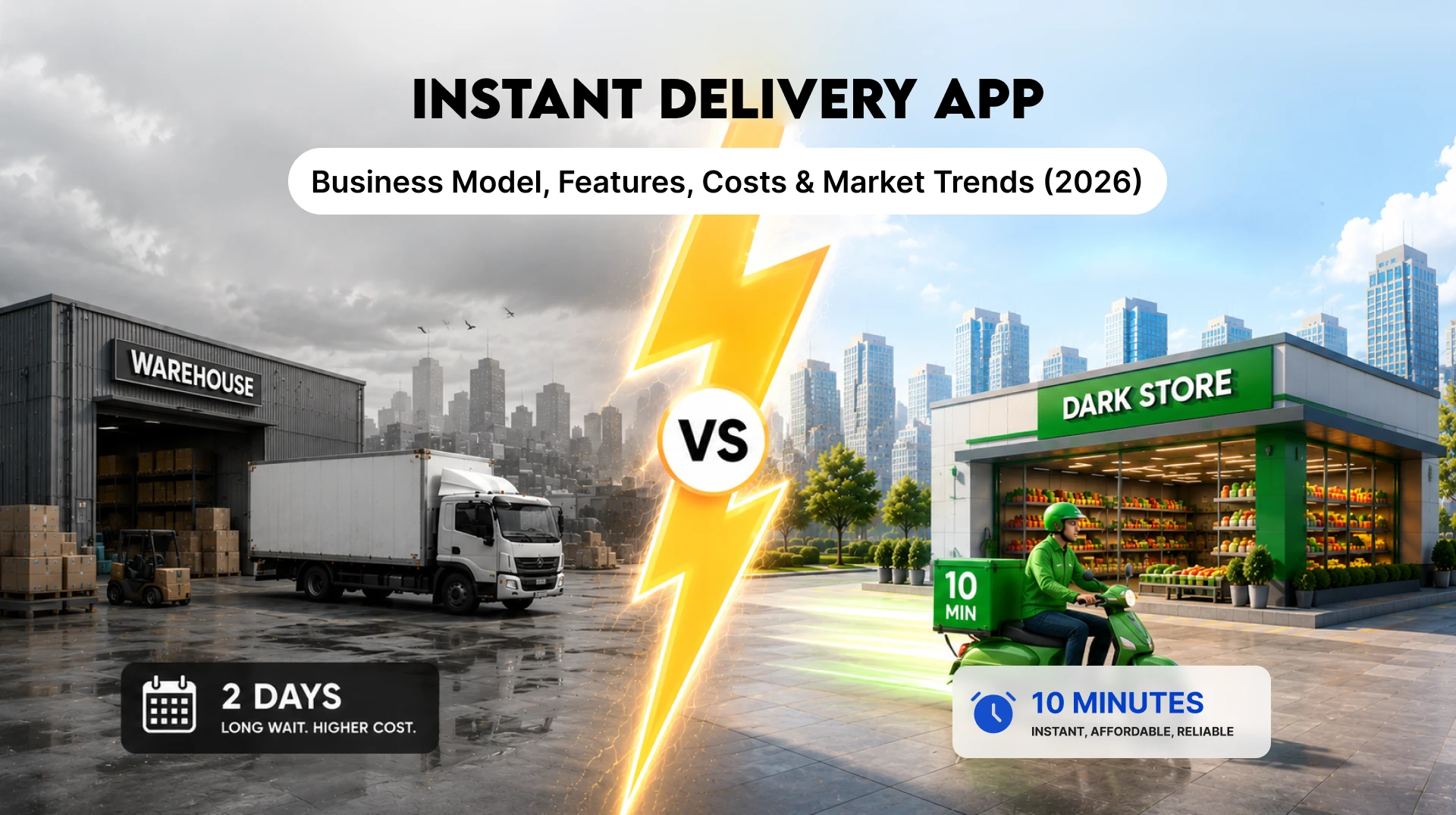
Five years ago, a 10-minute grocery delivery would have sounded like a marketing gimmick. Today it’s the baseline. The instant delivery app India market has moved from a niche experiment run by a handful of startups to a fixture of urban life, and the competitive intensity behind that shift is easy to underestimate if you’re only looking at it as a customer.
Quick commerce started with groceries, but that boundary didn’t hold for long. Electronics, beauty products, over-the-counter medicines, pet supplies, even fashion accessories now move through the same dark-store networks that once stocked only rice and vegetables. For a retailer or a founder, that expansion changes the question from “should we offer fast delivery” to “which categories can actually support the economics of fast delivery.”
Businesses evaluating this space usually need more than a feature list. They need to understand why the model works where it works, where it’s genuinely difficult to sustain, and what a scalable delivery platform actually requires under the hood, something teams that build on-demand delivery software tend to see play out project after project. Reflecting our approach to these complex systems, this article walks through the market forces behind instant delivery in India, the platforms shaping the competitive landscape, the business models underneath them, and where the real opportunities and risks sit heading into the next few years.
Why Instant Delivery Apps Are Growing Rapidly in India
Consumer expectations are changing
Convenience stopped being a nice-to-have somewhere around the pandemic, and it never went back. Shoppers who got used to 15-minute groceries don’t easily tolerate a same-day window for much else. That expectation has quietly spread across categories that never used to compete on speed.
A few patterns show up consistently:
- Shopping decisions increasingly favor whichever app can fulfill right now, not just cheapest or best-reviewed.
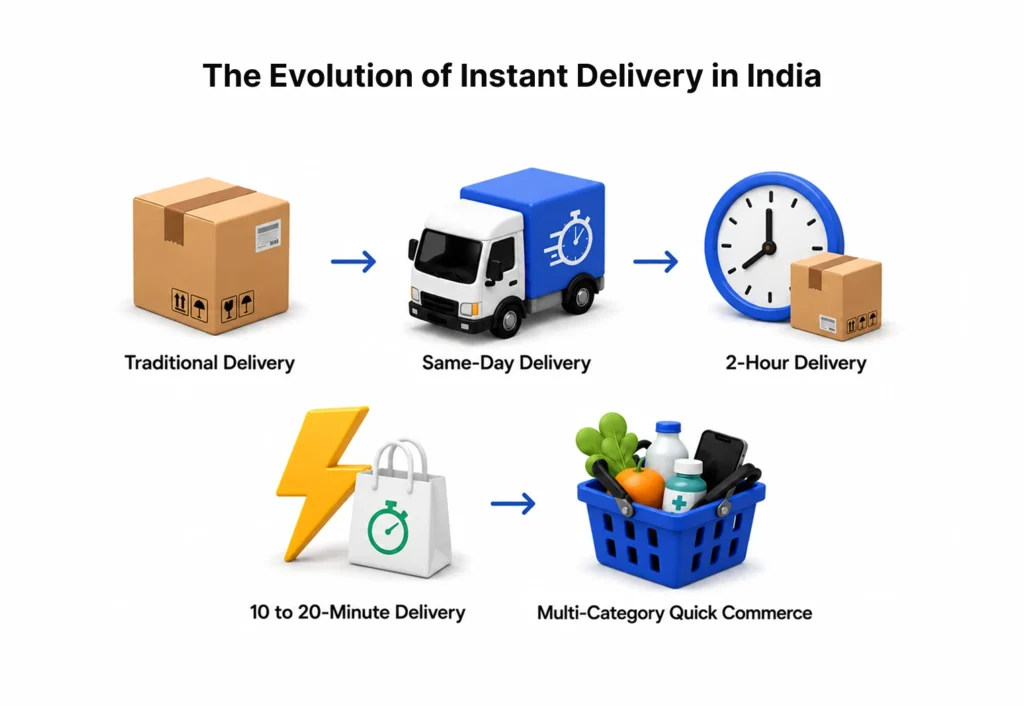
- The 10-to-20-minute delivery window has become the implicit standard in metro India, even for non-grocery categories.
- Impulse purchasing has increased measurably. When the friction between “I want this” and “it’s here” nearly disappears, basket behavior changes with it.
None of this is unique to India. But the scale here, with a young, urban, smartphone-first population, is unusual. It’s also why 10 minute delivery apps in India have become the reference point competitors get measured against, not the exception.
Market growth driving rapid expansion
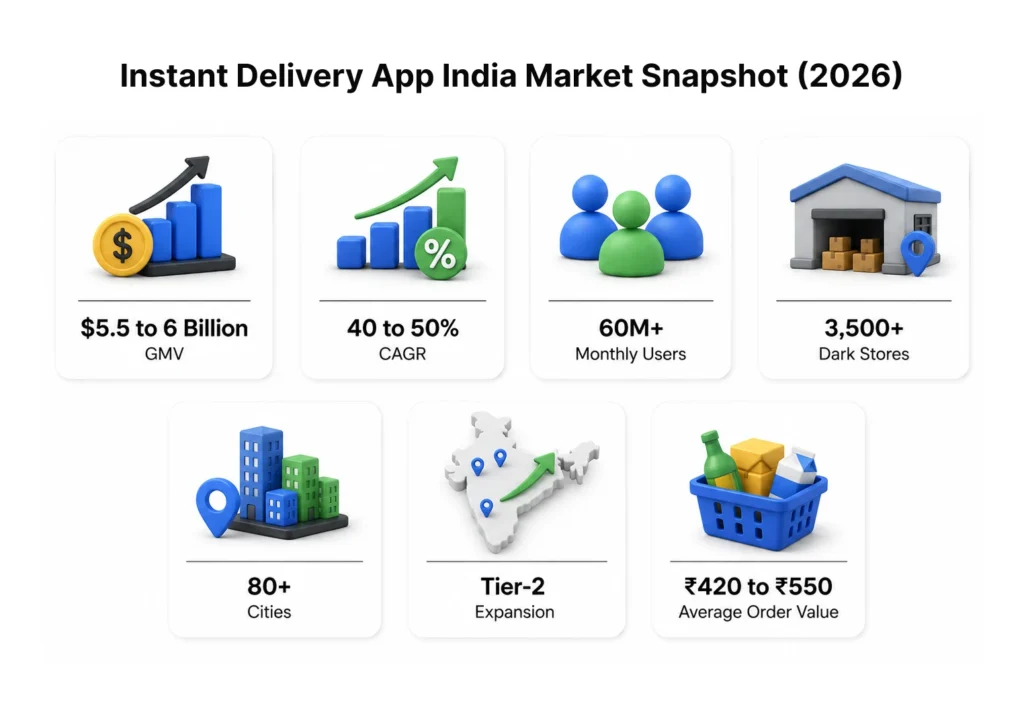
The growth numbers get thrown around a lot, and it’s worth being careful about them. Gross merchandise value in India’s quick commerce sector has been growing at a compound annual rate most traditional retail categories can only envy. Monthly active users across the major platforms now run into the tens of millions. Dark store counts have expanded aggressively in the last two years. Several players are pushing hard into Tier-2 cities like Jaipur, Lucknow, and Coimbatore, markets once considered too thin to support the model. Sustaining that pace depends heavily on the technology layer underneath it. That’s usually where a specialist Mobile App Development Company gets involved, keeping ordering, routing, and inventory systems reliable as order volumes scale.
That said, growth and profitability are different conversations. It’s a mistake to treat rapid GMV expansion as proof that the underlying unit economics are settled. They generally aren’t yet, which we’ll get into later.
Understanding the Instant Delivery App India Ecosystem
How the ecosystem works
An instant delivery app is really a coordination layer sitting on top of a physical network. Strip away the interface, and what’s left is three things: dark stores stocked with fast-moving inventory, a delivery partner fleet positioned close enough to hit minute-level SLAs, and an order-routing system deciding, in real time, which store and rider fulfill each order.
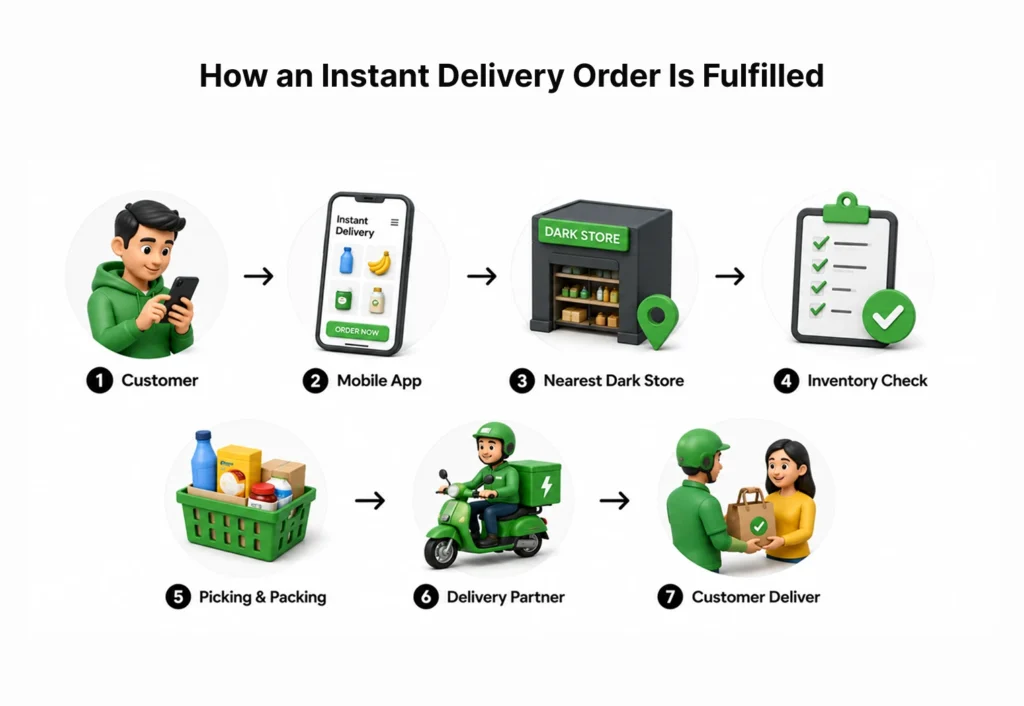
The fulfillment chain typically looks like this:
- Customer places an order through the app.
- The system identifies the nearest dark store with the required inventory.
- Store staff pick and pack the order, usually within 60–90 seconds.
- A delivery partner already stationed nearby is assigned the pickup.
- The order is delivered, and the app updates inventory and rider availability in real time.
Get any one of those steps wrong, whether stockouts, poor rider allocation, or a warehouse layout that slows picking, and the promise of instant delivery breaks down. That’s true no matter how polished the app itself looks.
Key participants in the ecosystem
Retailers supply or co-manage inventory. Logistics and delivery partners handle the last mile, often through a mix of full-time riders and gig-based fleets. Technology providers build and maintain the platform: the ordering app, the store-side management system, and the routing engine. Increasingly, this is where companies experienced in building an instant delivery app or partnering with an on-demand quick commerce app development company add real value. The software layer is what determines whether the operational model can actually scale. Customers sit at the center of all of it, and their tolerance for delay is the metric everyone else optimizes against.
Top Instant Delivery Apps Competing in India
The instant delivery app India space isn’t a two-horse race. It’s a crowded field, and differentiation increasingly comes down to assortment, price, and how well a platform handles categories beyond groceries.
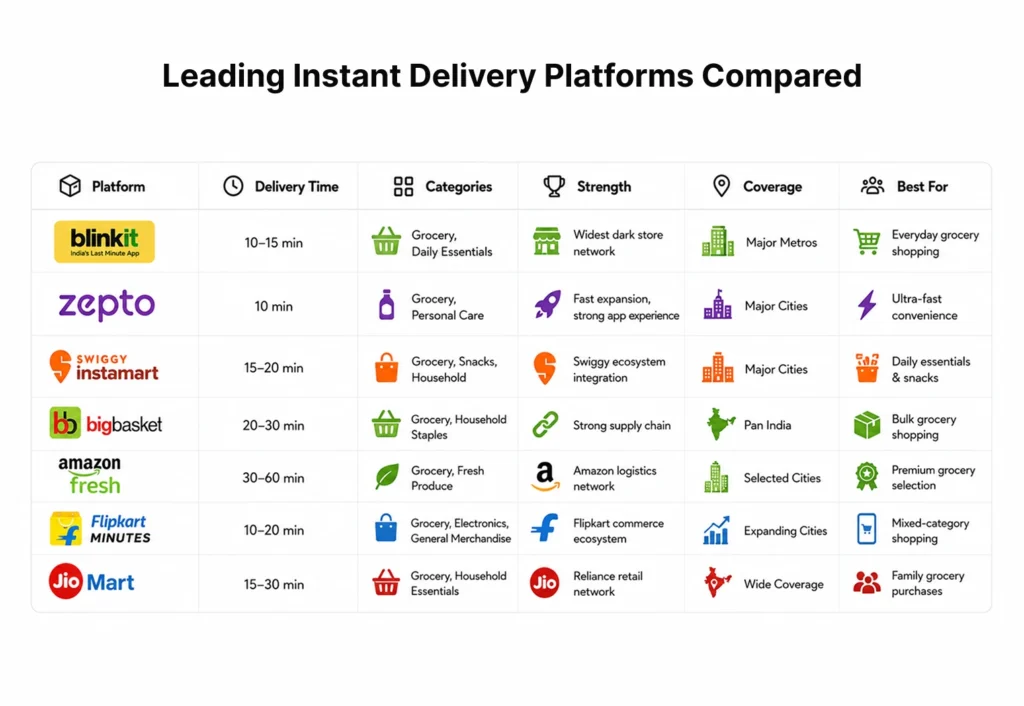
| Platform | Strength | Typical Delivery Time | Best For |
| Blinkit | Widest dark store network in metros | 10–15 minutes | Groceries, daily essentials |
| Zepto | Fast expansion, strong app experience | 10 minutes | Groceries, personal care |
| Swiggy Instamart | Cross-sell with Swiggy’s food delivery base | 15–20 minutes | Groceries, snacks, impulse buys |
| BigBasket | Established supply chain, deeper catalog | 20–30 minutes | Bulk grocery, household staples |
| Amazon Fresh | Backed by Amazon’s logistics infrastructure | 30–60 minutes | Groceries with wider brand selection |
| Flipkart Minutes | Leverages Flipkart’s ecommerce catalog | 10–20 minutes | Electronics, groceries, general merchandise |
| Dunzo | Hyperlocal errand and delivery model | Varies by task | Ad-hoc pickups and deliveries |
| JioMart Digital Express | Reliance’s retail and telecom distribution | 15–30 minutes | Groceries, Reliance-affiliated categories |
Market leaders
Blinkit, Zepto, and Swiggy Instamart currently set the pace. Their advantage isn’t really the app, since most quick commerce apps look and function similarly. It’s dark store density. Whoever has a warehouse closer to the customer usually wins that order. That’s why so much of the competitive fight happens in real estate and logistics planning, not product design.
Emerging competitors
BigBasket, Amazon Fresh, and Flipkart Minutes are approaching the category from an ecommerce-first background. They’re betting that catalog depth and existing customer trust can offset a slower delivery time. Dunzo has pivoted more toward hyperlocal errands than pure grocery delivery. JioMart Digital Express is leaning on Reliance’s retail footprint to reach markets the pure-play apps haven’t fully penetrated yet. Whether Dunzo still counts as a direct competitor in the 10-minute category is genuinely debatable. Its positioning has shifted enough that it now sits closer to a general delivery utility.
Trends Reshaping the Instant Delivery Market
Expansion beyond grocery delivery
Groceries were the easy first category: high frequency, low consideration, predictable demand. What’s happened since is more interesting. Electronics, beauty products, pharmacy items, pet care, and even fashion accessories are now available for instant delivery in major cities.
Pharmacy is probably the most consequential of these. Getting a prescription filled within 20 minutes changes the calculus for anyone managing an ongoing health condition. Several platforms have built dedicated verticals around this exact use case, with appropriate compliance checks for regulated medicines.
Customer experience becoming a competitive advantage
As delivery times converge, with most major players now within a few minutes of each other, the differentiation has shifted toward experience. Membership plans with free delivery, loyalty programs, regional language support, and wider product selection are becoming the actual battleground.
This mirrors a pattern that shows up in other delivery-heavy sectors too, from best food delivery website development work to general ecommerce website development, where the fastest checkout eventually stops being a differentiator once everyone’s checkout is fast enough. What lasts longer as an advantage is trust, personalization, and how well the platform understands repeat customer behavior.
Business Models Behind Instant Delivery Apps
Revenue streams
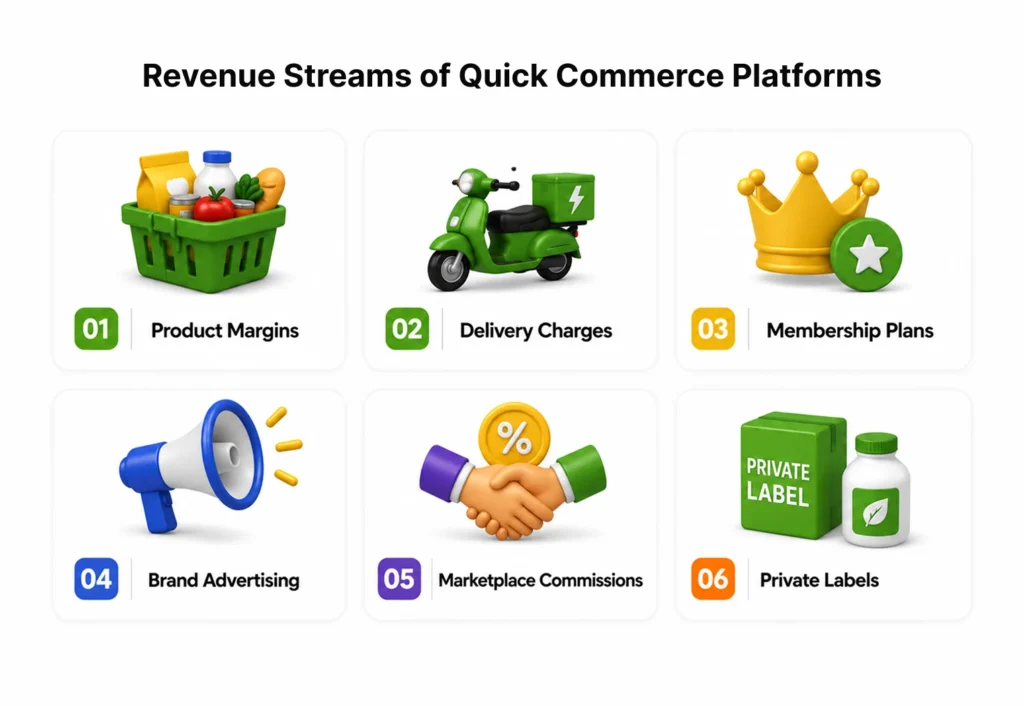
Most quick commerce platforms stack several revenue sources rather than relying on one:
- Product margins on the goods sold, typically thinner than traditional retail because speed and convenience compress pricing power.
- Delivery charges, often waived above a minimum order value or for subscribers.
- Membership subscriptions, which increasingly function as a retention lever more than a direct profit center.
- Advertising, where brands pay for placement within the app, and this has quietly become one of the higher-margin lines for several platforms.
- Marketplace commissions, in cases where third-party sellers list inventory rather than the platform holding stock directly.
Profitability challenges
Here’s the part that doesn’t get talked about enough outside industry circles: instant delivery is expensive to run well. Last-mile costs stay stubbornly high because you’re optimizing for speed over route efficiency. Dark stores carry real estate and staffing costs that scale with density, not with order volume alone. Inventory management for perishables adds spoilage risk that traditional ecommerce warehouses don’t deal with. And customer acquisition in a market with this many competing apps is not cheap, since discount-driven growth has a way of masking whether the underlying business is actually healthy.
None of this means the model is broken. It means profitability, for most players, depends on getting scale and density right in specific cities rather than spreading thin across too many markets at once.
Essential Features of a Modern Instant Delivery App
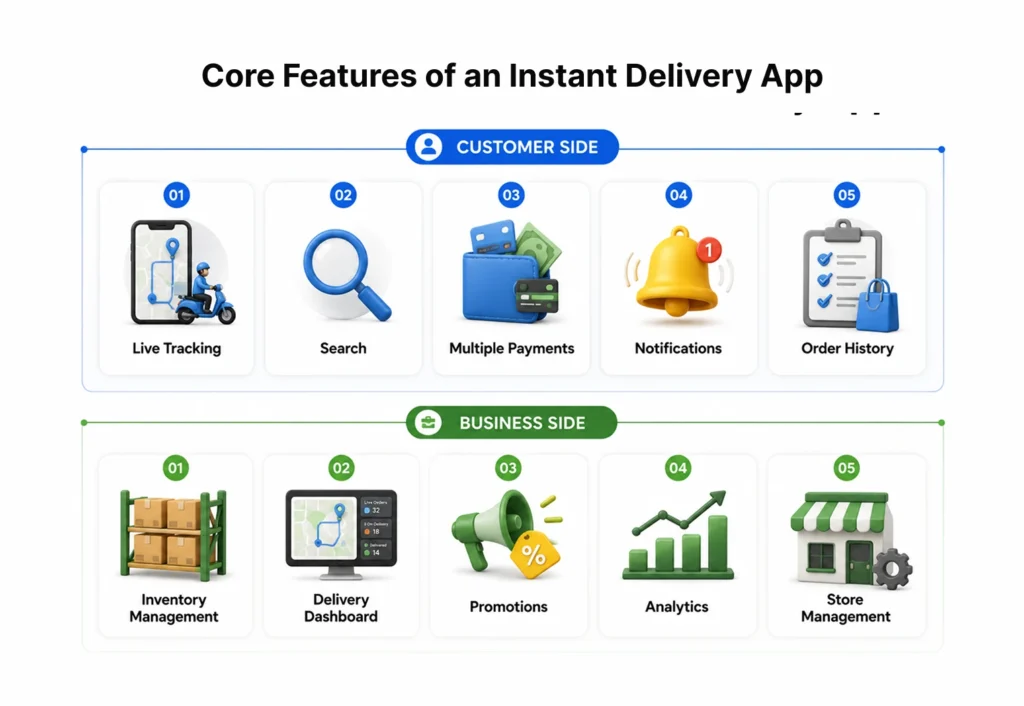
Customer Features Every Instant Delivery App Needs
A competitive instant delivery app generally needs live order tracking, fast and accurate search, multiple payment options including UPI, real-time notifications, order history, and responsive customer support, ideally with a way to resolve issues without waiting on a call center. None of these are novel individually, but the combination has to work under load, during peak evening ordering windows, without lag.
Business Features Behind Successful Instant Delivery Apps
On the operational side, the requirements look different: inventory management that syncs across stores in near real time, analytics dashboards for demand forecasting, multi-store management for chains running several dark stores in one city, a delivery partner dashboard for assigning and tracking riders, and a promotions engine that can run time-bound offers without manual intervention. This is where the technical build matters more than the customer-facing polish: teams researching the app development lifecycle or planning mobile app development for startups in this category quickly find that the backend logistics layer is harder to get right than the interface.
Business Opportunities in the Instant Delivery App India Market
The categories with the clearest opening right now include groceries in underserved Tier-2 cities, restaurants looking to extend beyond standard food delivery timelines, pharmacies wanting a compliant instant-delivery channel, D2C brands that need a faster fulfillment option than standard courier logistics, electronics retailers testing express delivery for high-demand SKUs, established retail chains adding a quick commerce layer to existing stores, and niche categories like pet care or fresh produce where dedicated players haven’t fully consolidated the market yet.
A business should seriously consider launching its own instant delivery platform when it already has physical inventory close to demand centers, a customer base that has shown willingness to pay for speed, and the operational discipline to manage a delivery fleet; building the app is the easier half of this problem. Without those foundations in place first, a standalone delivery app tends to become an expensive experiment rather than a growth channel, and it’s often worth testing demand through an existing marketplace before investing in proprietary infrastructure like laundry and cleaning app development style verticals or entering direct competition with the biggest food delivery app companies in India.
Challenges Facing the Instant Delivery App India Market
Rapid expansion and profitability tend to pull in opposite directions. Most companies in this space are still negotiating that tension rather than having resolved it. Logistics management gets harder as delivery radius shrinks and order density needs to rise to justify it. Inventory planning for a dark store model requires far tighter forecasting than a traditional warehouse. Overstocking perishables is a direct loss, and understocking means missed orders. Customer retention is difficult in a market where switching apps costs the user nothing. Competition is intense enough that pricing wars are common. Compliance, particularly around pharmacy and food safety regulations, adds operational overhead that’s easy to underestimate before you’re actually running it.
Future Outlook for Instant Delivery Apps in India
Market projections through 2030 indicate continued growth, though expansion is expected to slow as metro markets mature. Tier-2 cities are likely to become the next growth frontier, supported by improved dark store economics. Marketplace models will also expand, helping platforms offer wider product selections with lower inventory risk.
Category diversification will continue, but not every product suits ultra-fast delivery. Larger electronics may remain better suited for same-day fulfillment. Sustainability is also gaining importance, with more platforms adopting electric delivery fleets. Despite increasing competition, strong investment suggests the instant delivery app India market will continue evolving over the coming years.
Conclusion
India’s retail landscape has been reshaped by the instant delivery app India market faster than most predicted, but the platforms that last won’t necessarily be the ones that deliver fastest. They’ll be the ones that figure out how to be fast and operationally sustainable, balancing dark store density, inventory discipline, and customer experience against the real cost of last-mile logistics. For businesses evaluating whether to enter this space, the delivery-time race is the least interesting part of the decision. The harder and more important questions are about unit economics, category fit, and whether the operational foundation can actually support the promise before the app ever ships.
If you’re assessing whether your business model can support an instant delivery layer, or you need a technology partner to build the ordering, inventory, and delivery-routing systems behind it, that’s a conversation worth having before development starts, not after.
FAQ
1. Which is the best instant delivery app in India?
There isn’t a single answer that holds everywhere: Blinkit, Zepto, and Swiggy Instamart lead on speed and coverage in most metros, but availability, pricing, and catalog depth vary by city and even by neighborhood depending on dark store proximity.
2. What makes instant delivery different from traditional ecommerce?
Traditional ecommerce optimizes for selection and price across a wide geography with delivery windows measured in days. Instant delivery narrows the radius drastically and optimizes almost entirely for speed, which is why it depends on hyperlocal dark stores rather than centralized warehouses.
3. How do instant delivery apps deliver within minutes?
Quick commerce systems combine dark stores located near demand, pre-positioned delivery partners, and order-routing software to assign the nearest inventory and rider the moment a customer places an order.
4. Which instant delivery app offers the lowest prices?
Pricing shifts frequently due to promotions and city-specific competition, so the cheapest option on a given day depends on active discounts, membership status, and local dark store stock rather than a fixed platform-wide answer.
5. How do quick commerce companies make money?
Through a mix of product margins, delivery fees, membership subscriptions, in-app advertising, and marketplace commissions, usually several of these combined, since none alone reliably covers the cost of last-mile delivery.
6. Can medicines be ordered through instant delivery apps?
Yes, several platforms now offer dedicated pharmacy verticals with compliance checks for prescription medicines, though availability and turnaround time depend on the specific platform and city.
7. Is Dunzo still an instant delivery platform?
Dunzo has shifted its positioning toward hyperlocal errands and general delivery tasks rather than competing directly in the 10-minute grocery category, so it’s better understood today as a broader delivery utility than a pure quick commerce app.
8. What is the future of quick commerce in India?
Continued growth into Tier-2 cities, more third-party marketplace models, further category expansion beyond groceries, and increasing attention to sustainable delivery fleets, alongside sustained, though not necessarily consolidating, competition among the major platforms.