

Understanding Website Development Cost in Chennai requires more than comparing price lists or hourly rates. For growing businesses, the real question sits at the intersection of digital ambition, market expectations, and long term operational planning. Chennai has emerged as a mature technology hub, yet cost variations across projects remain wide and often misunderstood.
For founders and managers, a website is no longer a static asset. Instead, it functions as a sales channel, brand platform, and operational enabler. As a result, cost discussions naturally extend beyond development hours into areas such as scalability readiness, integration depth, and governance expectations. This shift explains why similar looking websites can carry very different investment ranges across the city.
Some teams ask whether Chennai offers a cost advantage purely because of location. While regional pricing plays a role, decision makers quickly discover that scope clarity, delivery maturity, and post launch ownership models influence budgets just as strongly. Therefore, viewing cost only through a location lens can lead to short term savings but long term inefficiencies.
From a strategic standpoint, engaging with a website development company in Chennai often reflects broader business intent. Companies aiming for rapid expansion, operational automation, or compliance alignment tend to evaluate cost as a controlled investment rather than an expense. Meanwhile, organizations with undefined digital goals frequently experience scope drift, which inflates cost unpredictably.
This pillar examines cost from a decision oriented perspective. As a result, it frames Chennai’s website development landscape through business context, operational challenges, and investment signals, which in turn are structured to evolve into deeper, standalone discussions as your evaluation progresses.
Website Development Cost in Chennai Market Overview
How Chennai’s digital ecosystem shapes website pricing expectations
The Website Development Cost in Chennai is shaped by a mature blend of technical talent, competitive vendor density, and evolving business expectations. Chennai is no longer positioned as a low cost alternative alone. Instead, it operates as a value balanced market where pricing reflects both capability depth and delivery accountability.
From a business standpoint, cost structures in Chennai respond strongly to demand patterns. Enterprises seeking stability, compliance alignment, and predictable delivery often engage with a website development company, where pricing reflects governance models, documentation rigor, and long term support readiness. Meanwhile, startups and mid sized firms may prioritize faster execution and controlled budgets, which leads to different cost benchmarks across similar project scopes.
Decision makers often wonder why two proposals with comparable visual scope vary significantly in cost. In most cases, the difference stems from hidden variables such as stakeholder involvement, discovery depth, and future scalability assumptions. Therefore, Chennai’s cost landscape rewards clarity more than negotiation. Organizations with defined objectives typically receive tighter estimates and fewer revisions.
At a strategic level, businesses increasingly evaluate cost in relation to brand credibility and operational resilience. As websites evolve into customer facing systems, the investment reflects not just development effort but also market positioning. Consequently, Chennai’s pricing maturity mirrors global delivery hubs rather than purely regional markets.
For companies assessing custom website development, this environment offers flexibility but also demands informed decision making. Cost becomes a signal of intent, readiness, and long term digital ownership rather than a standalone metric.
Business Factors Influencing Website Development Cost in Chennai
Why business intent and scope clarity change cost outcomes
The Website Development Cost in Chennai is rarely determined by visuals alone. Instead, cost aligns closely with how businesses define purpose, ownership, and long term value. When decision makers assess proposals, pricing often reflects strategic depth rather than surface level features.
A primary cost driver is business intent. Websites positioned for lead generation, operational workflows, or partner enablement usually require deeper discovery and validation. As a result, budgets expand to accommodate planning rigor, stakeholder alignment, and future adaptability. In contrast, brochure style platforms aligned with Business website development typically follow more predictable investment ranges.
Another influencing factor is how organizations treat scope ownership. Teams that finalize requirements early often stabilize costs, while evolving objectives introduce recalibration across timelines and budgets. Therefore, cost variation in Chennai frequently mirrors internal decision maturity rather than vendor inconsistency.
A common concern is whether higher investment always signals better outcomes. In practice, cost reflects alignment more than quality. Projects anchored to a defined website development process tend to reduce rework, which ultimately controls spend even at higher initial estimates. Conversely, lower upfront pricing may mask deferred costs tied to revisions or limitations.
From an operational view, governance expectations also influence pricing. Businesses that require structured documentation, review checkpoints, and post launch accountability typically encounter different cost models. Consequently, website investment becomes a business planning exercise rather than a procurement task.
This cost driver lens reinforces one insight. Pricing in Chennai responds to how clearly businesses connect digital presence to measurable outcomes, not merely how fast a site goes live.
Website Development Cost in Chennai by Business Stage
How startup, SMB, and enterprise needs influence pricing levels
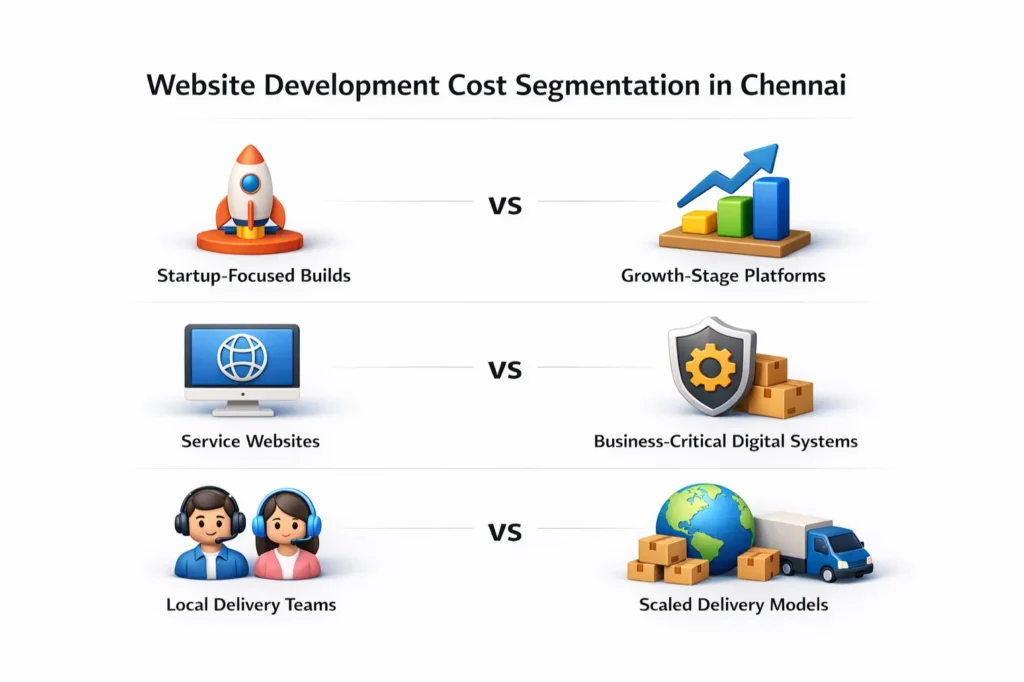
The Website Development Cost in Chennai becomes clearer when viewed through structured cost segmentation rather than headline pricing. Businesses rarely overspend by choice. Instead, misalignment between website purpose and investment tier often drives budget inefficiencies.
At a high level, website costs in Chennai align with business stage and functional ambition. Early stage companies typically prioritize speed and market entry, while growth stage organizations focus on performance, scalability, and integration depth. As expectations rise, cost expands to reflect operational readiness rather than design complexity alone.
Some teams ask how cost benchmarks differ when comparing similar websites across business sizes. The answer lies in hidden requirements such as validation layers, future extensibility, and performance tolerance. A platform designed for responsive website development across devices and traffic conditions naturally carries different investment signals than a static digital presence.
Below is a strategic cost segmentation view to help decision makers evaluate positioning rather than pricing alone.
Website Cost Segmentation Table (Indicative Ranges)
| Business Context | Website Purpose | Cost Positioning Signal |
| Early stage startup | Brand presence and validation | Entry level, scope controlled |
| Growing SMB | Lead generation and conversion | Mid range, performance focused |
| Established business | Operations and integrations | Higher investment, scalable |
| Multi location enterprise | Governance and compliance | Premium, long term ownership |
Decision makers often wonder whether location alone lowers the Cost to develop a website. While Chennai offers talent efficiency, cost ultimately reflects how well the website supports business continuity and growth objectives.
This segmentation helps leaders frame website cost as an investment tier decision. It shifts evaluation away from vendor comparisons and toward strategic alignment, which reduces long term financial friction.
Operational Challenges Affecting Website Development Cost in Chennai
Internal readiness and ownership gaps that affect budgets
The Website Development Cost in Chennai is often shaped as much by internal business readiness as by external delivery factors. While vendor capability matters, operational clarity within an organization plays a decisive role in determining cost predictability and long term value.
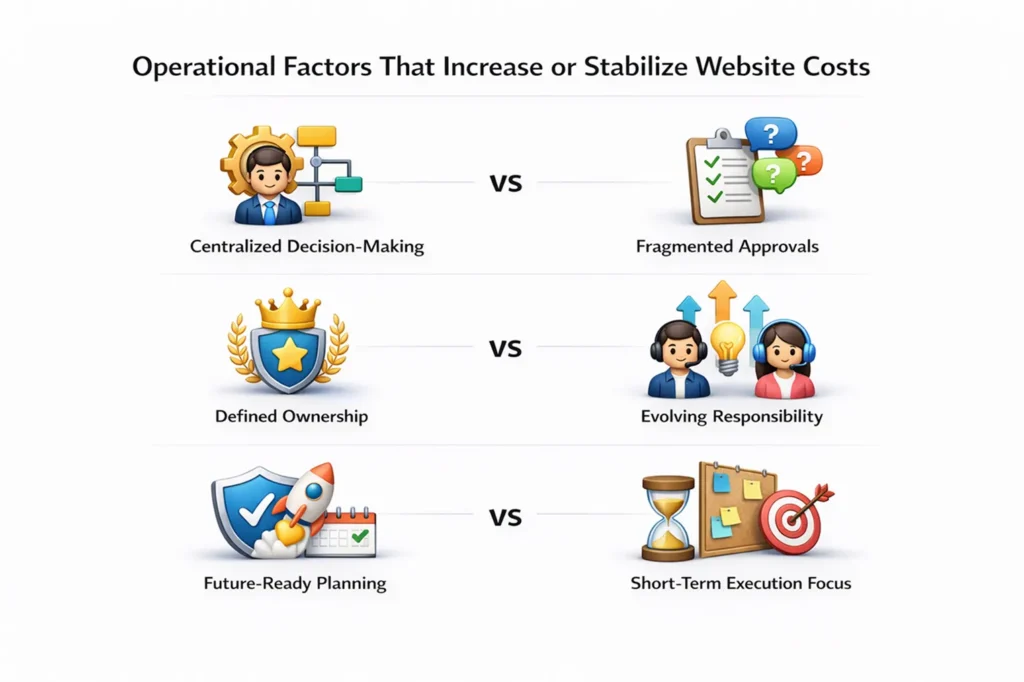
One recurring challenge is fragmented ownership. When multiple stakeholders influence scope without aligned priorities, cost estimates tend to expand over time. As a result, projects experience revision cycles that impact timelines and budgets. Businesses that centralize decision authority usually maintain tighter cost control and clearer delivery expectations.
Another cost influencing challenge is long term ownership planning. Websites built without clarity on future enhancements, integrations, or regional expansion often require rework. Consequently, what appears cost efficient initially can evolve into incremental spend later. This is especially relevant for organizations planning custom web application development, where architectural flexibility directly affects future investment.
Decision makers often underestimate the impact of content readiness and internal approvals. Delays in inputs, compliance reviews, or brand sign offs indirectly increase cost by extending delivery cycles. Therefore, operational discipline becomes a hidden pricing factor across Chennai based engagements.
Cost is also influenced by performance expectations tied to business credibility. Platforms expected to support conversion, trust building, and reliability naturally require deeper validation layers. These expectations differ significantly from basic digital presence initiatives.
Understanding these challenges helps leaders view cost not as a vendor variable but as a shared responsibility. When operational maturity aligns with digital ambition, pricing remains stable and outcomes remain predictable.
Technology Decisions and Website Development Cost in Chennai
How platforms and frameworks influence long term development cost
The Website Development Cost in Chennai increasingly reflects technology alignment rather than visual ambition. As businesses demand performance, security, and adaptability, platform choices quietly redefine cost expectations across projects.
Modern websites are no longer isolated assets. They connect with analytics systems, CRM platforms, and operational tools. As a result, technology decisions introduce layered cost considerations tied to compatibility, longevity, and maintenance readiness. Organizations that align early with prevailing website development trends often stabilize long term investment, even if initial budgets appear higher.
A common concern is whether adopting newer frameworks automatically increases cost. In practice, cost impact depends on how closely technology choices align with business timelines and scale plans. Mature stacks reduce rework and vendor dependency, while fragmented technology decisions can inflate costs over time. Therefore, Chennai based pricing models increasingly reward foresight over short term savings.
Technology also influences governance and compliance readiness. Websites handling data, transactions, or regulated interactions require additional safeguards. While not always visible at launch, these requirements shape pricing discussions early. For regulatory guidance on digital compliance and security expectations, businesses often reference official advisories from bodies such as the Ministry of Electronics and Information Technology .
From a decision standpoint, technology choices signal seriousness of intent. Platforms built with adaptability in mind support scalability without repeated reinvestment. Consequently, cost becomes a reflection of future preparedness rather than present functionality.
This perspective positions technology selection as a strategic cost lever. It encourages leaders to evaluate platforms through sustainability and risk lenses, not just immediate delivery estimates.
Vendor Strategy and Market Positioning in Cost Evaluation
How partner selection influences long term financial outcomes
The Website Development Cost in Chennai is closely tied to how businesses approach vendor strategy rather than who offers the lowest quote. Partner selection influences cost stability, delivery confidence, and post launch adaptability, all of which carry financial implications beyond initial estimates.
Many organizations compare proposals purely on scope and price. However, vendors position themselves differently within the Chennai market. Some operate as execution focused teams, while others function as strategic partners aligned with growth and governance needs. Engaging a top website development company often reflects a shift toward accountability, documentation, and structured delivery, which influences pricing models.
Decision makers often wonder whether premium vendors justify higher costs. In strategic terms, higher investment frequently correlates with reduced operational risk. Vendors with mature processes anticipate future requirements, which minimizes change driven cost escalation. Conversely, cost focused vendor selection may introduce hidden expenses tied to rework, scalability limits, or vendor dependency.
Market positioning also matters. Chennai hosts vendors serving local, national, and global clients simultaneously. Those aligned with broader markets often price based on delivery maturity rather than geography alone. This explains why cost benchmarks increasingly resemble pan India standards, especially when evaluating a Best Website Development Company in Chennai for business critical platforms.
From a governance perspective, vendor transparency affects budget predictability. Clear communication models, escalation paths, and ownership definitions help control cost fluctuations. Industry bodies such as NASSCOM provide guidance on responsible technology partnerships and delivery standards, which many businesses reference when evaluating vendor credibility.
Ultimately, vendor strategy reframes cost evaluation from transactional comparison to long term partnership assessment. This approach enables leaders to connect pricing with reliability, continuity, and measurable business impact rather than short term savings.
Scalability, Compliance, and Risk Considerations in Cost Planning
How future growth and regulatory alignment influence budget resilience
The Website Development Cost in Chennai often shifts when businesses factor scalability and compliance into early planning. While these elements may not appear urgent at launch, they influence cost sustainability as organizations grow and adapt.
Scalability expectations introduce a different cost mindset. Websites designed only for present traffic or limited offerings usually require reinvestment when demand increases. In contrast, platforms planned for modular expansion absorb growth with fewer disruptions. This distinction explains why costs vary even among visually similar projects. For businesses evaluating Corporate website development, scalability is less about size and more about readiness for structural change.
A common concern is whether compliance considerations meaningfully affect website budgets. For many industries, regulatory alignment around data handling, accessibility, and transparency adds non negotiable layers. These requirements influence validation effort, documentation depth, and governance models, all of which shape cost discussions. As regulatory expectations evolve, early alignment reduces reactive spending later.
Risk tolerance also plays a role in cost evaluation. Organizations operating in competitive or reputation sensitive markets often invest more upfront to reduce downtime, performance issues, or security exposure. As a result, cost reflects risk mitigation rather than feature count. This perspective becomes critical when websites support trust driven interactions.
Decision makers often underestimate how quickly digital risk compounds. A platform built without foresight may function initially but struggle under growth pressure. Therefore, cost planning becomes a strategic exercise tied to business continuity and stakeholder confidence.
By viewing scalability and compliance as cost stabilizers instead of addons, leaders can align website investment with long term resilience rather than short term delivery.
Governance, Ownership, and Long Term Cost Control
Why decision accountability defines financial efficiency
The Website Development Cost in Chennai is strongly influenced by how businesses define governance and ownership from the outset. While these factors rarely appear in proposals, they quietly determine whether costs remain controlled or expand over time.
Governance begins with decision accountability. When roles, approval authority, and escalation paths are clearly defined, projects progress with fewer interruptions. As a result, timelines stabilize and associated costs remain predictable. In contrast, loosely governed initiatives often face repeated revisions, which gradually inflate budgets without visible scope expansion.
Ownership models further shape cost outcomes. Websites treated as shared or temporary assets typically lack long term stewardship. Consequently, enhancements, fixes, and optimizations occur reactively, increasing cumulative spend. Organizations that assign clear digital ownership approach cost as a lifecycle investment rather than a one time expense. This distinction becomes especially relevant in custom website design, where future evolution is expected.
Decision makers often wonder how governance connects to vendor pricing. Mature vendors assess governance readiness before committing to fixed estimates. Strong internal alignment allows vendors to plan resources efficiently, which supports cost transparency. Weak governance, however, introduces uncertainty that is often reflected in higher buffers or variable pricing.
From a strategic lens, governance is not about control alone. It establishes rhythm, accountability, and financial discipline across the website’s lifespan. Businesses that embed governance early gain better visibility into cost drivers and avoid fragmented spending later.
This perspective positions governance as a cost management lever. It reinforces that sustainable website investment depends as much on internal structure as on external delivery capability.
Location Based Website Development Cost Comparison
Chennai pricing benchmarks versus other Indian tech hubs
The Website Development Cost in Chennai is often evaluated against other major technology cities in India. While Chennai is widely recognized for delivery stability, cost benchmarking requires a broader market lens that accounts for talent distribution, client mix, and delivery expectations.
From a national perspective, Chennai competes closely with Bengaluru, Delhi, and Pune. Each city carries a distinct pricing logic shaped by ecosystem maturity. Bengaluru’s pricing often reflects product centric innovation and startup density, while Delhi leans toward enterprise and government led projects. Pune, meanwhile, balances engineering depth with mid market delivery models. These differences explain why cost comparisons are rarely linear.
Decision makers often ask whether choosing a vendor from another city automatically changes cost outcomes. In reality, pricing aligns more with vendor positioning than geography. For instance, firms evaluated under the top 10 website development company in Bangalore category may price similarly to Chennai vendors serving global clients. Likewise, providers listed among the top 10 website development companies in Pune often mirror Chennai’s mid to upper investment ranges for business focused platforms.
Chennai’s advantage lies in predictability. Businesses seeking continuity, documentation discipline, and long term engagement often find cost structures easier to manage. This stability becomes valuable for organizations that prioritize operational confidence over experimental execution.
From a strategic viewpoint, location based benchmarking should guide expectation setting rather than final selection. Cost efficiency emerges when market maturity aligns with business intent, not when geography is optimized in isolation.
This comparison reframes Chennai as a balanced cost market. It supports informed decisions without assuming that lower or higher pricing automatically translates into better outcomes.

Aligning Website Development Cost With Business ROI
Measuring value beyond initial website build pricing
The Website Development Cost in Chennai ultimately gains meaning when aligned with business outcomes rather than isolated deliverables. For decision makers, cost evaluation reaches maturity when it connects directly to return expectations, risk tolerance, and growth priorities.
Many organizations struggle to link website spend with measurable impact. This disconnect often leads to underinvestment or reactive spending cycles. In contrast, businesses that define success signals early tend to evaluate cost through performance contribution, not feature volume. This mindset reframes budgets as enablers of continuity and market credibility.
Some teams ask whether higher website investment guarantees better ROI. In practice, return depends on alignment, not scale. Websites built to support lead quality, trust, and operational efficiency often outperform lower cost builds that lack strategic intent. This is especially relevant for companies reassessing website redesign costs as part of broader digital repositioning.
Another influencing factor is time to value. Platforms that require frequent rework delay ROI realization, which silently increases cost. Clear alignment between scope, governance, and vendor capability shortens this gap. As a result, cost efficiency improves even when upfront investment appears higher.
Decision makers often wonder how to benchmark ROI without technical metrics. Business indicators such as conversion reliability, sales enablement, and stakeholder confidence provide clearer signals. These outcomes validate whether cost decisions support long term objectives.
Viewing cost through an outcome lens completes the investment narrative. It positions website development not as a procurement task but as a strategic lever tied to measurable business performance.
FAQs
- Some teams ask how early stage companies should think about Website Development Cost in Chennai.
Early stage businesses benefit from aligning cost with validation goals rather than scale. Clear intent helps avoid overbuilding while preserving future flexibility. - A common concern is whether fixed pricing or flexible pricing works better in Chennai.
Pricing effectiveness depends on scope clarity. Well defined objectives support fixed models, while evolving strategies may benefit from phased flexibility. - Decision makers often wonder when it makes sense to reassess website investment.
Reassessment becomes relevant when business models shift, customer expectations change, or operational bottlenecks emerge around the digital platform.