Key takeaways
- Entertainment websites are no longer marketing assets; they function as core digital infrastructure for audience engagement and revenue stability.
- Entertainment website development services influence scalability, governance, and long-term platform control rather than just design or features.
- Industry-focused entertainment websites must balance performance, monetization, and compliance to sustain growth in volatile audience environments.
- Strategic platform decisions today determine how effectively entertainment brands adapt to evolving media digital platforms and future business models.
The entertainment industry operates where audience attention, content velocity, and commercial pressure intersect. Viewers move rapidly between formats, devices, and platforms, while brands must protect engagement without slowing innovation. In this environment, entertainment website development services influence more than visual presentation. They determine how effectively organizations sustain visibility, manage scale, and retain ownership of their digital ecosystem.
Unlike conventional business platforms, entertainment websites support continuous releases, campaign cycles, fan communities, and monetization models at the same time. Therefore, leadership teams increasingly approach these platforms with the same rigor applied to core operations. Many organizations collaborate with a website development company not just for build quality, but for long term alignment with content, growth, and audience behavior.
Decision makers often wonder whether social platforms reduce the need for owned digital properties. While social media expands reach, it introduces dependency risks. Algorithm shifts, limited data access, and monetization constraints weaken long term control. As a result, entertainment brands treat owned websites as stabilizing anchors within broader media digital platforms.
From a strategic lens, entertainment website development services shape how organizations respond to audience spikes, adapt to content format changes, and absorb evolving expectations influenced by website development trends. These decisions also affect governance, performance accountability, and digital resilience as platforms mature.
This discussion sets the foundation for examining how entertainment organizations align technology choices with business priorities, without drifting into execution detail or tactical instruction.
Entertainment Industry Context for Entertainment Website Development Services
How audience behavior shapes entertainment website strategy
The entertainment sector continues to evolve under shifting audience behavior and compressed content cycles. Viewers expect immediate access, immersive storytelling, and uninterrupted performance across devices. Within this environment, entertainment website development services serve as a stabilizing layer that connects creative output with business continuity.
Entertainment brands now operate across streaming, live events, gaming, and interactive media. Consequently, websites are no longer static destinations. They function as experience hubs that coordinate content discovery, fan engagement, partnerships, and data capture. This shift forces leadership teams to view websites through an operational lens similar to Business website development, where reliability and adaptability outweigh novelty.
Some teams ask how entertainment websites differ from other digital platforms in measurable terms. The distinction lies in demand volatility. Traffic spikes follow releases, promotions, or viral moments, while downtime directly impacts revenue and reputation. Therefore, entertainment organizations prioritize platforms capable of scaling without friction, often aligned with principles seen in responsive website development.
At the same time, audience loyalty increasingly depends on consistency. Fragmented journeys or performance gaps erode trust quickly. As a result, entertainment leaders focus on alignment between creative teams, technology partners, and governance models that support rapid change without compromising stability.
Within this context, entertainment website development services become decision frameworks rather than execution tasks. Choices around platform structure, ownership, and adaptability influence how well organizations respond to industry pressures while maintaining long term strategic control.
Business Challenges Affecting Entertainment Website Development Services
Managing volatility, ownership, and operational continuity
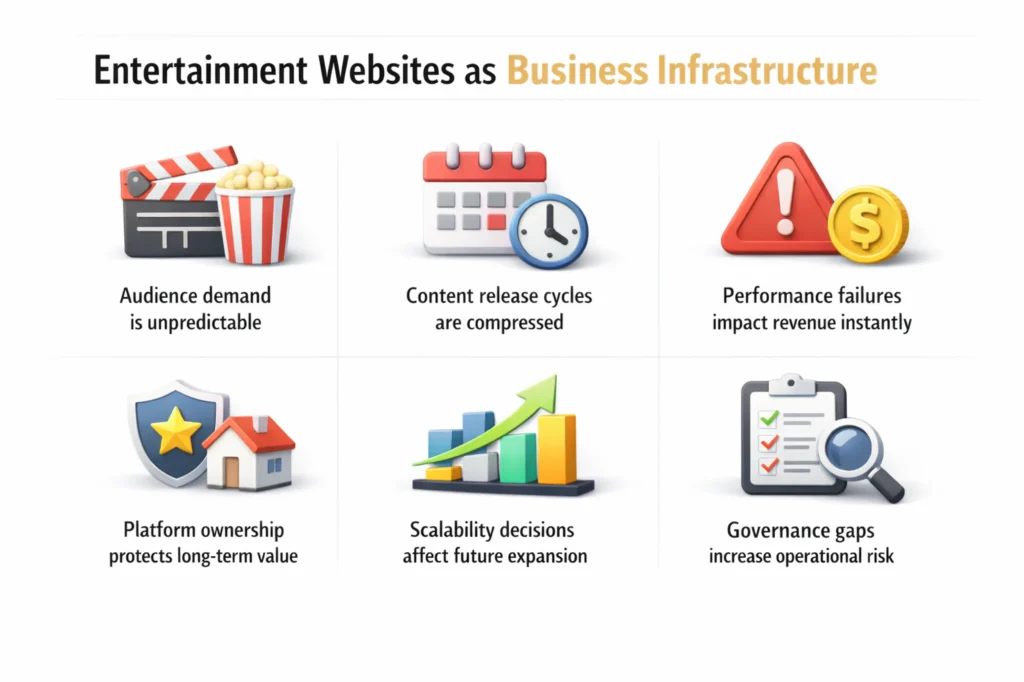
Entertainment organizations face a unique set of digital pressures that extend beyond content delivery. While creativity drives attention, operational discipline sustains growth. In this environment, entertainment website development services are shaped by challenges tied to scale, ownership, and performance reliability rather than feature complexity.
A common concern is how platforms handle sudden demand surges without disrupting user experience. Content launches, trailers, ticket sales, or live events can drive unpredictable traffic volumes. When infrastructure fails to absorb these spikes, the impact extends beyond lost sessions into brand trust and commercial loss. Therefore, platform decisions increasingly resemble those made in custom web application development, where resilience and adaptability remain central.
Decision makers often wonder whether outsourcing platform ownership introduces long term risk. Vendor dependency, unclear governance, and fragmented accountability can limit agility. As a result, entertainment leaders emphasize clarity around control, documentation, and extensibility when engaging a web development company in chennai or similar regional partners.
Operational complexity also grows as platforms integrate marketing, commerce, analytics, and fan engagement layers. Without clear boundaries, these integrations increase maintenance overhead and slow decision making. Consequently, entertainment website development services must account for operational sustainability, not just launch readiness.
These challenges shape how entertainment businesses evaluate digital investments. Each pressure point highlights the need for platforms that support rapid change while preserving stability, compliance, and long term strategic autonomy.
Technology Trends Influencing Entertainment Website Development Services
Platform flexibility, performance standards, and integration readiness
Technology choices increasingly define how entertainment brands compete for attention and loyalty. As formats evolve and consumption patterns shift, entertainment website development services must align with broader technology movements without locking organizations into rigid systems. Decision makers now prioritize adaptability over novelty, recognizing that platforms must evolve alongside audience behavior.
One visible trend is the move toward modular architectures. Rather than monolithic builds, entertainment platforms are structured to support rapid updates, feature isolation, and third party integrations. This direction mirrors shifts seen across web development frameworks, where flexibility and maintainability reduce long term operational friction. As a result, entertainment websites gain the ability to adopt new content formats or engagement models without disruptive rebuilds.
Another emerging expectation centers on intelligence and automation. Personalization, content recommendations, and operational insights increasingly rely on data driven systems. Some teams ask whether intelligent platforms add unnecessary complexity. In practice, the concern is less about features and more about governance. Without clear oversight, intelligence layers can complicate accountability. This is why many organizations assess alignment with ai-powered website development principles at a strategic level rather than as isolated capabilities.
Performance expectations also continue to rise. Audiences tolerate little delay, especially during high interest moments. Therefore, technology evaluations now consider how platforms sustain speed, resilience, and consistency under pressure.
Together, these trends push entertainment leaders to view technology selection as a business safeguard. The focus shifts from tools themselves to how well platforms support change, scale, and long term control without constraining creative ambition.
Scalability Expectations for Entertainment Website Platforms
Sustaining growth without compromising audience experience
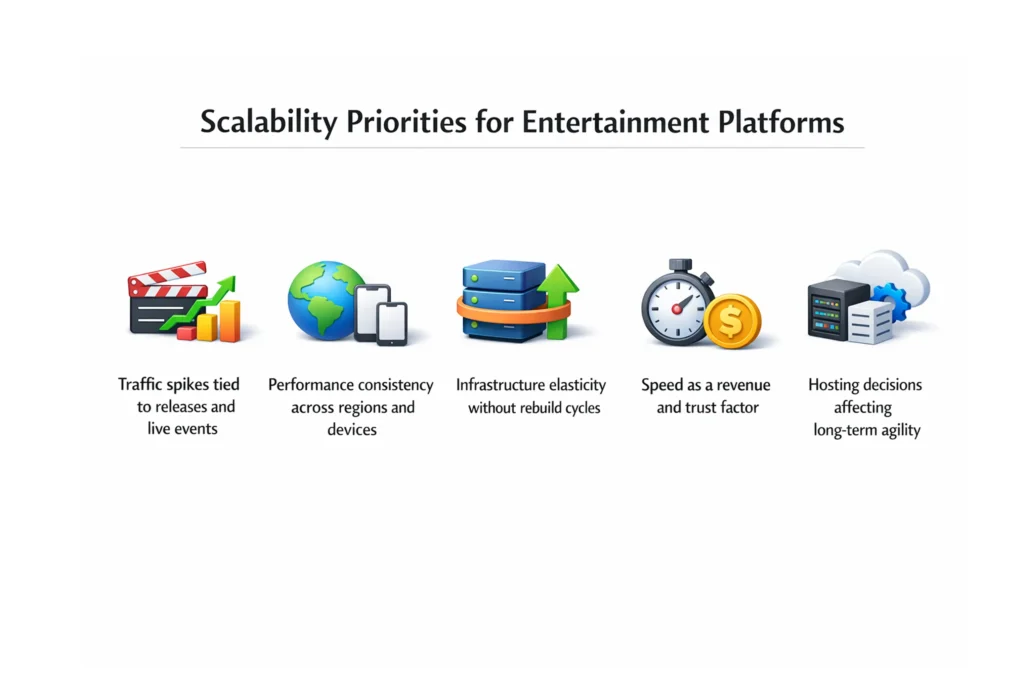
As entertainment platforms expand, scalability becomes a business requirement rather than a technical upgrade. Audience demand rarely grows in predictable patterns. Instead, it spikes around releases, campaigns, and cultural moments. Within this reality, entertainment website development services are judged by how well platforms perform under pressure, not during steady state conditions.
A common concern is whether performance investments deliver measurable business value. In entertainment environments, speed directly affects engagement, conversions, and repeat visits. Even minor delays can disrupt user momentum during high interest moments. Therefore, performance metrics such as website loading speed increasingly factor into executive level discussions, linking infrastructure decisions to revenue protection and audience trust.
Scalability also extends beyond traffic handling. Content libraries grow, integrations expand, and regional audiences increase operational complexity. Platforms must accommodate these shifts without triggering repeated rebuild cycles. As a result, entertainment leaders evaluate hosting and infrastructure models that support elasticity, redundancy, and long term efficiency, often aligned with cloud based website hosting strategies.
Decision makers often wonder whether scalability planning limits creative flexibility. In practice, the opposite tends to occur. When platforms scale reliably, creative teams gain freedom to experiment without fearing system failure. This balance between stability and innovation defines modern entertainment website strategy.
Ultimately, scalability choices signal how prepared an organization is for sustained attention, growth, and operational resilience in a competitive entertainment landscape.
Compliance and Governance in Entertainment Website Development
Balancing creative freedom with regulatory accountability
As entertainment platforms scale, governance becomes a strategic concern rather than a background function. Content distribution, data handling, accessibility expectations, and regional regulations introduce layers of accountability that leadership teams cannot ignore. Within this landscape, entertainment website development services increasingly intersect with compliance readiness and risk management decisions.
Entertainment websites often process user data through ticketing, subscriptions, fan registrations, or merchandise sales. This exposure raises questions around data protection, consent management, and transparency. A common concern is whether compliance requirements restrict creative freedom. In practice, governance frameworks aim to reduce uncertainty, not limit expression. Clear structures allow creative teams to operate confidently within defined boundaries.
Decision makers often wonder how governance differs between entertainment platforms and enterprise sites. The difference lies in pace and visibility. Entertainment sites evolve rapidly and attract public attention. Therefore, governance models often borrow principles from Corporate website development, where accountability, documentation, and role clarity protect organizational credibility.
Operational risk also increases when multiple vendors, tools, and integrations coexist without oversight. Fragmented ownership can lead to security gaps, inconsistent updates, or compliance drift over time. As a result, leadership teams emphasize alignment between platform architecture and the website development process, ensuring governance considerations remain embedded rather than reactive.
Ultimately, governance within entertainment platforms is not about control for its own sake. It supports trust, protects reputation, and enables sustainable growth as platforms expand across markets and audiences.
Vendor Strategy for Entertainment Website Development Services
Partner alignment, accountability, and platform ownership
Selecting the right partners influences how entertainment platforms evolve over time. While creative output attracts audiences, vendor strategy determines whether platforms remain adaptable or become constrained. In this context, entertainment website development services are often evaluated through the lens of ownership clarity, decision velocity, and long term flexibility.
Entertainment organizations frequently work with multiple stakeholders, including designers, developers, content teams, and infrastructure providers. A common concern is whether fragmented vendor models dilute accountability. When responsibilities blur, response times slow and platform evolution becomes reactive. Therefore, leadership teams increasingly prioritize structured engagement models similar to those used when working with a website development agency in Chennai, where defined roles support faster alignment.
Decision makers often wonder how vendor choice impacts future costs. While initial pricing matters, long term adaptability often carries greater financial weight. Platforms that require frequent restructuring introduce hidden operational expenses. As a result, many organizations assess vendor capability through comparisons like Cost to develop a website, focusing on sustainability rather than launch only metrics.
Vendor strategy also intersects with compliance and data protection responsibilities. Entertainment platforms handling user data must align with evolving regulatory expectations. For reference, guidance from authorities such as the European Union’s GDPR framework provides a baseline for accountability and transparency across digital platforms
Ultimately, vendor decisions signal how entertainment organizations balance speed with control. The right alignment supports innovation without compromising governance, scale, or strategic autonomy.
Monetization Alignment Across Entertainment Website Platforms
Converting engagement into sustainable business value
Audience attention alone does not guarantee commercial success. Entertainment organizations must align experience design with monetization logic without disrupting engagement. Within this balance, entertainment website development services influence how effectively platforms convert interest into measurable outcomes while preserving brand integrity.
Entertainment monetization models vary widely, spanning subscriptions, ticketing, advertising, merchandise, and partnerships. Each model introduces distinct technical and operational pressures. When experience and revenue mechanics feel disconnected, users disengage quickly. Therefore, leadership teams increasingly view platform decisions through the lens of custom website design, where user flow, trust, and clarity directly affect conversion behavior.
Some teams ask whether monetization should be prioritized early or layered later. Strategically, misalignment creates long term friction. Platforms built without revenue considerations often require disruptive changes as business models mature. As a result, entertainment organizations emphasize early alignment between experience strategy and scalable monetization frameworks, similar to planning approaches seen in ecommerce website development services.
Decision makers often wonder how audience trust influences monetization success. Transparency, performance stability, and consistent journeys play decisive roles. Regulatory guidance around digital consumer protection, such as principles outlined by the UK Information Commissioner’s Office, reinforces the importance of fairness and clarity in user interactions
Ultimately, monetization strategy is not about maximizing short term returns. It reflects how well platforms support evolving business models while maintaining audience loyalty, brand credibility, and long term growth flexibility.
Future Ready Planning for Entertainment Website Development Services
Platform evolution without disruptive rebuild cycles
Entertainment platforms rarely remain static. Audience expectations shift, formats evolve, and monetization models mature over time. Within this reality, entertainment website development services are increasingly assessed by how well platforms accommodate change without forcing disruptive redesign cycles or operational downtime.
A common concern is whether future growth requires periodic reinvention. Rebuild heavy strategies often introduce risk, cost, and audience friction. Therefore, entertainment leaders emphasize platform evolution over replacement. This mindset mirrors approaches seen in website redesign, where continuity, data preservation, and experience stability remain as important as visual updates.
Decision makers often wonder how technology choices today affect adaptability tomorrow. Platform flexibility depends on architectural decisions, content governance, and tooling compatibility. For example, debates such as React vs wordpress for business website are less about preference and more about long term scalability, content velocity, and integration tolerance within entertainment ecosystems.
Future readiness also includes preparedness for new distribution models, immersive formats, and emerging regulatory expectations. Platforms that evolve incrementally absorb these shifts with minimal disruption. Those built for short term needs struggle to adapt under pressure.
Ultimately, future ready entertainment websites protect business momentum. They allow organizations to respond confidently to industry change while preserving audience trust, operational efficiency, and strategic control.
FAQs
1. Some stakeholders ask whether entertainment website development services differ significantly from other digital services.
Entertainment platforms face higher demand volatility, content velocity, and public visibility. These factors elevate performance, governance, and scalability considerations beyond typical business environments.
2. Decision makers often wonder how early strategic decisions affect long term costs.
Early platform choices influence maintenance overhead, rebuild frequency, and adaptability. Strategic alignment reduces long term expense even if initial investment appears higher.
3. A common concern is whether owned platforms remain relevant alongside social media growth.
Owned websites continue to anchor data ownership, monetization control, and brand stability, while social platforms function as distribution channels rather than replacements.