Key takeaways
- Using data to choose the price of an app helps reduce pricing guesswork and improves revenue decisions.
- Competitor pricing research should compare subscription models, feature access, free trials, and user review sentiment, not just visible price points.
- Key metrics like trial-to-paid conversion, churn, ARPU, CAC, and LTV reveal whether your app pricing is too high or too low.
- Testing app pricing before and after launch through MVPs, landing pages, and paywall experiments can uncover the best monetization fit.
- App pricing should evolve with user behavior, regional demand, category benchmarks, and long-term product growth goals.
Many apps fail not because the product is weak, but because pricing is disconnected from market demand, perceived value, or monetization readiness. Businesses need data to choose the price of an app rather than relying on pure assumptions. Without solid metrics guiding your strategy, you risk leaving money on the table or alienating potential users before they even download your software.
When pricing an app using real market data, you remove the guesswork that often leads to lost revenue. In our development process, pricing decisions work best when product strategy, user behavior, and monetization data are aligned from the very start. A well-researched pricing model acts as a growth engine, helping you acquire users efficiently while maintaining healthy margins.
This guide explores the frameworks, metrics, and testing methods required to build a sustainable monetization model. You will learn how to evaluate competitors, track user behavior, and run validation experiments that ensure your app is positioned perfectly in the market.
Why Data to Choose the Price of an App Matters More Than Guesswork
Wrong pricing can heavily reduce installs, conversions, retention, and long-term revenue. Relying on gut feeling instead of hard numbers is a massive risk. Underpricing creates serious sustainability issues, making it difficult to cover the overall app development cost and fund future updates. Conversely, overpricing hurts adoption and app store performance, driving users directly into the arms of your competitors. This is where data to choose the price of an app becomes a strategic input, not just a minor launch task.
Signs you are not using data to choose the price of an app
When your pricing misses the mark, the market will tell you quickly. You might see a high volume of downloads but an abysmal trial-to-paid conversion rate. Alternatively, users might complain about the cost in App Store reviews, or you might experience a high churn rate within the first billing cycle. These signals indicate that the perceived value of your product does not align with the financial barrier to entry.
Why pricing decisions should start before launch
Monetization should heavily influence the features you build and the audience you target. As outlined in the App development lifecycle explained, treating pricing as an afterthought often leads to scrambled business models. By integrating pricing discussions early, you ensure that the architecture and user experience naturally guide users toward upgrading or purchasing.
What Data to Choose the Price of an App Should Include First
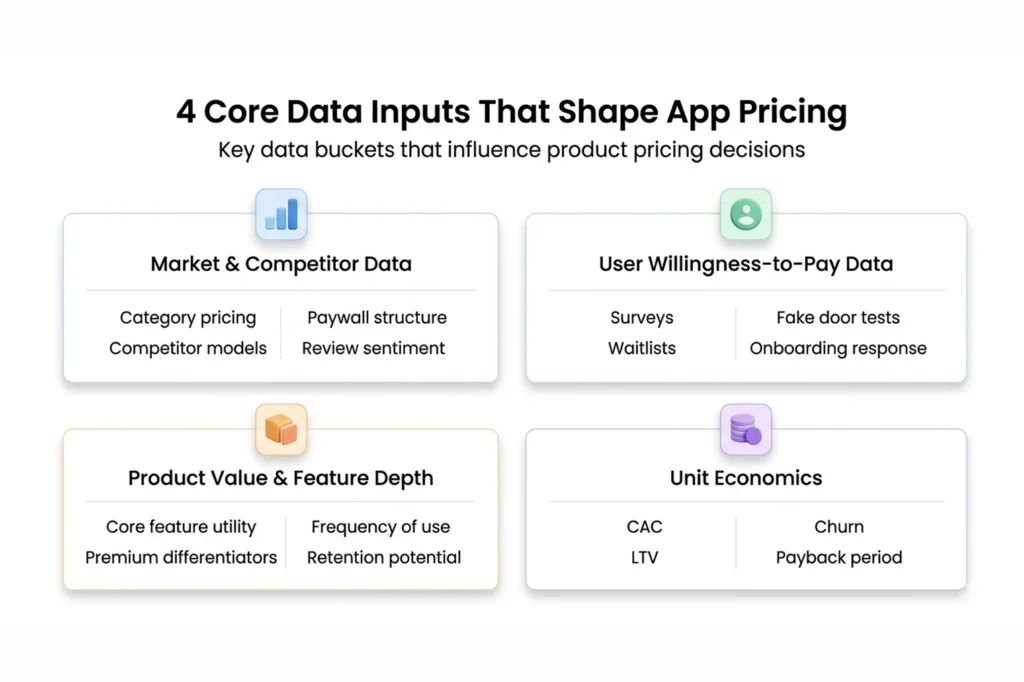
Gathering the right inputs is the most critical step in formulating a successful monetization strategy. When collecting data to choose the price of an app, you must focus on four primary buckets: market and competitor data, user willingness-to-pay, product value and feature depth, and your revenue model unit economics. These factors form the foundation of a logical pricing structure.
Market benchmarks and competitor pricing signals
Understanding what users are accustomed to paying in your specific category is essential. If every productivity app charges $4.99 a month, trying to charge $15 a month requires a massive leap in functionality and value. Analyzing these benchmarks helps you position your product appropriately.
User behavior data that reveals willingness to pay
Surveying your target audience or running early pricing tests helps identify how much they value your solution. Whether you are utilizing comprehensive mobile app development services or focusing on highly specialized custom mobile app development, mapping out feature depth against user behavior is crucial. Advanced features that save businesses hours of manual labor command higher prices than basic convenience features aimed at casual consumers.
How to Use Competitor Data to Choose the Price of an App
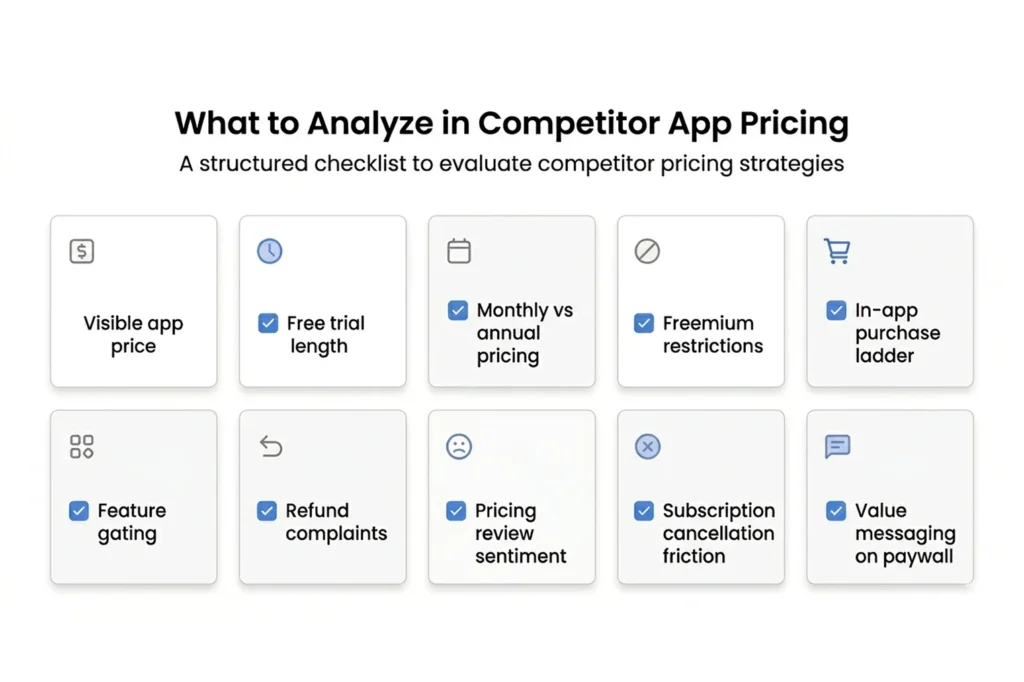
Looking at your competitors is necessary, but simply copying their price tags is dangerous. Your competitor might have lower overhead, a different funding structure, or a completely different long-term strategy. Compare pricing models, not just price points. Look closely at whether they use freemium versus paid upfront, their subscription tiers, trial lengths, and in-app purchase ladders. Feature gating is another critical element to analyze.
What to compare beyond the visible App Store price
Dive deeper into how competitors structure their value. Do they restrict core features behind a paywall, or do they only charge for cosmetic upgrades? Working with a top-tier Mobile App Development Company can help you dissect these complex monetization funnels. Understanding these nuances helps you identify gaps in the market where your app can deliver better value.
How user reviews reveal hidden pricing objections
App store reviews are a goldmine of qualitative data. Look for complaints about hidden fees, subscriptions that are too difficult to cancel, or perceived lack of value for the cost. Recognizing these pain points is one of the major Benefits of hiring a mobile app development company that conducts thorough market research. You can design your pricing page to explicitly counter the objections users have with competitor apps.
Pricing Models That Work Best for Different Types of Apps
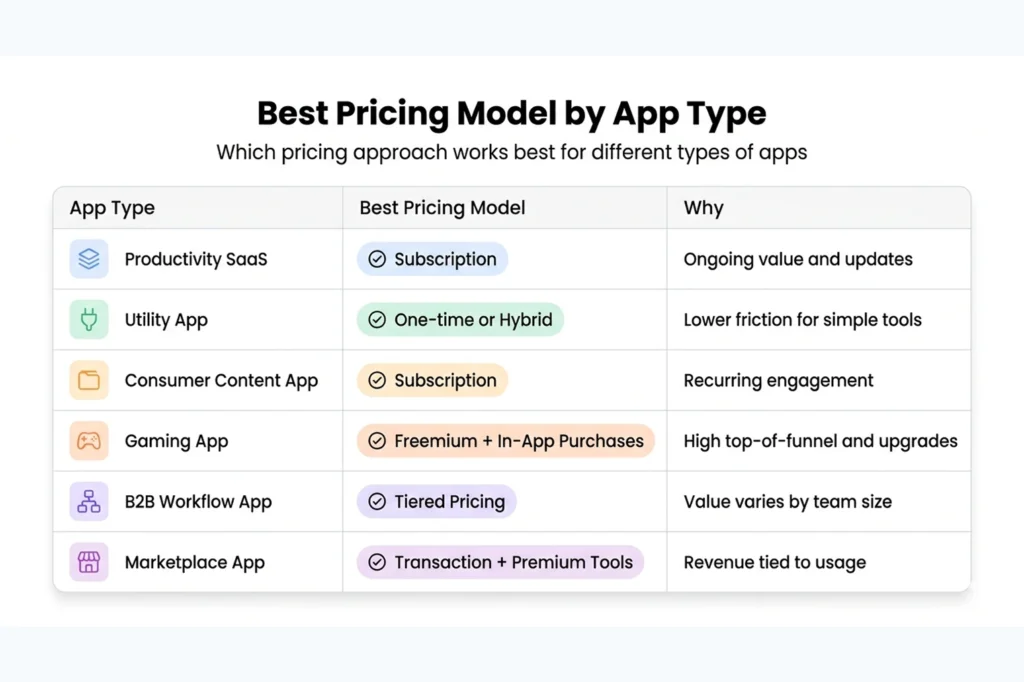
Choosing the right structure is just as important as choosing the right number. You have several options, including one-time paid apps, freemium, subscriptions, usage-based models, and tiered B2B pricing. Each has distinct trade-offs. For instance, a subscription improves lifetime value (LTV) but raises conversion friction. A freemium model boosts initial installs but requires a highly optimized upgrade path.
When freemium beats paid upfront
Freemium is highly effective when your app relies on network effects or when users need to experience the core utility before committing financially. By lowering the barrier to entry, you maximize top-of-funnel volume. If you are focused on Building MVP Mobile Apps, testing a freemium model early allows you to gather massive amounts of usage data quickly.
When subscription pricing makes the most sense
Subscriptions work best for products that deliver continuous value over time, such as content streaming, cloud storage, or consistently updated SaaS tools. If you plan to provide ongoing server costs and regular content updates, a subscription is almost mandatory. Knowing how to choose mobile app development company that understands subscription infrastructure is vital for setting up secure, recurring billing systems.
Metrics That Help You Choose the Price for an App
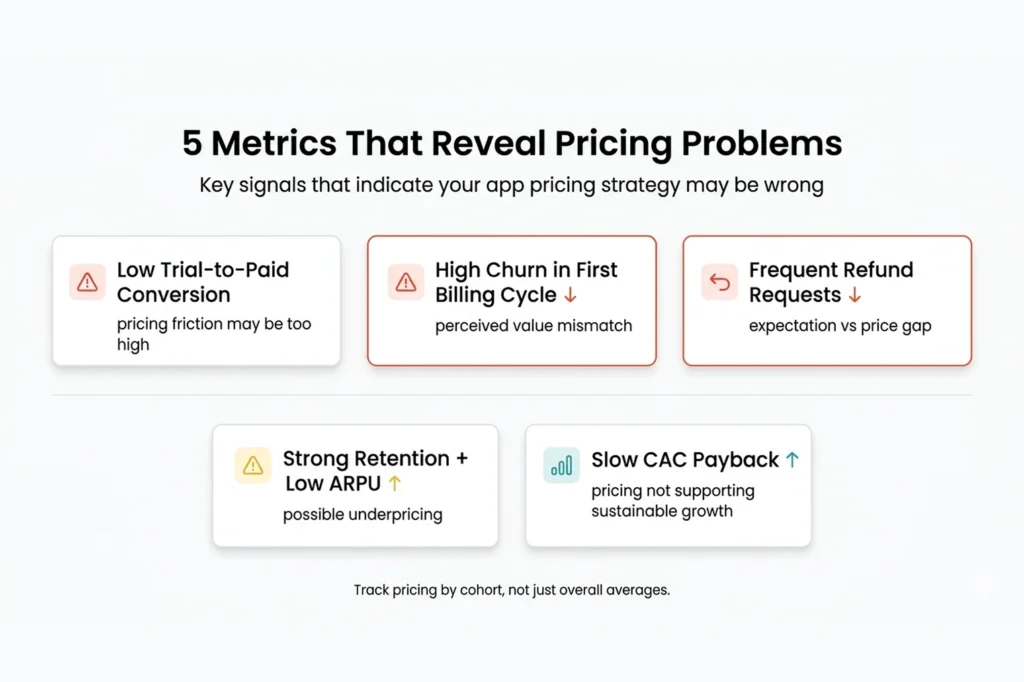
You must measure the performance of your pricing strategy constantly. Key metrics provide objective data to choose the price of an app that maximizes revenue. You should track download-to-paid conversion rates, trial-to-paid conversions, Average Revenue Per User (ARPU), and Customer Acquisition Cost (CAC).
Conversion metrics that reveal pricing friction
If your download numbers are high but your trial-to-paid conversion is under 2%, your price might be creating too much friction. Analyzing these drop-off points is a standard part of professional mobile app development services. You need to know exactly where users decide the cost outweighs the benefit.
Revenue metrics that show whether app pricing is sustainable
High churn rates or frequent refund requests strongly suggest that the product fails to deliver on the promise of its price tag. Furthermore, tracking the payback period, which is how long it takes a user to cover your app development cost, will dictate how aggressively you can spend on marketing and user acquisition.
How to Test App Pricing Before and After Launch
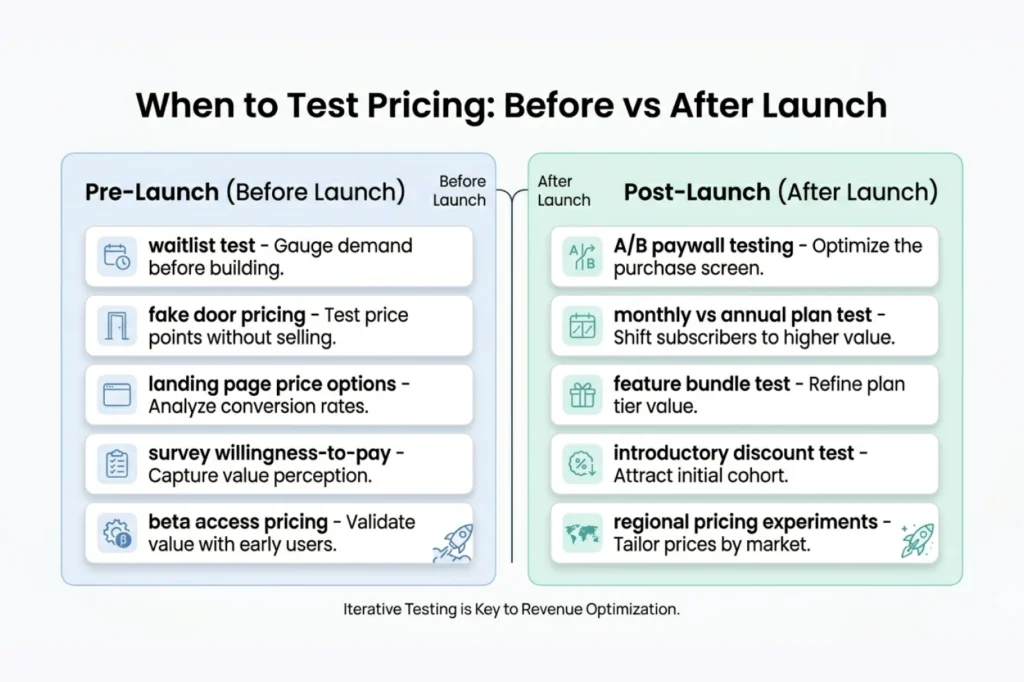
Pricing is never truly final. Real-world validation methods are necessary to find the sweet spot. You can use landing page price testing, regional price comparisons, beta pricing experiments, and introductory offer testing. A/B testing your onboarding paywalls allows you to see exactly which price points generate the highest conversions.
Pre-launch pricing validation methods
Before you write a single line of code, you can use fake door tests or waitlists to validate willingness to pay. This is highly recommended during custom mobile app development. Creating a landing page that outlines the product and asks users to select a pricing tier provides immediate feedback on what the market will tolerate. Testing monetization early is a core philosophy when Building MVP Mobile Apps.
Post-launch experiments that improve revenue without hurting growth
Once live, you can test annual versus monthly plan presentations, or experiment with different feature bundles. Offering a limited-time introductory discount can help you measure price elasticity. If a 20% discount doubles your conversion rate, your base price might be fundamentally too high.
Regional and Category-Based Factors That Change App Pricing
A blanket pricing strategy rarely works globally. Pricing varies drastically based on geography, purchasing power, and category norms. Health and B2B SaaS apps typically command higher prices than casual gaming or productivity apps. You also must account for seasonal buying behavior, platform differences between iOS and Android, and local tax or app store commissions.
Why the same app may need different price logic in different markets
Consumers in North America have vastly different purchasing power compared to users in Southeast Asia. Therefore, adjusting your prices for local economies, which is often called purchasing power parity (PPP), can massively increase global revenue. A strategic Mobile App Development Company will help you implement dynamic pricing tiers based on user location.
Category benchmarks matter more than generic app pricing advice
An educational app for medical students can easily charge $50 a month, while a basic habit tracker might struggle to charge $2 a month. The context of the problem you are solving dictates the price ceiling. Watching how category norms evolve is an important part of the App development lifecycle explained.
A Practical Framework to Use Data to Choose the Price of an App
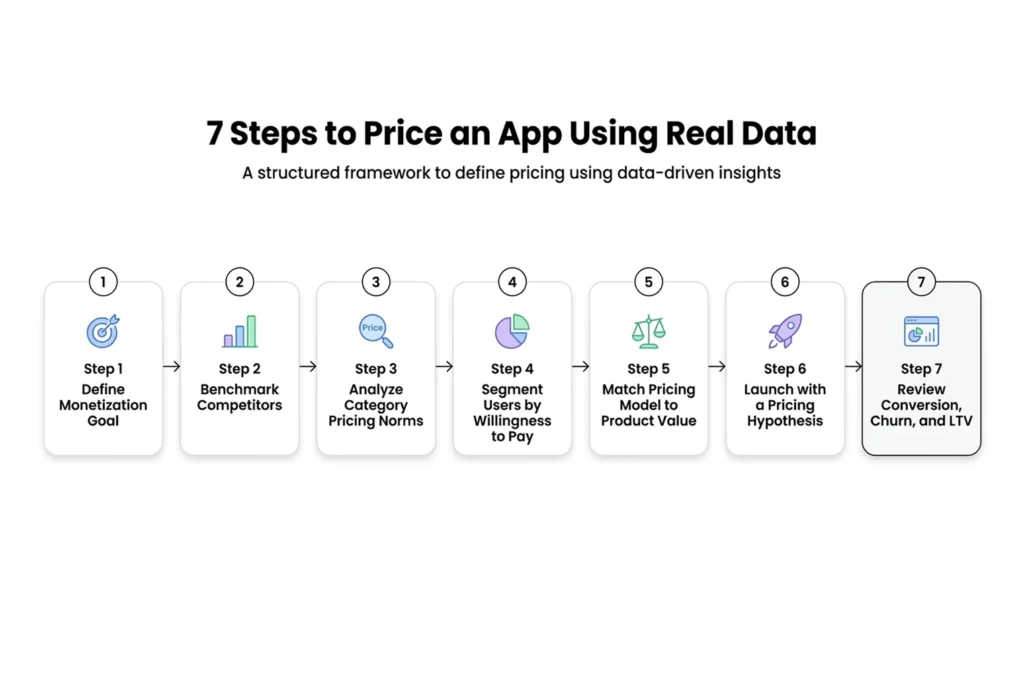
To bring all this together, you need a systematic approach. By utilizing data to choose the price of an app, you can build a repeatable testing loop. First, define your exact monetization goal. Next, map direct and indirect competitors, and benchmark category pricing. Segment your target users by their willingness to pay, and match your pricing model to the specific product value you offer.
A 7-step pricing workflow for founders and product teams
Launch with a testable pricing hypothesis rather than a permanent decision. Track conversion, churn, and LTV meticulously. Once the data rolls in, adjust your pricing by cohort and market response. Knowing how to choose mobile app development company that can build these analytics tracking tools directly into your product is essential for this framework to succeed.
When to revisit pricing after launch
Pricing should not remain static. You should revisit your strategy after major feature releases, when expanding into new international markets, or if user acquisition costs shift dramatically. One of the greatest Benefits of hiring a mobile app development company is having a technical partner that can quickly adjust paywalls and subscription logic as your business model evolves.

Final Thoughts on Using Data to Choose the Price of an App
The process of gathering data to choose the price of an app is not a one-time launch decision. It is an ongoing strategic initiative. Pricing must evolve continuously alongside product maturity, user feedback, monetization behavior, and broader market benchmarks. Smart pricing protects your profit margins while simultaneously improving adoption and long-term user retention.
If you are planning a new product or revisiting an existing monetization model, start by validating pricing alongside feature scope, user segments, and your launch strategy before committing to a fixed revenue path. Engaging with expert mobile app development services or exploring custom mobile app development options can provide the technical architecture necessary to test, iterate, and ultimately perfect your app’s pricing strategy.
FAQs About Data to Choose the Price of an App
1. What data is most important to choose the price of an app?
When using data to choose the price of an app, the most critical metrics include competitor pricing, conversion rates, retention, CAC, LTV, churn, willingness-to-pay signals, and specific category benchmarks.
2. Should I copy competitor pricing for my app?
No. Use competitors as a reference point, then price based on feature depth, audience, and monetization goals. Blindly copying ignores your unique unit economics.
3. Is subscription pricing better than one-time pricing?
It depends entirely on ongoing value delivery, update frequency, and retention potential. Subscriptions require continuous feature updates, whereas one-time pricing is better for standalone utilities.
4. How often should app pricing be reviewed?
Review your pricing after launch, after major feature releases, after significant market shifts, and at least every quarter if monetization is actively scaling.
5. Can MVP testing help validate app pricing?
Yes. Early pricing tests through MVPs, landing pages, and onboarding paywalls drastically reduce revenue risk. This is a crucial step when Building MVP Mobile Apps with a trusted Mobile App Development Company.