Key Takeaways
- AI voice ordering for restaurants helps reduce missed calls, improve order accuracy, and support customer service during peak hours.
- Successful implementations depend on seamless POS integration, menu understanding, and reliable human handoff workflows.
- Restaurants can use voice ordering systems for phone orders, drive-thru operations, reservations, and customer inquiries.
- Businesses should evaluate challenges such as background noise, complex order modifications, and customer preferences before deployment.
- A phased implementation strategy with clear performance metrics helps restaurants maximize operational efficiency and scalability.
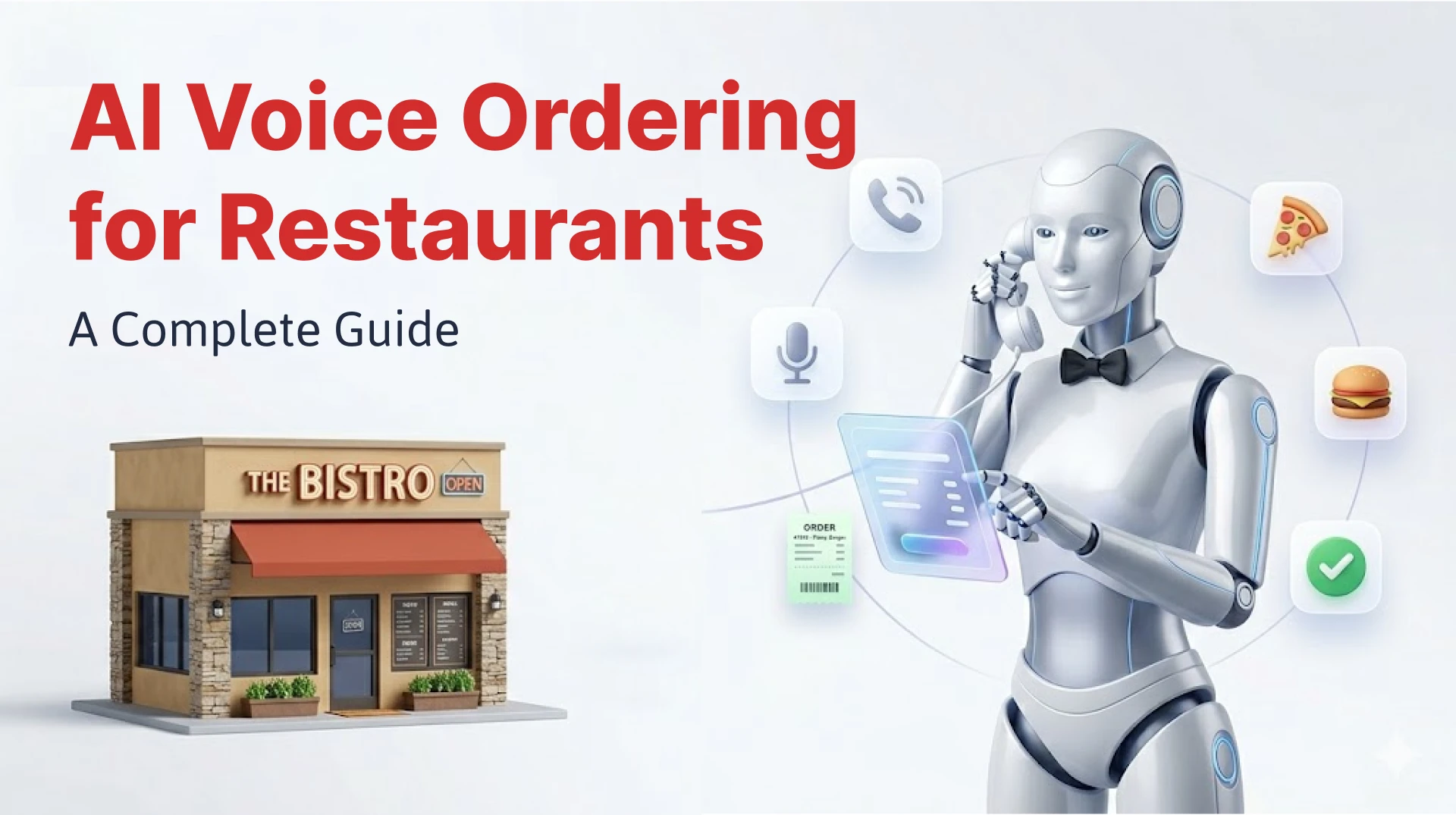
Restaurants deal with constant pressure during peak hours. Missed calls, delayed orders, incorrect modifications, and staff shortages directly affect customer experience and revenue. This operational strain forces owners and managers to find smarter ways to handle high-volume demand without burning out their teams. This is where AI voice ordering for restaurants is becoming a crucial part of the operational strategy for modern dining businesses.
Many restaurant owners are actively exploring voice-based ordering systems to manage phone orders, drive-thru requests, reservations, and customer inquiries more efficiently. Instead of relying entirely on staff availability to answer every ringing phone, businesses are looking for intelligent systems that can handle repetitive customer interactions consistently. Crucially, these systems must integrate seamlessly with existing POS workflows and kitchen displays to maintain order accuracy.
From our perspective, successful implementation depends less on the technology itself and more on how well it fits existing restaurant workflows. Teams working on digital transformation projects often combine these voice systems with strategic services like Building MVP Mobile Apps, scalable ordering infrastructure, and customer engagement tools. This approach helps improve restaurant operations gradually instead of attempting to replace existing processes entirely. By reading this comprehensive guide, you will understand how voice automation fits into your current workflow, the core features you need to look for, and the best practices for implementing this technology successfully.
Why Restaurants Are Adopting AI Voice Ordering for Restaurants
Restaurants lose tangible revenue when customers abandon calls or experience long wait times. During the notorious lunch and dinner rush hours, staff usually prioritize dine-in guests over phone interactions. This creates massive operational gaps where potential delivery or takeout orders are simply missed.
This loss of revenue is one of the biggest reasons why AI voice ordering for restaurants is gaining massive traction across quick service chains and independent brands alike. It offers a reliable safety net, ensuring that no customer is left waiting on hold indefinitely.
Common operational problems restaurants face
Managing a busy restaurant involves juggling multiple priorities simultaneously. Without automated support, several pain points frequently emerge:
- Missed incoming calls during busy periods when staff are overwhelmed.
- Incorrect order customization due to misheard instructions over noisy phone lines.
- Staff multitasking errors that compromise both the dine-in experience and phone order accuracy.
- Long drive-thru queues that frustrate waiting customers and slow down throughput.
- Delayed reservation handling, leading to poor table management.
- Poor upselling consistency, as rushed human staff often forget to suggest add-ons or premium upgrades.
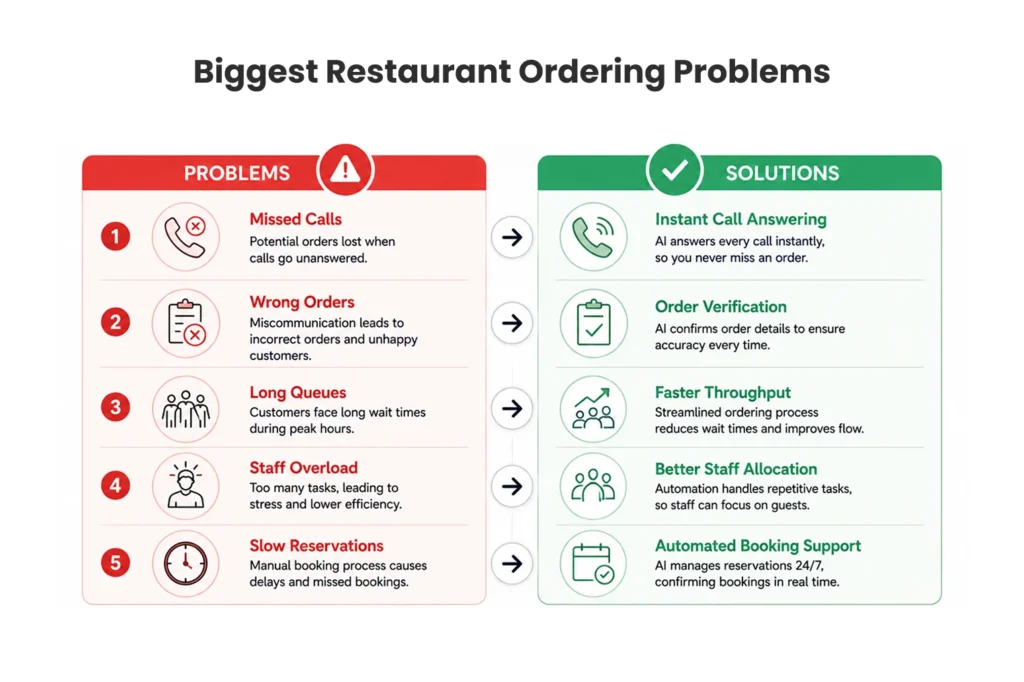
To solve these issues, many businesses now connect their voice systems with platforms related to Best Food Delivery website development. This creates a more unified, seamless ordering experience across phone, mobile, and online channels, ensuring data flows logically from the customer to the kitchen.
Where voice ordering fits in restaurant operations
Voice automation is not a blanket replacement for human interaction; rather, it is a targeted tool. Voice systems are commonly used for:
- Drive-thru order handling and queue management.
- Phone order management for takeout and delivery.
- Reservation booking and table availability inquiries.
- FAQ responses, such as answering questions about opening hours or parking.
- Menu recommendations and daily special announcements.
- Order status tracking for waiting customers.
Some businesses also strategically integrate these systems alongside conversational interfaces discussed in AI chatbots vs traditional chatbots to improve customer support consistency across every digital and voice channel.
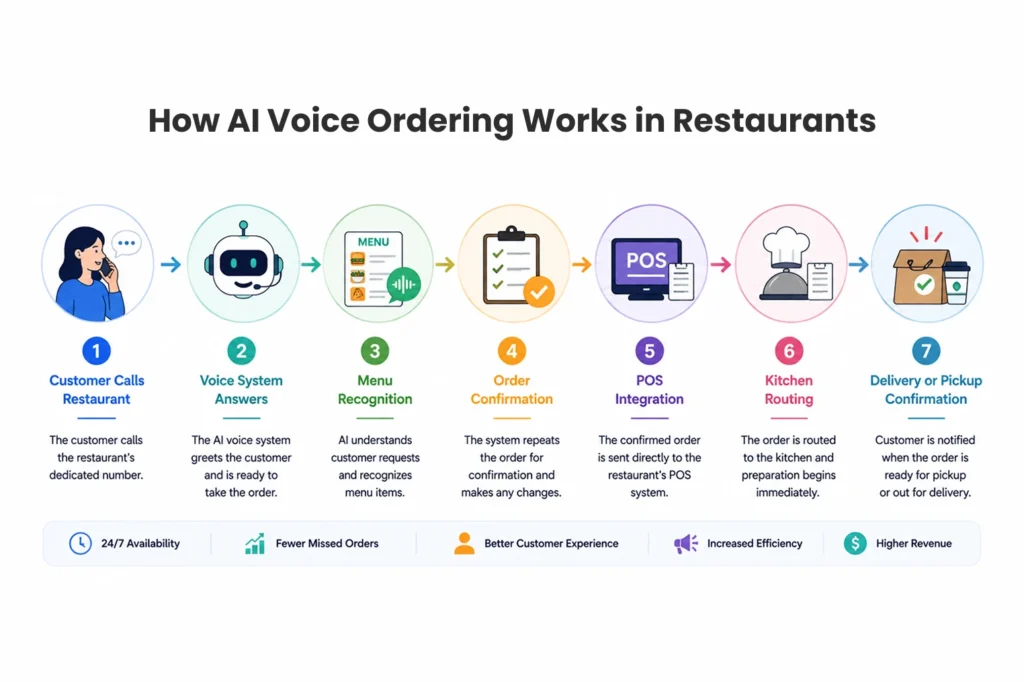
Core Features to Look for in AI Voice Ordering for Restaurants
Not every restaurant requires the exact same technical setup. A sprawling fast food chain has very different needs compared to an intimate casual dining restaurant or a delivery-only cloud kitchen. When evaluating AI voice ordering for restaurants, businesses should focus heavily on practical workflow compatibility rather than sheer feature quantity.
POS and delivery integration support
An automated ordering system is practically useless if it requires a human to manually punch the taken orders into a cash register. The system should integrate directly with:
- Existing POS platforms.
- Kitchen display systems (KDS).
- Delivery aggregators (like UberEats or DoorDash).
- CRM tools for tracking customer preferences.
- Loyalty programs for reward redemption.
This direct connection reduces manual re-entry errors and drastically improves kitchen coordination. Restaurants investing in Cloud-based app development often prioritize centralized infrastructure because it significantly simplifies scaling these integrations across multiple branch locations.
Menu understanding and order customization
A strong voice ordering system should deeply understand the nuances of food ordering, including:
- Menu add-ons and premium upgrades.
- Ingredient removals for picky eaters.
- Combo upgrades and side-dish swaps.
- Allergies and severe dietary restrictions.
- Portion modifications (like “extra sauce” or “light ice”).
Handling natural speech patterns is critical because customers rarely order in perfectly structured, robotic phrases. They use slang, change their minds mid-sentence, and ask clarifying questions.
Human handoff capability
One major implementation requirement is robust escalation support. When the artificial intelligence cannot confidently process an order, it should transfer the interaction to a human staff member immediately, smoothly, and with the full context of the conversation so the customer does not have to repeat themselves.
This becomes especially important in scenarios involving complex catering requests, active complaint handling, large family orders with chaotic modifications, and highly specific regional language variations. Businesses evaluating these conversational workflows sometimes consult an AI agent development company to create custom escalation paths uniquely aligned with their specific restaurant operations.

Benefits of AI Voice Ordering for Restaurants
The business impact of this technology extends far beyond simply answering incoming phone calls. Restaurants mainly adopt these systems to improve their overall operational consistency and customer throughput.
Faster order handling
Voice systems can process hundreds of customer interactions simultaneously. This completely eliminates hold times and dramatically improves response availability during the most chaotic rush periods. In drive-thru environments, faster processing directly translates to shortened queue times, allowing the restaurant to serve more cars per hour.
Better staff allocation
When automated systems handle the phones and drive-thru speakers, restaurant staff can focus more heavily on what really matters:
- Quality food preparation and kitchen safety.
- Front desk operations and welcoming guests.
- In-person customer service and table management.
- Delivery driver coordination and dispatch.
Instead of constantly answering repetitive calls asking if the restaurant is open, your team can focus on delivering exceptional hospitality.
Consistent upselling opportunities
Unlike human staff who might feel rushed or shy, voice systems maintain consistent upselling behavior across every single interaction. They can flawlessly execute:
- Combo upgrades.
- Beverage additions.
- Dessert recommendations.
- Loyalty program sign-ups and exclusive offers.
This strategic upselling aligns perfectly with broader trends involving the role of AI in mobile apps, where intelligent recommendation systems actively help improve the average order value across the board.
Improved multi-location scalability
Multi-branch restaurants often struggle immensely with operational consistency. One location might have excellent phone etiquette, while another leaves customers on hold. Standardized voice workflows help create highly predictable, uniform customer experiences across every single location, protecting the brand’s reputation.

Challenges of Implementing Restaurant Voice Ordering Systems
Although adoption is accelerating rapidly, AI voice ordering for restaurants still has technological limitations that businesses should evaluate carefully before committing to deployment.
Accent and noise handling
Restaurants operate in notoriously noisy environments. Drive-thru systems especially face acoustic challenges such as heavy traffic noise, loud engine sounds, multiple passengers speaking simultaneously, poor microphone hardware quality, and diverse regional accents. While accuracy improves significantly with restaurant-specific training models, difficult edge cases still exist.
Customer frustration risks
Some customers fundamentally prefer speaking with human staff directly. Severe problems occur when automated systems pause for too long, repeat questions unnecessarily, fail to understand basic modifications, or ignore contextual requests. This is exactly why seamless fallback routing to a human is absolutely essential to maintain goodwill.
Complex order scenarios
Large family orders or heavily customized meals can create significant processing issues for artificial intelligence. For example, handling half-and-half pizza items, parsing multiple ingredient substitutions, managing shared meal customization, and organizing catering combinations can confuse basic algorithms.
Businesses planning long-term, highly complex conversational systems often pair their restaurant tools with broader Agentic AI Development Services strategies. This ensures better workflow orchestration and much smarter routing logic for difficult interactions.
How to Implement AI Voice Ordering for Restaurants
Restaurants should avoid deploying voice ordering systems across every single channel immediately. A thoughtful, phased rollout generally produces much better operational outcomes and less staff resistance.
Start with one operational workflow
Most successful digital transformation projects begin with focused, low-risk areas like phone ordering, basic reservation management, and routine FAQ handling. This conservative approach helps management teams accurately measure operational performance before expanding the technology into high-pressure drive-thru environments.
Train using real restaurant conversations
Generic language models usually perform poorly with menu-heavy, highly specific interactions. Effective training should rigorously include:
- Local customer phrasing and slang.
- Menu abbreviations used by locals.
- Combo structures specific to the brand.
- Common modifications requested by regulars.
- Regional pronunciation patterns.
Restaurants building proprietary systems through custom mobile app development projects often include extensive conversation training datasets tailored specifically to their unique menu structure.
Measure operational KPIs
You cannot manage what you do not measure. Track vital metrics such as call abandonment rate, average order completion time, order correction frequency, customer escalation rate, and average order value. Without tracking these measurable KPIs, businesses cannot accurately determine the true operational impact or ROI of their software investment.
Which Businesses Benefit Most from Restaurant Voice Ordering Systems
Different restaurant models utilize voice ordering technologies in vastly different ways, adapting the software to fit their unique business models.
Quick service restaurants
QSR brands focus heavily on rapid drive-thru automation, faster vehicle throughput, aggressive upselling consistency, and significantly reduced staffing pressure during peak dining hours.
Cloud kitchens
Cloud kitchens (or ghost kitchens) lack dine-in customers and mainly use voice systems for high-volume order intake, third-party delivery coordination, FAQ handling, and repeat customer management.
Casual dining restaurants
Casual dining businesses have different priorities. They often use voice systems for seamless reservation handling, waitlist management, phone order support for curbside pickup, and detailed menu inquiries. Teams building restaurant technology stacks frequently combine these ordering systems with Building MVP Mobile Apps to validate user workflows before scaling massive backend infrastructure.

Future Trends in AI Voice Ordering for Restaurants
The next phase of conversational development will likely focus on deeper, more intelligent operational integration instead of merely offering standalone ordering features.
Emerging Trends in AI Voice Ordering for Restaurants
Expected upcoming trends include robust multilingual ordering support, deeply personalized customer recommendations based on past purchase history, cross-channel customer memory, and even vehicle-to-restaurant ordering directly from a car’s dashboard. Smarter loyalty integrations and predictive order suggestions will also become standard. Restaurants are fully expected to connect their voice systems with mobile apps, customer analytics platforms, and vast delivery ecosystems much more tightly over time.
As conversational ordering technology matures, businesses actively investing in scalable infrastructure and integrated ordering ecosystems will likely adapt much faster to rapidly changing customer expectations.

The Future of AI Voice Ordering for Restaurants
Restaurant operations increasingly depend on faster communication, flawlessly accurate order handling, and highly scalable customer service workflows. AI voice ordering for restaurants is rapidly becoming an essential part of that operational shift because it actively helps businesses reduce missed revenue opportunities during high-demand periods.
However, technology alone is not a silver bullet. Implementation success relies heavily on realistic deployment strategies, proper POS integration planning, and incredibly strong fallback support for human intervention. Restaurants that focus intensely on workflow alignment rather than distracting feature overload generally achieve much better long-term operational results. To stay competitive, evaluate your most painful operational bottlenecks today, and consider how a targeted, well-trained voice automation system could help your staff focus on what they do best: delivering exceptional food and hospitality.
FAQ About AI Voice Ordering for Restaurants
1. What is AI voice ordering for restaurants?
AI voice ordering for restaurants refers to voice-enabled systems that handle customer interactions such as phone orders, drive-thru requests, reservations, and FAQs using conversational technology integrated with restaurant operations.
2. Can voice ordering systems integrate with POS software?
Yes. Most modern systems integrate with POS platforms, kitchen display systems, delivery platforms, and CRM tools to reduce manual order entry.
3. Are voice ordering systems suitable for small restaurants?
Yes. Small restaurants often start with phone order handling or reservation automation before expanding into larger operational workflows.
4. What are the biggest challenges with restaurant voice ordering?
The most common challenges include background noise, accents, complex order customization, latency, and customer frustration when systems fail to understand requests accurately.
5. Do voice ordering systems replace restaurant staff?
No. Most restaurants use them to support staff by handling repetitive customer interactions while employees focus on food preparation and in-person service.