

Key Takeaways
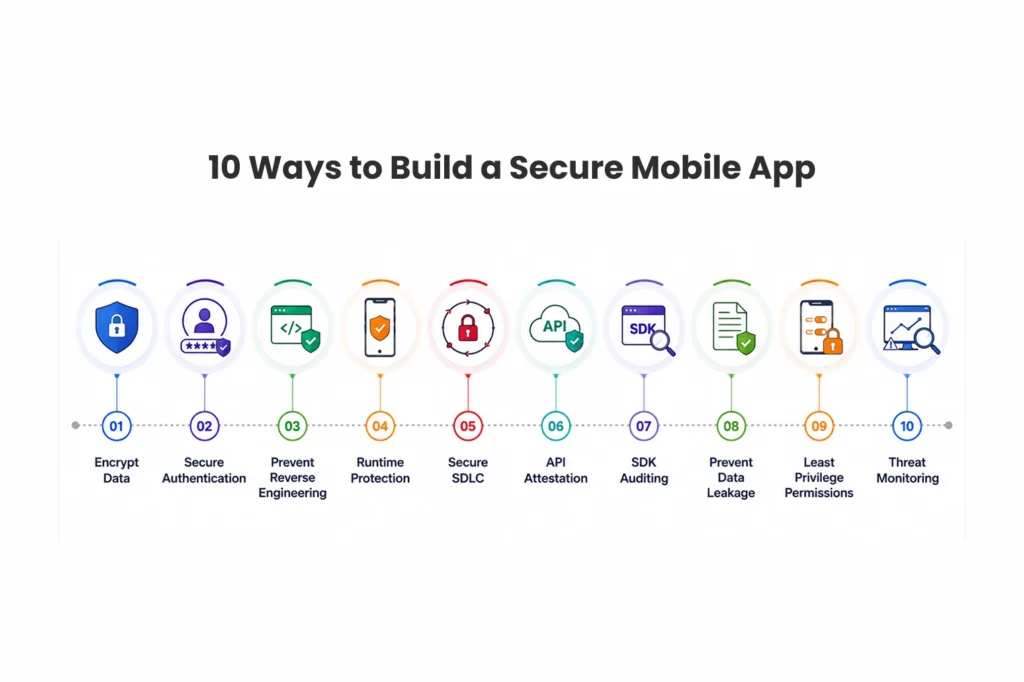
- The 10 ways to build a secure mobile app provide a practical framework for protecting user data and business assets.
- Strong encryption for data at rest and in transit helps prevent unauthorized access and data breaches.
- Secure authentication, API protection, and runtime defenses reduce the risk of modern mobile attacks.
- Regular SDK audits and least-privilege permissions strengthen overall mobile app security.
- Continuous monitoring and security updates help maintain a secure mobile application after launch.
Mobile applications now handle everything from banking transactions to healthcare records and customer communication. As businesses rely more on apps for daily operations, security failures can quickly turn into financial losses, compliance issues, and damaged customer trust. Companies are actively looking for practical, reliable methods to improve app protection before launching new products to the public.
Understanding the 10 ways to build a secure mobile app is no longer a requirement limited strictly to enterprise brands or financial institutions. Startups and mid-sized businesses need stronger encryption, secure authentication, and better API protection to meet modern security expectations. Furthermore, major platform providers like Apple and Google are enforcing much stricter privacy and security requirements across their respective app stores, meaning compliance is mandatory for visibility.
At Code Neptune, our approach to mobile security focuses on building protection into every development stage instead of treating it as an afterthought or a final testing step. Proper security planning early in the project lifecycle often reduces long-term maintenance costs and prevents major vulnerabilities from surfacing later.
Why Secure Mobile App Development Matters More in 2026
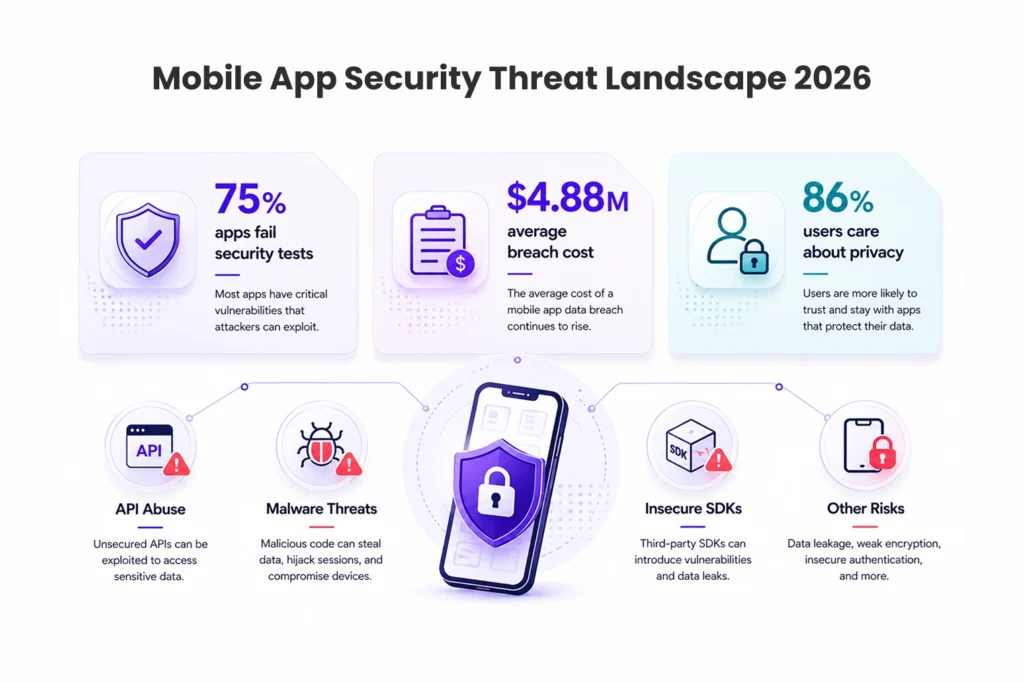
The mobile threat landscape continues to evolve rapidly. Many applications still fail basic security tests because of weak authentication, poor encryption practices, or insecure third-party SDKs. Businesses are also dealing with rising compliance pressure from privacy regulations and platform-level restrictions that demand a proactive approach to user data.
A truly secure mobile application protects user credentials, sensitive payment information, internal business APIs, customer communication, and device-level data storage.
Companies investing in Mobile App Security Best Practices can significantly reduce breach risks while improving user trust and long-term retention.
1. Encrypt Data to Build a Secure Mobile App
One of the most important steps among the 10 ways to build a secure mobile app is implementing strong encryption for both stored data and transmitted data. Unencrypted data is essentially an open invitation for malicious actors to steal user identities or financial details.
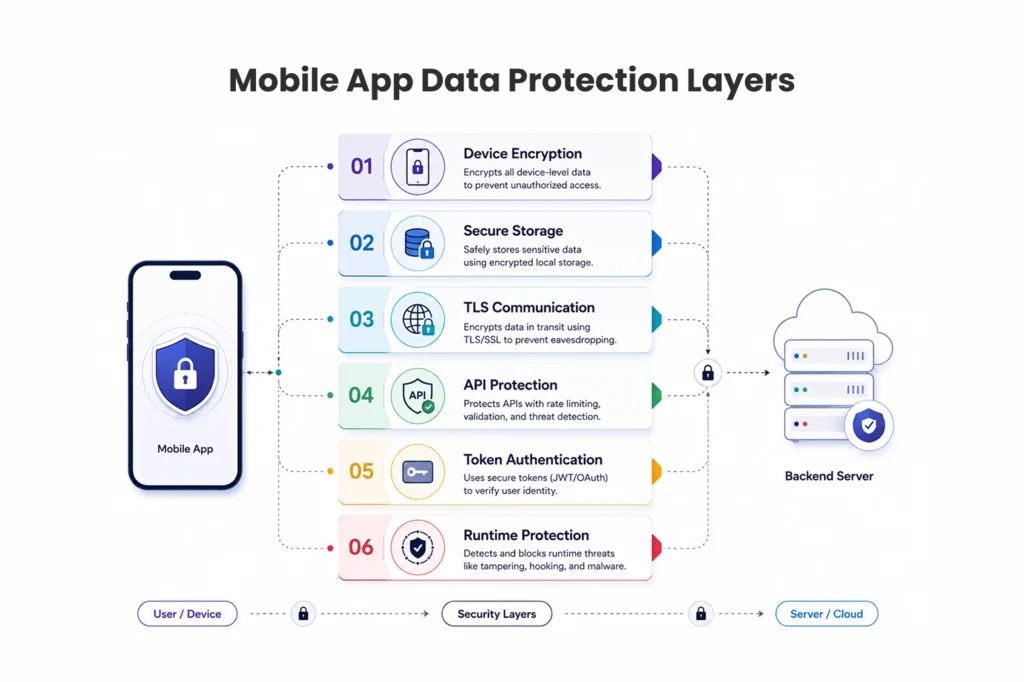
Sensitive information stored locally should always use platform-level encryption tools. Developers should prioritize tools like the iOS Keychain, the Android Keystore, AES-256 encrypted databases, and secure encrypted file storage.
Secure Communication Channels
All network traffic should use HTTPS with TLS 1.3 support. Businesses handling financial or healthcare data may also require certificate pinning for additional API protection, which ensures the app only communicates with a designated server. Weak encryption standards such as SHA1 or outdated SSL protocols should never be used in production environments. Organizations leveraging Cloud-based app development must be especially vigilant about securing data as it moves between local devices and remote servers.
2. Use Strong Authentication to Build a Secure Mobile App
Authentication vulnerabilities remain one of the leading causes of mobile security breaches globally. Login validation should always happen on the server side rather than inside the application itself to prevent local bypass attacks.
Recommended practices include utilizing OAuth2 with PKCE, enforcing multi-factor authentication (MFA), adding biometric login support, issuing short-lived access tokens, and implementing device-based session validation.
Avoid Storing Passwords Locally
Passwords should never be saved in plain text or placed inside insecure local storage environments. Apps should use encrypted token systems with proper refresh mechanisms to keep users logged in securely. Businesses planning customer-facing applications often include these robust protections during the custom mobile app development process to reduce future security risks and ensure a safe user experience from day one.
3. Prevent Reverse Engineering in a Secure Mobile App
Publicly distributed apps are inherently vulnerable to reverse engineering attempts. Attackers frequently decompile applications to steal API keys, uncover business logic, or hijack proprietary algorithms.
Common protection techniques to mitigate this risk include code obfuscation, resource encryption, binary hardening, string encryption, and secure API key handling.
Obfuscation Improves Security Layers
Android applications commonly use ProGuard or R8 for obfuscation. These tools deliberately scramble the code, making it incredibly difficult for attackers to understand the application’s structure after decompiling the app. This is one of the most overlooked areas when discussing the 10 ways to build a secure mobile app, especially for consumer apps with large user bases. Developers specializing in native app development must prioritize obfuscation to protect their core intellectual property.
4. Add Runtime Protection to a Secure Mobile App
Modern mobile threats often target apps while they are actively running on a device. Runtime protection helps applications detect suspicious activity in real-time, shutting down threats before they can extract data.
Important runtime security checks include root detection, jailbreak detection, emulator detection, anti-debugging systems, and overlay attack prevention.
Detect Tampering Early
If an app identifies code modification or malicious instrumentation, it can immediately restrict sensitive actions or terminate the user session automatically. This type of active protection is especially useful for fintech, healthcare, and enterprise platforms where sensitive customer data is constantly processed. Teams exploring Cross Platform App Development Explained resources will find that runtime application self-protection (RASP) tools are vital for maintaining security across different operating systems.
5. Integrate Security Throughout Secure Mobile App Development
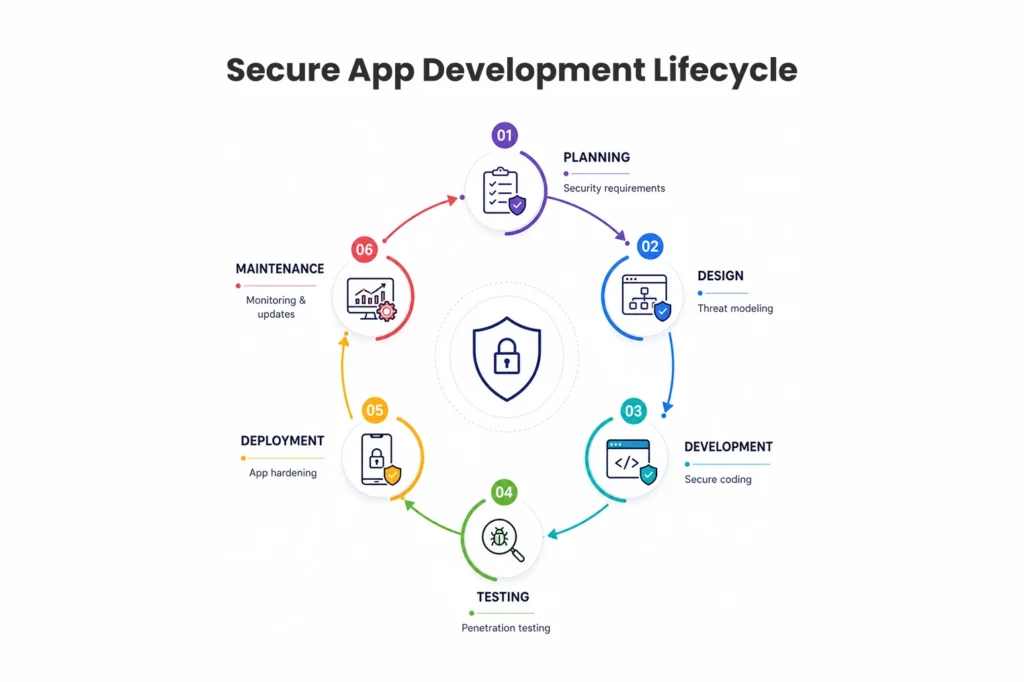
Security should never begin during final QA testing. It needs to be included from the initial planning stages all the way through to deployment and maintenance.
A secure development lifecycle generally follows a strict schedule of activities. During the planning stage, teams must define security requirements. The design phase should incorporate threat modeling. Development requires strict adherence to secure coding practices. Testing must involve rigorous penetration testing. Deployment should include app hardening, and finally, maintenance requires continuous monitoring.
Teams that understand the App development lifecycle explained process are usually better prepared to identify and resolve vulnerabilities much earlier in development, saving significant time and resources.
6. Secure APIs When Building a Secure Mobile App
APIs are one of the biggest attack targets in modern mobile ecosystems. Attackers often attempt to access backend services using modified applications or automated scripts designed to scrape data or overload servers.
App attestation helps verify several crucial factors. It confirms that the application is genuine, ensures the app has not been modified, validates that the device itself is trusted, and checks that the session environment is secure.
Reduce API Abuse
Google Play Integrity API and Apple DeviceCheck are commonly used for basic verification workflows. This strategy is becoming increasingly important within the 10 ways to build a secure mobile app because API abuse now heavily affects both scaling startups and established enterprise applications. Implementing these checks effectively is a core component of overall mobile app performance optimization, ensuring server resources aren’t wasted on malicious bot traffic.
7. Audit Third-Party Dependencies in a Secure Mobile App
Many mobile applications rely heavily on external SDKs, analytics tools, payment systems, and open-source libraries to speed up development. Unfortunately, insecure dependencies can introduce major vulnerabilities directly into your core product.
Security-focused teams should audit every SDK carefully before integration. It is vital to use dependency lock files, run automated vulnerability scans during the build process, remove unused packages immediately, and update outdated libraries regularly.
Supply Chain Risks Continue Growing
Compromised third-party libraries can expose thousands of applications simultaneously. Businesses should treat dependency management as a fundamental part of their long-term security strategy. Knowing how to choose mobile app development company partners that prioritize strict SDK auditing is essential for protecting your digital assets.
8. Prevent Data Leakage in a Secure Mobile App
Sensitive information can easily leak through screenshots, background logs, cloud backups, or clipboard access. Developers must proactively manage how the operating system handles the application’s data when it is minimized or running in the background.
Businesses should secure background snapshots by masking the screen when the app is minimized. They must also manage device backups, sanitize debug logs, restrict clipboard usage for sensitive fields, and prevent one-time password (OTP) visibility.
Secure Sensitive Screens
Financial and enterprise apps often disable screenshots entirely for highly sensitive pages such as payment screens or internal revenue dashboards. Among the 10 ways to build a secure mobile app, preventing device-level data leakage directly impacts user privacy and strict regulatory compliance.
9. Apply Least Privilege in a Secure Mobile App
Applications should only request device permissions that are absolutely necessary for their core functionality. Requesting broad permissions raises immediate red flags for both users and app store reviewers.
Examples of least privilege include requesting camera access only when the user is actively scanning a document, using temporary location permissions instead of “always-on” tracking, limiting contact list access, and automatically removing unused permissions over time.
Permission Transparency Builds Trust
Users increasingly review privacy labels before installing applications. Apps requesting excessive permissions often experience lower conversion and retention rates. Security and user experience now work together more closely than ever before, making permission management a critical business strategy.
10. Monitor Threats After Launching a Secure Mobile App
Application security does not end after deployment. Monitoring real-world attack patterns helps businesses improve future updates and respond to active threats much faster.
Comprehensive security monitoring should include tracking suspicious login attempts, flagging device anomalies, enabling API abuse detection, identifying repackaging attempts, and analyzing unusual traffic patterns.
Ongoing Monitoring Improves Stability
Continuous monitoring also helps development teams identify performance bottlenecks, infrastructure misuse, and emerging vulnerabilities before they affect large user groups. The most successful businesses treat security as a continuous operational process instead of a one-time implementation task to be checked off a list.
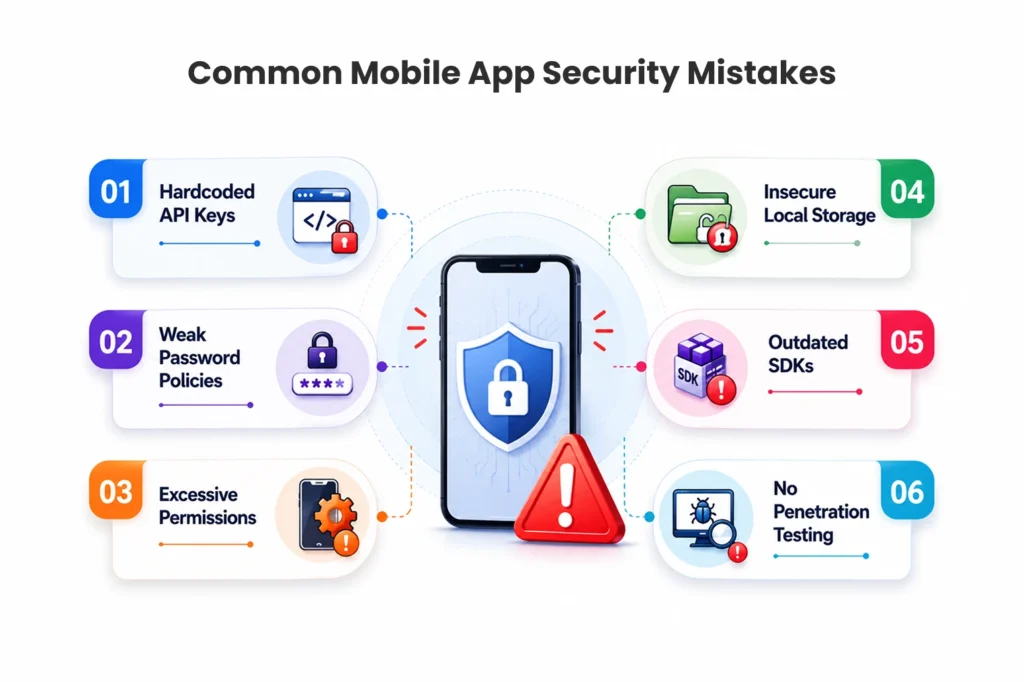
Common Mistakes That Prevent a Secure Mobile App
Even experienced development teams sometimes overlook critical areas during mobile development due to tight deadlines or miscommunication.
Some frequent mistakes include leaving hardcoded API keys in the source code, enforcing weak password policies for users, utilizing insecure local storage, demanding excessive permissions, relying on outdated encryption libraries, and skipping professional penetration testing before launch. Avoiding these common pitfalls significantly improves the overall resilience and trustworthiness of a mobile application.

How to Build a Secure Mobile App That Lasts
Understanding the 10 ways to build a secure mobile app helps businesses reduce risk while dramatically improving customer confidence and long-term application stability. Mobile threats continue evolving at a rapid pace, which means proactive security can no longer be treated as an optional feature or a luxury add-on.
Modern applications require secure authentication, encrypted communication, protected APIs, dependency monitoring, and continuous threat detection to survive. Businesses that prioritize security early in development are often significantly better prepared for rapid scaling, complex compliance audits, and future platform changes.
Prioritizing a secure mobile architecture today will prevent expensive security failures, data breaches, and reputational damage down the road. By implementing these practices comprehensively, your organization can deliver a reliable, highly secure mobile experience that users can trust.
FAQ
1. Why is mobile app security important in 2026?
Mobile apps now handle sensitive customer data, payments, and business operations. Strong security helps prevent breaches, financial losses, and compliance issues.
2. What is the most important mobile app security feature?
Encryption and secure authentication are among the most critical features because they protect sensitive user data and prevent unauthorized access.
3. How often should mobile apps receive security updates?
Security updates should be released regularly based on vulnerability assessments, dependency updates, and emerging threat intelligence.
4. Can cross platform apps be secure?
Yes. Proper architecture, secure APIs, encrypted storage, and runtime protection can make cross platform applications highly secure.
5. What are common causes of mobile app breaches?
Weak authentication, insecure APIs, poor encryption practices, and vulnerable third party SDKs are among the leading causes.