Key takeaways
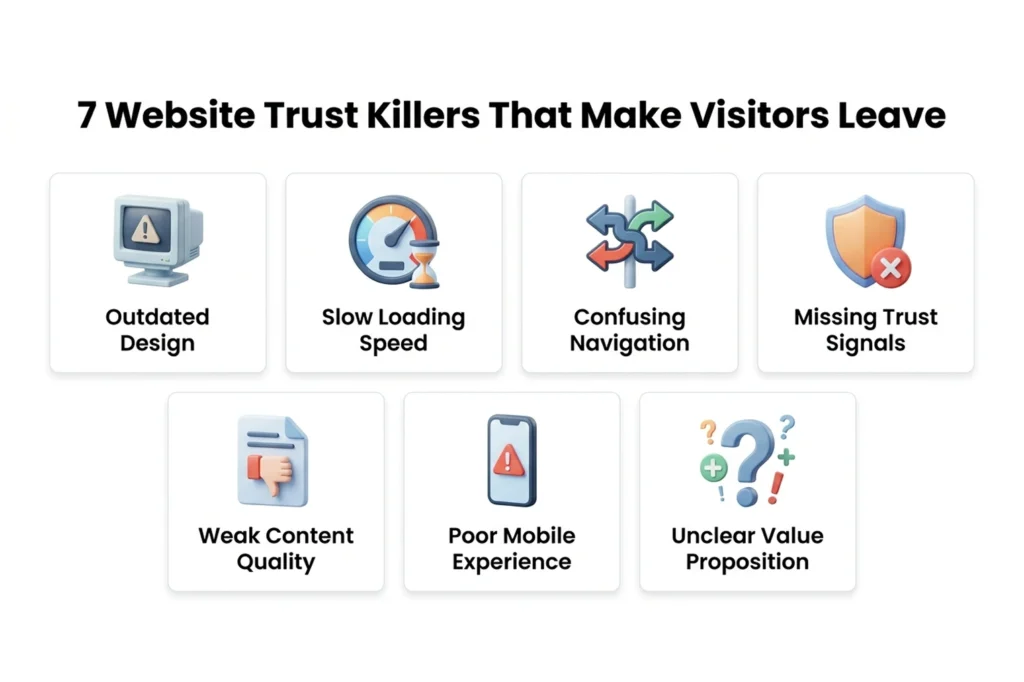
- The top reasons why users don’t trust your website often include weak design, slow speed, and unclear messaging.
- Outdated layouts, slow loading pages, and poor mobile usability can quietly reduce leads and conversions.
- Missing trust signals like testimonials, secure browsing, and clear contact details make visitors hesitate.
- Weak service explanations and confusing navigation can make even high-traffic websites lose trust fast.
- Improving UX, trust signals, and content clarity can turn your website into a stronger conversion asset.
Most of the businesses are not losing leads or sales due to low traffic; they are losing these customers because of a fear created by your site. In mere seconds, visitors assess your business credibility. They will leave and find a competitor if they feel uncomfortable. This uncertainty directly translates into fewer form submissions, sales and retention of customers.
Digging deeper to discover the top reasons why users don’t trust your website is the initial step to improving your conversions. These problems mostly result from inconsistencies in design, slow loading speed, poor trust signals, and vague messages. Finding these weaknesses enables you to transform a holey sales funnel into a dependable source of leads.
We have been able to see how even minor adjustments can lead to significantly increased confidence for visitors in our process, and some of the changes and results through our strategy. These hidden blockers can be avoided with a structured website development process. Now, let us discuss the most frequent problems that prevent visitors from staying and consider at least a couple of practical solutions for them.
Top reasons why users don’t trust your website start with poor first impressions
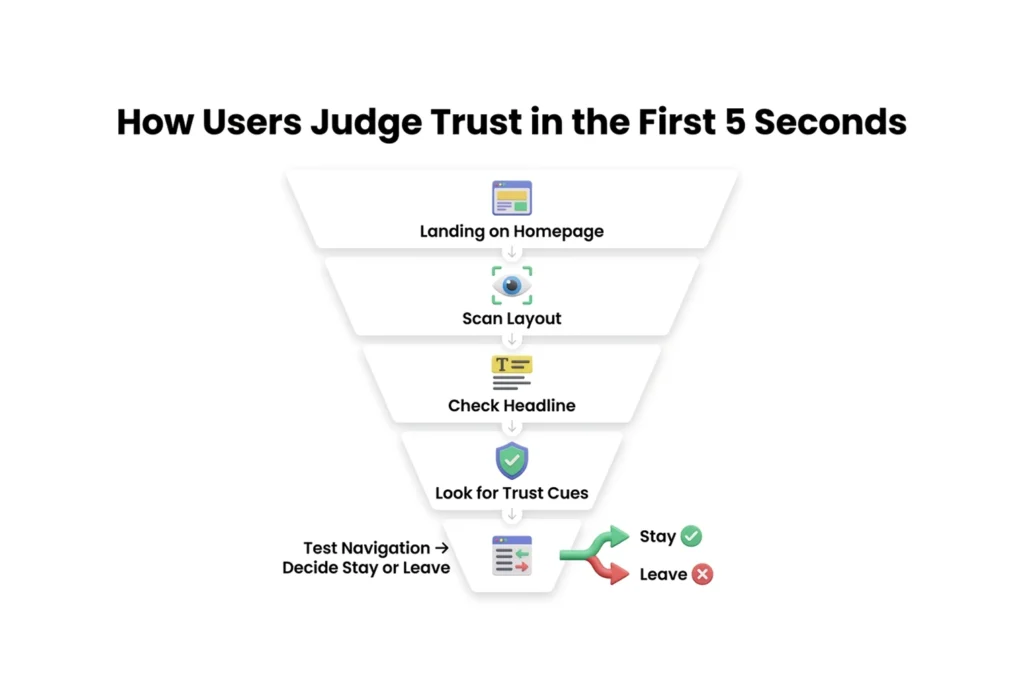
As soon as your page opens, a user gets an opinion about your business. First impressions matter immensely. Visitors judge your authority on aesthetics before they read a single word of your content.
Outdated layouts make your business look inactive
If you still have an old and unkempt design, it tells the users that your business might be closed. Visitors nowadays expect a certain level of modernity when going through the web. When they stumble upon a page that appears to have been built in the early 2000s they instantly presume that your products (or services) are similarly aged. Having a custom website design demonstrates that you value your own digital storefront and you care about the experience your customers have.
Inconsistent branding creates hesitation fast
If the alignment of font, color and quality of image are not appropriate and it lowers your authority. A cluttered homepage leaves users unsure about where they should click. Keeping a professional look is essential. Using Modern Website UI UX Practices helps your branding to be homogenous in each of the pages and that comes as a solace to the users.
Slow pages are one of the top reasons why users don’t trust your website
Credibility is directly connected to performance. Visitors will be angry if the site is slow to load, and this is a very real fact. Need speed is a technical requirement and a basic trust signal.
A slow homepage feels risky to visitors
If your homepage takes longer than a few seconds to load, users will think the business is not well taken care of. It can be particularly dangerous to have this delay when users are prompted for sensitive data, e.g., to fill out their info, go through a checkout process, or log in to an account. They will lose interest if your website takes too long to load, so optimizing your website loading speed is necessary to keep potential customers engaged.
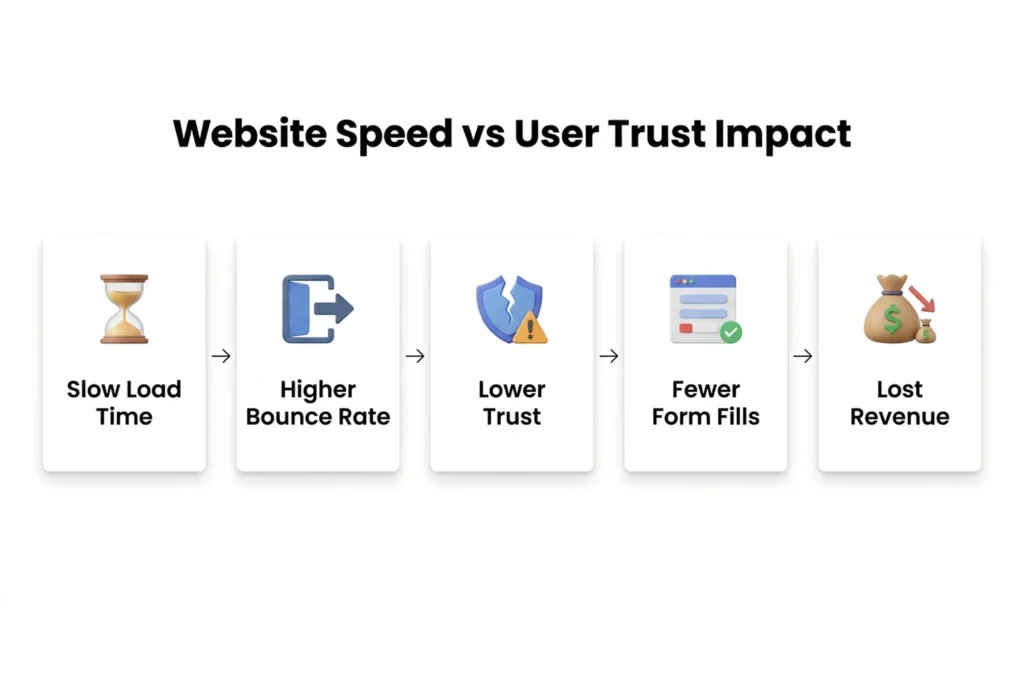
Performance issues quietly damage trust and conversions
Mobile users are far less patient than desktop users. If a mobile experience is slow, your bounce rates are going to be gigantic. Learning How to fix slow websites by compressing images, minifying code, and upgrading hosting can dramatically improve your conversion metrics. Consumers equate safety with speed
Poor UI and navigation can make users lose trust in your website
A well-designed, speedy site will still come up short if it’s hard to use. An intuitive user interface leads your visitors effortlessly towards your primary goals.
Confusing navigation increases doubt
Your visitors should easily find your services, pricing, and how to contact you. Visitors feel disoriented with convoluted or concealed menus. Okay, so good ui and ux design is all about predictability. Users are looking to discover what they need without a lot of guess work and clicking.
Poor visual hierarchy makes important actions feel unsafe
Overcrowding buttons and making them too pushy just sounds spammy. Hard-to-scan pages reduce reader confidence. Avoid Common Website Development Mistakes like overwhelming the user with choices. A clean, logical structure builds confidence and encourages users to take the next step.
Missing trust signals are among the top reasons why users don’t trust your website
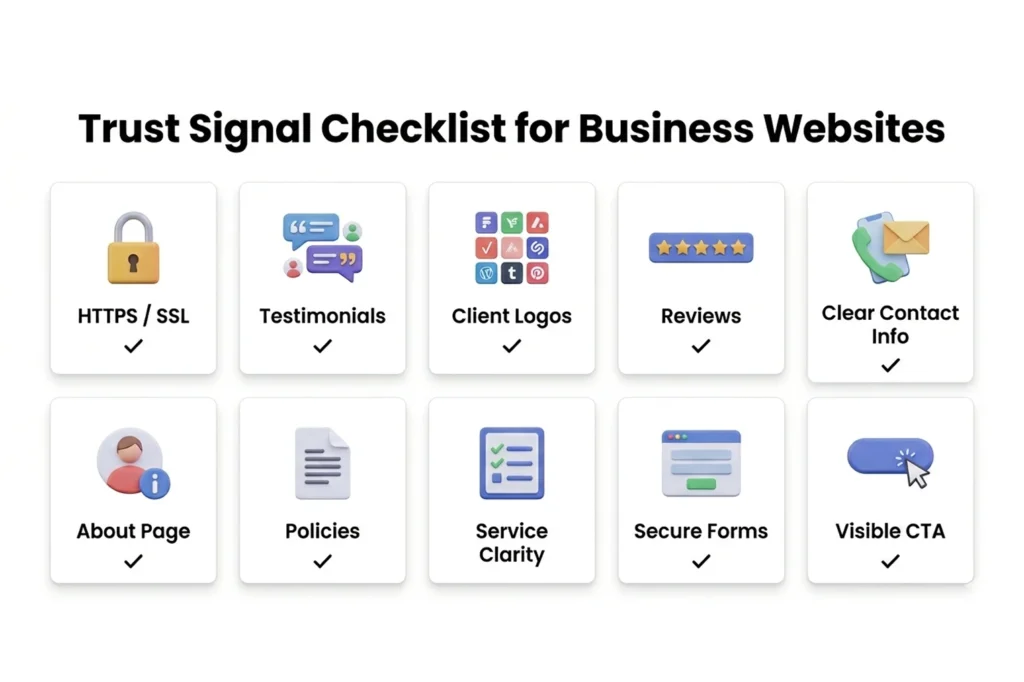
Trust signals are things that indicate that your business is real, alive and reliable. In the absence of trust, users are not going to be willing to offer their money or their data.
No proof of legitimacy creates friction
When a website lacks basic security measures; for example, an HTTPS certificate that lets a user know their connection is not secured– it red flags the user. Unclear Business Identity: Users question if the company even exists, given the absence of a physical address, or specific policies. Hiring a reputable website development company ensures these foundational security and legitimacy elements are correctly implemented.
Lack of social proof makes visitors pause
People trust other people. If your site is missing testimonials, client reviews, partner logos, or case studies there is no way a new visitor will accept your claims as fact. If you want local authority for your business, then local case studies work great. Expert web development services in chennai can ensure that these social proof elements are integrated beautifully into core pages.
Poor content quality can be one of the top reasons why users don’t trust your website
Everyone loves visuals, however, it is words who closes the sale. Your writing is a reflection of your business.
Generic Copy Sounds Copied or Sloppy
Spelling and grammar mistakes instantly reduce your own credibility. Visitors can tell if your expertise lies deep in the industry by reading your thin content, generic content, or both. The key to effective custom website development is that you have your own voice to go with your specific design. Your message should be sounding business and professional as well.
Weak service explanations reduce confidence
Vague service pages hurt decision-making. Without a clear articulation of your outcomes, your process, and your deliverables, users are unlikely to believe in your ability to deliver results. SEO-friendly website development tips guide you to structure your content in a way that not only answers your users questions clearly, but also convinces a search engine like Google that your content must be listed first.
Mobile usability issues are top reasons why users don’t trust your website on modern devices
A big share of your traffic is coming from the mobile devices. If your site can only be viewed properly on a desktop computer you are missing out on a huge chunk of your audience. Default trust is mobile trust now.
Broken mobile layouts feel unprofessional
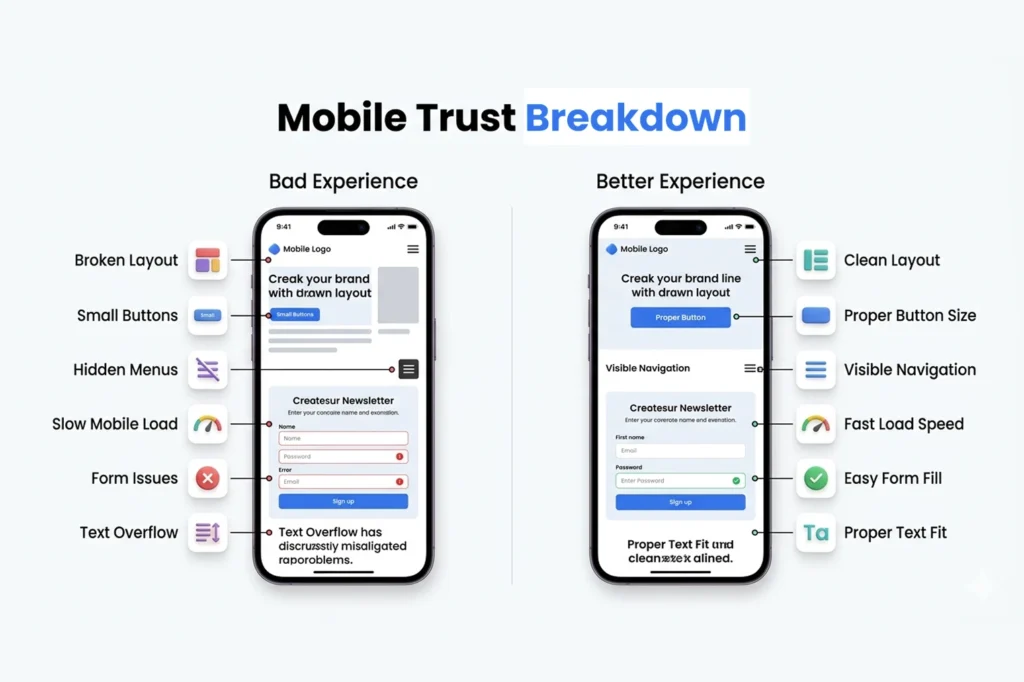
Text that spills off the screen and overlapping images create an unprofessional aesthetic for a business. Irrespective of the device, users strongly expect to have a seamless experience. Responsive website development ensures your site exactly fits on any screen size.
Increase drop-offs with touch issues and hidden content
If buttons are too small to tap or forms break on mobile screens, there is instant frustration. Small text and hidden menus cause users to abandon ship. The best web designers in chennai ensure that touch targets are sized correctly and that all content stays visible on phones.
Unclear messaging is a hidden reason users do not trust your website
At times a site may look all beautiful and be moving lightning fast yet people still bounce. The more common issue is with the fundamental messaging.
Visitors should know what you do in seconds
Ambiguous headlines confuse readers. Now, if a user comes to you homepage and in five seconds they do not know in which industry you are or what problem you solve, they are out. Your clarity has to be more prioritized than cleverness.
If your value proposition is vague, trust drops fast
Your business becomes invisible, without a distinct line between you and the competition. A good website redesign makes you think through your value proposition. So what this means is, you have to literally spell it out to your users of the path forward, step by step, step by step.
How to fix the top reasons why users don’t trust your website before they leave
This is where he can help as the knowing the problems well is not the end of the problem. So, you have to fix these friction points in order to increase your conversion rates and more importantly, build long-lasting customer relationships.
Audit trust blockers across design, speed, and UX
Conduct everything homepage trust audit Test your loading speed, mobile-friendliness, clarity of navigation, and how easy it is for users to find your contact information. Use error-free copy that speaks directly to your customers.
Prioritize fixes that improve credibility first
Instead, work on incorporating trust signals that might be missing, including testimonials and secure browsing certificates. Optimize your visual hierarchy to ensure your calls to action stand out by default. First, go through the basic friction points, before investing in scaling your traffic to paid ads or aggressive marketing.
If users do not trust your website, they will not trust your business
Ignoring the most common reasons users do not trust your site is a direct hit on your revenue. Trust in the website is not a design aspect, it is a core business quality. With site visitors who are low-funnel and ready to purchase more than other visitors, if your site looks dated, loads slowly, or doesn’t have clearly defined messaging, you are losing customers.
The good news is that all of these trust blockers are completely riadable. Building a digital space where visitors feel safe is the first step, and design consistency, speed optimization, copy clarity, and social proof can help you achieve this. Get to work on auditing your homepage, mobile journey and refining your service pages today. Creating an expert online persona is the surest way to convert hesitant visitors into life-long customers.
Frequently Asked Questions About Website Trust
1. Why do users not trust a website immediately?
Users take mere seconds to figure out and judge if they can trust you or not. Negative perceptions can arise the moment people lay eyes on the page: horrible design; lack of speed; no courtesy for clear messages, contact information; and a weak presence of security, and people will be out of there before they even read your words.
2. What makes a website look untrustworthy?
In other words, an untrustworthy site that still uses old-fashioned design with broken pages, busted grammar, invasive pop-ups, no HTTPS, crummy mobile experience, and lack of social proof (reviews, testimonial).
3. Does website speed affect trust?
Yes. Pages that take a while to load give users the impression that a site is shabby or unsecure. Slow loading times for forms, checkout pages, or service pages can cause visitors to leave before converting.
4. How can I make my website look more trustworthy?
Make clearer layouts, faster, mobile responsive, contactable, testimonials, the explanation of your services, trust signals like safe browsing, policies and professional design.
5. Can a website redesign improve trust and conversions?
Yes. Planned website redesign can eliminate the friction, provide a better first impression, support the UX, and instill a trustworthy feeling for your site, which in turn helps improve leads and sales.
6. Why do business websites lose leads even with good traffic?
Lots of sites get users but lose their trust during conversion. It isn’t any kind of trickery, weak messaging, service pages that confuse more than clarify, low UX, and no trust signals, which results in a user leaving without reaching out to your business.