Key Takeaways
- Rideshare software helps businesses streamline ride booking, driver management, dispatch, and payment operations from a single platform.
- A successful rideshare platform combines passenger apps, driver apps, GPS tracking, and an admin dashboard for efficient fleet management.
- Choosing between white-label and custom rideshare software depends on your business goals, scalability requirements, and long-term ownership plans.
- The overall development cost is influenced by features, integrations, supported platforms, security requirements, and ongoing maintenance.
- Investing in scalable rideshare software can improve operational efficiency, customer experience, and long-term business growth.
Ride-hailing has moved well past the era of hailing a cab on the street. Passengers expect an app that shows them a driver’s location in real time, a fare before they commit to the trip, and a payment that happens without touching cash. Behind that simple experience sits a fairly complex system, and it’s one that most businesses running fleets manually eventually discover they can’t scale without.
Spreadsheets and phone dispatch work when you have five drivers. At fifty, dispatchers start double-booking cars, drivers waste time idling between fares, and customers who had a bad experience just switch to whichever app got there first. That’s usually the point at which a business starts looking seriously at rideshare software.
This guide walks through what rideshare software actually is, the features that matter, what it costs to build, and how to pick a development partner that won’t leave you stuck halfway through the project. We’ll also touch on how we approach these builds, not as a sales pitch, but because the process shapes a lot of the decisions covered below. If you’re weighing whether to build a custom platform, a mobile app development company with fleet-tech experience is usually the first conversation worth having.
What Is Rideshare Software?
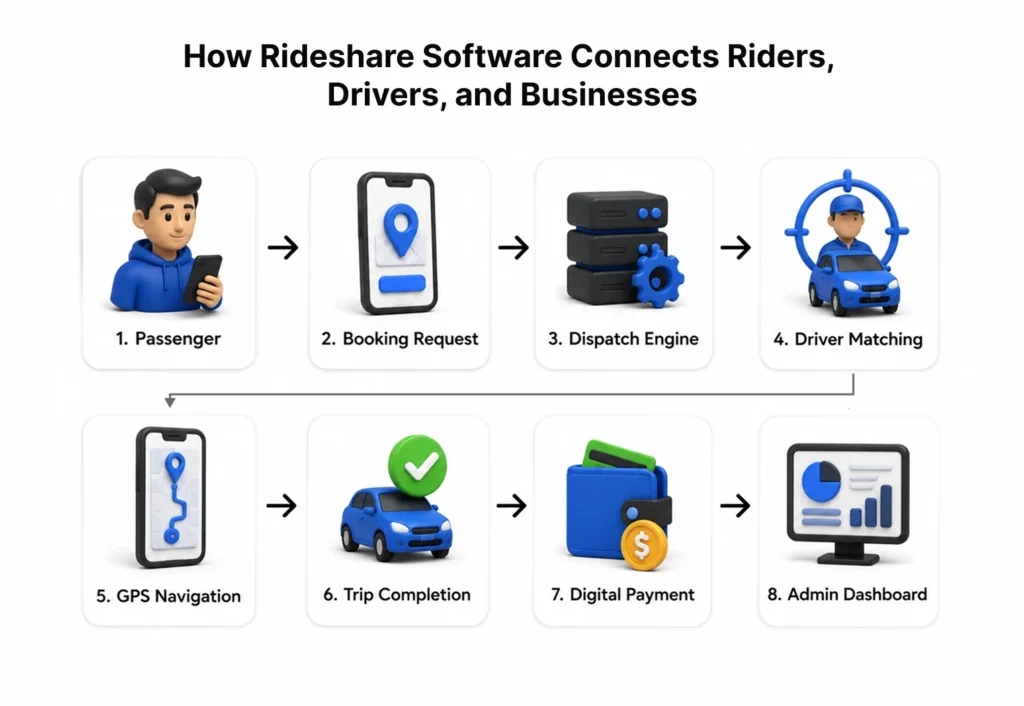
Rideshare software is the technology stack that connects passengers, drivers, and a business’s back-office operations in one system. It handles the booking, the matching, the payment, and everything a fleet manager needs to see to keep the operation running.
How It Works
A working rideshare platform is really five to six connected pieces:
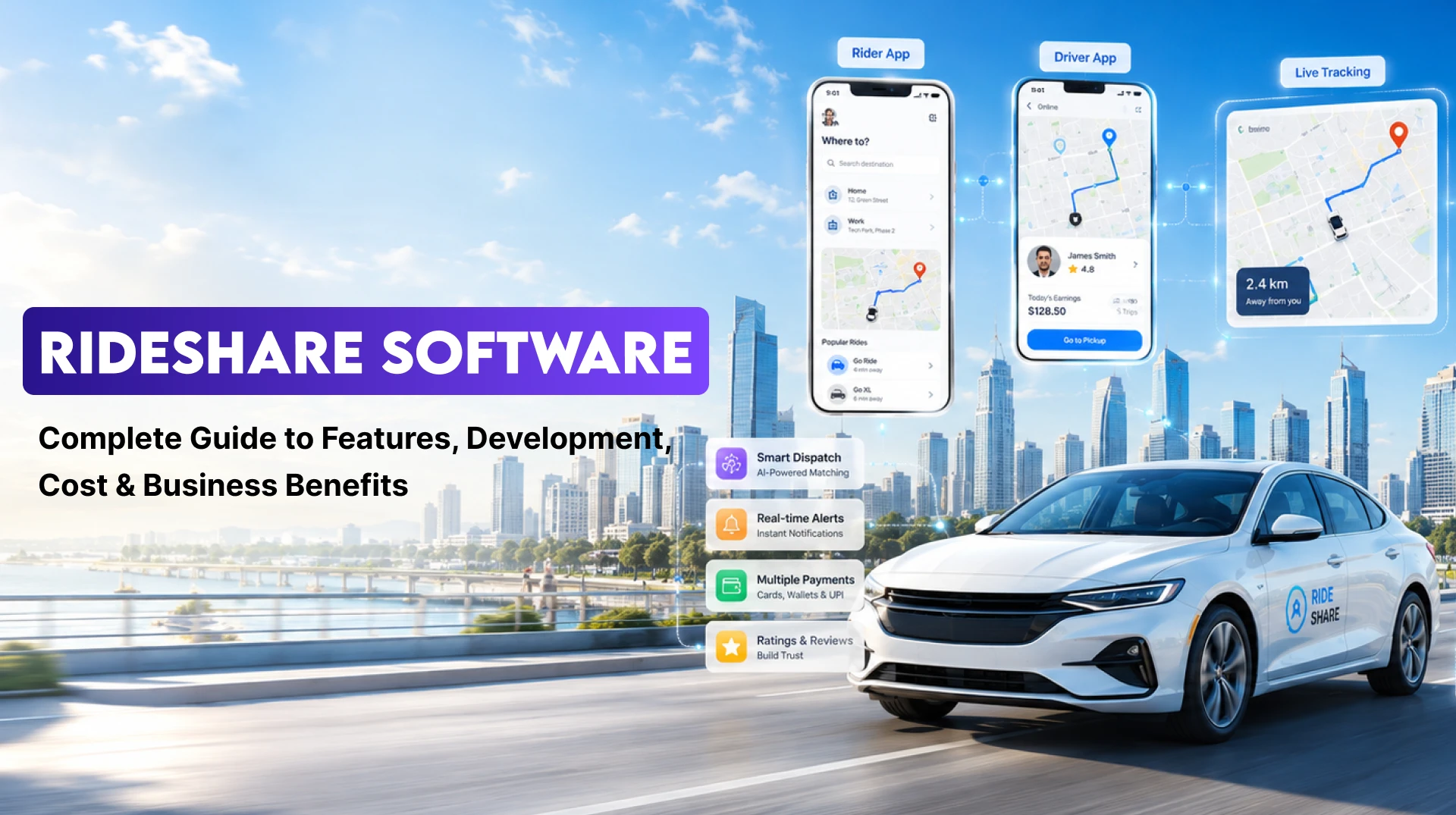
- Passenger app – where riders book, track, pay, and rate trips
- Driver app – where drivers accept rides, navigate, and manage earnings
- Admin dashboard – the control center for fleet managers and operations staff
- Dispatch system – the logic that matches riders to available drivers
- Payment gateway – handles fares, refunds, tips, and payouts
- GPS tracking – powers live location, ETAs, and route accuracy
None of these work well in isolation. A dispatch system is only as good as the GPS data feeding it, and a payment gateway that lags during peak hours will generate support tickets faster than any other part of the platform.
Businesses That Use It
Rideshare software isn’t limited to consumer taxi apps. We’ve seen demand come from:
- Taxi companies replacing legacy dispatch radios
- Corporate transport providers managing employee commutes
- Airport shuttle operators coordinating fixed routes and surge periods
- Employee transport programs run by large campuses or factories
- School transport services needing safety and tracking features
- Rental companies layering ride services on top of their existing fleet
If your business already runs vehicles and struggles with visibility into where they are or how efficiently they’re being used, custom mobile app development for dispatch and tracking tends to solve problems generic tools can’t. Some of these use cases also overlap with what a Transportation website development company would typically scope during discovery, since the web presence and the operational app usually need to be planned together. Companies overseeing routine staff transit typically adopt the same dispatching, live location monitoring, and logistics mapping features found in professional corporate mobility solutions
Essential Features Every Rideshare Software Should Include
Feature lists for rideshare apps tend to look similar on the surface. The difference between a platform that works and one that frustrates users is usually in the execution, not the checklist. Still, the checklist is a reasonable starting point.
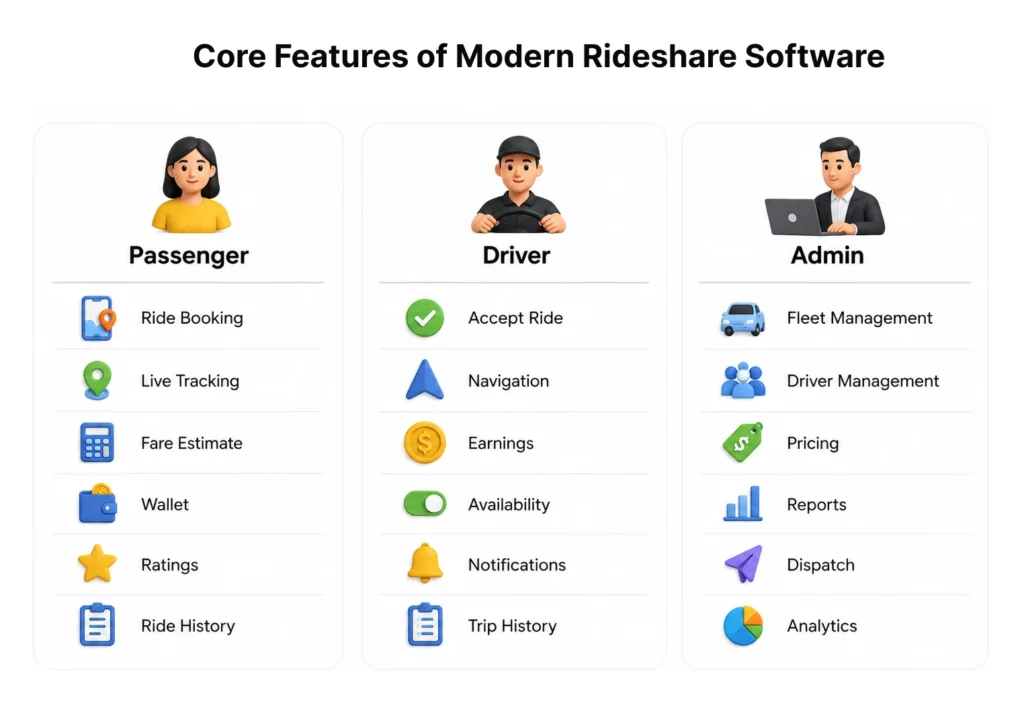
Customer Features
- Booking (instant and scheduled)
- Live tracking of the assigned driver
- Fare estimation before confirming a ride
- In-app wallet for faster checkout
- Ride history for repeat bookings and receipts
- Ratings and feedback after each trip
Business & Driver Features
- Driver onboarding with document verification
- Fleet management for vehicle assignment and maintenance tracking
- Dispatch panel for manual overrides when automation isn’t enough
- Route optimization to cut fuel cost and trip time
- Reports covering revenue, driver performance, and utilization
- Pricing management, including surge rules and fixed-rate zones
Fare estimation and live tracking get the most attention because riders see them directly, but reports and pricing management are usually what determine whether the business is actually profitable. A platform with beautiful tracking and no usable reporting will still leave a fleet manager guessing at month-end. Fleet operators managing high vehicle throughput often benefit from reviewing logistics tracking software features alongside rideshare-specific needs, and pairing that with cloud-build application keeps the system responsive as demand grows.
Business Benefits of Investing in Rideshare Software
Operational Benefits
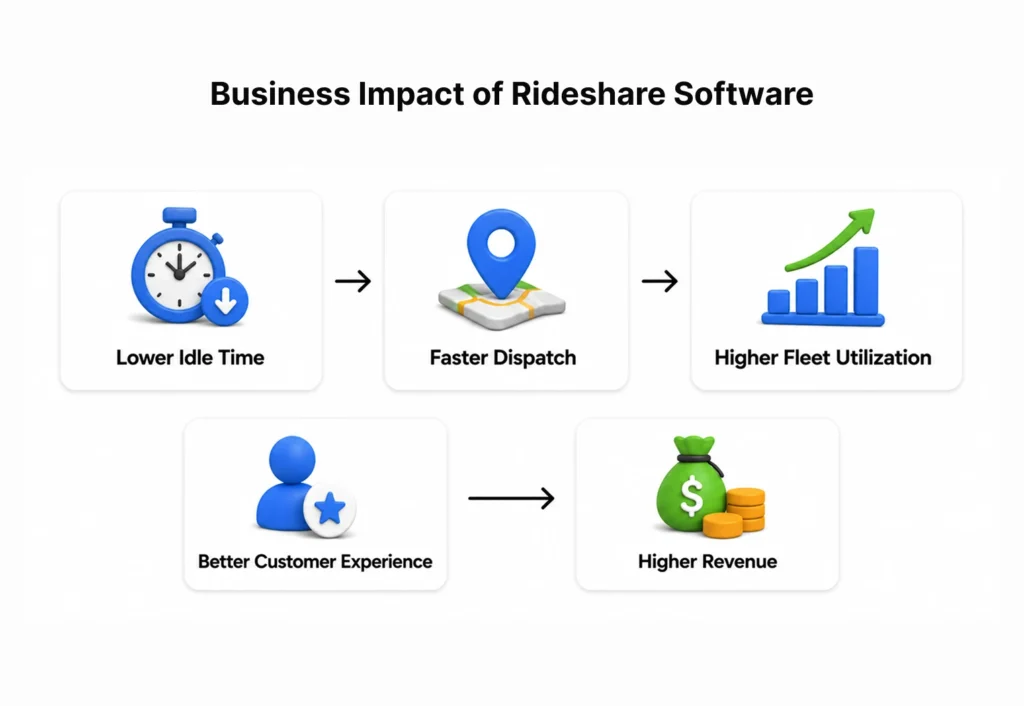
Better dispatch reduces the guesswork that comes with manual coordination. When the system automatically matches the nearest available driver, idle time drops, and idle vehicles are, in effect, sunk cost sitting in traffic. Higher utilization follows naturally, and customers stick around when their trips are consistently on time.
Revenue Benefits
Dynamic pricing lets a business respond to demand spikes without a human manually adjusting rates. Subscription models create predictable revenue from repeat riders or corporate accounts. Commission-based models work well for platforms connecting independent drivers to riders. Business analytics ties it together, showing which routes, times, or driver segments actually generate margin.
None of these revenue levers matter much without the operational foundation in place first, since a business analytics dashboard is only useful if the underlying dispatch and tracking data feeding it is accurate. Businesses scaling this kind of system often end up evaluating it against a broader enterprise saas platform strategy, particularly once they’re managing more than one city or service line.
Types of Rideshare Software Solutions
There are really two paths here, and the right one depends on how much control your business needs.
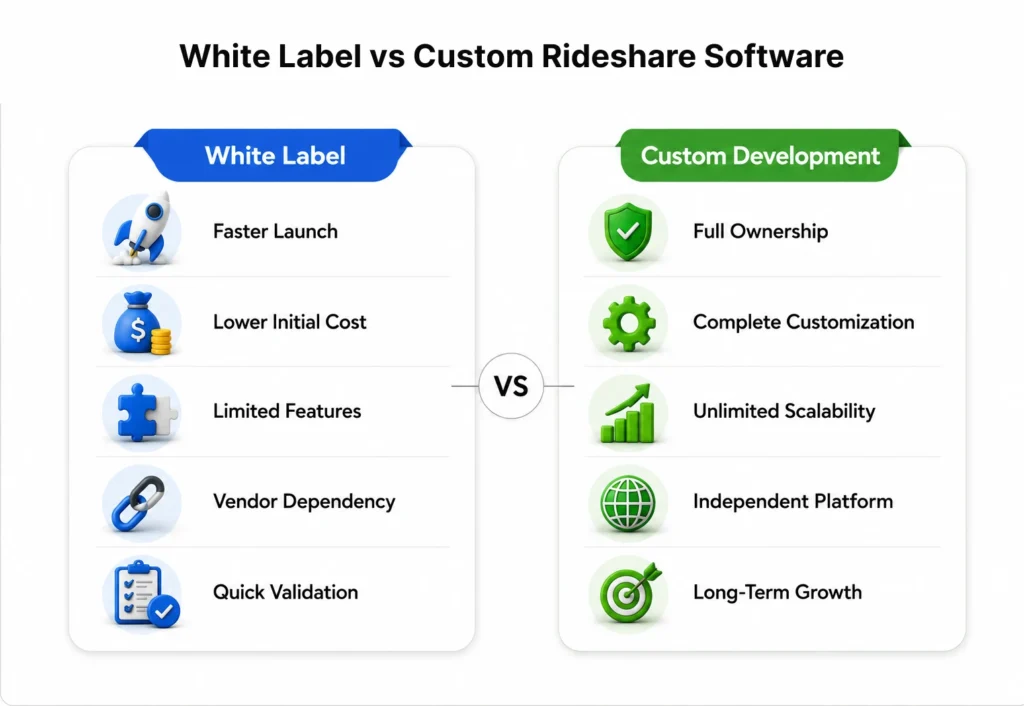
White Label Solutions
Pros: Faster to launch, lower upfront cost, proven core functionality.
Cons: Limited customization, ongoing licensing fees, and you’re often sharing infrastructure decisions with the vendor’s roadmap rather than your own.
Best use cases: Businesses testing a new market or service line before committing to a long-term build, or smaller operators who don’t need deep customization.
Custom Development
Pros: Full control over features, branding, and integrations; the platform grows with the business rather than around a vendor’s limitations.
Cons: Higher upfront investment and a longer initial timeline.
Scalability: Custom builds handle growth better because the architecture is designed around your actual usage patterns, not a generic template.
Ownership: You own the codebase outright, with no dependency on a third-party’s continued existence or pricing changes.
Maintenance: Requires an ongoing relationship with a development team, which is worth factoring into cost planning from day one.
In our experience, white label makes sense for validating an idea quickly. Once a business has proof that demand exists, though, the licensing fees and feature ceiling of white label solutions tend to become the bottleneck. Businesses wanting an early market test sometimes start with building MVP mobile apps before committing to a full custom platform. Custom-built platforms often bridge the gap into neighboring mobility services like vehicle rentals, enabling a business to scale past simple ride-hailing through integrated booking engines, real-time fleet visibility, and streamlined management tools. For companies branching into this area, looking at self-drive car rental platforms provides a clear blueprint for delivering a modern, digital-first rental experience.
Rideshare Software Development Process
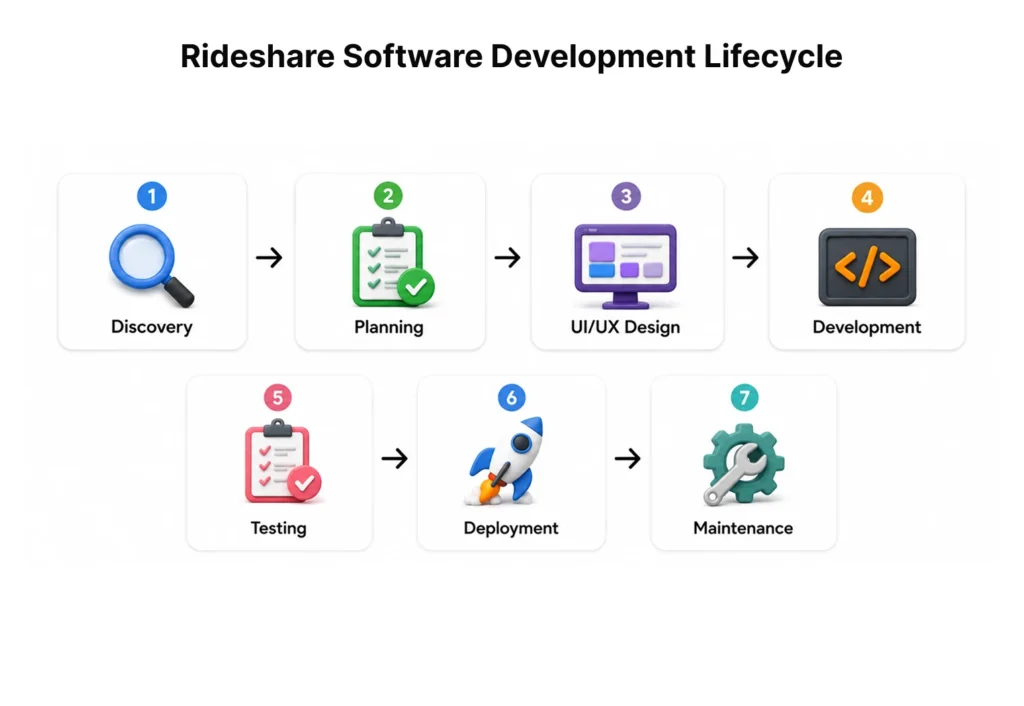
Planning Phase
This stage decides most of what happens later. It typically covers market research (who are the actual competitors in your operating city), defining user roles (rider, driver, dispatcher, admin, and sometimes a fleet-owner role if drivers don’t own their vehicles), settling on a business model (commission, subscription, or hybrid), and choosing a technology stack that can support real-time location updates at scale.
Development & Launch
UI/UX design comes first, since dispatch-heavy apps live or die on how quickly a driver can accept a ride without fumbling through screens. Backend development and API integrations (maps, payment gateways, SMS/notification services) happen in parallel tracks. Testing needs to include load testing specifically, because a rideshare app that works fine with ten test users can fall over during a Friday evening surge. Deployment and ongoing maintenance close the loop, and maintenance is where a lot of businesses underestimate the long-term commitment.
Startups approaching this for the first time often benefit from reading through mobile app development for startups guidance before locking in scope, since scope creep here gets expensive quickly. The app development lifecycle explained in a fleet-tech context looks a little different from a typical consumer app lifecycle, mainly because of the real-time and safety-critical components.
How Much Does Rideshare Software Development Cost?
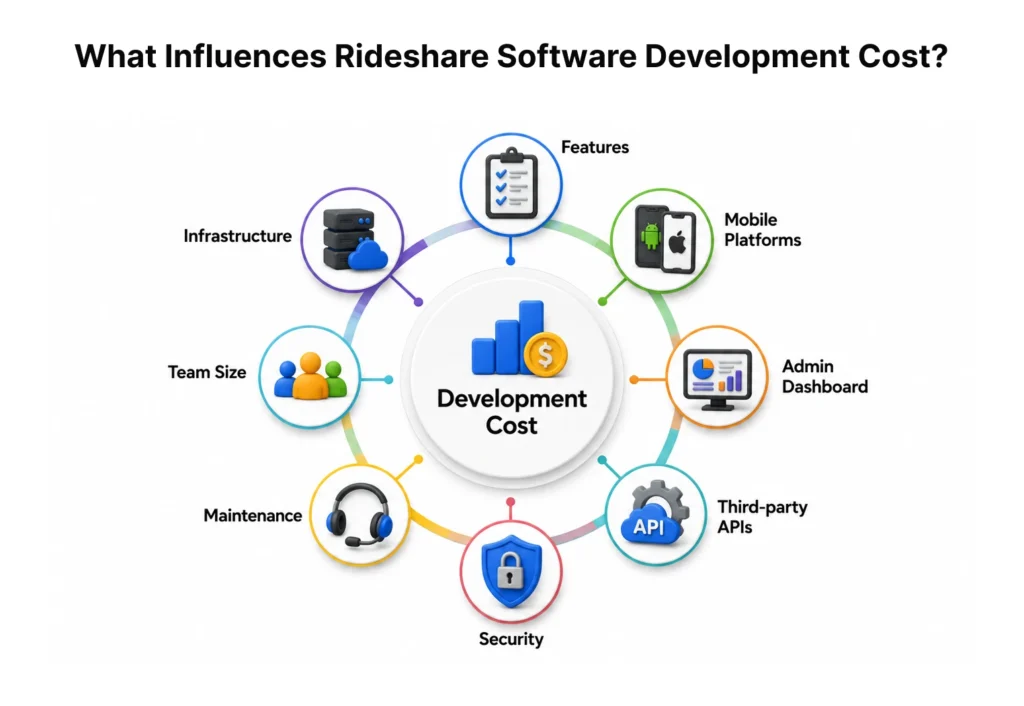
Cost Factors
- Number and complexity of features
- Number of platforms (iOS, Android, web admin panel)
- Third-party integrations (payment gateways, mapping APIs, SMS providers)
- Team size and location
- Security requirements, especially around payment data
- Ongoing maintenance and support commitments
Typical Pricing Models
Costs vary a lot by scope, but as a rough guide:
- MVP: A functional but limited version, enough to test the model with real drivers and riders in one city.
- Mid-size platform: Adds features like dynamic pricing, richer analytics, and multi-city support.
- Enterprise solution: Built for scale, meaning multiple service lines, deep integrations, and dedicated infrastructure.
We’d rather not throw out a fixed number here without knowing your specific scope, since a single-city MVP and a five-city enterprise platform aren’t remotely comparable projects. A conversation about fleet management software development cost alongside your feature list usually gives a more honest estimate than a generic price range would. If budget is the main constraint early on, developing mobile apps first is generally the more defensible approach.
Common Challenges While Building Rideshare Software
Technical Challenges
Real-time GPS accuracy is harder than it sounds, particularly in dense urban areas with tall buildings interfering with signal. Payment failures during high-traffic periods can quietly damage trust if not handled with proper retry logic. Scalability issues tend to surface exactly when you don’t want them to, meaning during peak demand, when the system needs to handle a spike in concurrent ride requests without slowing down.
Business Challenges
Driver acquisition is often harder than building the software itself; a platform with no drivers on it is just an app. Regulatory requirements differ by city and country, and ignoring them early is a common reason launches get delayed. Customer retention requires more than a working app, since it requires consistent service quality as well. Pricing competition from established players can squeeze margins if the business model isn’t differentiated somehow.
None of these challenges are unique to first-time builders, but they’re easier to plan around if a cloud-based app development approach is factored in from the start, giving the platform room to absorb demand spikes without a full re-architecture.
How to Choose the Right Rideshare Software Development Partner
A checklist worth running through before signing anything:
- Industry experience – Have they built dispatch-heavy, real-time systems before, or is this their first attempt?
- Security practices – How do they handle payment data and rider/driver personal information?
- Scalability approach – Can the architecture handle 10x growth without a rebuild?
- Support after launch – What does the maintenance relationship actually look like once the app is live?
- Customization depth – Are you getting a templated white-label rebrand or genuinely custom development?
- Technology expertise – Do they have real depth in the specific stack your project needs, not just a general claim of “full-stack capability”?
Asking for examples of similar projects, and talking directly to the engineers (not just the sales team), usually reveals more than a portfolio page does.
Future Trends in Rideshare Software
The rideshare space keeps shifting, and a few trends are worth planning around rather than reacting to later:
- EV fleets are becoming standard in several markets, which changes how routing and charging logistics get handled in software.
- Multi-service mobility, meaning combining rides, deliveries, and rentals on one platform, is increasingly common rather than the exception.
- Shared transportation models are gaining traction in cost-sensitive markets.
- Connected vehicles are starting to feed telematics data directly into fleet software, improving maintenance prediction.
- Sustainability reporting is becoming a genuine business requirement in some regions, not just a marketing angle.
- Subscription mobility is reshaping how riders pay, moving away from strictly pay-per-ride models.
Businesses building now don’t need to implement all of these on day one, but architecting the platform so these additions don’t require a rebuild later is a decision worth making upfront.

Conclusion
Rideshare software isn’t a single product. Rather, it’s a connected system of apps, dispatch logic, payments, and reporting that has to work reliably under real-world pressure. The right approach depends heavily on your stage: white label to test an idea, custom development once you know the model works, and a clear plan for cost, compliance, and scale either way.
If you’re evaluating whether to build custom or go white label, or you’re past that decision and need a development partner who’s actually built dispatch-heavy systems before, that’s a conversation worth having early, before the scope and budget get locked in by a template that doesn’t fit your business.
FAQ
1. What is rideshare software?
Rideshare software is the technology platform connecting passengers, drivers, and business operations, typically including a passenger app, driver app, admin dashboard, dispatch engine, GPS tracking, and payment processing.
2. How does rideshare software work?
It matches riders to available drivers using real-time location data, calculates fares, processes payments, and gives fleet managers visibility into operations through an admin dashboard.
3. What features should rideshare software have?
At minimum: booking, live tracking, fare estimation, an in-app wallet, ride history, ratings, driver onboarding, fleet management, dispatch tools, route optimization, reporting, and pricing controls.
4. How much does rideshare software development cost?
Cost depends on features, platforms, integrations, and team structure. An MVP costs considerably less than a multi-city enterprise platform, so getting an accurate figure requires scoping your specific requirements.
5. What industries use rideshare software?
Taxi companies, corporate transport providers, airport shuttles, employee transport programs, school transport services, and rental companies with fleet operations.
6. What is the difference between rideshare software and taxi dispatch software?
Taxi dispatch software is generally narrower, focused mainly on matching and dispatching cabs. Rideshare software often includes broader features like dynamic pricing, multi-service support, and rider-facing apps built for a consumer marketplace model.
7. Can rideshare software support multiple cities?
Yes, though it requires planning for city-specific pricing, regulatory compliance, and localized dispatch logic from the architecture stage, since retrofitting multi-city support later is more expensive than building for it upfront.
8. How long does it take to build rideshare software?
An MVP can typically launch in a few months; a full-featured, multi-city platform with deep integrations takes considerably longer. Timeline depends heavily on scope and team size.