Key Takeaways
- These 10 reasons why businesses need mobile apps show how apps improve retention, engagement, and long-term growth.
- Mobile apps offer faster user experiences, direct communication, and stronger brand visibility.
- Businesses with frequent transactions often gain more value from apps than websites alone.
- Mobile apps can support sales growth, loyalty programs, and operational efficiency.
- A well-planned app can become a long-term digital asset with measurable ROI.
Customer acquisition costs are rising across almost every industry. Companies often struggle with low repeat purchase rates, limited direct engagement, and an overdependence on social media platforms to reach their own audiences. When algorithm updates reduce your visibility, relying entirely on external networks becomes a massive vulnerability.
Instead of viewing mobile applications as just another tech trend, leadership teams must recognize them as fundamental business growth tools. A dedicated application shifts your brand from fighting for attention in crowded feeds to sitting securely on a user’s home screen. Exploring 10 reasons why businesses need mobile apps reveals exactly how companies can take back control of the customer relationship.
By applying our approach to digital strategy early on, organizations can build assets that genuinely serve their users. Partnering with a skilled Mobile App Development Company ensures the resulting software aligns with concrete revenue goals. Ultimately, leaning into mobile apps digital transformation helps solve those core business problems by prioritizing direct communication and long-term retention.
Why Businesses Are Prioritizing Mobile Apps Over Traditional Digital Channels
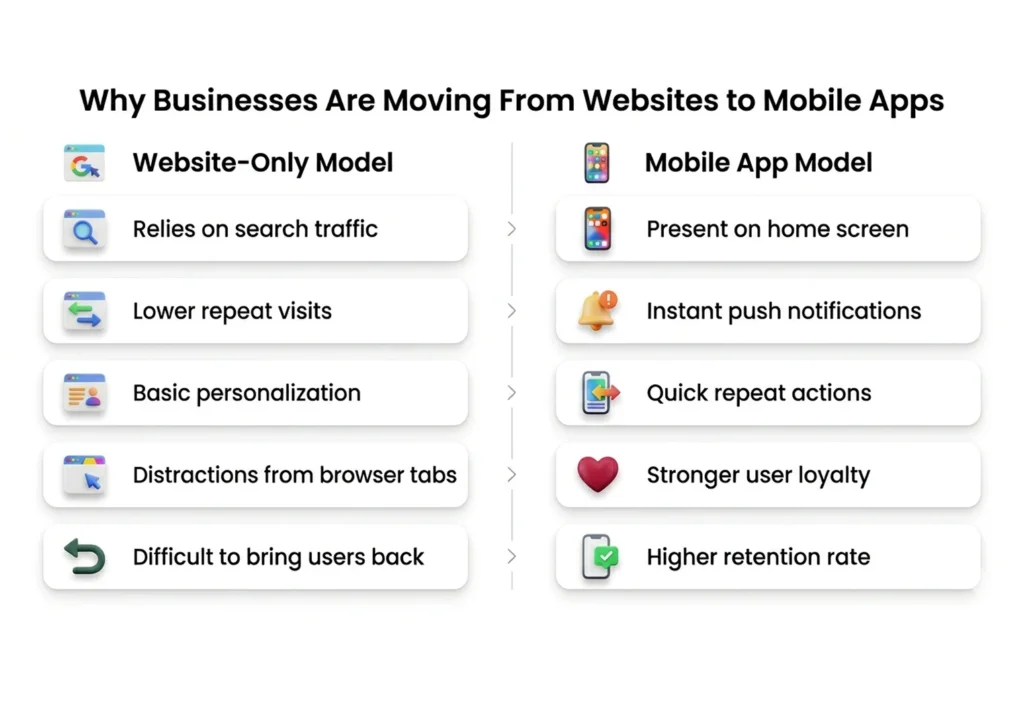
Customer behavior has fundamentally shifted toward app-first experiences. People spend hours every day interacting with the software installed directly on their devices, bypassing traditional browsers entirely. This environment yields much higher retention rates than website-only models. Brands gain a direct communication advantage, establishing stronger ownership of the entire customer journey from discovery to post-purchase support.
Mobile App vs Website: What Has Changed for Modern Businesses
Mobile websites remain essential for initial discovery. When someone searches for a solution online, your responsive site acts as the front door. However, relying solely on web traffic makes it difficult to keep users engaged over time. Investing in custom mobile app development changes the dynamic completely. It allows you to build a dedicated environment optimized for returning customers. Understanding the Benefits of hiring a mobile app development company early in your strategy phase helps bridge this gap between simple web presence and high-retention mobile software.
10 Reasons Why Businesses Need Mobile Apps for Growth, Retention, and Revenue
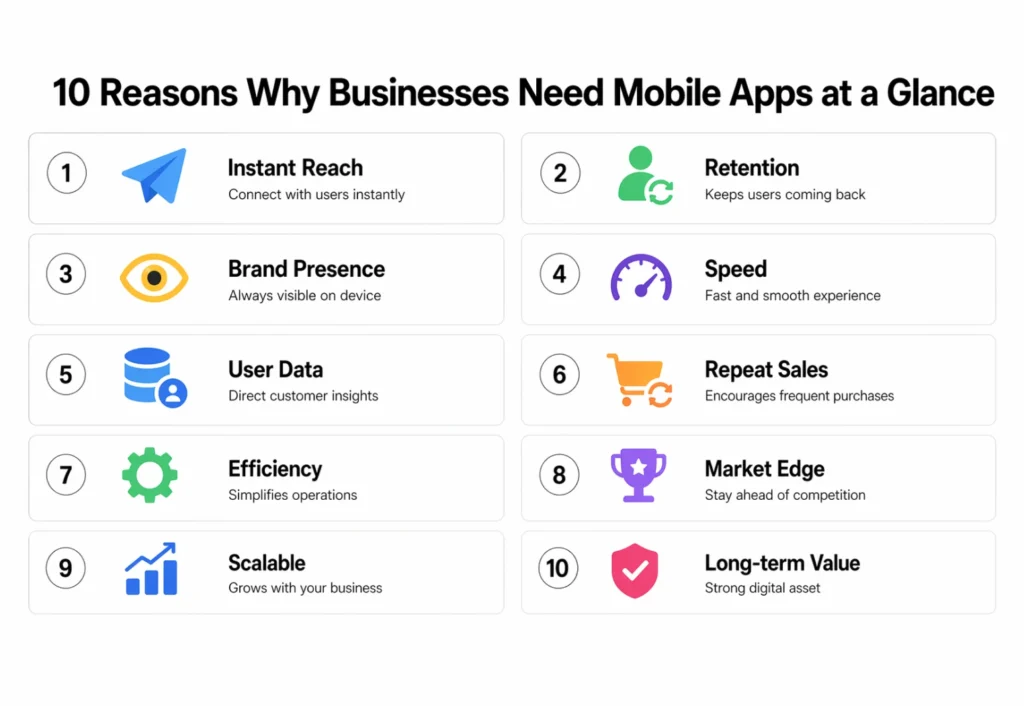
If you want to understand the shift in digital strategy, you have to look at the tangible benefits. Here are 10 reasons why businesses need mobile apps to thrive in the current market.
Why Mobile Apps Give Businesses a Direct Communication Channel
Email open rates often hover in the low twenties, and social media reach is heavily throttled. Applications solve this through push notifications. You can send updates, special offers, reminders, and appointment nudges straight to a user’s lock screen. Working with experienced mobile app development companies ensures these notification systems are built respectfully, keeping users informed without causing annoyance.
How Mobile Apps Improve Customer Retention and Loyalty
Repeat customers drive profitability. An application provides the perfect container for loyalty rewards, repeat ordering systems, and personalized offers. By saving user preferences securely, you remove friction from future transactions. Exploring Mobile App Development for Startups often reveals that building a loyalty-first mobile experience is the fastest way to stabilize early revenue.
Why Businesses Gain Better Brand Visibility With Mobile Apps
An installed application places your logo on a screen your customer looks at dozens of times a day. This home screen presence builds subconscious brand recall. When the user eventually needs your product or service, re-engagement happens almost instantly. Partnering with the best mobile app company ensures your icon and interface look premium, securing that valuable digital real estate.
How Mobile Apps Create a Faster and More Convenient User Experience
Browsers require users to type URLs, wait for page loads, and navigate complex menus. Native software bypasses this. Customers experience fewer clicks, quicker load times, simpler checkout processes, and highly intuitive navigation. Applying practical mobile app UI/UX design tips makes the journey seamless. Furthermore, dedicated mobile app performance optimization guarantees the software responds instantly to user inputs.
Why Mobile Apps Help Businesses Collect Valuable First-Party Data
Third-party cookies are disappearing, making owned data incredibly valuable. Applications allow you to track behavior insights, specific preferences, and usage patterns directly. This provides rich personalization opportunities. Learning how to choose mobile app development company partners who understand data compliance and secure architecture is critical for maximizing this benefit safely.
How Mobile Apps Increase Sales Through Personalization and Repeat Purchases
Sales naturally increase when you remove buying friction. Apps allow for saved shopping carts, highly targeted offers, and one-click reorder flows. You can also trigger perfectly timed in-app upsells based on browsing history. Working with a top mobile app development company in India can provide the technical capability to build these advanced ecommerce features cost-effectively.
Why Business Mobile Apps Streamline Operations and Workflows
Applications do not just serve external buyers. They can revolutionize internal workflows, support ticketing systems, booking calendars, and field team management. Connecting these tools via Cloud-based app development ensures your data syncs across the whole organization in real time. Having the App development lifecycle explained to your operations team will clarify how these internal tools can be continuously improved.
How Mobile Apps Give Businesses a Competitive Edge
When multiple vendors offer similar services, convenience wins the contract. Offering a seamless mobile experience creates a premium perception of your brand. It gives you a clear differentiation point.
Why Mobile Apps Support Scalable Business Growth
A successful platform grows alongside the company. You can launch with core features and add new modules later. This might include community marketplaces, advanced analytics, or automated loyalty tiers. Reading about Building MVP Mobile Apps shows how businesses can launch a minimal version first, then scale the architecture as user demand dictates.
How a Well-Built Mobile App Becomes a Long-Term Business Asset
Software you own is an appreciating asset. You own the audience, you own the data, and you drastically reduce your dependency on third-party platforms. The long-term ROI easily justifies the initial app development cost, as the software continuously drives repeat business and shields you from sudden market shifts.
Do Businesses Need Mobile Apps If They Already Have a Website?
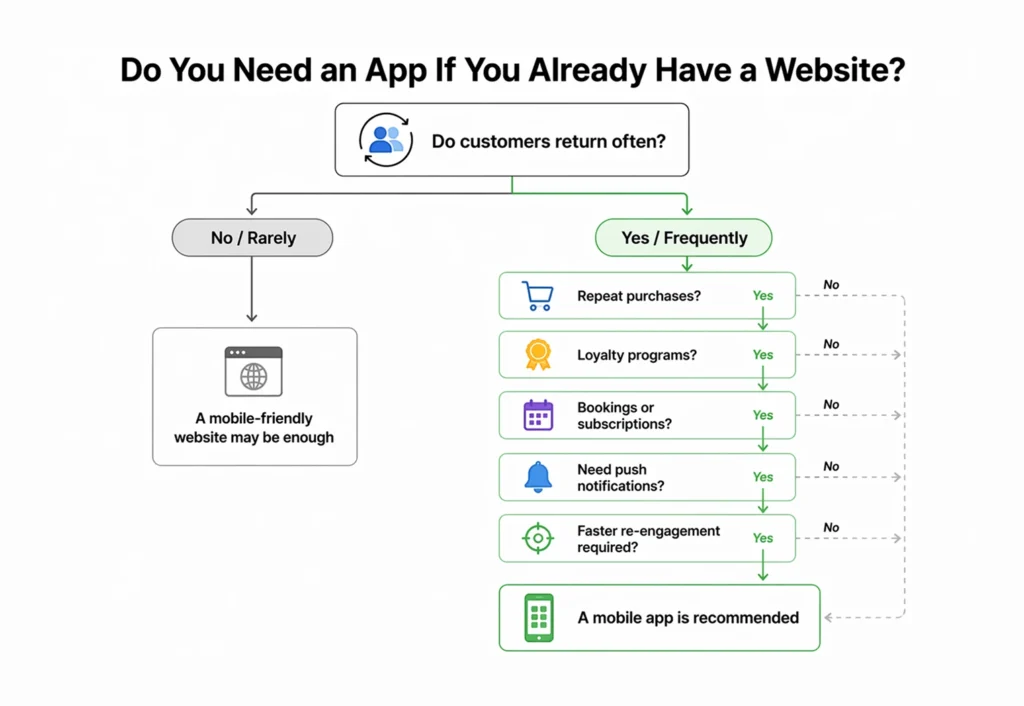
Many leaders wonder if maintaining two distinct digital properties makes financial sense. The answer depends heavily on your business model and engagement frequency.
When a Mobile-Friendly Website Is Enough
Early-stage businesses still in the validation phase should stick to responsive websites. For example, if your model relies on low repeat use, such as selling large one-off purchases, an app will likely struggle to gain traction. In that case, companies operating with a strictly limited budget should prioritize optimizing their mobile web traffic before expanding into native software.
When a Dedicated Mobile App Makes More Business Sense
If your business thrives on repeat transactions, loyalty programs, or frequent bookings, native software is highly recommended. Service businesses, dynamic ecommerce brands, and community platforms require frequent engagement. A website simply cannot match the speed and convenience required for these interactions.
What Types of Businesses Need Mobile Apps the Most?
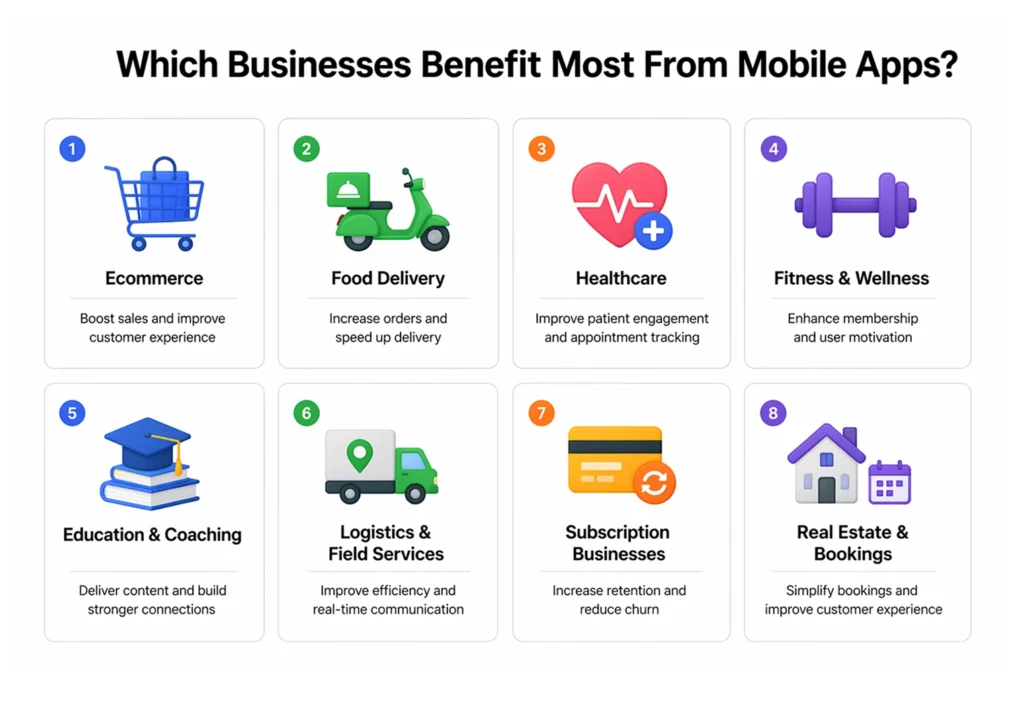
Certain industries naturally align with mobile-first customer habits. Ecommerce businesses see massive cart abandonment reductions with native checkouts. Restaurants and food delivery services rely heavily on location-based nudges and saved payment details. Healthcare and wellness brands use them for secure patient portals and daily habit tracking.
Additionally, education and coaching businesses deliver video content much more smoothly via native video players. Logistics and field service companies require offline capabilities for rural routes. Startups building recurring engagement models, subscription-based businesses, and real estate services also see significant operational improvements.
Signs Your Business Is Ready for a Mobile App
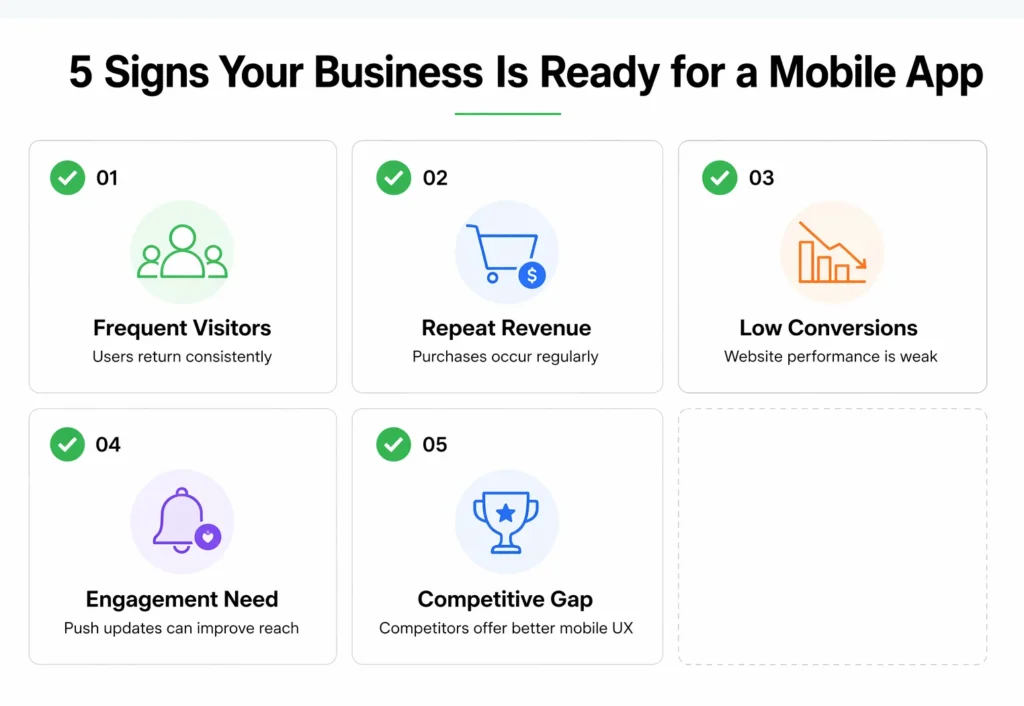
You know it is time to upgrade when customers return often for repeated transactions. If you manage complex bookings, need to send urgent service updates, or heavily prioritize brand loyalty, you fit the profile.
How Much Does It Cost to Build a Business Mobile App?
Budgeting requires understanding the scope of your project. A basic application costs significantly less than a complex, enterprise-grade system. Cost drivers include the total number of features, the platforms you target (iOS, Android, or both), and the depth of the UI/UX design. Backend complexity, thorough testing phases, and post-launch maintenance also heavily influence the final number. Rather than viewing this strictly as a build price, frame the expenditure around expected ROI from increased customer lifetime value.
What Actually Impacts Mobile App Development Cost
Specific technical requirements dictate the budget. Complex user roles, a custom admin panel, and multiple third-party APIs add development hours.
How to Decide Whether Your Business Should Invest in a Mobile App Now
Moving forward requires honest internal assessment. Ask your team if customers engage repeatedly. Determine if faster access to your catalog would improve conversion rates. Evaluate whether loyalty programs or subscription models matter to your upcoming quarterly goals. Consider if operational workflows can be simplified, and ask if securing owned customer data aligns with your strategic vision.
A Simple Decision Checklist for Business Owners
- Do customers return weekly or monthly?
- Do you need push-based engagement to trigger sales?
- Are mobile website conversions currently underperforming?
- Do competitors offer smoother mobile journeys?
- Would launching a minimum viable product help validate market demand?

Conclusion: Why Mobile Apps Are Becoming a Smart Business Investment
Reviewing the 10 reasons why businesses need mobile apps clearly demonstrates their value in the modern marketplace. Native software is certainly not mandatory for every single business model. However, for organizations prioritizing repeat engagement, customer retention, maximum convenience, and scalable growth, they are incredibly powerful digital assets.
Leadership teams should evaluate current customer behavior, identify repeat use cases, and calculate long-term ROI. If you are uncertain about a massive build, adopting an MVP-first approach minimizes risk while validating demand. Whether you need strategic consulting or a complete technical roadmap, reaching out to a reputable Mobile App Development firm will clarify your next steps. Choosing the right mobile app partnerensures your investment transforms casual buyers into highly engaged, long-term brand advocates.
FAQs About Why Businesses Need Mobile Apps
To fully grasp the 10 reasons why businesses need mobile apps, we have compiled answers to the most common questions leaders ask during the planning phase.
1. Why would a business need a mobile app?
Companies need them to increase direct engagement, improve retention, and create a frictionless purchasing environment. They remove the distractions found on web browsers and secure a permanent place on the user’s device.
2. Do I need a mobile app if I already have a website?
Yes, if your business relies on repeat customers. Websites are great for initial discovery and capturing search traffic, but native software is vastly superior for retaining users and driving recurring revenue.
3. What are the benefits of a mobile app for small businesses?
Small businesses gain increased brand visibility, a direct marketing channel via push notifications, and the ability to run highly effective digital loyalty programs that encourage local repeat visits. Working with a [mobile app development company in India] can often make this accessible for smaller budgets.
4. How can a mobile app increase customer loyalty?
They increase loyalty by removing buying friction. Features like saved payment methods, personalized recommendations based on past behavior, and points-based reward systems naturally encourage users to return.
5. How much does it cost to build a business mobile app?
Costs range widely based on complexity, platform choice, and integrations. A simple build might start around $15,000, while complex enterprise platforms can exceed $100,000.
6. What types of businesses need mobile apps the most?
Ecommerce, food delivery, healthcare, fitness, and service-based businesses see the highest ROI. Any company that relies on frequent, repeat interactions benefits immensely from native software.
7. Is a mobile app better than a mobile-friendly website?
It is better for retention and user experience. Websites win for initial search engine discovery, but native software provides faster load times, offline capabilities, and direct notification access. Consulting with [mobile app development companies] can help clarify which suits your current phase.
8. What features should a business mobile app include?
Essential features include secure user authentication, push notifications, intuitive navigation, quick checkout or booking flows, and a dedicated customer support portal.