Key takeaways
- The role of AI in mobile apps is driving smarter, more personalized user experiences across industries.
- Features like predictive search, recommendations, and in-app support improve engagement and retention.
- Businesses use intelligent capabilities in ecommerce, fintech, healthcare, and logistics to solve real problems.
- Choosing between on-device and cloud processing depends on speed, privacy, and scalability needs.
- Starting with focused features and a clear strategy helps control costs and deliver measurable results.
Mobile app users today expect smarter, faster, and more relevant experiences. Businesses face immense pressure to keep users engaged. High retention, strong conversion rates, and lower support costs are no longer achieved through good design alone. This new landscape is exactly where the role of ai in mobile apps becomes commercially important.
Organizations now compete heavily on personalization, smart recommendations, and predictive capabilities. A static interface simply cannot keep up with user demands for tailored content. The role of ai in mobile apps solves these challenges by turning raw data into meaningful interactions.
As part of our development process, we see firsthand how intelligent features directly influence customer lifetime value. If you want to succeed in a competitive digital market, partnering with a Mobile App Development Company can help you navigate this transition effectively.
Why the Role of AI in Mobile Apps Matters for Modern Businesses
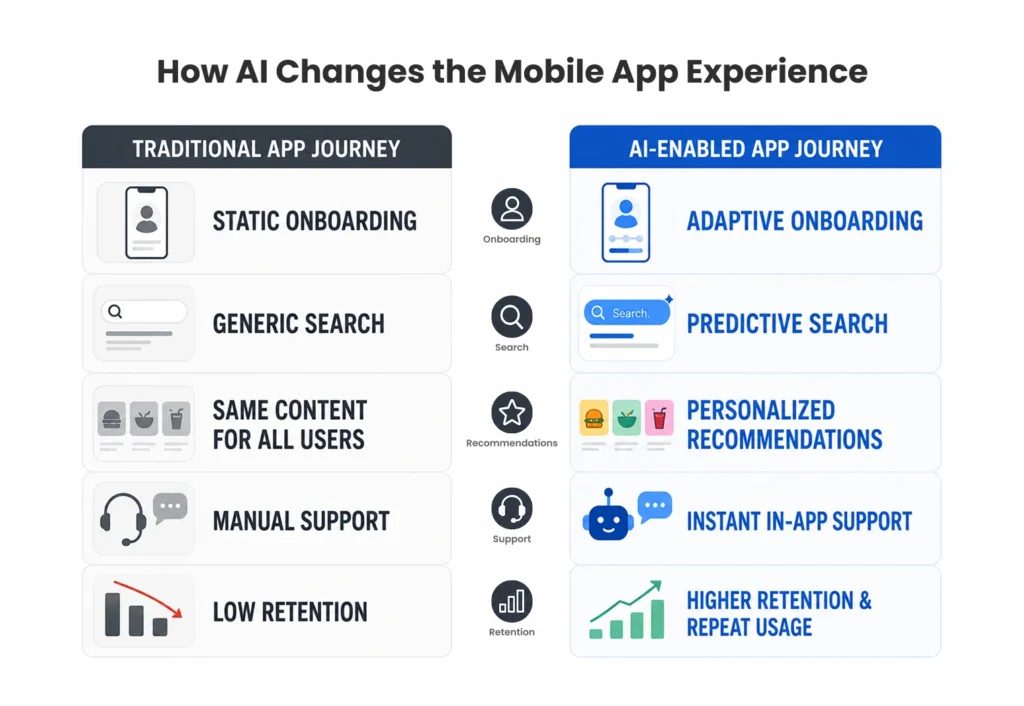
Mobile applications have shifted from static tools to adaptive, dynamic environments. Users do not want to search for answers manually. They expect personalized feeds, highly relevant search results, and instantaneous support.
How user expectations have changed in mobile apps
Adding intelligent functionality improves retention and reduces customer churn. When an application learns user preferences, session depth naturally increases. This is a critical driver for revenue in ecommerce, healthcare, fintech, and software-as-a-service platforms.
Businesses undergoing a mobile apps digital transformation must understand this shift. Working with a mobile app development company in India can provide the necessary technical foundation to build these adaptive capabilities.
Core Features That Show the Role of AI in Mobile Apps
Personalization and recommendation engines
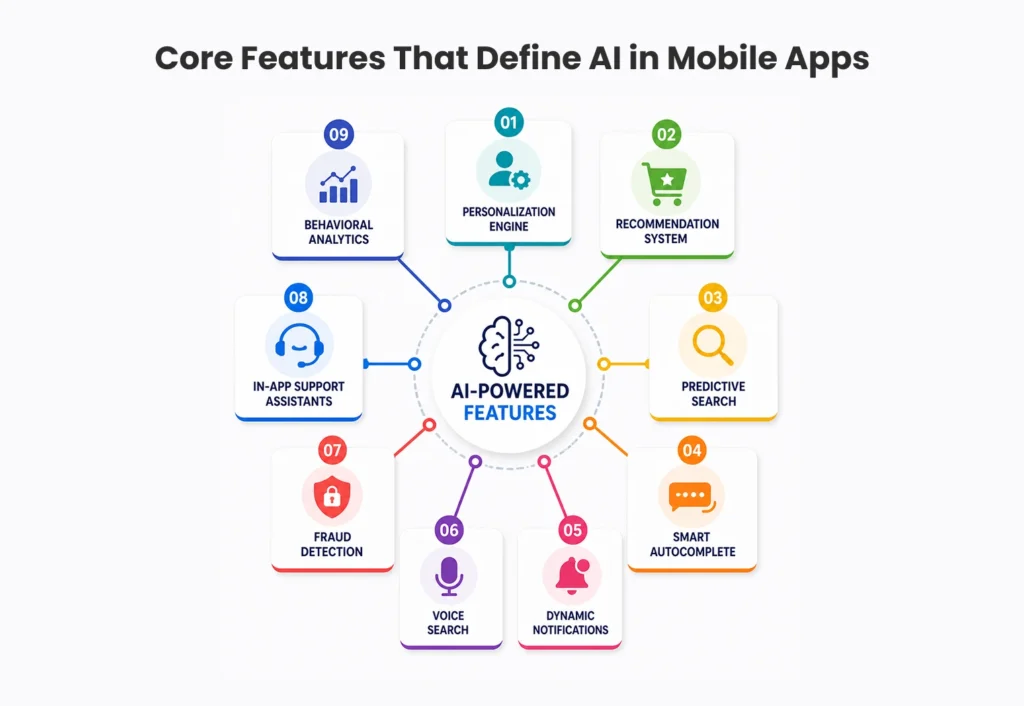
Intelligent features operate quietly in the background to streamline user interactions. Personalization and recommendation engines are some of the most visible examples. These systems analyze behavior to suggest the right products or content at the exact right moment.
Predictive search and smart notifications
Predictive search and smart autocomplete functions save users time. Dynamic push notifications determine the best time of day to alert a user. Voice search and contextual suggestions provide hands-free accessibility.
In-app support, voice search, and behavior analysis
Under the surface, fraud detection algorithms and anomaly alerts protect user accounts. Support assistants answer common queries instantly, while behavioral analysis maps out complex user journeys. If you are exploring mobile app development services, focusing on these specific features will elevate your product. Implementing custom mobile app development ensures these capabilities align perfectly with your business goals.
Top Business Use Cases That Define the Role of AI in Mobile Apps
Ecommerce and retail app use cases
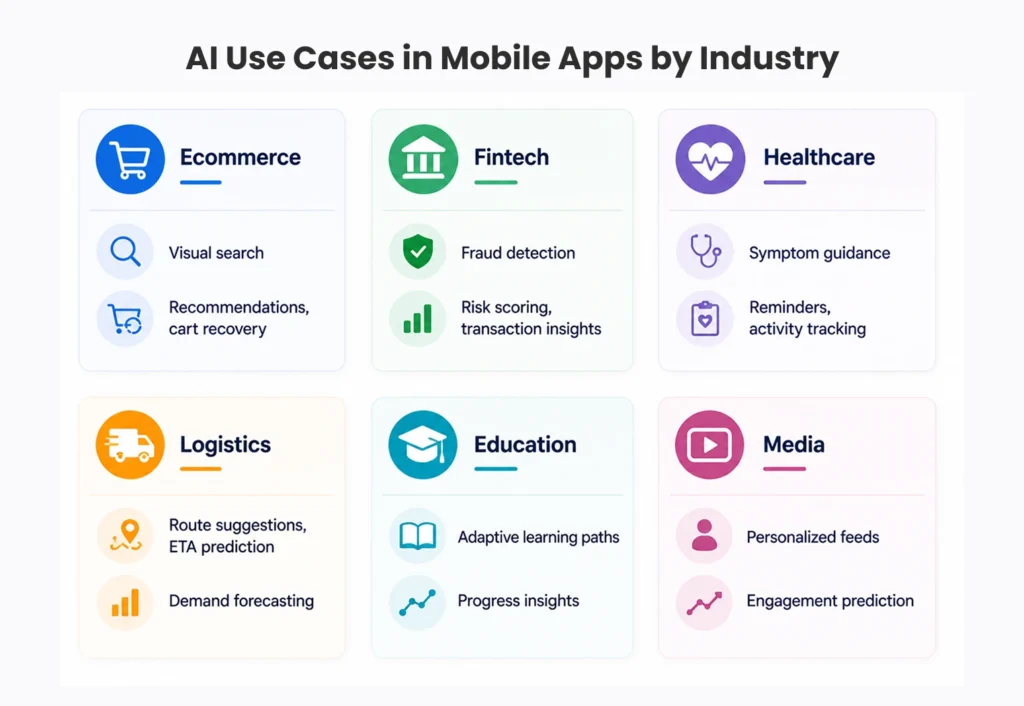
Different industries leverage intelligent features to solve highly specific problems. In ecommerce, visual search and abandoned cart recovery systems drive sales. A user can upload a photo of a product, and the application instantly finds similar items in the catalog.
Fintech and healthcare app applications
Financial technology platforms use machine learning for risk scoring and transaction categorization. Healthcare platforms offer symptom guidance, medication reminders, and actionable activity insights. Partnering with an ios and android app development company helps tailor these solutions to specific mobile operating systems.
Logistics, education, and media use cases
Logistics companies rely on demand forecasting, accurate arrival times, and dynamic route suggestions. Education platforms create adaptive learning paths for individual students. Media applications predict engagement and curate personalized content feeds. Taking advantage of Cloud-based app development allows these industries to scale complex processing power easily.
How the Role of AI in Mobile Apps Improves User Experience and Retention
Smarter onboarding and personalized journeys
A smooth onboarding process dictates whether a user stays or deletes your application. Intelligent onboarding flows adapt to user responses in real time. This helps new users discover relevant content immediately, drastically reducing friction.
Reducing friction in search, forms, and checkout
Checkout processes and form completions benefit from context-aware assistance. Predictive interfaces anticipate the next action a user wants to take. Better accessibility via voice commands opens your platform to a wider audience. Following solid mobile app UI/UX design tips ensures these intelligent layers feel natural rather than intrusive.
How retention improves with better app experiences
These improvements directly translate to higher retention and increased lifetime value. Users return to platforms that anticipate their needs. Proper mobile app performance optimization ensures that these advanced features do not slow down the device.
On-Device vs Cloud Models in Mobile Apps: What Businesses Should Know
When on-device processing makes more sense
Choosing where data gets processed is a critical business decision. Processing data directly on the device offers incredible speed. It also provides offline support and stronger privacy protections since sensitive information never leaves the phone.
When cloud-based processing is the better fit
Cloud processing allows you to use much larger, more powerful models. It makes updating algorithms easier and provides scalable computing power. Many modern applications use a hybrid setup to get the best of both worlds.
Why a hybrid model works for many mobile apps
There are trade-offs regarding cost, latency, battery life, and model size. Consulting Mobile App Security Best Practices helps determine which data should remain local and which can be sent to external servers.
Security, Privacy, and Compliance Risks in AI-Enabled Mobile Apps
Common security risks businesses should plan for
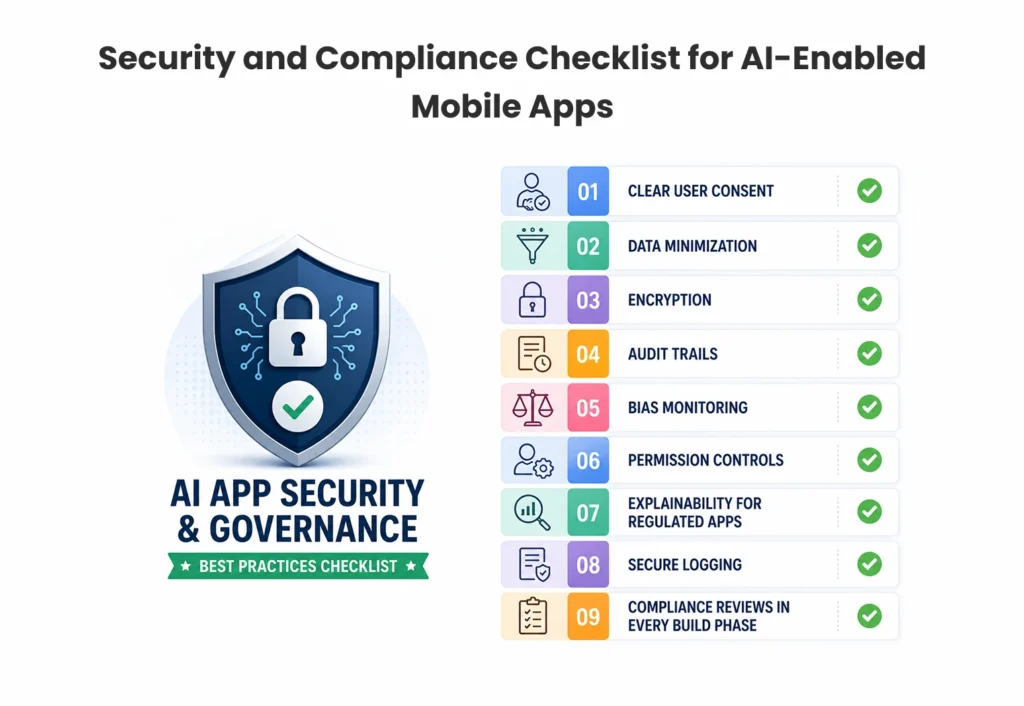
Adding intelligence without proper safeguards creates massive liabilities. Data collection practices must clearly obtain user consent. If models are trained poorly, they can produce biased or unreliable outputs.
Privacy and consent challenges in data-driven apps
Exposing sensitive user data ruins brand trust. Furthermore, accessibility permissions can easily be misused if not monitored properly. Finance and healthcare platforms face strict explainability requirements, meaning they must prove how a system arrived at a specific decision.
How to build compliance into the app lifecycle
Mitigating these risks requires robust logging, encryption, and audit trails. Reviewing the app development lifecycle explained documentation ensures that compliance checks occur at every stage of the build.
What the Role of AI in Mobile Apps Means for Startups vs Enterprises
What startups should prioritize first
Startups and large corporations have vastly different priorities when building software. Startups should focus on one or two high-impact features initially. A minimal viable product approach works best here. Focusing on basic recommendations or smart search proves value quickly without draining resources.
How enterprise app goals differ at scale
If you need guidance on this approach, exploring Mobile App Development for Startups can clarify your strategy. Building MVP Mobile Apps is all about getting to market fast to test your core assumptions.
Why feature prioritization matters more than feature volume
Enterprises operate differently. They focus on workflow orchestration, personalization at a massive scale, and operational insights. They need robust fraud detection and risk management systems. Regardless of company size, feature prioritization matters far more than launching with too many untested ideas.
Cost Factors Behind AI Features in Mobile App Development
What increases development costs
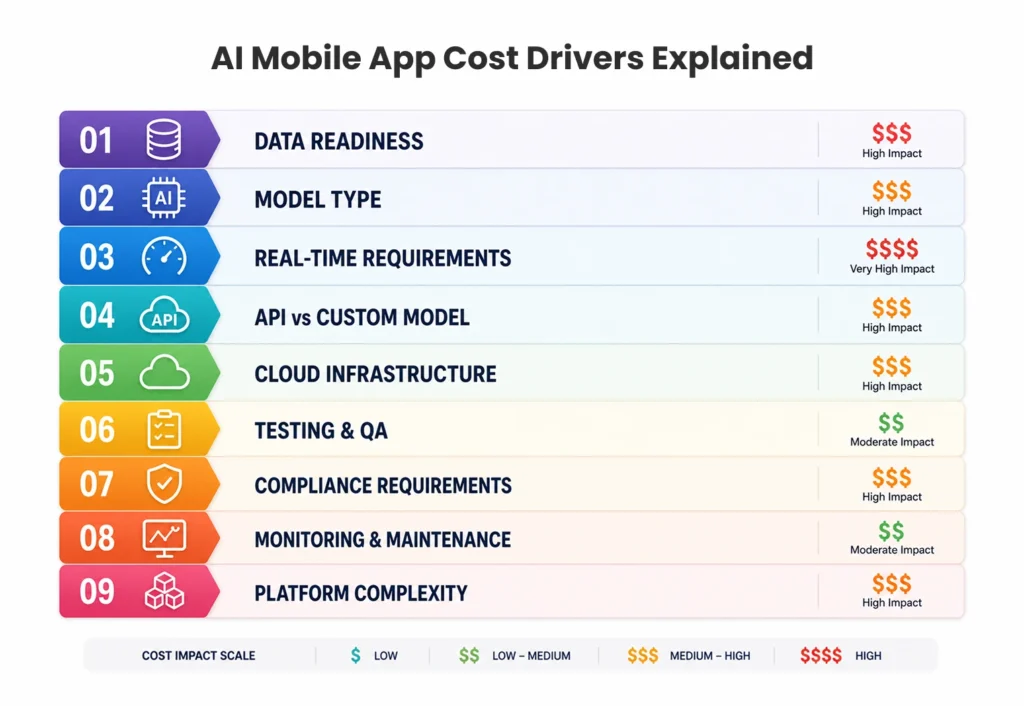
Budgeting for intelligent features requires understanding several variables. Costs depend on data availability, the type of model used, and real-time processing needs. Regulatory compliance and rigorous testing also add to the final bill.
API integrations vs custom model implementation
Processing data on a local device has different financial implications than paying for continuous cloud computing. Relying on third-party application programming interfaces is usually cheaper upfront than building custom models from scratch. Factoring in infrastructure and monitoring is crucial when estimating the total app development cost.
Why phased rollout helps control budgets
A phased rollout strategy reduces financial risk. Testing the waters with a few Best tools for app development helps keep early budgets firmly under control.
How to Choose the Right Development Strategy for AI-Ready Mobile Apps
Start with the business outcome, not the feature
Before writing a single line of code, start with the desired business outcome. Validating your data sources is the most important first step. Prioritize one measurable use case to ensure you actually solve a user problem.
How to evaluate architecture and platform choices
Deciding between native and cross-platform builds depends on the complexity of your features. A cross platform app development company can help you reach both major operating systems efficiently if your processing needs are moderate.
What to look for in a development partner
Review privacy and compliance requirements immediately. Plan your testing, retraining, and analytics phases early. Evaluating technical partners is vital here. Working with the best mobile app company ensures your architecture can scale. Researching various mobile app development companies will help you find a team that aligns with your specific industry needs.
Future Trends Shaping the Role of AI in Mobile Apps
More on-device intelligence and privacy-first design
The future of mobile software points toward hyper-personalized interfaces. We will see more intelligence moving directly onto the device itself. Multimodal experiences will allow users to interact via text, voice, and visual inputs simultaneously.
Conversational interfaces and multimodal experiences
Search functions will become entirely conversational. Applications will anticipate user workflows and proactively complete routine tasks. Privacy-led architecture decisions will become mandatory rather than optional.
Workflow-driven mobile apps and proactive assistance
Firms offering Agentic AI Development Services are already building systems that can execute complex tasks autonomously. Partnering with an ai agent development company will give forward-thinking businesses a distinct competitive edge. Keep an eye on the Top AI Development Companies in India to see where the next wave of innovation originates.

Final Thoughts on the Role of AI in Mobile Apps
Businesses should not add intelligent features just because they are currently trending in the tech space. True success comes from focusing on concrete business goals like retention, support efficiency, personalization, and conversion rates.
Start your journey with a single high-impact use case. Choose your architecture and rollout strategy based on your available data, budget, privacy constraints, and user expectations. Understanding how to choose the best ai agent website development principles will further solidify your digital strategy across all user touchpoints.
Frequently Asked Questions About the Role of AI in Mobile Apps
1. What is the role of AI in mobile apps?
It helps mobile platforms become more responsive, personalized, and useful by improving recommendations, search functions, notifications, support, and user behavior analysis.
2. How does AI improve user experience in mobile apps?
It improves user experience by tailoring content, reducing friction, predicting user intent, and making navigation, support, and discovery significantly faster.
3. Is AI in mobile apps expensive to implement?
It depends on the features, data requirements, integrations, and whether you use cloud services or local processing. Starting with one focused feature helps control expenses. Using Best AI Tools can also streamline the initial setup.
4. Which industries benefit most from AI in mobile apps?
Ecommerce, healthcare, fintech, logistics, education, and media platforms often see strong benefits because they rely heavily on personalization, prediction, and user engagement.
5. Is on-device or cloud processing better for mobile apps?
Neither is always better. Local processing works well for speed and privacy, while external servers handle complex algorithms better. Many applications use a hybrid setup. Understanding the difference between ai chatbots vs traditional chatbots often dictates which processing method is required.