
Key takeaways
- Banking use cases of AI in fraud detection help banks monitor suspicious transactions in real time.
- Behavioral analysis improves fraud prevention accuracy and reduces unnecessary transaction blocks.
- Modern banking fraud systems strengthen mobile banking security and customer authentication.
- Scalable cloud infrastructure supports faster fraud analysis and secure banking operations.
- Future banking fraud prevention focuses on predictive monitoring and adaptive risk analysis.
Financial fraud has become highly sophisticated as digital banking channels continue to expand globally. Banks now process millions of transactions every single day. These interactions happen rapidly across mobile applications, payment gateways, credit cards, and online banking systems. Traditional monitoring systems often struggle to keep pace with these evolving fraud patterns. They suffer from delayed alerts, rigid rule sets, and frustrating false transaction blocks that annoy legitimate customers.
This is exactly where banking use cases of ai in fraud detection are becoming incredibly important for modern financial institutions. Banks are focusing heavily on smarter risk analysis, transaction monitoring, behavioral analysis, and fraud response workflows. These advanced artificial intelligence systems improve security significantly without disrupting the everyday customer experience. They learn from historical data to make accurate predictions about which transactions are safe and which ones require immediate review.
Many financial technology teams are also taking a step back to rethink their platform architecture, scalability, and security integration alongside their overall fraud prevention strategies. From our perspective, similar strategic discussions are happening across areas like Top AI Development Companies in India and enterprise banking transformation initiatives. In these circles, operational efficiency, regulatory compliance, and customer trust remain the highest priorities. Understanding how artificial intelligence addresses these challenges provides a clear roadmap for the future of financial security.
Why Fraud Detection Has Become a Core Banking Priority
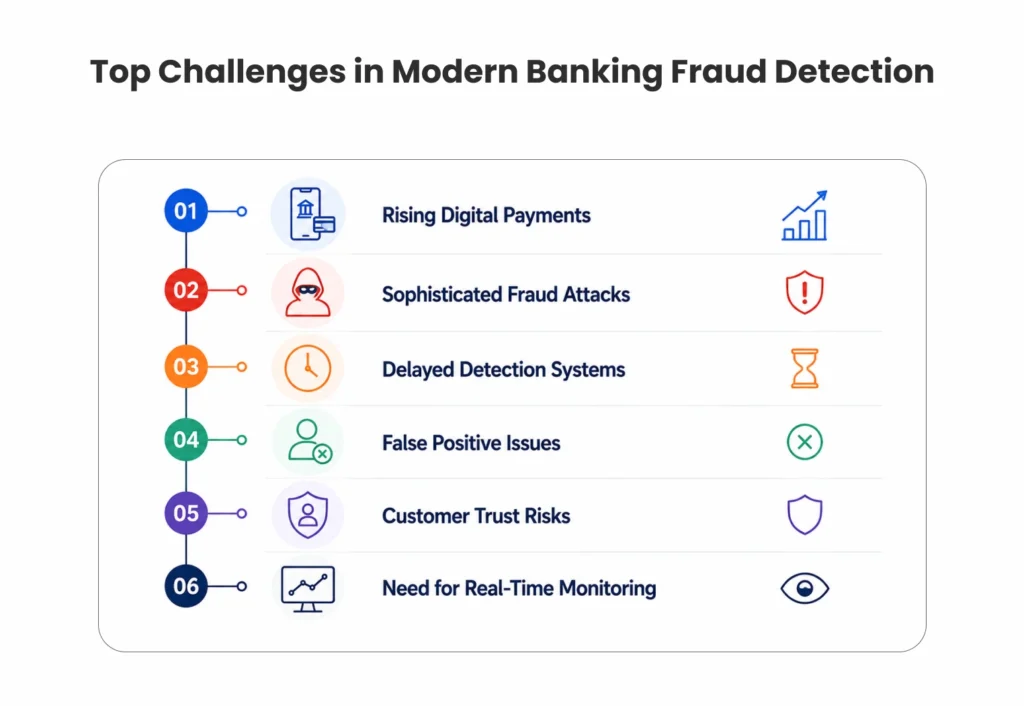
Digital transactions have increased rapidly across UPI payments, mobile wallets, online banking, and international wire transfers. Fraudsters now use sophisticated account takeovers, phishing attacks, identity spoofing, and payment manipulation techniques. These malicious methods evolve much faster than traditional, rule-based security systems can handle. When a bank relies solely on manual reviews or static rules, it leaves the door open for agile cybercriminals to exploit vulnerabilities before security teams even notice a breach.
Banks require dynamic systems that can evaluate massive volumes of activity in real time. These systems must identify subtle suspicious behavioral changes instantly. This fundamental shift in operational requirements has accelerated interest in banking use cases of ai in fraud detection across retail banking, fintech platforms, and large enterprise financial services. Artificial intelligence provides the scale and speed necessary to analyze thousands of variables in milliseconds, offering a robust defense against modern financial crimes.
Modern fraud detection frameworks also depend heavily on highly secure infrastructure and scalable application ecosystems. Many financial institutions now combine their advanced fraud analytics with Cloud-based app development practices. This integration improves overall transaction visibility and enables centralized monitoring across diverse global markets. By moving these critical security workloads to the cloud, banks can scale their processing power dynamically during peak transaction periods.
At the same time, secure banking platforms increasingly rely on Mobile App Security Best Practices to reduce the risks of account compromise across mobile channels. Because mobile phones are often the primary device for banking customers, securing the application layer is just as critical as analyzing the transactions themselves.
Key Challenges Banks Face Today
- Rising digital payment fraud across multiple consumer channels
- Increasing false positive alerts that frustrate legitimate banking customers
- Delayed fraud investigation workflows that allow funds to leave the institution
- Multi-device identity spoofing and complex account takeover attempts
- Real-time transaction validation demands during peak shopping seasons
- Compliance and audit reporting complexity required by global regulators
Real-Time Transaction Monitoring in Banking Systems
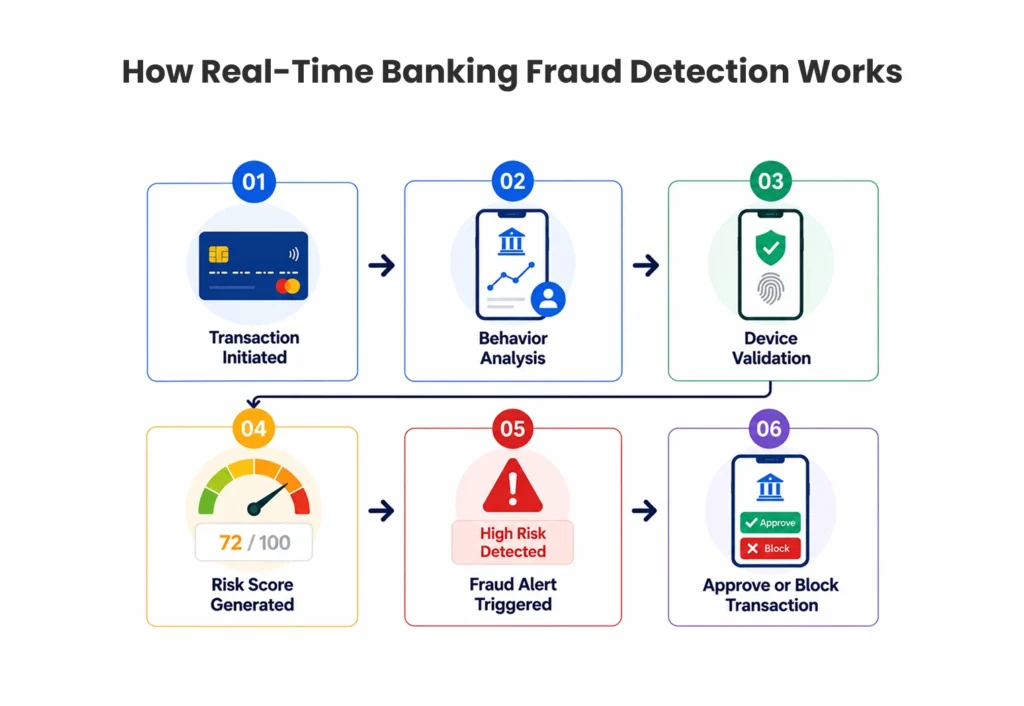
One of the most important banking use cases of ai in fraud detection involves real-time transaction monitoring. Banking systems continuously analyze vast amounts of customer activity patterns. This includes looking closely at spending behavior, transaction frequency, specific device usage, and geographic activity. By training machine learning models on billions of past transactions, artificial intelligence learns what a “normal” transaction looks like for different customer segments.
When highly unusual behavior appears, the AI system can flag the transactions instantly for immediate review or block them entirely. For example, a sudden high-value international transaction originating from a brand-new device after repeated failed login attempts will immediately trigger a critical risk alert. The AI analyzes all these contextual clues simultaneously, rather than evaluating them in isolation, which provides a much more accurate assessment of the threat level.
Financial institutions also integrate these powerful fraud prevention mechanisms into broader digital ecosystems. These ecosystems are typically supported by custom web application development and highly secure banking portals. Creating a custom interface allows bank investigators to interact with AI-generated alerts seamlessly, reviewing the evidence the AI gathered and making final determinations quickly.
Many enterprise banking teams further strengthen their detection speed and accuracy through enterprise devops consulting strategies. These methodologies improve deployment cycles, monitoring reliability, and the overall infrastructure stability required to run complex machine learning models in production environments.
Common Monitoring Signals
- Sudden high-value transactions that fall outside normal spending habits
- Multiple login attempts from unrecognized IP addresses
- Device fingerprint mismatches indicating a potential cloned device
- Unusual geographic activity, such as transactions in two distant countries within hours
- Rapid card usage spikes characteristic of automated card-testing scripts
- Transaction timing abnormalities, like large transfers occurring at 3:00 AM local time
Behavioral Analysis for Customer Risk Profiling
Behavioral analysis helps banks deeply understand how customers normally interact with their banking services. Instead of relying only on fixed, rigid rules, these intelligent systems compare current activity against established historical behavior patterns. The AI looks at everything from how quickly a user types their password to the specific navigation paths they take within the mobile application.
This specific approach dramatically improves fraud prevention accuracy because legitimate users usually follow highly predictable interaction habits. A standard customer may consistently log in from a specific region, use the exact same mobile device, and transfer funds within a completely normal transaction range. If a user suddenly copies and pastes a password for the first time or navigates the app in a completely alien manner, the AI raises a red flag.
Behavior-based security frameworks are becoming a major part of banking use cases of ai in fraud detection because they help reduce unnecessary transaction declines. By understanding the human behind the screen, banks can offer frictionless experiences to verified users while throwing security hurdles only at anomalous actors.
Banking platforms investing heavily in scalable digital experiences also focus on mobile apps digital transformation initiatives. These projects support secure user engagement across multiple devices, ensuring that behavioral profiles follow the customer whether they use a tablet, phone, or desktop.
Similarly, financial platforms using ai-powered website development workflows are constantly improving secure customer interactions. They utilize adaptive authentication systems that scale the security requirements up or down based on the behavioral risk score calculated in real time.

Reducing False Positives in Fraud Detection Workflows
False positives remain one of the biggest and most expensive operational problems in banking fraud management. Blocking perfectly legitimate transactions can severely frustrate customers, increase costly support tickets, and negatively affect long-term brand trust. When a customer’s card is declined at the grocery store or during a critical business purchase, they may choose to use a competitor’s card instead.
Modern artificial intelligence systems improve accuracy by analyzing multiple complex risk indicators before generating alerts. Instead of blocking every single unusual transaction based on one trigger, systems assign dynamic risk scores. These scores are based on deep customer behavior, device history, and contextual activity.
This practical improvement represents one of the absolute strongest banking use cases of ai in fraud detection because it perfectly balances strict security with an excellent customer experience. It allows banks to reserve manual reviews only for cases that genuinely warrant human intervention.
Banks improving their core fraud response systems also focus heavily on mobile app performance optimization. They must ensure that these secure authentication workflows do not slow down everyday user interactions. A security check that takes five seconds to process can lead to cart abandonment and user frustration.
At the infrastructure level, financial institutions increasingly adopt the Best Cloud DevOps Service Providers in India to support these scalable fraud analysis environments. High-volume transaction processing requires elastic cloud environments that can expand processing power during high-traffic events like holiday shopping weekends.

Benefits of Lower False Positives
- Better overall customer satisfaction and retention rates
- Reduced support workload for call centers and branch staff
- Faster transaction approvals leading to higher transaction volumes
- Improved operational efficiency within the fraud investigation team
- Lower total fraud investigation costs and resource allocation
Fraud Detection Across Mobile and Digital Banking Apps
Mobile banking adoption has expanded incredibly rapidly over the last decade. This boom has naturally increased the need for much stronger fraud prevention inside banking applications. Fraud detection now extends far beyond financial transactions. It delves deeply into login activity, biometric verification, session behavior, and device authentication protocols.
Banks building these secure mobile ecosystems often combine advanced fraud analytics with custom mobile app development strategies. This combination helps improve both user security and operational flexibility. By building security directly into the application code, banks can gather richer telemetry data to feed their artificial intelligence models.
Many institutions also choose to modernize their banking experiences through strategic partnerships with an ios and android app development company. These partners are capable of supporting highly secure authentication frameworks and scalable financial applications that meet strict regulatory compliance standards.
As digital banking continues to grow globally, banking use cases of ai in fraud detection continue expanding rapidly. They are pushing into complex areas like account takeover prevention, SIM swap detection, and advanced phishing mitigation workflows. AI algorithms can detect if a banking app is running alongside known malicious software, protecting the user before a fraudulent transfer is even attempted.
Detecting Emerging Scam Patterns in Banking Networks
Fraud tactics constantly evolve as criminals find new ways to exploit the financial system. Static rule-based systems often fail completely to identify newly emerging scam techniques because they depend heavily on predefined conditions. By the time a security analyst writes a new rule to stop a scam, the fraudsters have already moved on to a different methodology.
Modern banking fraud systems analyze massive, unstructured volumes of transaction and behavioral data. They use unsupervised machine learning to identify suspicious trends and clusters before widespread damage occurs. This capability helps banks respond much faster to coordinated fraud campaigns, money laundering rings, and authorized push payment scams.
Financial institutions improving their digital scalability often combine these intelligent fraud systems with low code app development environments. This combination accelerates internal workflow deployment and allows risk teams to push operational updates without waiting months for traditional software release cycles.
At the same time, these sophisticated fraud prevention platforms rely heavily on optimized infrastructure. Metrics like website loading speed and transaction response times are absolutely critical for customer-facing banking systems that must evaluate risk without causing visible lag to the end user.
Emerging Fraud Trends
- Synthetic identity fraud created using fragments of real and fake data
- QR code payment scams directing users to malicious payment gateways
- Account takeover attacks utilizing leaked credentials from other data breaches
- Deepfake verification bypass attempts targeting video-based KYC processes
- Social engineering payment fraud where victims are tricked into authorizing transfers
Strengthening Banking Infrastructure for Fraud Prevention
Fraud detection is certainly not limited to advanced analytics alone. Overall infrastructure reliability, application architecture, robust cloud monitoring, and secure deployment pipelines all contribute significantly to better fraud response systems. An AI model is only as effective as the data pipeline that feeds it and the infrastructure that hosts it.
Banks increasingly modernize their legacy core systems using scalable frameworks and distributed microservices architectures. This structural shift improves transaction visibility across different platforms and banking products. This broader digital transformation actively supports stronger banking use cases of ai in fraud detection by enabling much faster data processing and centralized risk monitoring across the entire banking group.
Financial institutions often improve their operational resilience through Cloud based website hosting solutions. These environments support highly secure transaction environments and can seamlessly handle the scalable workloads required by complex machine learning algorithms.
Development teams within these banks also rely extensively on modern web development frameworks to build secure internal dashboards. These tools allow them to create intuitive fraud monitoring portals and robust banking administration systems that empower human investigators to work more efficiently.
Building Scalable Fraud Detection Ecosystems
Large global banking institutions require fraud systems capable of processing many millions of distinct events daily. This massive scope includes transaction analysis, ongoing customer authentication, payment validation, and real-time regulatory reporting to financial authorities.
Scalable fraud ecosystems depend completely on tight collaboration between banking operations, compliance teams, security engineers, and platform developers. Many organizations also invest heavily in specialized workflows. These are highly similar to the structures used by an ai agent development company for automated decision support, complex event analysis, and autonomous risk mitigation.
Banks modernizing their digital financial services also carefully evaluate the app development lifecycle explained strategies. Understanding this lifecycle helps them to significantly improve software release management, maintain testing consistency, and enforce strict security governance throughout the development pipeline.
In parallel to these efforts, banking operations teams frequently assess the best cloud automation tools available on the market. Implementing these tools helps streamline complex deployment management and solidifies monitoring workflows across entirely diverse banking environments.
AI Chat Systems and Fraud Support Operations
Customer support plays a surprisingly important role in successful fraud prevention. Banking users often report suspicious activity, question blocked transactions, or raise alarms about account compromise attempts directly through digital support channels. Handling these inquiries swiftly is vital to stopping fraud in progress.
Modern banking systems use highly intelligent support workflows to prioritize fraud-related tickets automatically. Natural language processing models read incoming customer messages, guide the user through necessary verification steps, and escalate high-risk cases to human fraud specialists much faster than traditional queuing systems.
Organizations actively exploring fraud support modernization also meticulously compare ai chatbots vs traditional chatbots. They evaluate these tools based on overall customer service efficiency, linguistic understanding, and their ability to trigger automated fraud response workflows securely.
Many large financial institutions additionally partner with a specialized Mobile App Development Company to integrate these secure, AI-driven support experiences directly inside their mobile banking applications. This provides customers with a safe, authenticated environment to report fraud without needing to call a public support line.

Future Trends in Banking Fraud Detection
Fraud prevention will undoubtedly continue evolving as digital banking ecosystems expand into new territories. Future banking environments will likely focus much more on highly predictive analysis, completely adaptive authentication, continuous session monitoring, and deep cross-platform behavioral intelligence.
Financial institutions are widely expected to invest more heavily in secure digital ecosystems, highly scalable cloud infrastructure, and completely integrated fraud management platforms. Businesses looking to meaningfully improve their digital banking experiences also prioritize deep website development process planning. This forethought is required to support long-term scalability, performance, and rigorous security governance.
At the exact same time, organizations will continue exploring and launching highly practical implementations related to banking use cases of ai in fraud detection. As fraud patterns become increasingly sophisticated across global financial systems, artificial intelligence will transition from a competitive advantage into a mandatory baseline for institutional survival.

Securing the Future of Financial Transactions
Fraud prevention has fundamentally become a critical operational requirement for all modern banking institutions. As digital transactions continue to rise exponentially, banks require intelligent systems capable of identifying suspicious activity instantly while completely minimizing customer friction.
The rapid, widespread adoption of banking use cases of ai in fraud detection clearly reflects the industry’s need for smarter transaction monitoring, nuanced behavioral analysis, scalable security infrastructure, and much faster fraud response mechanisms. AI is no longer just an experimental technology; it is the core engine protecting global financial assets.
Banks that successfully combine secure application development, intelligent scalable infrastructure planning, and advanced AI-driven fraud monitoring workflows are in the best position to succeed. They will dramatically reduce their operational risks while simultaneously improving customer trust and elevating their overall digital banking performance.
FAQ Section
1. What are the main banking use cases of AI in fraud detection?
The main use cases include transaction monitoring, behavioral analysis, scam detection, account takeover prevention, and fraud risk scoring.
2. How does fraud detection reduce false positives in banking?
Modern fraud systems analyze multiple transaction signals together before generating alerts, helping reduce unnecessary transaction blocks.
3. Why is real-time fraud monitoring important for banks?
Real-time monitoring helps banks detect suspicious activity instantly before financial losses escalate.
4. Can fraud detection systems improve mobile banking security?
Yes. Fraud systems help monitor login behavior, device authentication, transaction activity, and unusual access patterns inside banking applications.
5. What technologies support banking fraud detection platforms?
Banks commonly use cloud infrastructure, secure application development, behavioral analytics, monitoring systems, and scalable transaction processing frameworks.