Key Takeaways
- AI in Manufacturing Industry Applications help manufacturers reduce downtime, improve quality control, and optimize production planning.
- Predictive maintenance enables early detection of equipment issues, minimizing costly unplanned shutdowns.
- Computer vision systems improve product quality by identifying defects faster and more consistently.
- Supply chain optimization enhances inventory accuracy, demand forecasting, and logistics coordination.
- A strong data foundation, including a Unified Namespace, is essential for successful implementation and long-term scalability.
The manufacturing world has never been more complex. Global supply chains generate new sources of risk every day, production lines are faster, and customer demand is changing overnight. There is never a dull day at a plant because managers must balance dozens of variables, including machine health, raw material availability, labor schedules, and quality targets, often using systems that do not communicate with one another.
It is this growing complexity that explains the need for better visibility across manufacturing operations. Data often exists in isolated silos across production, quality, maintenance, and supply chain teams, leaving decision-makers with only a partial view of what is happening. The result is slower responses, costly mistakes, and missed opportunities. Our approach focuses on helping organizations connect operational data so teams can make informed decisions based on accurate information rather than assumptions.
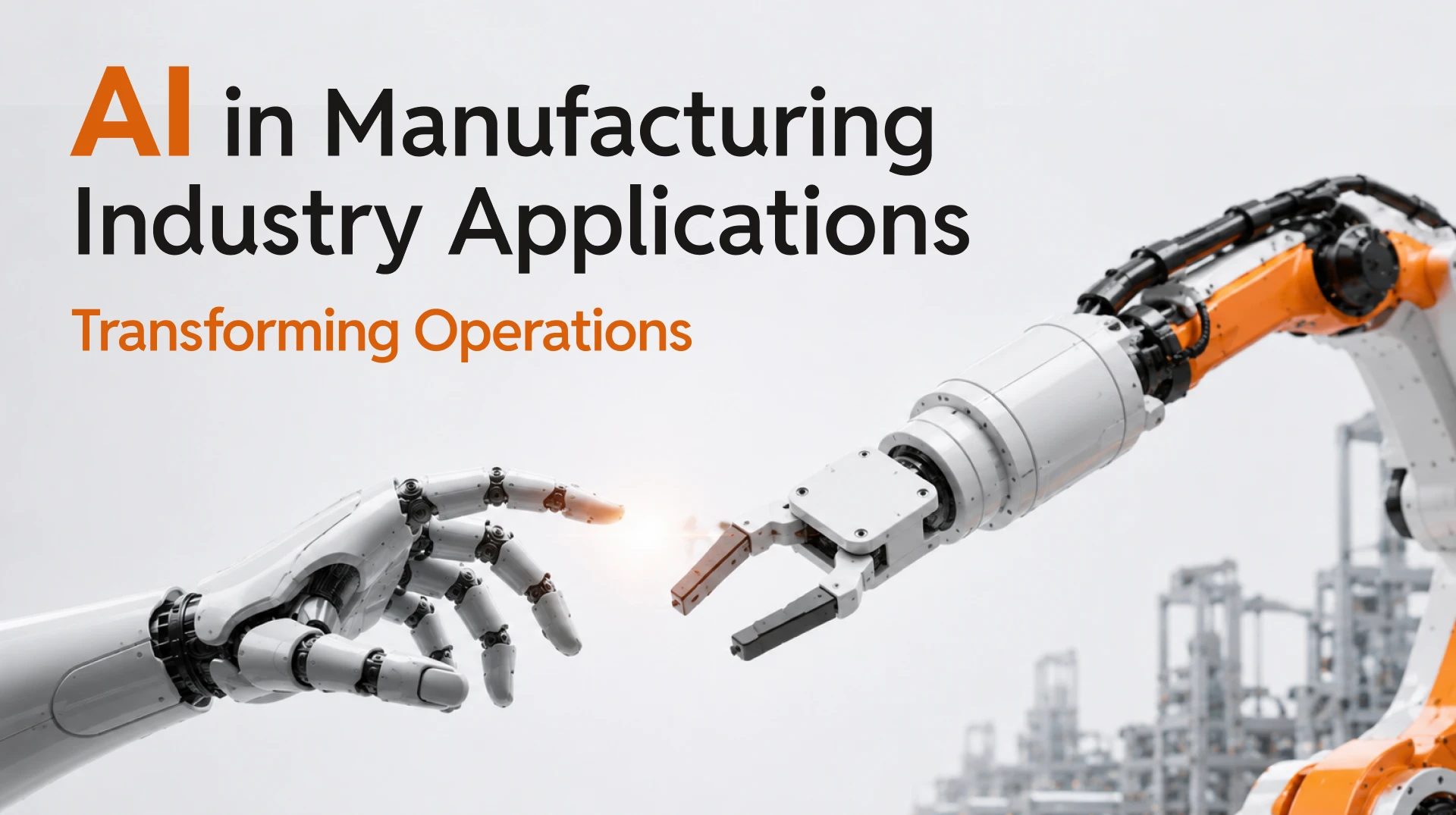
That’s where AI in Manufacturing Industry Applications come into play. These solutions help manufacturers identify issues earlier, optimize processes, and improve planning by analyzing large volumes of operational data in real time. This guide explores the most impactful use cases across the production lifecycle, compares leading industrial platforms, and highlights the best practices for successful implementation.
What is AI in Manufacturing Industry Applications?
The term AI in manufacturing industry applications denotes software systems that implement machine learning, computer vision, and advanced analytics across manufacturing operations. They learn from both historical and real-time data in order to predict outcomes, detect anomalies, and suggest or automate actions, such as when to schedule production runs or flag defective parts before they’re shipped.
How Manufacturing Systems Have Evolved
Previously factories used manually maintained logs, spreadsheets and basic automation. Next came enterprise resource planning (ERP) and manufacturing execution systems (MES), which digitized records with little cross-departmental insight. Today, AI sits on top of these systems converting raw data into clear; suggestive recommendations. That’s why contemporary factories tend to be powered by connected sensors, cloud platforms and smart software, a transition in the world of manufacturing that many refer to as Industry 4.0.
Custom web application development that ties a plant’s proprietary processes together is often needed to support these connected systems. Most off-the-shelf tools are not able to conform to all workflows so it is common for manufacturers to invest in software naturally designed around existing equipment or specific goals.
Why Data-Driven Decision Making Matters in Manufacturing
It is expensive to make decisions based on gut feeling. Rather than guesswork, AI will now be replacing it as AI in manufacturing industry applications zero down on the best course of action based on real production data. The key point is, because manufacturing creates massive volumes of data, scalable infrastructure really matters. To prevent overwriting the physical servers, some manufacturers are now looking towards cloud-based app development services that store, process and analyse this data. The reward for doing this is quicker insights, reduced IT expenditure, and freedom to scale.
Key AI in Manufacturing Industry Applications Across the Production Lifecycle
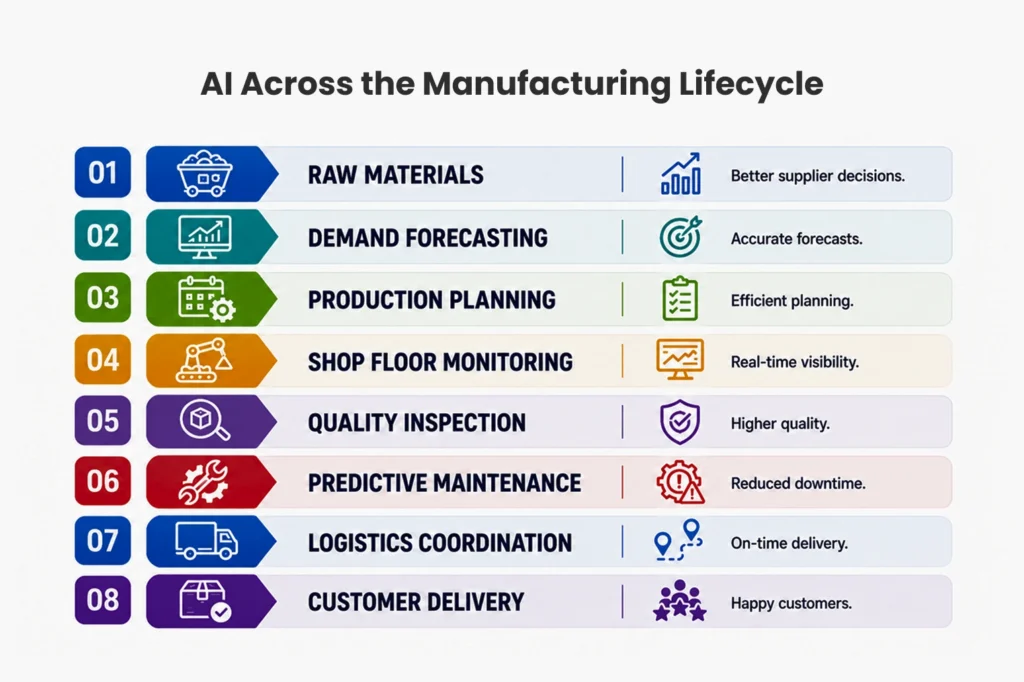
AI permeates just about every aspect of production. Here are two of the highest-impact areas with the quickest returns according to manufacturers.
AI-Powered Production Planning and Scheduling
Planning a production schedule means balancing demand, machine capacity, material supply, and labor, all while minimizing cost. AI models analyze these variables and generate optimized schedules in minutes, not days. When conditions change, such as a sudden rush order or a machine breakdown, AI can automatically reschedule to keep output on track.
Manufacturing Process Optimization and Shop Floor Monitoring
On the shop floor, sensors stream data on temperature, vibration, speed, and output quality, The data is then continuously analysed by AI for inefficiencies and provides suggestions for corrections. It might, say, discover a minor temperature increase increases yield and subsequently suggest that adjustment across equivalent machines.
Manufacturers leverage low code app development to speed up these insights into the hands of operators by constructing dashboards and tools without lengthy development cycles. When combined with the new mobile apps for digital transformation, these tools provide floor supervisors with alerts and controls in real-time, and directly on their smartphones and tablets.
AI in Manufacturing Industry Applications for Predictive Maintenance
One of the major challenges in manufacturing is the expensive unplanned equipment failure. AI-based predictive maintenance prevents it.
Identifying Equipment Issues Before Failure
For example, AI models learn from historical data on sensor data (such as vibration, heat, sound, power draw) to identify early indicators of wear. As readings wander from the norm, the system will tell you this machine needs to be inspected before it breaks down. Going from Repairing to Predicting also saves Money → They will now know →when to replace equipment– it extends the lifecycle of machinery → meaning less wear and tear → on machines.
Reducing Unplanned Downtime
According to industry estimates, unplanned downtime can cause manufacturers on high-output lines to lose thousands of dollars every minute. AI avoids disrupting lines and endangering revenues by scheduling maintenance to take place during planned breaks instead of emergencies.
Predictive maintenance you can count on requires stable pipelines and proficient at building software automation. DevOps consulting services are used by numerous manufacturers to support the seamless deployment and updating of models. When you select among the best cloud automation tools, you also can automate data collection, model retraining, and alerts at scale across teams.
AI in Manufacturing Industry Applications for Quality Control
Quality issues damage both margins and reputation. AI-powered inspection catches defects faster and more consistently than the human eye.
Computer Vision for Automated Visual Inspection
Cameras and AI are used in Computer Vision systems to inspect products at high speed. They can detect scratches, cracks, misalignments and other defects that a human might miss after a long shift. These systems run 24×7 without any fatigue and provide repeated output with the same efficiency.
Improving First-Pass Yield with Manufacturing Intelligence
First-pass yield is the percentage of products that meet quality standards without the need for rework. AI improves that number by catching defects early on and by finding the reason that caused them. Less waste, lower costs, and faster delivery thanks to a higher first-pass yield.
Some manufacturers go further by working with an AI agent development company to build intelligent systems that not only detect defects but also recommend corrective actions automatically.
AI in Manufacturing Industry Applications for Supply Chain Optimization
A production line is a good performance in train, but without the right materials in place at the right time, it stalls. Complex supply chains made simpler with AI
Demand Forecasting and Inventory Optimization
Traditional forecasting methods, like sales history, seasonality, market trends, and sometimes weather data have long been used to analyze demand, but AI forecasting models improve the prediction accuracy. Less stockouts and less excess inventory here due to better forecasts. So this is why, when talking about use cases of AI in warehouse management, manufacturers often find that smarter inventory control saves money and warehouse space.
Real-Time Logistics Coordination
AI monitors shipments, predicts delays and reroutes deliveries when challenges occur. This really synchronizing maintains materials moving, and consumers satisfied. And as always, for companies planning to build these capabilities, understanding supply chain management software development cost is an important first step in budgeting and planning.
AI in Manufacturing Industry Applications for Smart Factory Operations
AI does not dwell purely in the software; in fact, it increasingly courses through the mechanized bodies that move and assemble products.
Autonomous Mobile Robots in Smart Factories
Description: Autonomous mobile robots (AMRs) use on-board real-time data processing to travel around factory floors unattended, carrying raw materials and finished goods. AI when used for navigation and obstacle avoidance adjusts to changing layouts and works safely alongside people.
Human-Robot Collaboration in Manufacturing
Collaborative Robots (cobots), which assist human operators in tasks such as assembly and packaging. AI also assists cobots in responding to human motions in a safe manner or in allowing them to more quickly learn how to perform new tasks. This creates a workforce of human intelligence paired with robotic repetition and stamina.
Developing these systems of autonomous bindings often involves Agentic AI Development Services that make AI to plan, decide, and act with minimal human input.
AI in Manufacturing Industry Applications Platform Comparison
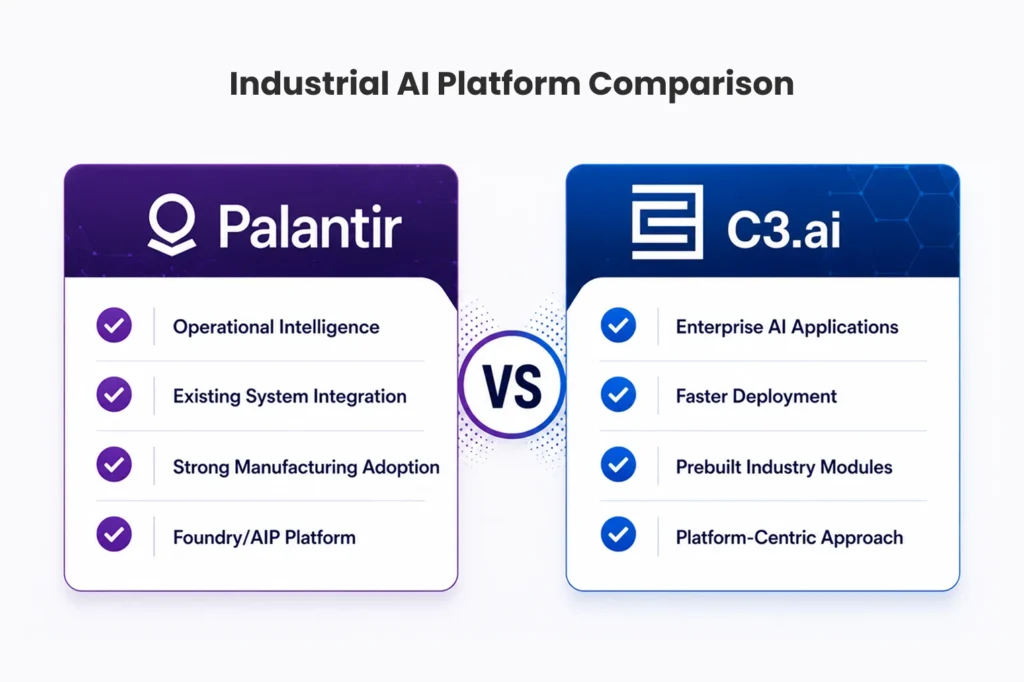
Two of the most prominent industrial AI platforms are Palantir and C3. ai. They both have big manufacturing clients, but they do it in pretty different ways. Industry leader C3 AI, offers 40+ off the shelf Enterprise AI applications, servicing more than 300 client and partner brands, such as Holcim, a major manufacturer of cement and shell, and many others.
Platform Architecture and Integration Approach
The Foundry and AIP platforms from Palantir adopt a “wrap-and-extend” approach, building operational intelligence upon existing systems. C3. ai centers around the concept of a platform where similar to AIDO, you have pre-deployed enterprise applications for manufacturers that can be deployed and customized. Take Palantir if you want to integrate, raw, dissimilar information sources; choose C3, in case you do. AI, if you like pre-built applications that accelerate the time to value.
Manufacturing Scalability and Business Outcomes
Both platforms are results-driven but scale in a distinct manner. However, Palantir has great scalability as well as high manufacturing adoption, during its growth phase. ai is how it continues to scale better than ever, building a rich library of applications.
| Feature | Palantir | C3.ai |
| Deployment Model | Foundry/AIP | Enterprise AI Platform |
| Focus | Operational Intelligence | Enterprise Applications |
| Integration Style | Wrap-and-Extend | Platform-Centric |
| Manufacturing Adoption | High | Moderate |
| Scalability | Strong | Improving |
Selecting and integrating these platforms often requires specialized expertise. Partnering with one of the Top AI Development Companies in India can help manufacturers implement and customize these systems cost-effectively.
Building Data Foundations for AI in Manufacturing Industry Applications
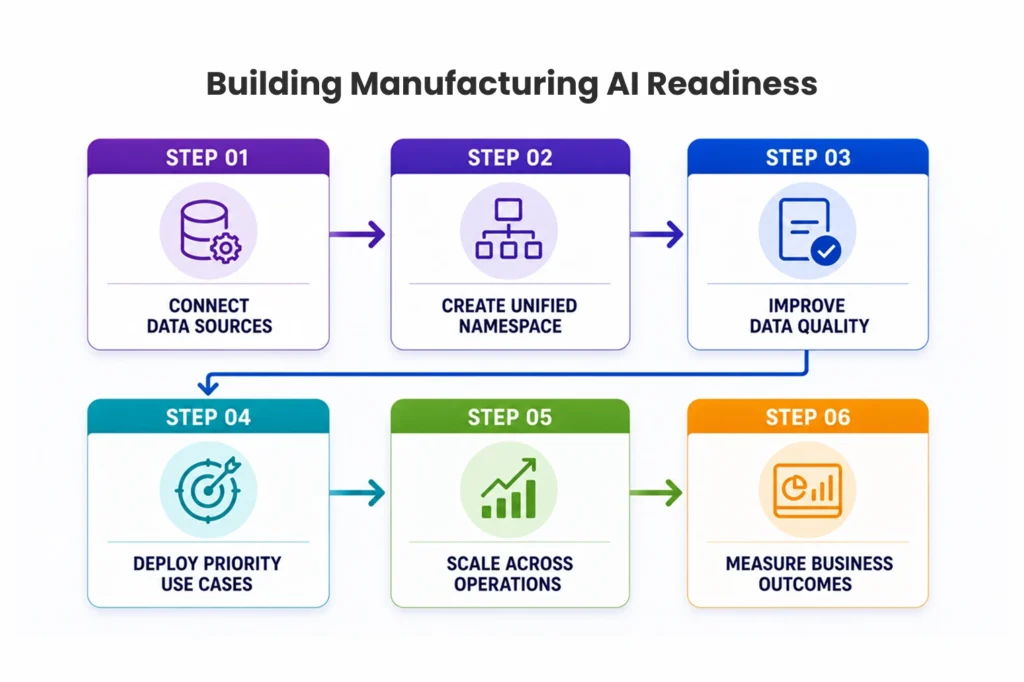
AI is only as good as how you feed that data in. The line dividing successful AI projects from failed projects is a strong data foundation.
Understanding Unified Namespace for Manufacturing Data
Unified namespace (UNS) is an overall, organized structure of real-time data, where all factory data lives and flows in real time. Every device, sensor, and application all read from and write to a single shared source of truth rather than disparate systems. By making data harmonized, accessible, and ready for AI consumption.
Eliminating Data Silos Across Factory Operations
One of the major roadblocks to AI success is data silos. AI cannot understand the entire context when production, quality, and maintenance data are siloed in separate systems. Silos are broken down and a connected data environment is created. Insights move seamlessly from one part of the organization to another. One example of this is with strong deployment practices. Building more secure and sustainable data pipelines fills in the gap with the aid of using Working with the Best Cloud DevOps Service Providers in India.
Benefits of AI in Manufacturing Industry Applications
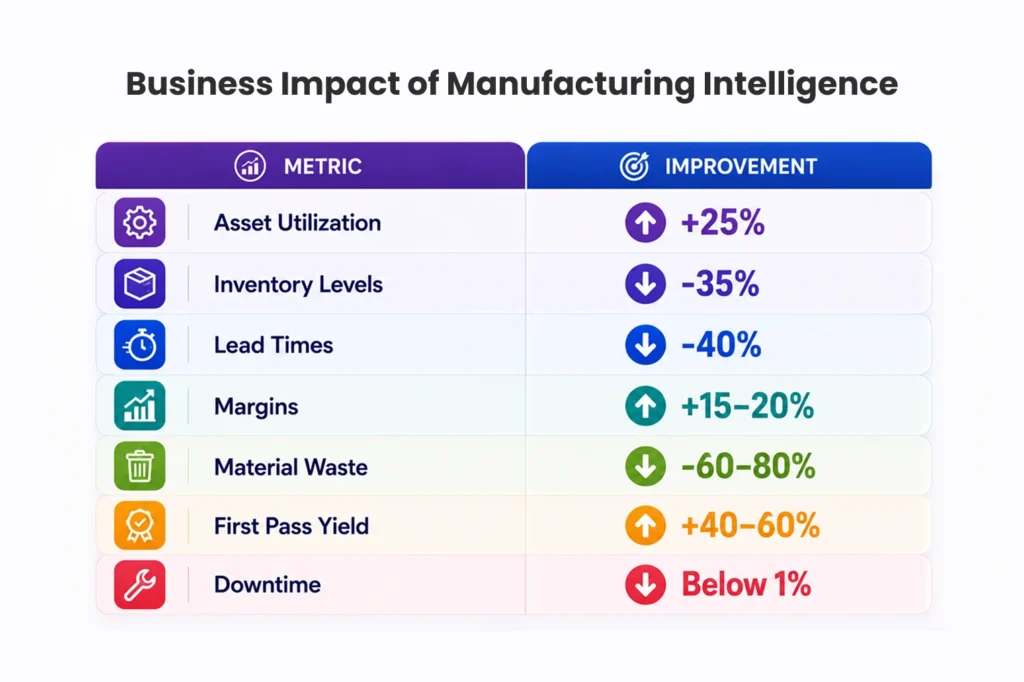
The manufacturing industry applications for Ai, when done right, will provide clear, tangible value:
- Reduced downtime: Predictive maintenance prevents costly, unexpected failures.
- Better quality outcomes: Computer vision catches defects early and consistently.
- Faster planning cycles: AI generates optimized schedules in minutes.
- Lower inventory costs: Accurate forecasting trims excess stock and stockouts.
- Improved energy efficiency: AI optimizes machine settings to cut energy waste.
- Enhanced workforce productivity: Robots and smart tools free people for higher-value work.
Challenges of Implementing AI in Manufacturing Industry Applications
Artificial Intelligence provides real value, if manufacturers prepare for common roadblocks.
Data Quality and System Integration Challenges
Data quality is the first cause of failure of AI projects. All these factors undermine the ability of AI to work well with imperfect data (because systems have inconsistent formats or missing values) either directly or indirectly. Manufacturers must clean, standardize, and connect their data to prepare it for AI deployment. It requires time, but in return, delivers accurate, trusted results.
Workforce Adoption and Change Management
A factory alone, technology for it does not become the factory of the factory; it is ultimately the people who do this. Workers may balk against new tools due to fear of losing their job or fear of additional complexity. To successfully adopt an AI product, one must invariably communicate clearly, provide relevant training, and involve employees early. Adoption follows when the teams know how AI helps them work smarter.
Future Trends in AI Manufacturing Applications
AI in manufacturing keeps evolving. The next age of Smart Factories will be characterized by multiple trends.
Agentic Systems for Manufacturing Operations
Agentic AI systems are capable of limited planning, decision-making, and acting with little to no human direction. In a manufacturing landscape, these systems might even autonomously plan, calendarizing production and orders on their own. They will also specifically support engineers and operators with questions and actions in natural language for industrial copilots.
Physical Intelligence and Autonomous Factories
It consists of employing AI with robotics to build machines which can understand and conform with the reality of the material world. Take digital twins, which are virtual replicas of physical assets, that allow manufacturers to simulate changes before making them. It also denotes factories that largely run themselves when applied with regards to advanced robotics, and edge intelligence (AI that operates right on the devices).
How to Get Started With AI in Manufacturing Industry Applications
By a long shot, AI in manufacturing live up to real time, tangible benefits from reduced downtimes, better quality, speedy planning, reduced inventory cost, optimized energy consumption, and productive workforce. These gains are tangible: top manufacturers are achieving them today.

But none of this will work without the right data foundation. Only connected, clean, and well-governed data transforms AI from just a buzzword to a business advantage. You are in a position to set your manufacturers up for long-term success with those investments first.
The smartest approach is to focus on business outcomes, not technology for its own sake. Start with a clear problem, such as reducing downtime, cutting defects, or improving forecasts, and let that goal guide your AI strategy. If you’re ready to explore how AI can transform your operations, our team can help you assess readiness, build the right data foundation, and deliver results that matter.
Frequently Asked Questions
1. What are the main applications of AI in manufacturing?
Predictive maintenance, computer vision for quality control, production planning and scheduling, supply chain optimization and robotics are the most common AI applications in the manufacturing industry. By doing so, these applications are able to tackle problems of downtime, quality, and help manufacturers make faster, data-driven decisions.
2. How much does it cost to implement AI in manufacturing?
Costs vary a lot based on the size of the factory, how mature the data is, and the scope of the project. Pilot projects can be tens of thousands of dollars with full-scale deployments running even higher. Historically, one of the factors holding back the uptake of predictive maintenance applications was high upfront costs, but with the recent advent of cloud-based and low-code tools, costs have been significantly cut, and most manufacturers see returns within months from lower downtime and waste.
3. How long does it take to see results from manufacturing AI?
All the above is fairly use case-dependent and data-ready, naturally. Specific projects, such as predictive maintenance, can demonstrate outcomes in 8 to 12 weeks. Deployment at a larger scale can be anywhere between 3 to 6 months as it is scaled out through operations. Having strong data foundations accelerates every timeline.
4. What are the biggest risks of adopting AI in manufacturing?
The deadliest risks are of inferior data quality, weak systems integration, and poor workforce adoption. In fact, a lots of AI projects crash not on account of the innovation yet due to messy data / change resistant teams. Tackle data early, tackle people early, and you will be much more successful.
5. Which is better for manufacturing: Palantir or C3.ai?
If you need priority on carefully integrating disparate, complicated source data, choose Palantir adopting its wrap-and-extend methodology. Choose C3. ai so you can go with off-the-shelf enterprise apps which will deliver faster deployment. Selecting one or the other depends on the systems and capabilities already in your organizations and their aims.
6. Who should lead AI adoption in a manufacturing company?
AI adoption does best when leadership is supportive, and frontline teams are involved. Top management determines the strategy and budget, while operatives and IT implement. Bringing floor workers in early helps adoption and brings out realistic examples of use.
In a manufacturing business, AI adoption must come from the very top level of leadership. This means having the right strategy and budget for execution. Unless there is an appropriate mandate from C-level executives to adequately scale AI-based solutions into existing architecture and businesses processes, it is an almost impossible feat.