Key takeaways
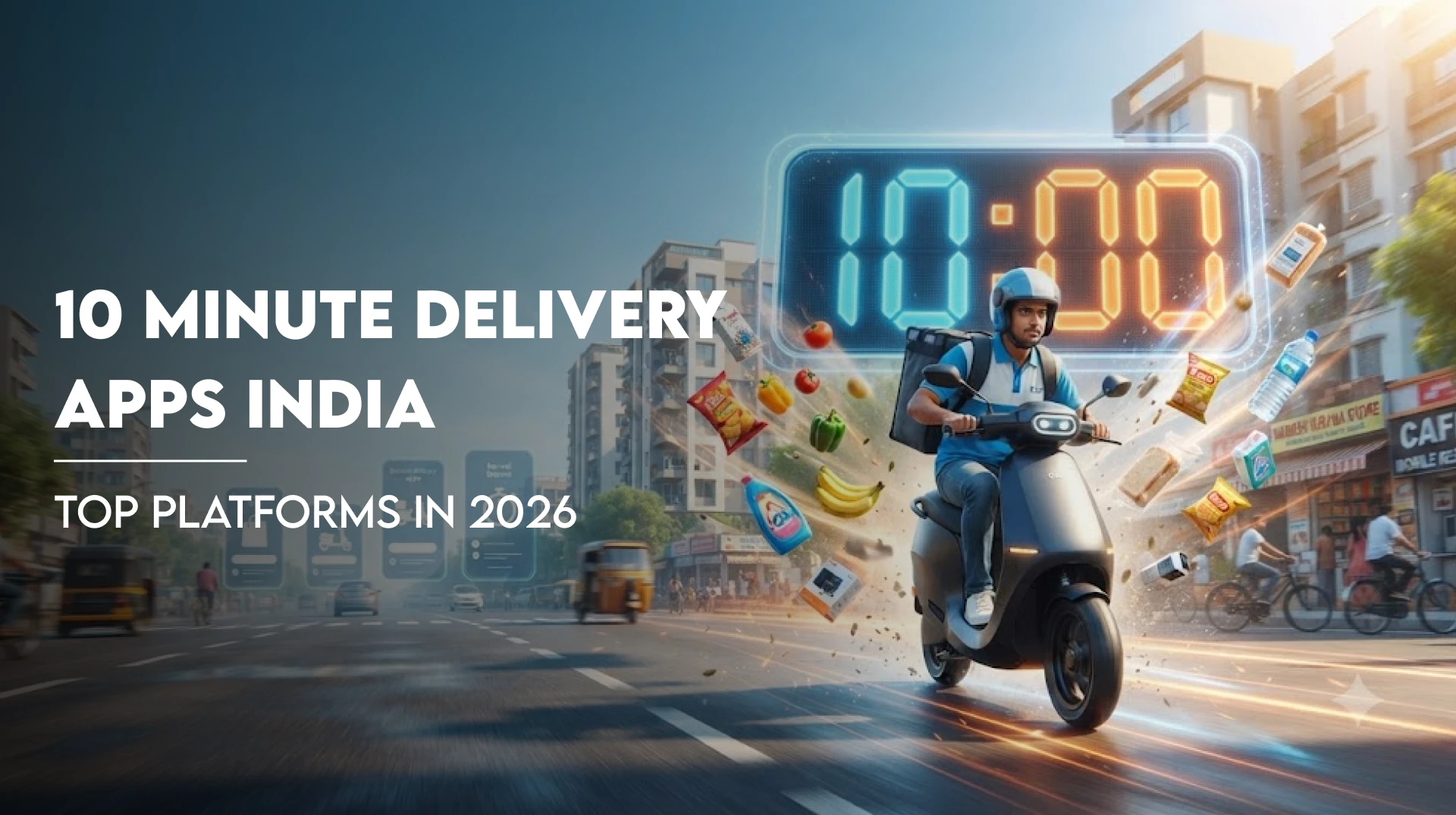
- 10 minute delivery apps india continue to grow through dark store networks and dynamic delivery models despite the shift away from guaranteed 10-minute promises.
- Blinkit, Zepto, Swiggy Instamart, Flipkart Minutes, Amazon Now, and BigBasket are leading India’s quick commerce market.
- The industry is expected to reach USD 47 billion by FY30, driven by rapid expansion into Tier 2 and Tier 3 cities.
- Businesses entering quick commerce need scalable technology, efficient inventory management, and optimized delivery operations.
- Long-term success depends on balancing customer convenience, operational efficiency, and rider safety rather than focusing only on delivery speed.
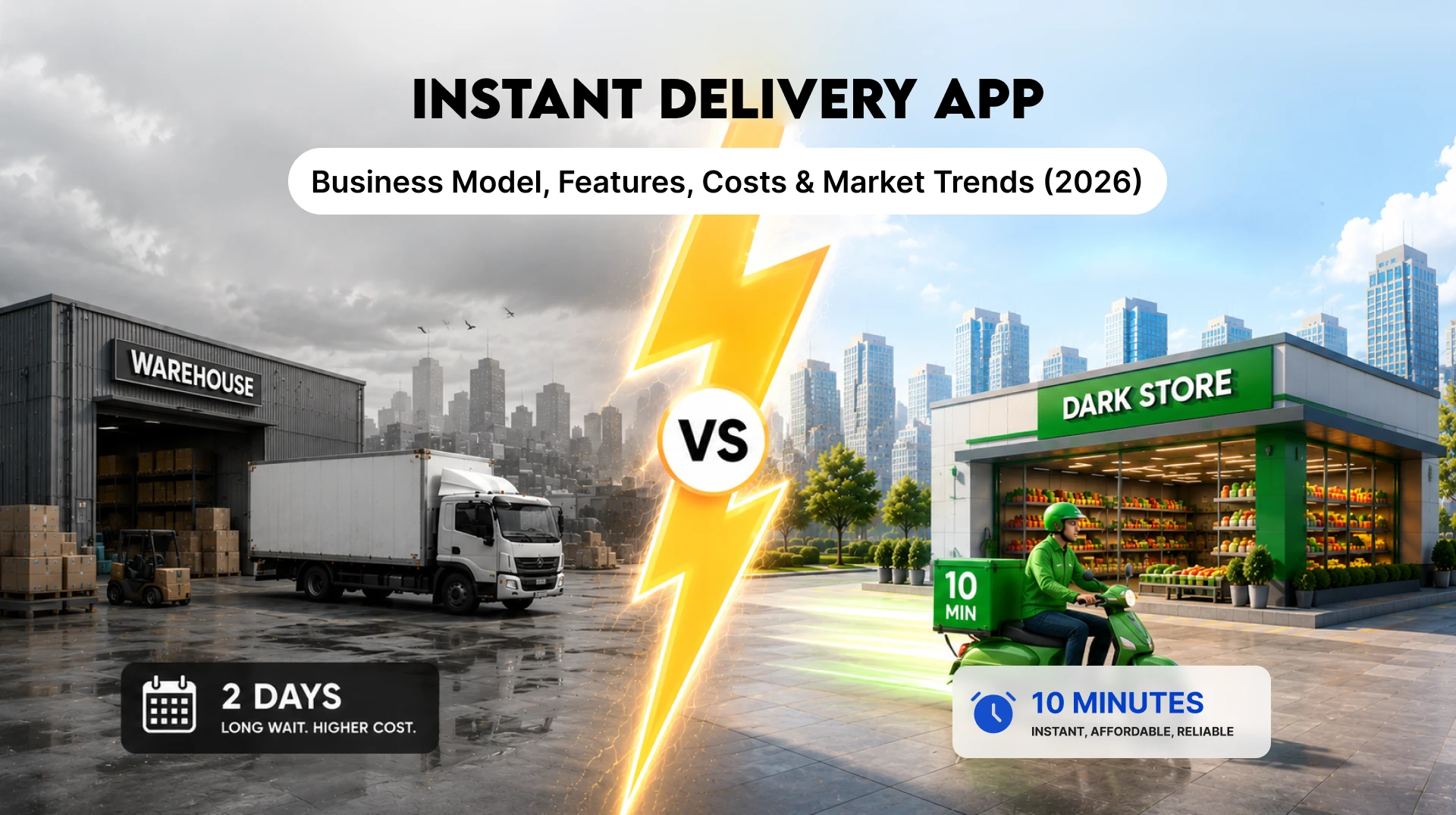
The world of on-demand grocery, medicine, snacks and basic daily essentials buying is being completely revamped, by the rapid rise of 10 minute delivery apps India. Instead of planning purchases days ahead, consumers now expect everyday items to arrive within minutes. This shift has pushed retailers to rethink inventory management, logistics, and customer service.
Most platforms no longer advertise 10-minute delivery. However, quick commerce continues to grow rapidly. Strategic dark stores and efficient rider networks still enable fast deliveries across many Indian cities. To begin, businesses looking to explore this market always see customer expectations and operational viability, and our perspective is to understand those changing demand patterns before we strategize the right technology.
In this guide, learn more about the 10 most used 10 minute delivery apps users in india in 2026, the reason behind delivery platforms changing their branding, the market trends right now, why rapid deliveries are challenging and what businesses need to learn before entering the quick commerce space.
What Are 10 Minutes Delivery Apps in India?
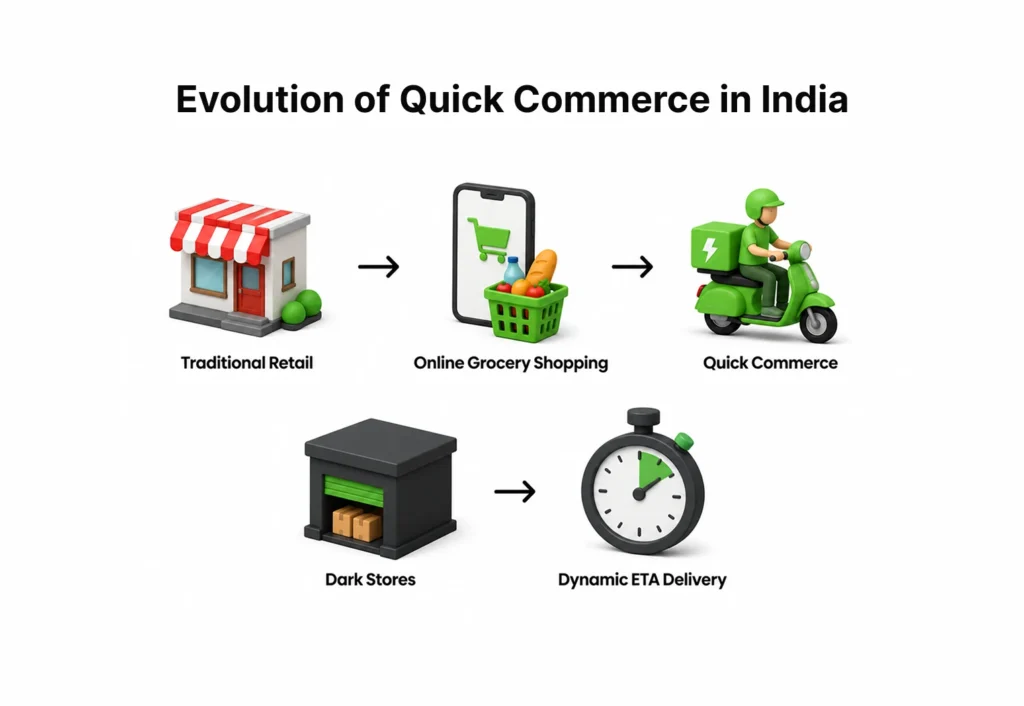
Quick commerce is one of the fastest-growing sectors of India’s digital economy. Although guaranteed 10-minute delivery is no longer promoted, the infrastructure continues to support rapid deliveries. The infrastructure powered 10 minute delivery apps India continues to help in fulfilling orders mostly within 60 minutes or less by leveraging technology to optimise things like logistics and location-specific inventory.
Unlike traditional ecommerce, quick commerce stores products in nearby fulfillment centers, within quick commerce platforms well-known items are saved in small fulfillment centers near to residential areas. This reduces travel distance and speeds up deliveries.
If you are investigating how similar platforms are constructed, learning the basics of an instant delivery app can help clarify the tech, logistics, and customer-experience foundations of modern quick commerce services.
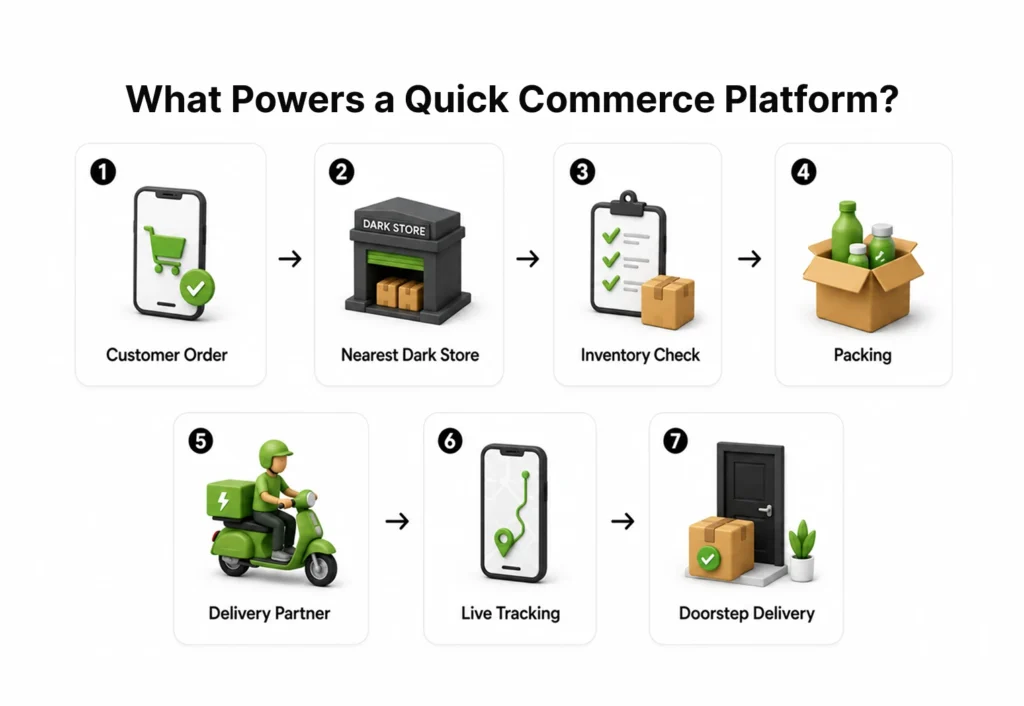
How 10 Minute Delivery Apps in India Work
Every order follows a streamlined fulfillment process. When a customer orders, the platform finds the nearest dark store with available supply. Store staff pack the order quickly. The system then assigns the nearest available delivery partner.
Route optimization helps riders choose the fastest available path. Advanced route selection enables users to select the fastest route based on different traffic participants and the distance of delivery. Many orders still arrive within 20 minutes because products are stored close to customers.
For instance, some businesses venturing into this market might choose niche solutions offered by an On demand quick commerce app development company, which combine inventory, order management, payment processing, and real-time tracking, basically putting everything under one umbrella.
Why 10 Minute Delivery Apps India Are Popular
The way of consuming has transformed a lot in the last couple of years. Many customers no longer wait until the weekend to buy household essentials. Instead, they place orders whenever they need groceries or daily essentials.
Fast delivery encourages smaller but more frequent purchases. Customers do not have to maintain large inventories at home; Products can be received almost immediately in the case of an emerging need. Quick commerce has become a part of everyday life for busy professionals, students, or families living in urban areas rather than just an occasional convenience.
This rising demand is further fuelling investments in specialised fulfilment networks to enable faster turnaround time, variety of choices and better customer experiences across India’s quick commerce space.
Why 10 Minute Delivery Apps India Stopped Promoting the 10-Minute Promise
Ultra-fast delivery has defined India’s quick commerce industry for years. Companies competed by promising deliveries within 10 minutes. Eventually, rider safety issues, difficult-to-meet delivery timelines, and increased consumer scrutiny transformed the message behind such services.
Currently, ten minute delivery apps india keep on making quick deliveries today, but the majority of platforms wish to show dynamic estimated arrival times rather than fix promises.
Government Rules Affecting Quick Commerce Apps
Even, in January 2021, Union Labour Ministry directed quick commerce platforms to desist from advertising inflexible 10-minute deliveries. The decision followed concerns about rider safety and delivery pressure.
The government stressed responsible operations that serve their customers fast while also protecting workers, instead of merely just faster. It also opened up broader discussions around issues in the gig economy, such as fair pay, working conditions and access to social insurance.
More sophisticated routing and dispatch systems are a must for businesses running their own delivery networks. Logistics tracking software features, like live GPS tracking, intelligent route optimization, and delivery monitoring, help improve operational efficiency without putting pressure on the riders.
How Quick Commerce Platforms Changed Their Delivery Strategy
The industry’s response was swift. A few top-performing platforms refreshed their messaging to highlight a more holistic customer experience instead of doubling down on a set delivery time.
For example:
| Platform | Previous Positioning | Current Positioning |
| Blinkit | “10,000+ products delivered in 10 minutes” | “30,000+ products delivered at your doorstep” |
| Zepto | “10-minute grocery delivery” | “Groceries in minutes” |
| Swiggy Instamart | Fast delivery messaging | “Groceries and More” |
| Flipkart Minutes | 10-minute branding | Focus on convenience and availability |
| BigBasket | Continued highlighting fast grocery delivery in some markets | Dynamic positioning based on location |
Although the branding has changed, the underlying technology remains the same. Fire and forget it with dense networks of dark stores, smart inventory allocation and regional fulfillment still get us deliveries under than in 15min in many cases depending on weather you are getting foodies (meals) or groceries.
It shows an overall maturing of the industry in which sustainable operations, customer trust and long-term growth become as important as raw delivery speed.
Top 10 Minute Delivery Apps India Users Prefer in 2026
While companies have dialed back their promises of guaranteed 10-minute deliveries, multiple platforms remain the dominant players in India’s quick commerce market, with large dark store networks, wide product catalogs, and effective delivery capabilities. These services remain the best available for consumers looking for speedy delivery to their door.
Blinkit
Blinkit is top, with a market share of around 40 to 45 percent in India’s quick delivery arena in 2026. It operates more than 2,200 dark stores across 200 cities. This network supports hundreds of millions of orders each quarter.
Customers can order groceries, electronics, personal care products, and household essentials. With a wide range of inventory and its embattled, dense fulfillment network, it is able to deliver quickly in key urban centers.
With its continued investment in adding NEW product categories, Blinkit is firmly cementing its position as a leader and one of the most heard names in 10 min delivery apps india.
Zepto
And Zepto has quickly become one of the big competitors in quick commerce. The platform operates over 1,100 dark stores in dozens of cities and has earned a reputation for rapid grocery deliveries and an innovative shopping experience.
It offers a wide range of products (fresh vegetables, dairy, packaged foods, beverages, household items, and essentials). The company is also diversifying into electronics and lifestyle products to boost average order size.
Zepto continues to be a formidable player in India’s quick commerce space with robust revenue growth and ongoing expansion.
Swiggy Instamart
It also leverages on the existing customer base and the delivery infrastructure of Swiggy Instamart. NetMEd is a pure grocery and convenience player, and although it has lost share to Blinkit and Zepto in last mile delivery, it still has millions of customers every day on its platform buying through a huge selection.
Users usually prefer to have both food ordering and grocery shopping in one app. It also continues to scale into personal care, home essentials, and packaged foods.
BigBasket Now
BigBasket uses its long experience in grocery retail to strengthen its quick commerce service. Whereas several rivals altered their marketing language and tone, BigBasket kept focusing on fast grocery delivery in large parts of the country in the initial months of 2026.
Having great strength with plethora of fresh produce, dairy, high-end grocery items, organic products etc and delivery options for specific time slots without compromising on quick fulfilment.
This mix customers that value not only speed but also more grocery assortment.
Flipkart Minutes
Flipkart Minutes has expanded rapidly across metropolitan and emerging cities. It has groceries, electronics, personal care products, stationery, household supplies and basic daily needs on the platform.
Among the most important factors of the plan is its efforts to expand into Tier 2 and Tier 3 cities where average order value is regularly much higher than in the biggest Metros. This regional growth then aligns with Flipkart’s long-term quick commerce ambitions.
Amazon Now
Amazon Now: Amazon is slowly establishing its footprint into India’s speedy commerce sector. The service, which is continuing to expand into new cities and offer new products, benefits from Amazon’s supply chain know-how.
It specializes in groceries, home needs, packaged foods, beverages, personal care products, and select home items. Amazon now is likely going to be an even bigger competitor, however, as its fulfillment network expands.
Quick Comparison of Leading Platforms
| Platform | Primary Categories | Estimated Delivery | Coverage | Key Strength |
| Blinkit | Groceries, electronics, essentials | Minutes (ETA based) | 200+ cities | Largest market share |
| Zepto | Groceries, fresh produce, daily essentials | Minutes (ETA based) | 66+ cities | Rapid expansion |
| Swiggy Instamart | Groceries, household items | Minutes (ETA based) | Major cities | Strong ecosystem integration |
| BigBasket Now | Fresh groceries, premium products | Minutes (location dependent) | Selected cities | Trusted grocery brand |
| Flipkart Minutes | Groceries, electronics, essentials | Dynamic ETA | 130+ cities | Tier 2 and Tier 3 expansion |
| Amazon Now | Daily essentials, groceries | Dynamic ETA | Expanding network | Supply chain capabilities |
Learn more about the biggest food delivery app companies in india to compare food delivery and quick commerce platforms.
Likewise, enterprises launching digital ordering experiences must understand the fundamentals of Best Food Delivery website development, especially the architecture for integrating ordering, payments, inventory management and delivery operations into a single platform.
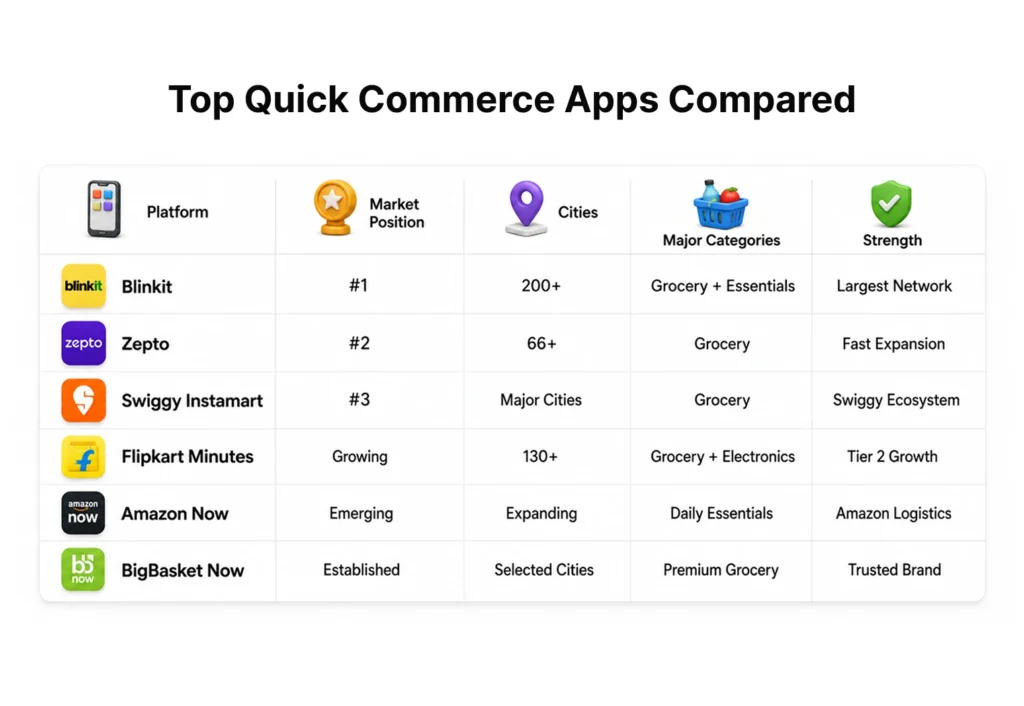
10 Minute Delivery Apps India Market Size and Growth
Also read: How India’s Quick Commerce Sector Transformed a Convenience Service Into One of Digital Retail’s Fastest-Growing Segments By that time, consumer demands for instant gratification are putting pressure on businesses who are already heavily investing in infrastructure, inventory and technology to keep up. This trend of 10 minute delivery apps india is part of this larger change in online shopping habit.
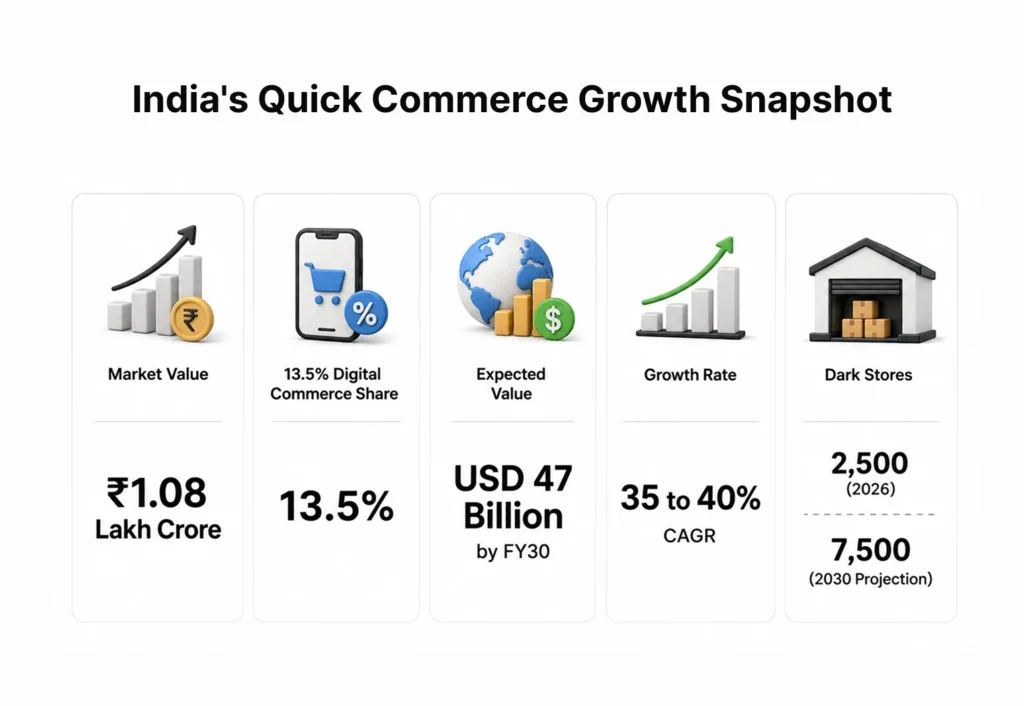
Growth of Quick Commerce in India
The fast commerce market in India has become a ₹1.08 lakh crore section, valued at over USD 11 billion. It now represents about 13.5% of India’s digital commerce market in the country, underscoring just how rapidly consumers have turned to on-demand purchasing.
According to industry analysts, the market is expected to scale at a CAGR of 35% to 40% between FY25 to FY30. At this pace, the segment could touch USD 47 billion by FY30, capturing 25%-30% of the overall online retail GMV of India.
This growth is being driven by a number of factors:
Rising smartphone penetration
Improved digital payment adoption
Increasing demand for convenience
Tier 2 and Tier 3 city expansion
Broader product categories beyond groceries
These developments suggest that quick commerce is broadening past just city grocery supply. It is slowly emerging as a critical channel for day-to-day retail purchases.
To take advantage of this opportunity, businesses usually invest in scalable digital platforms built by an expert Mobile App Development Company that supports inventory management, real-time order processing, and high transaction volumes.
How Dark Stores Power Quick Commerce Apps
It is the dark store, those small fulfillment centers close to residential neighborhoods that power the speed behind this quick commerce. These facilities are dedicated to processing online orders and quickly sending them out, unlike traditional retail locations.
India has around 2,500 dark stores as of early 2026 and is expected to grow to 7,500 by 2030. This expansion will enable more deliveries to be made while also shortening travel distances for the delivery partners.
These major investments continue to stay flowing into this infrastructure:
| Platform | Current Expansion Status |
| Blinkit | More than 2,200 dark stores across 200+ cities |
| Zepto | Over 1,100 fulfillment centers across 66 cities |
| Flipkart Minutes | Around 1,000 micro-fulfillment centers with plans for further expansion |
| Amazon Now | Expanding its dark store network into nearly 300 cities |
Dark stores offered companies a way to fast delivery speeds while expanding the availability of products. With anticipated market growth, there is further scope of competition coming not just on delivery times but on pricing, product assortment, and overall customer experiences as well, as an increasing number of retail supply companies go to this model of fulfilment.
Challenges Facing 10 Minute Delivery Apps India
To ensure the products reach you within minutes requires an intricate network around operations. Customers love speedy deliveries, but business trades-off speed, profitability, the welfare of riders and inventories. It will take time to talk about the 10 minute delivery apps india, but these issues must be taken into account for long-term sustainability as these companies continue to grow.
How Quick Commerce Delivery Partners Are Affected
Delivery partners play a vital role in quick commerce. Riders complete multiple deliveries every day while managing traffic and delivery timelines between 12 and 20 minutes within 30 minutes and completing 4 to 5 trips throughout the day with traffic.
Earnest distributions, by industry bat measured, huddle up verticals penetrate around ₹35 and ₹55 each sabáng but shipment, betting delivery, level and lark grow from sentence to zero. To achieve earnings of about ₹25,000 to ₹30,000 monthly in cities like Delhi NCR, most riders state that, they regularly do 30 to 35 deliveries a day.
Despite industry growth, worker welfare remains a major concern. Many gig workers still lack health insurance and long-term social security. These challenges have attracted more focus from policymakers and industry actors.
By establishing better route planning, vehicle utilization, and dispatch management, businesses that operate delivery fleets on their own find efficiency increases. Fleet Management Software Development Cost varies, however understanding the trends will allow organizations to build solutions that up-boosts deliveries while contributing to ecological viability.
Business Challenges in Quick Commerce Operations
Getting products to you in a matter of minutes is not as simple as a rider noting your proximity. Companies have to maintain proper inventory, keep products stocked in different dark stores, and also have to maintain order fulfillment in real-time.
We try to cover some of the largest operational challenges:
Keeping track of inventory large numbers of fulfillment centers
Managing stock replenishment without overstocking
Finding a balance between delivery speed and operating costs
Reducing failed or delayed deliveries
Dealing with volume surges during holidays and Sunday afternoon shopping
Increasing customer retention with cost-effective acquisition
Profitability remains a key theme as well. Every order requires investment in warehousing, delivery, technology, and customer support. Companies now focus more on efficiency than delivery speed alone.
Having strong operational visibility is key to making this balance. Modern platforms continue to rely more and more on highly sophisticated logistics tracking application options like live order tracking, route optimization, inventory sync, and real-time analytics to help ease fulfillment while maintaining the level of service.
Of course the quick commerce business will last only if you are able to combine speed of response with effective way of doing business, a sustainable way of managing your workforce and consistent customer satisfaction.
Essential Features of a Quick Commerce App
On a successful quick commerce platform, the entire process is completely seamless for the customers but the businesses must have full control over the operations. These days, customers expect a seamless experience when shopping for products; they want easy browsing, secure payments, and real-time order tracking. Simultaneously, businesses require centralised access to track inventories, delivery partners, order processing, and sales performance through a single dashboard, instead of toggling between multiple systems.
The platform further enhances engagement and encourages repeat purchases with features like personalized offers, customer reviews, and instant notifications. Rather than integrating all potential features at once, several businesses focus on those functions that boost the user experience directly and evolve the platform from what end users share in terms of needs and performance.
Custom mobile app development empowers businesses with more flexibility to add new features with the changing needs of customers instead of depending on the limitations of ready-made solutions.
Choosing the Right Quick Commerce Development Strategy
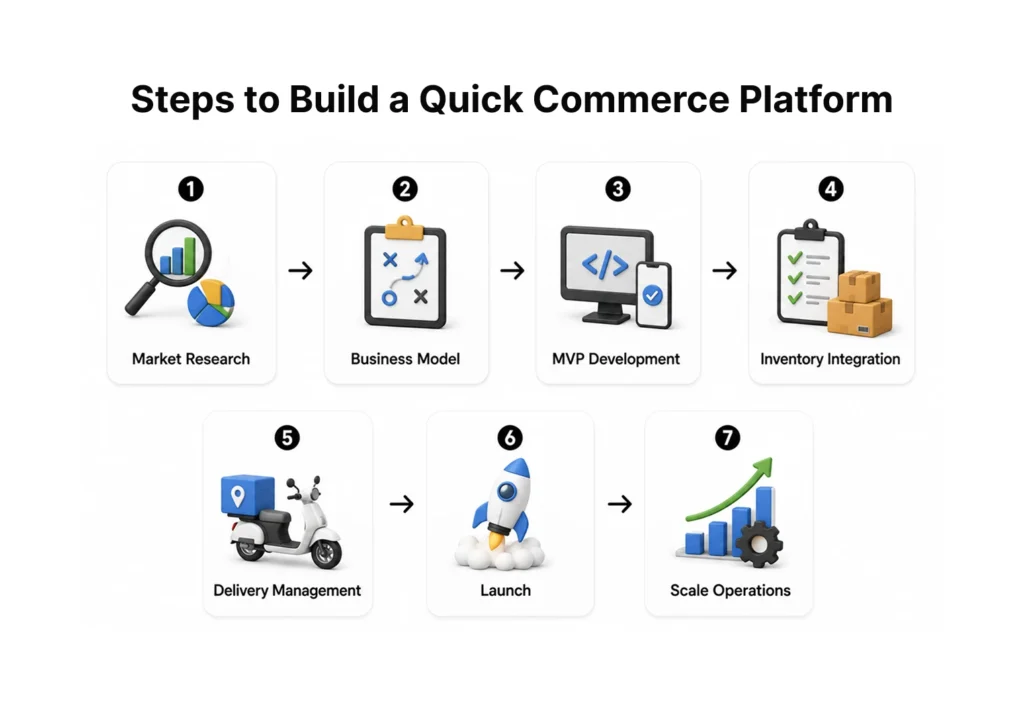
The success in launching quick commerce involves making pragmatical decisions as you germinate the business. When startups start out, they have a fairly narrow product, usually just the core shopping and delivery experience. This enables them to validate market demand, customer behavior, and operational pains before diving into deeper functionality.
Which is why so many founders follow the strategy we talked about in Building MVP Mobile Apps. Initiating with an MVP reduces the development cost while providing significant insights that help you improve in the future.
New features can also be added in a structured way via a development roadmap as the firm evolves. In the above, understanding the app development lifecycle explained helps businesses to plan each stage carefully with requirement gathering, UI designs, testing, deploy and maintenance for the longer run. The phased implementation approach mitigates technical risks and ensures that the platform can scale with growing volumes of orders and customer expectations.
Future of 10 Minute Delivery Apps India
India’s quick commerce is gearing up for a second phase of growth Initially, the competition was to deliver groceries in the shortest possible time, but the agenda has expanded since then. Brands are diversifying their categories, enhancing their operational excellence and making their way to customers in tier II and tier III cities. Consumer expectations are changing the way 10 minute delivery apps india are going to take an even bigger piece of a bigger pie of what the retail ecosystem in the country looks like following the pandemic.
Expansion of Quick Commerce Apps Beyond Metro Cities
Quick commerce services were primarily focused in kind of cities like Bengaluru, Delhi, Mumbai, Hyderabad, Chennai in first couple of years. However, that trend is changing. Increasing internet penetration coupled with rising digital payments and purchasing power of the consumers is making Tier 2 and Tier 3 Cities a new investment haven for companies.
What is interesting is that the average order values in smaller cities are reported to be higher than metros on some of the platforms. In these regions, consumers tend to order across a greater breadth of household essentials within one order, making quick commerce an enticing business model far beyond the traditional conurbation scope.
To facilitate this growth, organizations are unrolling larger dark stores that are close to the residential areas where the businesses operate, allowing for better last mile deliveries at the same, economy of scale.
What Businesses Should Expect from Quick Commerce Growth
The future of quick commerce and the next phase of its evolution will come from customer experience and not just from delivery time. Consumers are expectation reliable product availability, accurate delivery estimates, competitive pricing, and responsive customer service. Brands that continue to meet these expectations are able to sustain customer loyalty for the long-run.
Profitability is a persistent challenge that will need to be addressed as well. They will likely have to overhaul inventory management and reduce fulfillment costs while also improving speed, without sacrificing service. In addition, regulatory compliance and rider welfare will likely receive more attention as the industry continues to mature.
If you are a business looking to enter this space, onboarding an experienced On demand quick commerce app development company can help easily build a scalable platform that has the ability to handle all aspects of order management, real time tracking and can be lead to future expansion.
The future of quick commerce in India will not only be determined by speed, but rather by convenience, operational excellence and the ability to fulfill the promise of consistently serving every city of every size.
Conclusion
The trajectory of 10 minute delivery apps india mirrors the rate at which our expectations of the consumer in may have changed. That UncleFred has dismissed ads for guaranteed 10 minute deliveries is long ago, and dark stores aren’t doing much than ever using large store networks, advanced logistics and wider product ranges to keep quick commerce evolving.
It has also proven the point that convenience is still the most value-addition behind the online order, with front-running names like Blinkit, Zepto, Swiggy Instamart, Flipkart Minutes, Amazon Now, BigBasket, etc., leading platforms in the domain. Simultaneous, most of the industry is putting greater emphasis on sustainable growth, rider safety, and operational efficiency rather than just on fast delivery.
This creates an opportunity for businesses to quickly gain a foothold in a rapidly growing new market, with a quick commerce platform planned for at least up to date info till October 2023. The key to success will be the ability to identify customer expectations, make scalable technology investments, and deploy a fulfilment architecture that optimally aligns urgency with long-term profitability.
With digital commerce in India maturing further, quick commerce can emerge from a premium mode of shopping to a standard shopping channel. Organizations able to embrace these shifting expectations now will find themselves in prime position to compete for years to come.
FAQs About 10 Minute Delivery Apps India
1. Is India Banning Store-to-Home 10-Minute Delivery?
No. Nothing, the Indian government has not banned quick commerce of fast deliveries. Rather, it told platforms that they must cease promoting unqualified 10-minute delivery promises, citing rider safety and working conditions. Companies today typically show moving estimated delivery dates based on the customer’s location and the item order.
2. Deliveries are still made in 10 Mins right?
In many cases, yes. Deliveries can also reach them in 10 minutes or even less if customers are near a dark store and the products ordered are available. Whereas previously platforms could offer a guaranteed time-frame, this is now dependent on traffic, weather, order volumes and distance, so the delivery time-variable, much like the restaurant takeout experience.
3. What is the largest quick commerce app in India?
As per the estimates, Blinkit has emerged as the largest quick commerce player in India, beating others by a significant margin. The largest market share, with thousands of dark stores operating across 200+ cities. Some of the other major players are Zepto, Swiggy Instamart, BigBasket Now, Flipkart Minutes, and Amazon Now.
4. Monetisation of quick commerce companies?
These companies have revenue streams coming from multiple sources rather than just product sales alone. Revenue is generated from delivery fees, platform fees, payments from brands for promotions, and advertising partnerships, membership services, and markups on the products sold through their platforms. Gain Even Greater Operational Efficiencies As you take on more volume, improving the efficiency of your operational execution is just as critical to profitability.
5. What would be the earnings of delivery partners?
In this scenario, earnings depend on the city in which one works, the platform used, demand, and quantity of deliveries performed. Base pay typically varies between ₹35–55 for each delivery. Most delivery partners earn a higher salary each month through performance incentives, peak-hour bonuses and completing surplus orders during peak hours.
6. Can small businesses start their own quick commerce platform?
Yes. With the right technology and operational planning, small businesses, supermarket chains, pharmacies, and local retailers can create their own quick commerce platform. Mostly, starting with one delivery area and scaling slowly is more realistic than starting in different cities in day 1. It is really a puzzle; having a scalable platform, being able to manage the Inventory efficiently, having reliable delivery operations are always valued greater than promising to deliver the fastest delivery time and all that jazz.