Key takeaways
- An on demand quick commerce app development company builds three synchronized systems: the customer app, the delivery partner app, and the admin dashboard.
- Real-time inventory sync, not delivery speed alone, is what actually makes 10-minute delivery possible.
- A quick commerce MVP typically costs a lower-to-mid five-figure USD budget and takes four to five months from discovery to launch.
- Flutter, React Native, Node.js, Go, PostgreSQL, Redis, and Kafka form the core of most modern quick commerce tech stacks.
- Choosing a development partner with real experience in inventory sync and delivery routing matters more than picking the cheapest quote.
Three years ago, “quick commerce” wasn’t a line item in most founders’ business plans. Now it’s the thing investors ask about first. Grocery brands, pharmacy chains, electronics retailers, even florists, are all asking the same question. Can we deliver in 10 to 30 minutes? And can we do it without losing money on every order?
The honest answer is that most can’t. Not without the right technology underneath. Quick commerce looks simple from the customer’s side: tap, pay, receive. Underneath that simplicity sits a genuinely hard engineering problem. Real-time inventory across dozens of dark stores. Delivery routing that reacts to traffic in seconds. A backend that doesn’t fall over during a lunch-hour order spike. This is exactly where the choice of development partner stops being a procurement decision and starts being a business risk decision.
This guide walks through what quick commerce actually requires to build. What it costs. How long it takes. And what separates a platform that scales from one that stalls at 200 daily orders. We’ll also touch on how a Mobile App Development Company approaches this differently than a general software vendor, since the operational demands here are unlike almost any other app category.
What Is an On Demand Quick Commerce App Development Company?
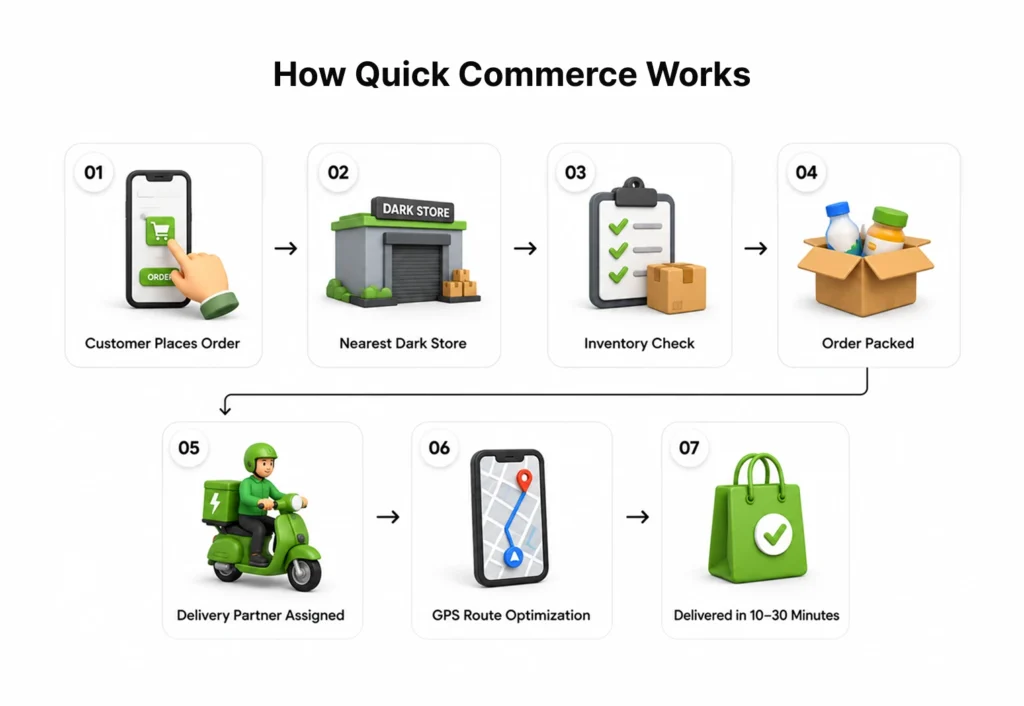
An on demand quick commerce app development company builds the software layer behind ultra-fast delivery. That means the customer app, the delivery partner app, and the store or warehouse dashboard. It also means the backend systems that keep all three synchronized in real time. It’s a narrower specialty than general mobile app development, closer in spirit to building air traffic control for grocery orders.
Quick commerce refers to delivery models promising goods within 10 to 30 minutes, as opposed to the same-day or next-day windows typical of standard ecommerce. The category grew out of grocery, with Blinkit, Zepto, and Swiggy Instamart as the most recognizable names in India. It has since spread into pharmacy, electronics accessories, and even quick-turnaround fashion items.
How the Quick Commerce Business Model Works
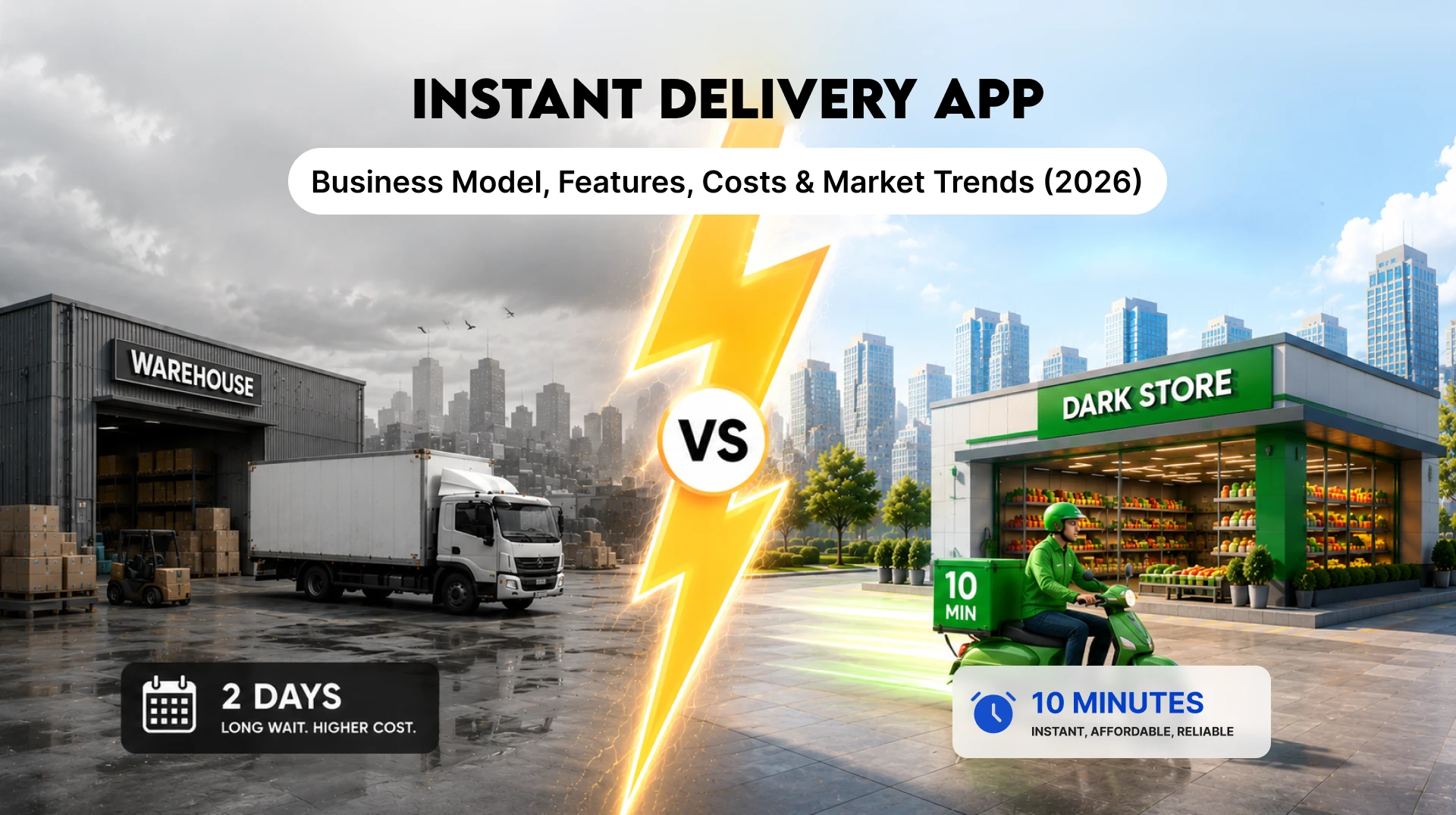
The model depends on proximity, not scale in the traditional retail sense. Instead of one large warehouse serving a city, quick commerce operators run networks of small, densely placed “dark stores.” These are typically 1,000 to 3,000 square feet, stocked with a curated SKU set, and positioned so no customer sits more than a 2 to 3 kilometer radius away. Orders route to whichever dark store can fulfil and dispatch fastest. A delivery partner gets assigned before the picker has even finished packing the bag.
That’s the operational side. The technical side is what makes it possible. Inventory has to reflect real stock levels down to the minute. Order-to-store matching has to happen algorithmically. Delivery assignment has to account for partner location, traffic, and current load, all within a few seconds of the order being placed.
Why Speed Depends on Technology Rather Than Delivery Alone
It’s tempting to assume speed is mostly a logistics and staffing problem: more riders, more bikes, faster roads. In practice, the software is usually the bottleneck first. If inventory sync lags by even 90 seconds, a customer can order an item that’s already sold out. That triggers a cancellation, which costs goodwill and, at scale, real revenue. If order-routing logic isn’t optimized, a nearby dark store gets skipped in favor of one three kilometers further away. Those extra minutes break the entire promise.
This is why quick commerce development leans so heavily on cross-platform engineering and distributed backend design, rather than simple CRUD app-building. Our piece on Cross Platform App Development Explained covers these architectural decisions in more depth. Our breakdown of the app development lifecycle explained is worth reading alongside this guide too.
Why Businesses Are Investing in Quick Commerce Apps
Consumer patience for delivery has been shrinking for years, and quick commerce is the clearest evidence of it. Depending on which research firm you ask, the numbers vary, but they all point the same direction. Mordor Intelligence puts India’s quick commerce market at roughly USD 3.65 billion in 2026, growing toward USD 6.64 billion by 2031. IBEF’s estimate for FY25 runs considerably higher, at USD 7–8 billion. That report also cites a growth rate of 110–130% between 2021 and 2025, and projects the segment could reach USD 65–70 billion by 2030. A separate Equirus report cited in Indian retail press pegs quick commerce at roughly INR 1.08 lakh crore in 2026. It’s expanding around 40% year-on-year, more than twice the pace of overall digital commerce.
The spread between these figures says something useful on its own. This is still an early, fast-moving market where even analysts disagree on the exact size. That usually means there’s still real room for new entrants, not a market that’s already been carved up.
A few data points are harder to argue with. The combined dark-store footprint of Blinkit, Instamart, and Zepto grew from 3,405 locations to 5,026 in the space of a year. Grocery and staples still dominate order volume, holding roughly 61% share. But electronics and accessories are now the fastest-growing category. That tells you quick commerce is spreading well beyond its original grocery use case. Tier I metros still generate about two-thirds of order volume, but Tier II cities are growing faster. That matters if you’re building for a five-year horizon, not just next quarter.
None of this means every business should build a quick commerce app. It means the operational and technical bar for entering the category has gone up, not down, as the market matures.
Industries Using Quick Commerce App Development
Grocery remains the anchor category. Pharmacy delivery, convenience retail, pet supplies, and even fresh flowers have adopted the same 10-to-30-minute promise. Electronics accessories, phone cases, chargers, cables, are showing the fastest category growth right now. They’re small, high-margin, and impulse-driven, which suits the quick commerce basket size well.
For founders exploring this space for the first time, our guide on Mobile App Development for Startups covers the earlier-stage decisions. Our detailed breakdown of app development cost is a useful companion once you’re ready to scope a build.
Core Components of a Quick Commerce App Platform
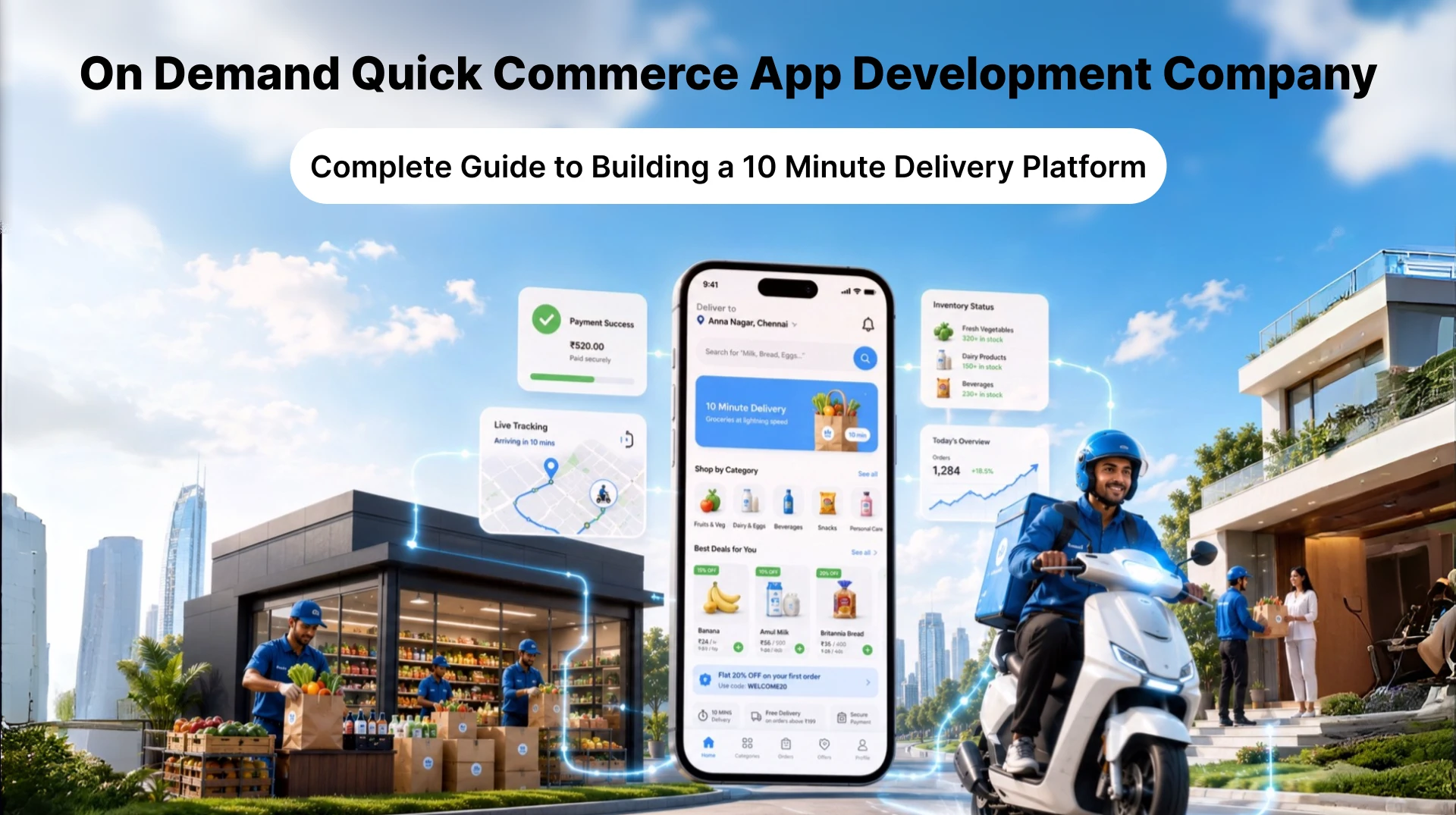
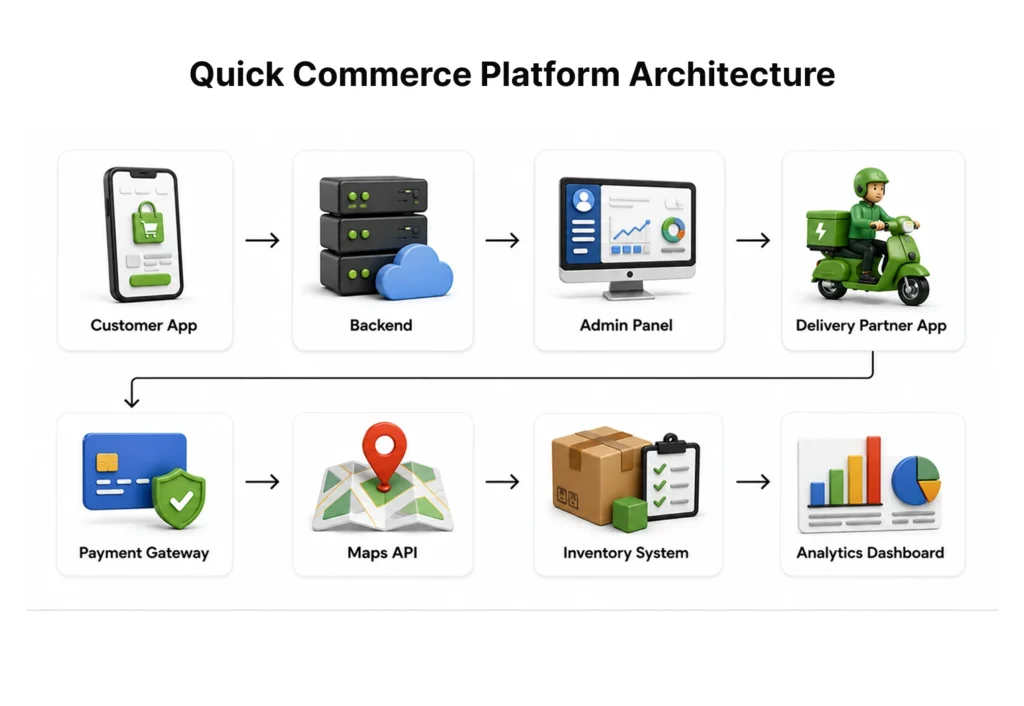
A quick commerce platform isn’t one app. It’s three interconnected systems. Treating any one of them as an afterthought is where a lot of first-time builds go wrong.
Customer App for Quick Commerce Platforms
This is the storefront: browsing, cart, checkout, live order tracking, and delivery scheduling. It needs to feel instant even when the backend is juggling hundreds of concurrent orders. That means aggressive caching, optimistic UI updates, and a search experience that doesn’t choke on typos or partial product names.
Delivery App for Quick Commerce Operations
Built for speed and one-handed use on a moving scooter, not for browsing. Route optimization matters here. So does order batching, assigning multiple nearby orders to one rider when it makes sense. Earnings visibility and offline resilience matter more than visual polish. A partner app that drains battery or loses GPS lock in dense urban areas will cost you riders faster than a slow customer app costs you shoppers.
Admin Dashboard for Quick Commerce Management
The operational nerve center: live inventory across every dark store, order-to-store routing rules, rider assignment overrides, demand forecasting, and store-level performance analytics. This is where store managers catch stock discrepancies before they become cancelled orders. It’s also where operations teams spot which dark stores are underperforming during peak hours.
These three pieces have to talk to each other constantly and in near real time. A change in the admin dashboard, marking an item out of stock, for instance, needs to reflect in the customer app within seconds, not minutes. Getting this right usually depends on solid custom mobile app development practices. It also depends on backend architecture purpose-built for high-frequency updates, an area closely related to logistics tracking software features used in last-mile delivery generally.
Essential Features in Quick Commerce App Development
Feature lists are easy to write and easy to ignore. What matters is understanding why each one earns its place. In quick commerce, a missing feature isn’t a minor UX gap. It’s often the difference between a completed order and a cancelled one.
Customer Features for Quick Commerce Apps
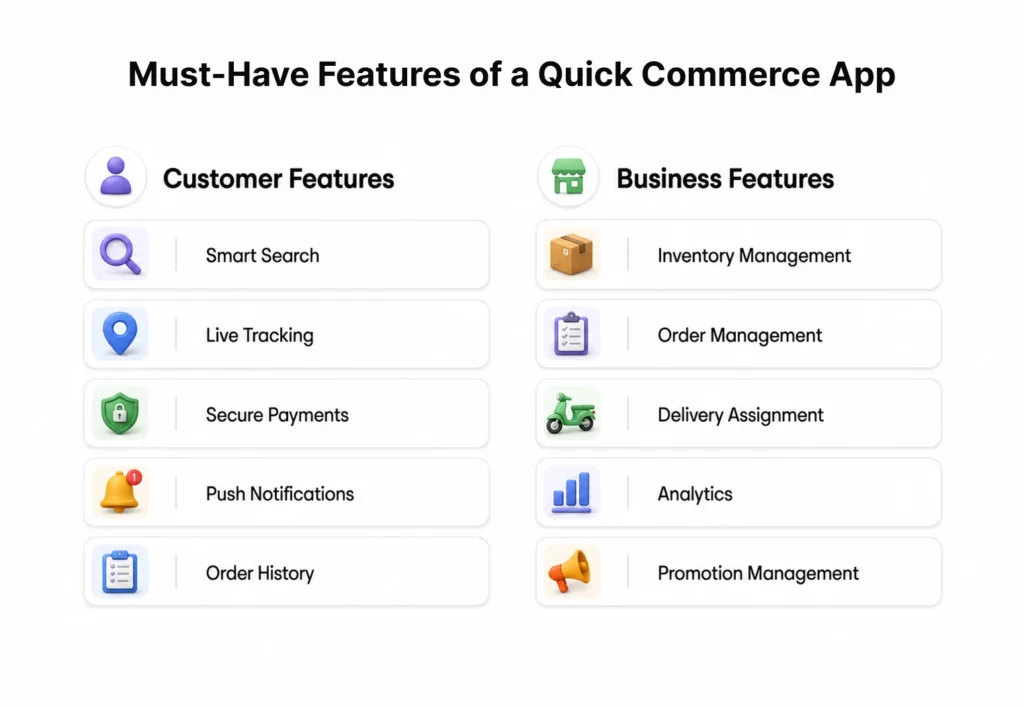
Live order tracking isn’t a nice-to-have here the way it might be for a furniture delivery app. When the entire pitch is speed, customers watch the map almost obsessively during those 10 minutes, and any gap in tracking accuracy erodes trust fast. Smart search needs to handle typos, regional product names, and partial matches, because grocery searches are messier than most product catalogs. Multiple payment options, UPI especially in the Indian market, reduce checkout friction at a stage where every extra tap risks cart abandonment. Delivery scheduling matters less for the core 10-minute promise, but it becomes important once a platform expands into bulk or planned orders. Push notifications, order history, and ratings round out the retention layer. They give customers a reason to reopen the app instead of defaulting to a competitor.
Business Features for Quick Commerce Platforms
Inventory sync across dark stores is arguably the single most technically demanding feature on this list. It’s the one that quietly determines whether the whole platform works. Store management tools need to let managers adjust stock, pricing, and availability without waiting on a developer. Analytics dashboards should surface which SKUs are moving and which stores are lagging. They should also flag where delivery times are creeping upward, before it becomes a customer complaint pattern rather than after.
If you’re scoping a first version rather than a full platform, it’s worth reading our thoughts on Building MVP Mobile Apps before committing to a feature list this long. Most successful quick commerce launches start with a tighter core and expand from there.
Technology Stack Used by an On Demand Quick Commerce App Development Company
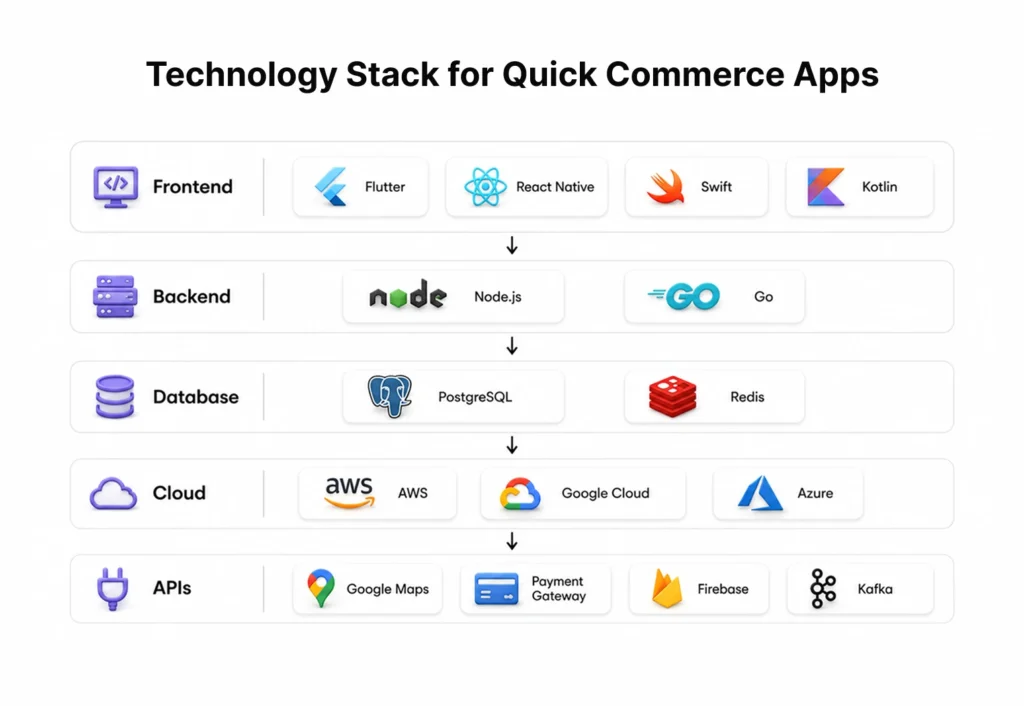
There’s no single “correct” stack for quick commerce. But there are patterns that show up repeatedly, because they hold up under the specific pressure this category creates: high order concurrency, real-time state changes, and a genuine need for low-latency communication between apps and backend.
On mobile, Flutter and React Native are the common cross-platform choices. They let teams maintain one codebase across iOS and Android without doubling development effort. Where performance-critical features demand it, native Kotlin (Android) or Swift (iOS) sometimes get used selectively. For most quick commerce MVPs though, cross-platform is the more practical starting point.
On the backend, Node.js and Go both show up frequently. Node.js is strong at handling many concurrent, I/O-heavy requests, while Go tends to win where raw throughput and low latency matter more, such as in order-routing services. PostgreSQL remains the standard for transactional data like orders and inventory. Redis handles the caching and real-time lookups that keep the app feeling instant. Kafka, or a similar event-streaming system, is what actually keeps inventory, orders, and delivery status synchronized across services without everything grinding to a halt under load.
Cloud infrastructure typically runs on AWS or Google Cloud, chosen for auto-scaling during demand spikes. That matters enormously in a category where lunch-hour and dinner-hour traffic can be five or six times baseline. Payment gateway integration and Maps APIs round out the essential third-party layer, covering routing, geofencing, and delivery zone management.
Mobile Frameworks for Quick Commerce App Development
For most quick commerce builds, cross-platform development is the pragmatic default. It’s faster to ship and easier to maintain, and the performance gap versus native has narrowed considerably in recent years. That said, if your app leans heavily on background location tracking for delivery partners, native development sometimes earns its higher cost through better battery and GPS reliability.
Backend Infrastructure for Quick Commerce Apps
The backend needs to survive traffic spikes without buckling. That usually means designing for horizontal scaling from day one, rather than retrofitting it after a launch-week traffic surge exposes the weak points. Message queues, database read replicas, and caching layers aren’t optional extras here. They’re what separates a platform that handles 10,000 daily orders from one that starts timing out at 2,000.
On Demand Quick Commerce App Development Company Cost Explained
Cost ranges in this space get thrown around loosely. It’s worth being specific about what drives them, rather than just quoting a number.
MVP vs Enterprise Quick Commerce Platform
An MVP covers a customer app, a basic delivery partner app, and a simple admin panel. It generally lands in a lower-to-mid five-figure USD range for most markets, though this varies significantly based on feature depth and team location. A full enterprise-grade platform moves into six figures and sometimes well beyond. That tier adds multi-city support, advanced routing algorithms, demand forecasting, and integrations across ERP or third-party retail systems, so the jump in cost tracks a real jump in scope.
Factors Affecting Quick Commerce App Development Cost
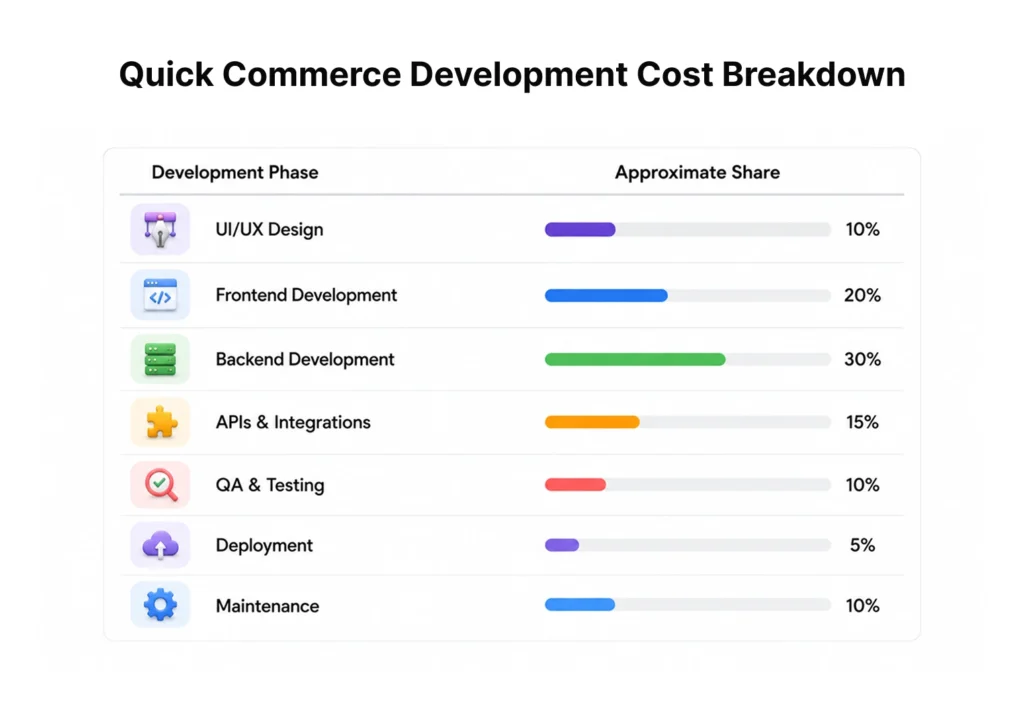
Several factors move the budget meaningfully. The number of platforms involved (iOS, Android, web admin). The complexity of the routing and matching engine. Real-time tracking accuracy requirements. Third-party integrations like payment gateways, SMS, and maps. Post-launch scaling plans. A single-city pilot with one dark store costs a fraction of what a five-city rollout with dynamic inventory across fifty stores requires. It’s usually a mistake to size the initial build for the five-city version before the one-city version has proven the model works.
Maintenance is a line item people underestimate. Budgeting roughly 15-20% of the initial build cost annually for updates, bug fixes, and infrastructure scaling is a reasonable starting assumption, though actual figures depend heavily on order volume growth. If you’re still deciding between a lean first version and a full build, It covers that trade-off directly.
Quick Commerce App Development Timeline
Realistic timelines matter more than optimistic ones. Quick commerce operations are unforgiving of delayed launches. Dark store leases and staff hiring don’t pause while development runs late.
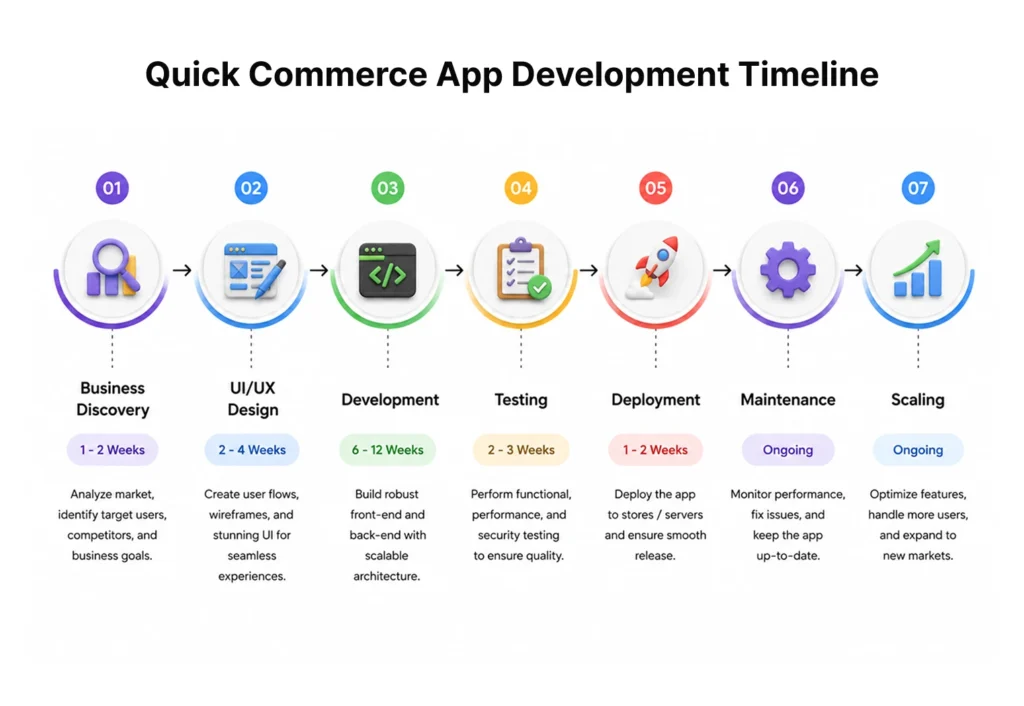
MVP Development Timeline
Discovery and requirements gathering typically takes two to three weeks. UI/UX design for all three apps runs three to four weeks, often overlapping with early backend architecture work. Core development, the customer app, delivery app, and admin dashboard together, generally takes ten to fourteen weeks for an MVP scope. Testing needs two to three dedicated weeks, particularly load testing for concurrent orders. Skipping this is one of the more common, and expensive, mistakes we see. Deployment and initial monitoring adds another one to two weeks. All told, a realistic MVP timeline runs four to five months, not the six-to-eight-week promises that sometimes circulate in sales conversations.
Scaling a Quick Commerce Platform
Post-launch, the priority shifts. Maintenance, performance tuning under real traffic, and iterative feature additions based on actual usage data take over from pre-launch assumptions. Most platforms find their first three months of live data reshape the product roadmap considerably. That’s a good argument for building the initial version with flexibility in mind, rather than locking in every feature before a single real order has been placed.
Business Models for Quick Commerce Apps
Revenue architecture in quick commerce is rarely a single mechanism. Most established platforms blend several.
Delivery fees, sometimes flat, sometimes surge-priced during peak hours, are the most direct lever. Commission on vendor sales works well when the platform hosts third-party sellers rather than operating its own dark stores exclusively. Subscription models offer free or discounted delivery for a monthly fee. These have become increasingly common as a way to lock in repeat customers and smooth out revenue predictability. Vendor plans add tiered listing or placement fees for sellers, another layer for marketplace-style platforms. Advertising and sponsored product placements, the same mechanism that funds much of traditional ecommerce, are increasingly present in quick commerce apps too, as order volumes justify the ad infrastructure.
Choosing a Revenue Model for Quick Commerce
The honest answer is that the right mix depends on your setup. Are you running owned dark stores, a vendor marketplace, or some hybrid of both? Owned-inventory models generally lean harder on delivery fees and subscriptions, since there’s no commission layer to fall back on. Marketplace models can distribute risk across commission and advertising. But they also give up some control over fulfilment speed, a real trade-off in a category built entirely around speed.
Challenges in On Demand Quick Commerce App Development Company
It’s worth being direct about this. Quick commerce is one of the harder categories to build well. Underestimating the operational complexity is the most common reason platforms stall after launch.
Inventory synchronization across dozens of dark stores, each with its own stock fluctuations, is a constant technical challenge, not a one-time integration task. Delivery routing has to account for real-world variables, traffic, rider availability, order batching, that shift minute to minute. Dark store management means deciding which locations serve which pin codes and rebalancing that as demand shifts. It’s as much an operations problem as a technical one, but the software needs to support it flexibly. High concurrent user load during predictable peak windows, lunch, dinner, weekend evenings, can expose backend weaknesses that never show up during normal testing conditions. Peak hour demand specifically tends to reveal whether the routing and inventory systems were actually built to scale, or just built to work in a demo. Operational costs, dark store rent, rider payouts, packaging, remain a persistent margin pressure too. No amount of good software fully eliminates that pressure, though good software can meaningfully reduce waste and inefficiency within that cost structure.
Scaling a Quick Commerce App Efficiently
This is the tension at the heart of the entire category. Growth, more stores, more cities, more SKUs, tends to add complexity that can slow the system down exactly when speed matters most. Platforms that scale well usually invest early in monitoring and alerting. That way, a slowdown in one city or one dark store gets caught and fixed before it becomes a pattern of missed delivery windows.
How to Choose the Right On Demand Quick Commerce App Development Company
This decision carries more weight than picking a vendor for a typical business app. A weak build here shows up directly in cancelled orders and frustrated riders, not just in a slow-loading screen.
Look for genuine industry experience, not just general app development history. Quick commerce has enough operational quirks that a team without prior exposure will relearn expensive lessons on your timeline. Review the portfolio for evidence of real-time systems, not just polished UI screenshots. Assess technology expertise specifically around the backend patterns discussed earlier: event streaming, caching, and horizontal scaling. Ask directly about scalability planning. What happens when you go from one city to five? Post-launch support terms matter more here than in most app categories, because quick commerce platforms need continuous tuning, not a one-time delivery. Security practices around payment data and location tracking deserve scrutiny given the sensitivity of both. Communication style and reporting cadence during development often predict how the partnership will hold up once real operational pressure hits. And clarify ownership, of code, of data, of infrastructure accounts, before signing anything, not after.
Questions to Ask Before Hiring
Worth asking directly: Have you built inventory sync across multiple physical locations before? How do you handle order routing logic, is it custom-built or off-the-shelf? What’s your approach to load testing before launch? What does post-launch support actually include, and for how long? Can you show a system architecture diagram, not just app screens, from a comparable project? Vague answers to any of these are a reasonable signal to keep looking.
Leading Quick Commerce Platforms Shaping the Market
Looking at how established players approach the category is useful. Less as inspiration to copy, more as a study in different strategic bets.
Blinkit, now integrated with its parent company’s broader retail operations, holds close to half the Indian market by some estimates. It has leaned into an inventory-led, private-label strategy that strengthens margins over time. Zepto built its early reputation on aggressive dark store density and has continued expanding its network and category range, supported by ongoing funding rounds. Swiggy Instamart has an advantage most competitors lack: a large existing food delivery user base. It has leveraged that base to scale quick commerce alongside its core business, rather than building demand from scratch.
What’s notable is that none of these three compete on identical terms. Blinkit leans on retail integration. Zepto leans on density and speed. Swiggy Instamart leans on cross-selling into an existing audience. That divergence is a useful reminder. “Build what the market leader built” isn’t necessarily the right strategy for a new entrant with different resources and a different starting audience.
For businesses in adjacent categories, our coverage of Best Food Delivery website development and our roundup of biggest food delivery app companies in india offer more context on how delivery-first platforms have evolved alongside quick commerce.
Future Trends in On Demand Quick Commerce App Development Company
Hyper-personalization is moving from experimental to standard practice. That means tailoring product recommendations, and even dark store assortments, to neighborhood-level buying patterns. Sustainable delivery, electric vehicles, optimized packaging, is gaining ground too, partly from cost pressure and partly from genuine consumer and regulatory expectation. Voice ordering remains more talked-about than adopted at scale, but it’s a natural fit for a category built around minimizing friction. Dark store expansion into Tier II and Tier III cities is one of the more confidently predicted trends across nearly every market report we reviewed, given that Tier I markets are approaching saturation in major metros. Customer retention strategies are shifting from pure discounting toward subscription and loyalty mechanics, a sign the category is maturing past its land-grab phase. And regional expansion, both geographically and across product categories beyond grocery, looks likely to define the next few years more than any single technology shift.
Where the Industry Is Heading
If current growth estimates hold, even the more conservative ones, quick commerce in India is set to roughly double in market size within the next four to five years. What that growth will reward is less about who moves fastest. It’s more about who builds the underlying systems, inventory sync, routing, scalable infrastructure, well enough to expand without the operational cracks that have forced some early entrants to retrench.

Conclusion
Quick commerce rewards businesses that treat the software as core infrastructure, not a feature layer bolted onto an existing retail operation. The market opportunity is real. Growth estimates from multiple research firms agree on that much, even where they disagree on exact figures. But the operational bar for entering it well has risen as the category has matured. Choosing a development partner with genuine experience in real-time inventory systems, delivery routing, and high-concurrency backend design matters more here than in almost any other app category we work on.
If you’re evaluating whether quick commerce is the right move for your business, or you already know it is and need a team that’s built this kind of system before, that’s exactly the conversation worth having before any code gets written.
Frequently Asked Questions About Quick Commerce App Development
1. How much does it cost to develop a quick commerce app?
Costs vary widely based on scope. An MVP with a customer app, delivery partner app, and basic admin dashboard typically falls in a lower-to-mid five-figure USD range. A full enterprise platform with multi-city support and advanced routing can run into six figures or more.
2. How long does development take?
A realistic MVP timeline runs roughly four to five months, covering discovery, design, development, and load testing. Rushed timelines under six to eight weeks usually mean corners are being cut somewhere, most often in testing.
3. Which technologies are commonly used?
Flutter or React Native for cross-platform mobile apps. Node.js or Go for backend services. PostgreSQL for transactional data, Redis for caching, and Kafka for real-time event streaming. AWS or Google Cloud for scalable infrastructure.
4. What are the essential features?
Live order tracking, smart search, real-time inventory sync, multiple payment options, and delivery partner route optimization are the non-negotiables. Everything else can reasonably wait for a later release.
5. Which revenue models work best?
Most successful platforms combine delivery fees, vendor commissions, and subscription plans, rather than relying on a single mechanism. The right blend depends heavily on whether you’re running owned dark stores or a vendor marketplace.
6. Is quick commerce profitable for startups?
It can be, but margins are tight and heavily dependent on order density per dark store. Startups generally have better odds focusing on a single city or category first. Prove the unit economics work before attempting the multi-city scale that larger platforms operate at.