Key Takeaways
- Learn how to identify the Best Software Development Company in Chennai based on expertise, industry experience, and long-term support.
- Compare the top software development companies in Chennai across services, strengths, pricing, and ideal business use cases.
- Understand the key factors that influence software development costs and project timelines for startups and enterprises.
- Explore the essential software development services, from custom business applications to enterprise SaaS solutions.
- Use a practical evaluation checklist to choose the Best Software Development Company in Chennai for your business requirements.
Picking a software development partner used to be a simpler decision. A company had a website, a portfolio, and a sales call, and that was often enough to move forward. That approach doesn’t hold up anymore, particularly given our development process. Projects have grown more complex, budgets are scrutinized more closely, and a bad hire can cost months of rework and a fair amount of internal credibility.
Chennai has quietly become one of India’s most consistent software development hubs, home to global product companies, IT services giants, and a growing number of specialized firms building for startups and mid-sized businesses alike. That density of talent is an advantage, but it also means the market is crowded. Not every company that calls itself a best software development company in Chennai actually operates at that level once you look past the homepage.
What separates a dependable partner from a risky one usually comes down to a few things: whether they understand your business before they touch a line of code, whether their technical practices hold up under real production load, and whether they stick around after launch instead of disappearing once the invoice is paid. This guide walks through what to look for, profiles the firms worth shortlisting in 2026, and lays out realistic pricing so you’re not negotiating blind.
If you’re specifically looking for a partner who builds tailored, business-specific systems rather than templated products, our breakdown of a custom software development company in Chennai covers that angle in more depth.
Why Chennai Has Become a Leading Software Development Hub
Growing Startup and Enterprise Ecosystem
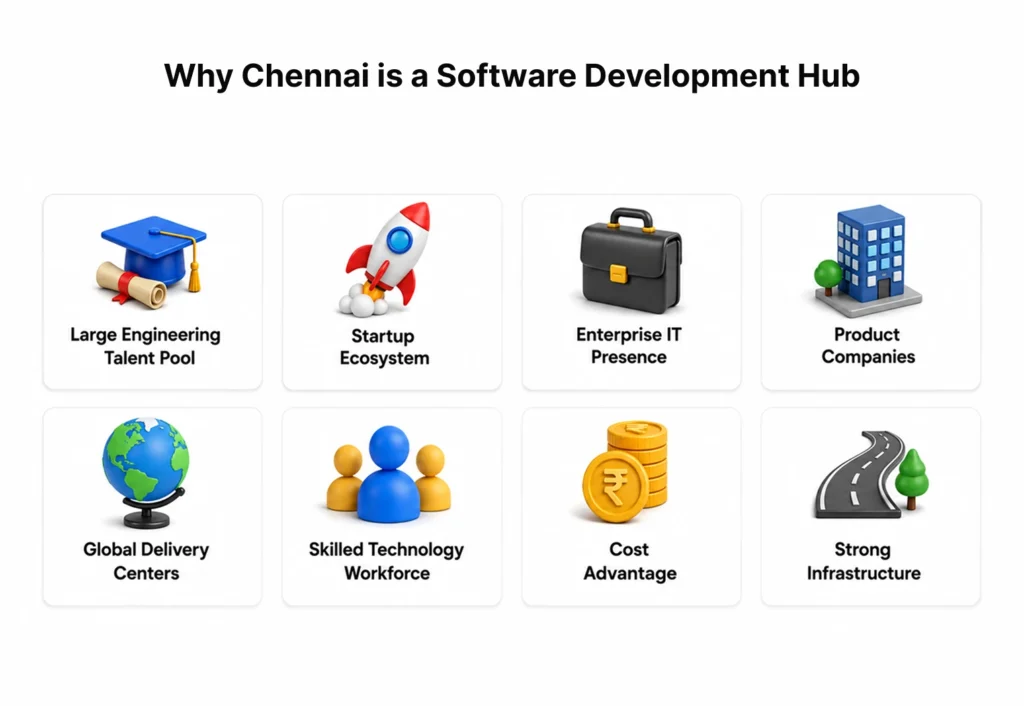
Chennai’s IT corridor along OMR and GST Road houses a mix of global captive centers, mid-size product firms, and a steadily expanding pool of independent studios. The city has produced a deep bench of engineers trained in traditional IT services, which means there’s no shortage of people who understand enterprise-grade delivery discipline. At the same time, a newer generation of founders and CTOs has been building leaner, product-focused teams that move faster than the legacy service model ever could.
That combination matters. Enterprises get access to engineers who’ve shipped large systems before, while startups can find smaller teams willing to move at startup speed without the overhead of a traditional IT vendor. Neither segment dominates; they coexist, and a business shopping for a partner in Chennai today has more range to choose from than it did five years ago.
Industries Driving Software Demand
The demand isn’t evenly spread across sectors. A few industries are pulling harder than others right now:
- Healthcare – patient management, telehealth platforms, and compliance-heavy record systems
- Manufacturing – production tracking, IoT integration, and supply chain visibility tools
- Logistics – fleet management, route optimization, and warehouse software
- FinTech – lending platforms, payment infrastructure, and reconciliation systems
- Retail – inventory, e-commerce backends, and omnichannel order management
- Education – LMS platforms and student engagement tools
- SaaS – multi-tenant products built for global markets, not just local clients
If your project falls under retail or logistics specifically, it’s worth reviewing what a website development company in Chennai or a mobile app development company typically delivers for that kind of build, since the technical requirements differ quite a bit from an internal enterprise tool.
What Makes the Best Software Development Company in Chennai?
Business Understanding Before Technology
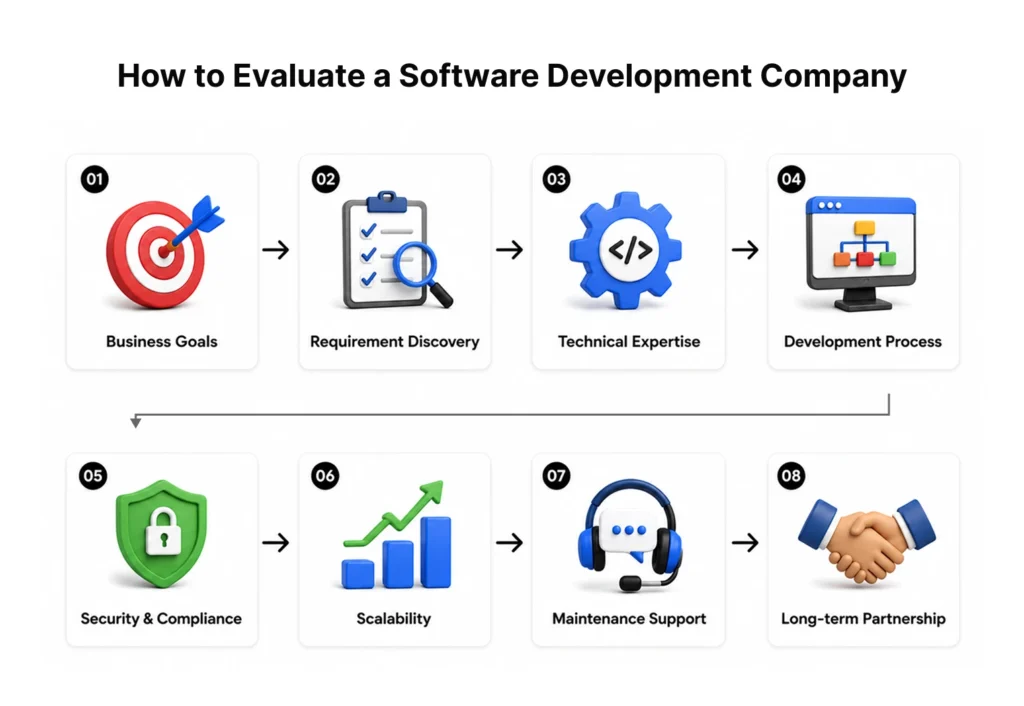
The strongest teams ask uncomfortable questions before they open an IDE. What problem are you actually solving? Who uses this daily, and what do they currently do instead? What happens if this project takes six extra weeks? A company that jumps straight into architecture diagrams without mapping your business process first is usually optimizing for a fast sale, not a working product.
Good discovery looks slow at first. It involves process mapping, honest conversations about scale (are you planning for 500 users or 50,000?), and a willingness to push back on requirements that don’t actually serve the business goal. That friction early on tends to save far more time later.
Technical Expertise That Matters
Past that discovery phase, technical depth becomes the differentiator. A few things worth checking:
- Architecture choices that match your scale, not over-engineered for problems you don’t have yet
- API design that anticipates future integrations rather than being bolted on later
- Cloud infrastructure that’s actually monitored, not just deployed and forgotten
- Security practices baked into development, not added as an afterthought before launch
- QA processes that go beyond manual click-testing
- A support model that survives past the warranty period
Teams building custom web applications or handling UI/UX design services for SaaS products tend to be more transparent about these details upfront, since the complexity of those builds makes shortcuts obvious fairly quickly.
Software Development Services You Should Expect
Custom Business Applications
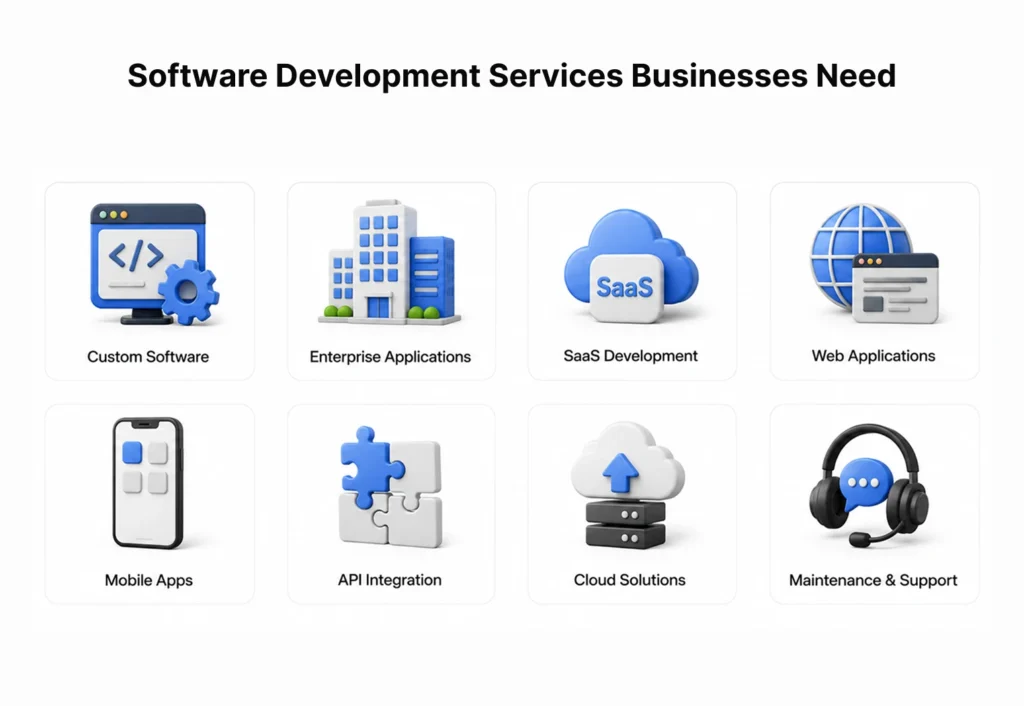
Most Chennai-based software firms handle a core set of business-application work: CRM systems tailored to a specific sales process, ERP modules for manufacturing or inventory-heavy operations, HRMS platforms, and workflow automation tools that replace spreadsheets and manual approvals. This is the bread-and-butter work, and it’s where a lot of ROI gets realized quietly, without much fanfare.
Modern Product Development Services
On the other end of the spectrum sits product-style development: SaaS platforms built for external customers, enterprise portals, customer-facing platforms, and the API integrations that stitch third-party tools together. Post-launch maintenance belongs here too, and it’s often underpriced or ignored during the sales conversation, which is a mistake worth avoiding.
Companies offering an Enterprise SaaS Platform build or cloud-based app development generally price these engagements differently from a standard CRM build, since the ongoing infrastructure and scaling requirements are a different category of work entirely.
Top Software Development Companies in Chennai (2026)
The list below is ordered by a mix of market presence, breadth of services, industry depth, technology capability, and general business fit rather than any single ranking metric. Company sizes and specifics change over time, so treat this as a starting shortlist rather than a final verdict; always verify current capacity and portfolio directly with each firm.
Code Neptune
Overview: Code Neptune is a Chennai-based software development and AI agency offering custom web and mobile application development, AI agent development, and full-stack product engineering for clients across India, the UK, and Canada.
Services: Custom web applications, mobile app development (React Native, Flutter, iOS), AI agent development, SaaS product builds, and technical SEO-integrated web development.
Industries: Retail, professional services, SaaS, and early-stage startups looking for both product and go-to-market technical support.
Company size: Small to mid-size team, founder-involved delivery.
Best for: Startups and SMEs that want a technical partner who understands both engineering and the business context around search visibility and growth, not just code delivery.
Pros: Direct access to senior technical decision-makers, AI-focused capability alongside traditional development, and cross-border client experience.
Possible limitations: As a smaller firm, very large enterprise-scale engagements with heavy compliance requirements may need to be scoped carefully to confirm capacity.
Contus Tech
Overview: A larger product engineering company with an established presence in enterprise software and SaaS delivery.
Services: SaaS product development, enterprise application engineering, and digital transformation consulting.
Industries: Enterprise clients across media, communication, and business software.
Company size: Mid-to-large, with a broader delivery bench than most boutique studios.
Best for: Enterprises needing SaaS-grade engineering at scale with established process maturity.
Pros: Track record with larger, more complex product builds; established delivery frameworks.
Possible limitations: Larger firms sometimes come with slower decision cycles and higher minimum engagement sizes, which may not suit smaller projects.
Ideas2IT
Overview: A product engineering firm known for innovation-driven projects and a global customer base.
Services: Product engineering, R&D-style development, and technology consulting.
Industries: Cross-industry, with a lean toward innovation-heavy product work.
Company size: Established mid-to-large firm.
Best for: Businesses with ambiguous, innovation-stage problems that need strong technical exploration before a clear product spec exists.
Pros: Comfortable working in less-defined problem spaces; experienced with global clients.
Possible limitations: This kind of exploratory engagement often costs more per hour than straightforward build-to-spec work.
Xenovex Technologies
Overview: A firm with a global footprint offering consulting alongside development, with an analytics angle.
Services: Enterprise software development, technology consulting, and data analytics.
Industries: Enterprise and mid-market businesses needing both software and data strategy.
Company size: Established, multi-location presence.
Best for: Companies that want a single partner handling both the software build and the analytics layer on top of it.
Pros: Consulting depth that goes beyond pure development; broader geographic reach.
Possible limitations: Combined consulting-plus-development engagements can blur scope if not defined tightly at the contract stage.
Pyramidion Solutions
Overview: A firm with visible strength in mobile and blockchain development alongside custom software.
Services: Mobile app development, blockchain solutions, and custom software builds.
Industries: Startups and mid-market clients across varied sectors.
Company size: Mid-size.
Best for: Projects specifically requiring mobile-first delivery or blockchain-based components.
Pros: Reasonably strong client feedback; niche technical capability in blockchain, which not every Chennai firm offers.
Possible limitations: Blockchain-specific expertise is valuable only if your project genuinely needs it; it’s not a fit for every use case.
NexBorg Software Solutions
Overview: A firm focused on custom software and progressive web applications, generally serving SME clients.
Services: Custom software development, Progressive Web Apps (PWAs).
Industries: SME-focused, cross-sector.
Company size: Small to mid-size.
Best for: SMEs that need practical, mid-complexity software without enterprise-level pricing.
Pros: SME-friendly engagement style; PWA expertise, which is often underrepresented among smaller studios.
Possible limitations: May have less bandwidth for very large or multi-team enterprise projects.
Smarther Technologies
Overview: A startup-friendly development shop with a focus on mobile apps and affordable engagement models.
Services: Mobile app development, MVP builds.
Industries: Early-stage startups.
Company size: Small.
Best for: Founders validating an idea who need a working mobile MVP without enterprise pricing.
Pros: Lower entry cost; comfortable with early-stage ambiguity.
Possible limitations: Smaller teams typically mean less capacity for scaling support once the product grows past MVP stage.
V-Accel
Overview: A firm oriented toward enterprise software, SaaS, and cloud-native development.
Services: Enterprise software, SaaS platforms, cloud-native architecture.
Industries: Enterprise and growth-stage companies.
Company size: Mid-size.
Best for: Businesses needing cloud-native architecture from the outset rather than retrofitting it later.
Pros: Cloud-native focus aligns well with modern scaling needs.
Possible limitations: Cloud-native builds can carry higher upfront architecture costs, which may not suit tightly budgeted MVPs.
iPower Solutions
Overview: A software development firm serving varied client needs across the Chennai market.
Services: Custom software development, business applications.
Industries: Cross-sector SME clients.
Company size: Small to mid-size.
Best for: Straightforward business-application builds without heavy technical complexity.
Pros: General-purpose capability across common business software needs.
Possible limitations: Less publicly documented specialization compared to firms with a clearer niche, so due diligence on recent project examples matters more here.
Risolutor Technologies
Overview: A startup-focused firm with capability in MVP development, AI/ML, and SharePoint solutions.
Services: MVP development, AI/ML integration, SharePoint development.
Industries: Startups and businesses already invested in Microsoft ecosystem tools.
Company size: Small to mid-size.
Best for: Startups needing a lean MVP or businesses specifically needing SharePoint-based solutions.
Pros: Niche SharePoint capability that’s uncommon among Chennai’s startup-focused studios; AI/ML exposure.
Possible limitations: The SharePoint specialization narrows relevance for businesses outside the Microsoft ecosystem.
How to Compare Software Development Companies
Shortlisting five names from a search result is the easy part. Comparing them properly is where most buyers rush and regret it later.
Technical Checklist Before Hiring a Software Development Company
Before signing anything, dig into:
- Tech stack – does it match your long-term hiring plans, or does it lock you into a niche framework with limited talent availability.
- Architecture – can you ask them to explain their approach in plain language, or does it dissolve into jargon the moment you push back.
- Security – do they have a documented practice, or is it something they’ll “handle if needed”.
- QA – automated testing, or manual click-through before every release.
- Documentation – will you actually own readable documentation, or just a working app with no paper trail.
Business Factors to Compare Before Choosing a Software Development Company
Technical skill without business discipline creates its own set of problems. Also evaluate:
- Communication – weekly updates, or radio silence until a milestone deadline.
- Transparency – will they tell you when something’s behind schedule, or will you find out on delivery day.
- Timeline – is the estimate realistic, or unusually optimistic compared to similar quotes.
- Pricing – fixed-bid, time-and-materials, or a hybrid, and does that model fit your risk tolerance.
- Ownership – do you get full source code and IP rights, or is that ambiguous in the contract.
- Support – what happens in month two after launch, when the warranty period ends.
Firms that also handle a product design agency for startups function or a UI/UX design company for tech companies mandate tend to be more comfortable walking through this kind of evaluation, since design-led teams are generally used to defending their process decisions.
Software Development Cost in Chennai: What Businesses Should Expect
Factors That Influence Software Development Pricing
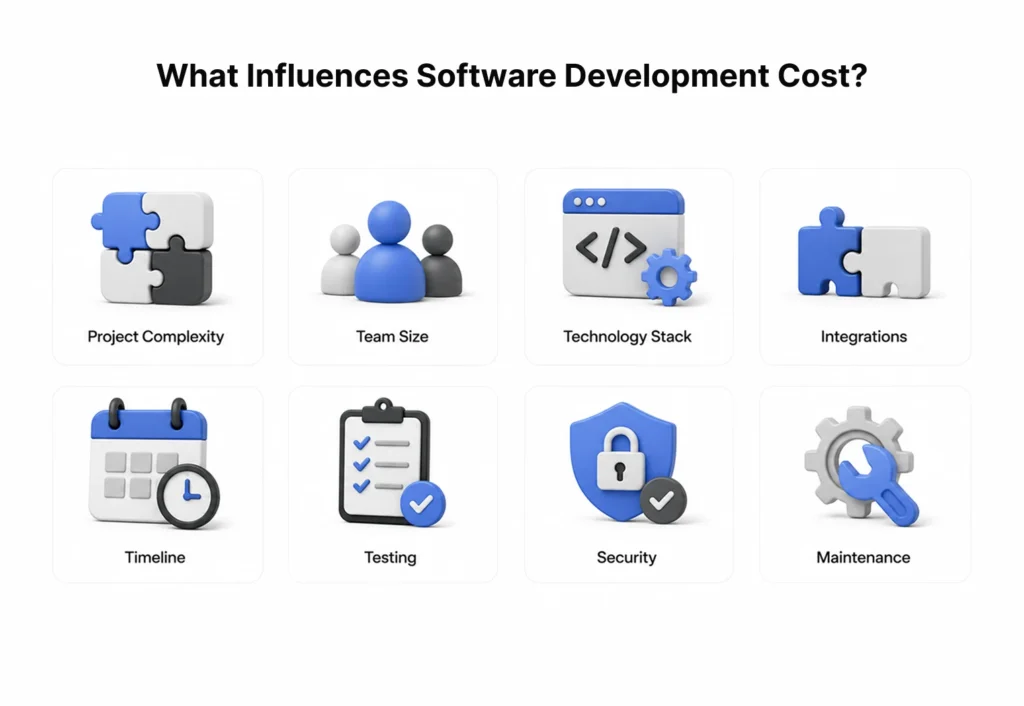
Cost estimates without context are close to useless, so here’s what actually moves the number:
- Complexity – a booking system and a multi-tenant SaaS platform aren’t priced the same way, even if both sound simple on a call
- Team size – more specialized roles (DevOps, dedicated QA, a solutions architect) raise cost but also reduce risk on larger builds
- Timeline – compressed deadlines usually mean parallel workstreams, which costs more
- Integrations – every third-party API adds testing overhead and occasional surprise costs when documentation is incomplete
- Testing – thorough QA takes real time; skipping it just moves the cost to post-launch bug fixing
- Maintenance – often quoted separately, and often underestimated by first-time buyers
Software Development Cost by Project Type
These are broad, directional ranges based on typical Chennai market rates. Actual quotes vary based on scope, team composition, and the specific vendor.
| Project Type | Typical Range (INR) | Typical Timeline |
| MVP | ₹3 lakh – ₹12 lakh | 6–12 weeks |
| Internal Business Software | ₹5 lakh – ₹20 lakh | 8–16 weeks |
| SaaS Platform | ₹15 lakh – ₹60 lakh+ | 4–9 months |
| Enterprise System | ₹25 lakh – ₹1 crore+ | 6–12 months |
| Mobile Platform (iOS + Android) | ₹6 lakh – ₹30 lakh | 10–20 weeks |
| Ongoing Support/Maintenance | ₹15,000 – ₹1.5 lakh/month | Ongoing |
Treat any quote that sits far below these ranges with some skepticism. In many cases, unusually low bids point to a smaller or less experienced team, incomplete scope, or maintenance costs that will surface later.
Software Development Process Followed by Leading Companies in Chennai
Discovery and Planning for Successful Software Development Projects
This phase should feel more like a business conversation than a technical one. Reliable teams spend time understanding your users, your existing workflows, and what “success” actually looks like before committing to a scope document.
Design, Development and Deployment
From there, the process generally moves through requirement gathering, UI design, development sprints, QA cycles, User Acceptance Testing (UAT), deployment, and then a defined support phase. Teams that skip UAT, or treat it as a formality rather than a genuine testing window, tend to ship products with gaps that only surface once real users start clicking around.
If your project involves a marketing-facing component, an AI-powered website development approach can shorten certain parts of this cycle, particularly content structuring and on-page optimization work that would otherwise sit in a separate workstream. Larger, infrastructure-heavy builds may also benefit from bringing in enterprise DevOps consulting early rather than retrofitting deployment pipelines after the fact.
Custom Software vs Ready-Made Software
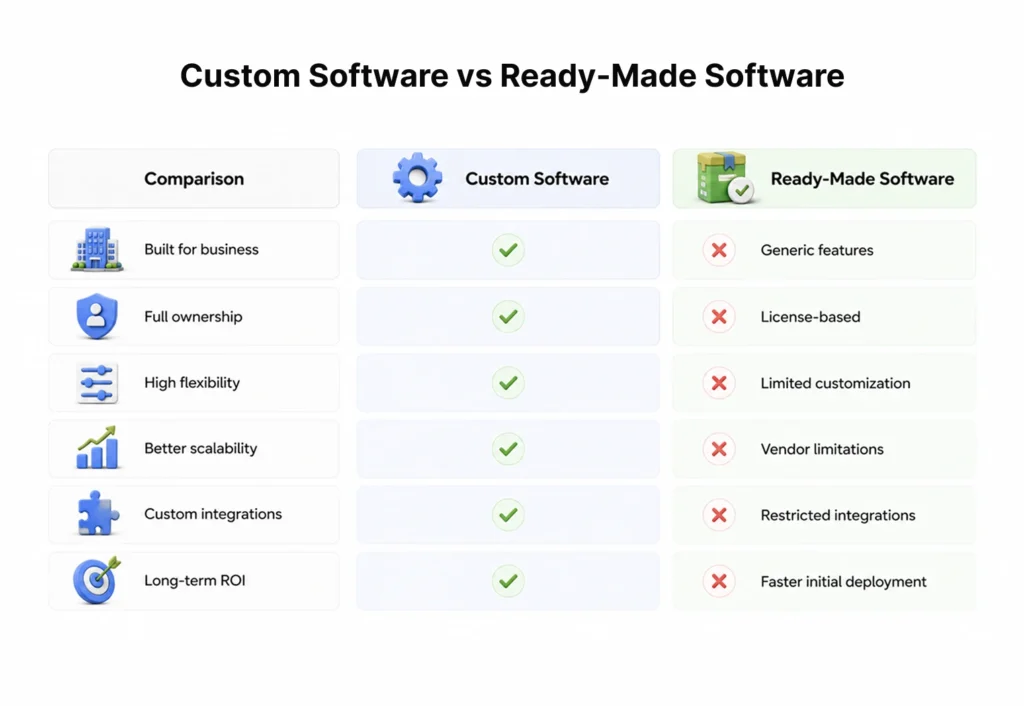
| Factor | Custom Software | Ready-Made Software |
| Initial Cost | Higher upfront | Lower upfront |
| Flexibility | Built around your process | Limited to vendor’s design |
| Ownership | Full ownership | Licensed, not owned |
| Security | Controlled internally | Dependent on vendor’s practices |
| Integrations | Built to fit your stack | Often limited or add-on priced |
| Maintenance | Your responsibility, fully controllable | Vendor-managed, less control |
| Scalability | Scales with your business model | May cap out at certain tiers |
| ROI | Better long-term, slower to realize | Faster short-term, plateaus over time |
Ready-made software often wins for generic, low-differentiation functions (basic accounting, standard helpdesk tools). Custom software tends to win when your process is genuinely different from what off-the-shelf products assume, which is common in manufacturing, logistics, and healthcare workflows.
Future Trends Every Software Development Company in Chennai Should Follow
A few shifts are worth tracking heading into the rest of 2026, without getting distracted by hype cycles:
- Cloud-native applications are becoming the default starting point rather than a later migration
- Composable architecture is letting teams swap components instead of rebuilding entire systems
- Enterprise integration demands are growing as businesses run more disconnected SaaS tools than ever
- SaaS evolution continues toward vertical, industry-specific platforms rather than generic horizontal tools
- Low-code adoption is filling gaps for internal tools, though it rarely replaces custom development for core products
- Security-first development is shifting from a compliance checkbox to a design principle baked in from day one
- Platform engineering is emerging as its own discipline, separate from traditional DevOps
- Modern DevOps practices are pushing toward faster, safer releases rather than infrequent, high-risk deployments
Businesses evaluating a DevOps consulting company in India or comparing the best cloud DevOps service providers in India are, in effect, preparing for these shifts rather than reacting to them after the fact.
How to Choose the Best Software Development Company in Chennai
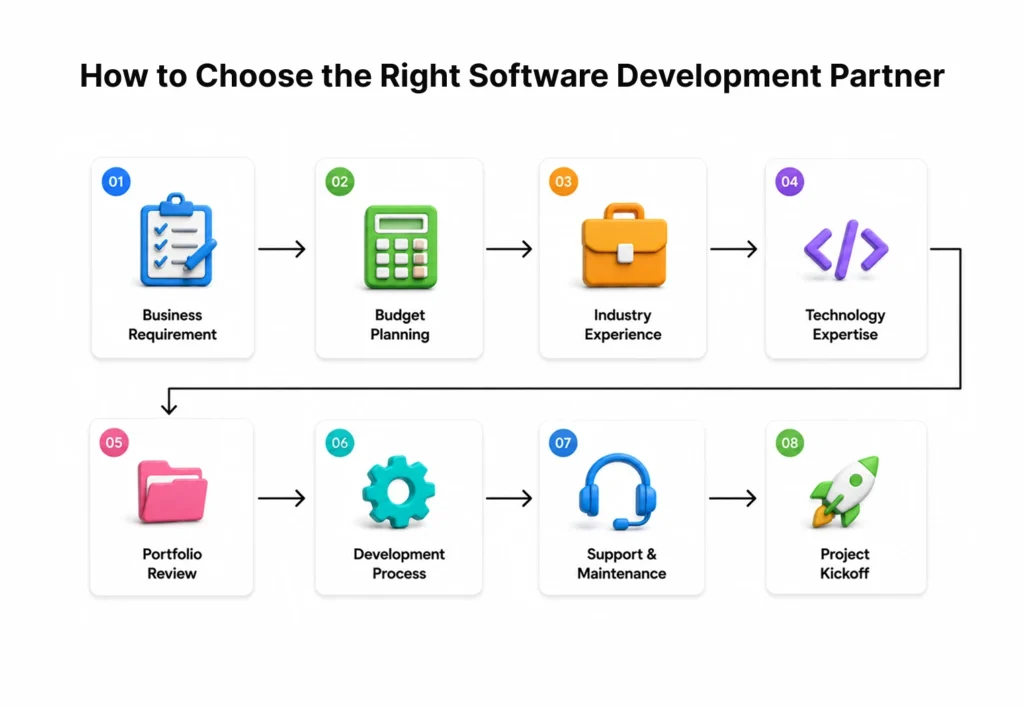
There’s no single formula, but a practical decision sequence looks something like this:
Business size and current maturity → Budget realism → Project complexity → Long-term support needs → Technology expertise required → Industry-specific knowledge → Communication style fit → Security requirements → Ongoing maintenance model
Walking through that sequence in order, rather than jumping straight to price, tends to surface mismatches early. A vendor that’s a great fit for complexity might be a poor fit for your communication style, and that gap causes more failed projects than technical shortcomings ever do.
Choosing the Best Software Development Company in Chennai for Your Business
Price alone is a weak filter. The cheapest quote and the most expensive one can both fail you, just in different ways. What actually predicts a good outcome is whether the company understood your business before proposing a solution, whether their technical practices hold up under scrutiny, and whether they’re structured to support you well after launch, not just through the initial build.

Before committing to any vendor, have an honest requirement discussion first, even if that means delaying the decision by a week or two. It’s a far smaller cost than six months into a project that never should have started the way it did.
For further reading, our roundups on top software development companies in Chennai, the best AI development company in Chennai, and top AI development companies in India cover adjacent angles worth exploring depending on your project’s specific technical direction.
FAQ
1. What does a software development company in Chennai do?
It typically covers custom application development, mobile app builds, SaaS products, and ongoing maintenance, ranging from small business tools to enterprise-grade systems, depending on the firm’s specialization.
2. How much does custom software development cost in Chennai?
Costs generally range from ₹3 lakh for a basic MVP to over ₹1 crore for a complex enterprise system, depending on scope, team size, and timeline. Ongoing maintenance is usually priced separately.
3. Which industries hire software development companies?
Healthcare, manufacturing, logistics, FinTech, retail, education, and SaaS businesses are among the most active industries hiring software partners in Chennai currently.
4. How long does software development usually take?
An MVP might take 6 to 12 weeks, while a full enterprise system can run 6 to 12 months or longer, depending on complexity and how frequently requirements change mid-project.
5. What technologies do software companies commonly use?
Most Chennai firms work across common stacks such as React, Node.js, Flutter, React Native, and cloud platforms like AWS or Azure, though the right choice depends on the specific project rather than a one-size-fits-all default.
6. How do I choose the best software development company in Chennai?
Evaluate technical capability, industry experience, communication style, pricing transparency, and post-launch support model together, rather than relying on price or portfolio size alone.
7. Is custom software better than off-the-shelf software?
It depends on how unique your business process is. Off-the-shelf tools work well for generic functions, while custom software tends to pay off when your workflow doesn’t fit standard templates.
8. What support is provided after deployment?
This varies by vendor and should be defined in the contract. Reliable partners typically offer a warranty period followed by an optional ongoing maintenance and support plan.