Key Takeaways
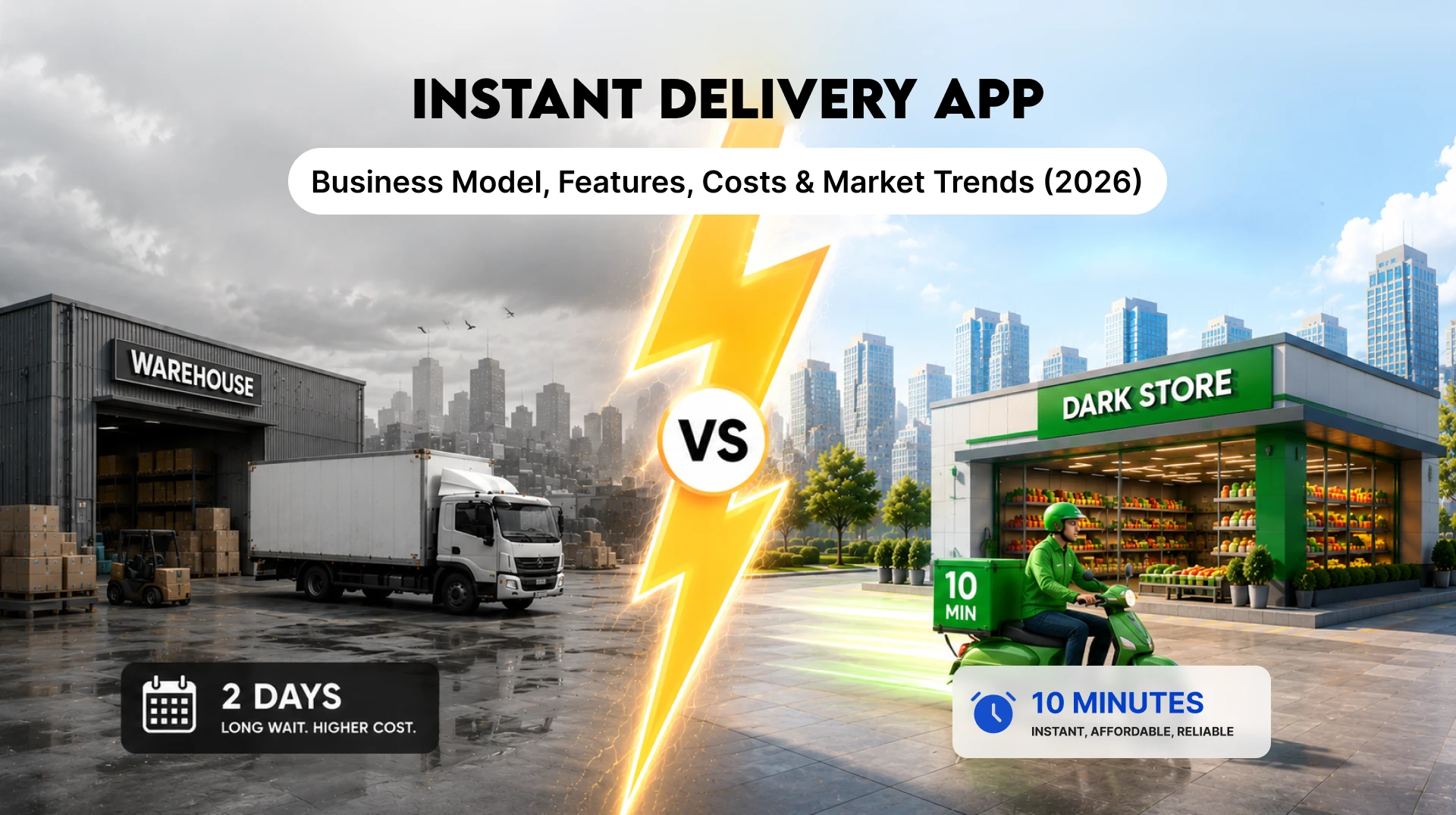
- An instant delivery app uses dark stores and hyperlocal logistics to deliver groceries and everyday essentials within 10 to 30 minutes.
- The success of an instant delivery app depends on strong unit economics, efficient inventory management, and high order density.
- Essential features include live order tracking, secure payments, inventory management, rider tracking, and an admin dashboard.
- Businesses should validate local demand, optimize delivery operations, and focus on sustainable growth before expanding to new markets.
- Choosing an experienced development partner helps build a scalable platform that supports long-term business growth.
Not that long ago, waiting a full day for groceries was just how things worked. Nobody complained about it. Now a delivery that’s ten minutes late can get a one star review, and the app that took twenty extra minutes yesterday might be the one you uninstall this week.
That shift didn’t happen gradually. A handful of companies proved near instant fulfillment was actually possible, and once people experienced it in one city, they started expecting it everywhere else too.
Which is exactly why so many retail chains, grocery businesses, and D2C brands keep circling back to the same question: is this a category worth entering, or is it a game only a few well capitalized players can actually win?
Honestly, it depends. It depends on how dense your order volume can get, what category you’re in, and whether you can stomach thin margins for the first several months without panicking. This guide breaks down how these apps actually function, what they cost to build, which companies figured out the business model, and which ones burned through funding trying to force something the market wasn’t ready to support. We’ll point to our development process here and there for anyone weighing whether to build one.
If you’re evaluating this specifically for India, the dynamics shift quite a bit from what plays out in the West, and we get into that in more detail in our related piece on the Instant Delivery App India market.
What Is an Instant Delivery App?
At its core, an instant delivery app fulfills orders, usually groceries or everyday essentials, within roughly 10 to 30 minutes of purchase. That’s the short version. Most of what follows in this article is really just an expansion of that one idea.
People call this quick commerce, or q-commerce if you want the shorthand. It’s not simply e-commerce with a faster clock. The entire operating model underneath it is different, and that difference is where things get interesting.
How Instant Delivery Differs from Traditional Delivery Apps
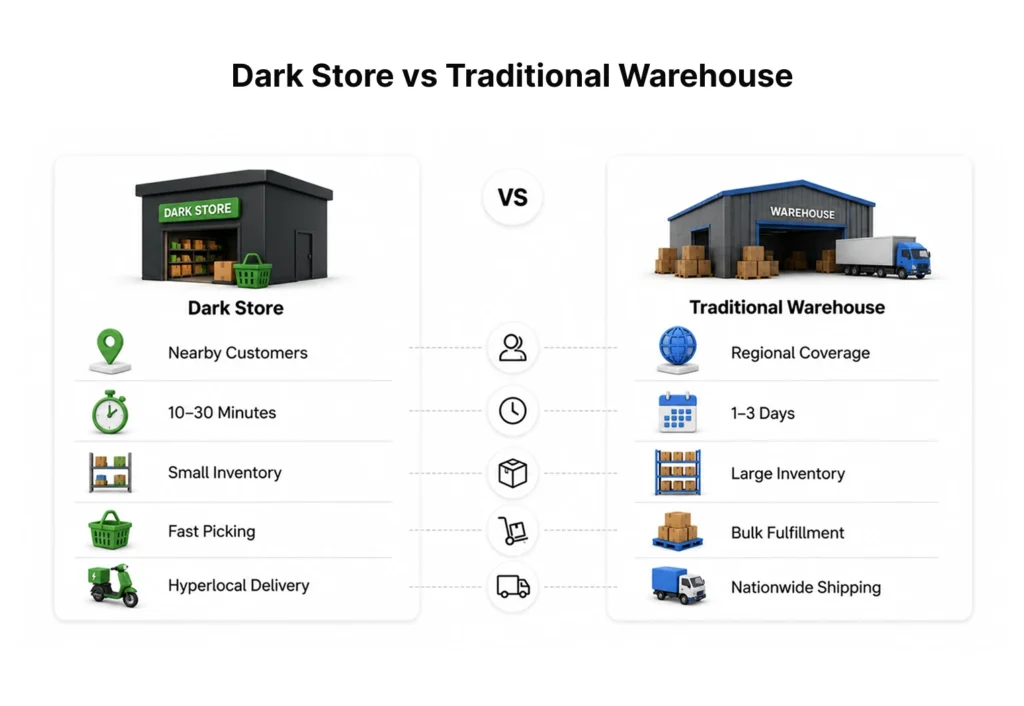
Traditional delivery, whether it’s e-commerce or restaurant food, tends to run on one of two setups: centralized warehouses shipping over several days, or a marketplace connecting you to a third party seller who ships from wherever their stock happens to be sitting. Amazon is built this way. So is Flipkart, for the most part.
Instant delivery apps sidestep all of that. They keep their own inventory in small, hyperlocal warehouses called dark stores, usually within two or three kilometers of the customers they’re serving. An order comes in, a picker inside that dark store puts it together in a matter of minutes, and a rider who’s already nearby takes it from there. No seller sitting in the middle, no cross-country shipping, no guessing how long a third party will take to actually fulfill anything.
That structure is what makes ten minute delivery possible in the first place. It’s also exactly why the model is expensive to run. Every dark store is a rent and staffing cost that a regular e-commerce warehouse simply doesn’t carry at anywhere near the same density.
Why Consumers Prefer Faster Deliveries
This isn’t really about impatience, even though it can look that way from the outside. It’s more that instant delivery apps have replaced the corner store run rather than the weekly grocery haul. If you’re halfway through a recipe and realize you’re out of eggs, a next day delivery slot is useless to you. A fifteen minute one actually solves the problem.
That behavioral change, small frequent orders instead of big occasional ones, is really the story behind why this category grew the way it did. It’s a different job to be done than what Amazon or a hypermarket handles, which is part of why the Instant Delivery App model carved out its own lane instead of just eating into traditional grocery e-commerce.
How an Instant Delivery App Works
Underneath the app a customer actually sees, there are three systems running in sync: inventory, order routing, and last mile logistics. If any one of these falls behind, the whole speed promise collapses pretty quickly.
Dark Stores and Inventory Management
A typical dark store stocks somewhere between 1,500 and 3,000 SKUs, small enough to walk end to end in under a minute, but deep enough to cover most of what people actually need day to day. Inventory has to be tracked close to real time, because there’s no buffer to substitute an item or delay a delivery the way a traditional warehouse operation might.
Store placement ends up being its own puzzle. Get the radius wrong and delivery times slip past thirty minutes, which defeats the entire point of the model. Get the density wrong and you’re paying rent on a location that simply can’t generate enough orders to justify itself.
Order Processing and Last-Mile Delivery
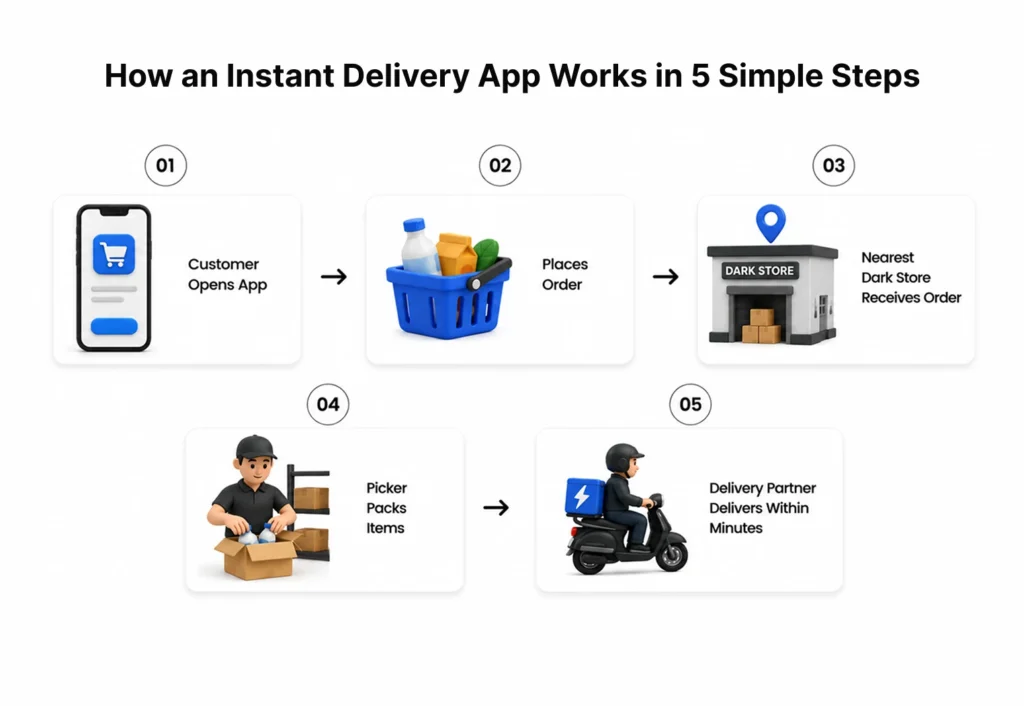
Here’s roughly what happens between you tapping “place order” and a rider showing up:
- The order gets placed and is instantly routed to the nearest dark store carrying what you ordered.
- A picker inside that store gets a pick list, often sequenced for the fastest walking path through the aisles.
- The order is packed and handed off to a rider who’s either already close by or dispatched based on proximity.
- Route optimization software works out the fastest path, accounting for traffic and whatever else that rider might already be carrying.
- The customer sees live tracking the whole way, and delivery gets confirmed in the app once it’s handed over.
A quick visual suggestion: a five step process diagram mapping this out would genuinely help readers who’d rather see the flow than read through it, and it’s the kind of thing that tends to do well in featured snippets too.
None of this works without inventory data that’s actually accurate in the moment. A two second lag in stock sync can mean a rider showing up to a store for something that’s already sold out, which is why platforms working with a partner like on demand quick commerce app development company usually build these pieces as tightly integrated modules rather than bolting separate tools together after the fact. That kind of integration is closer to what you’d expect from Ecommerce Website Development built specifically for speed, not just general scale.
Core Features Every Instant Delivery App Needs
Feature lists in this space look pretty similar on paper. What actually separates apps people keep using from apps people abandon after one bad order is execution, not the list itself.
Customer Experience Features
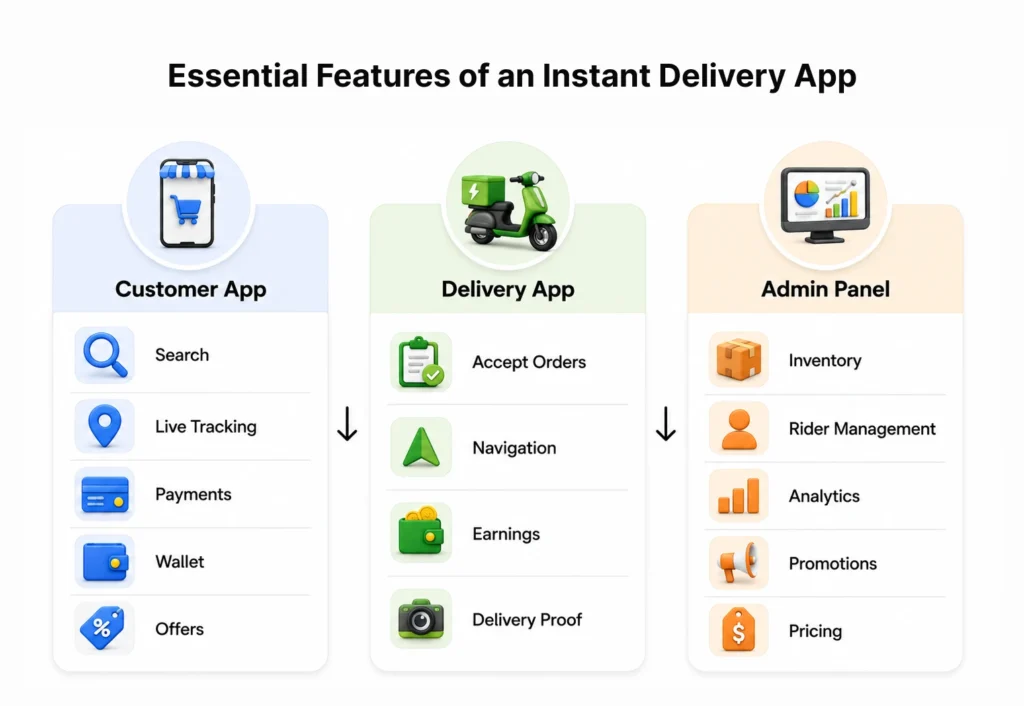
- Product search that’s forgiving of typos (people are often rushing and misspell brand names)
- Category browsing with clear, accurate stock indicators
- Live tracking showing the rider’s actual location
- Multiple payment options, including wallets and buy now pay later where that’s common regionally
- A saved wallet balance for refunds and cashback
- Offers and personalized promotions
- Product reviews
- Order history for fast reordering
Delivery Partner Features
Riders need their own dedicated experience, and this side is often underbuilt in earlier stage apps:
- A simple, low-friction order acceptance flow
- Navigation built for two wheelers specifically, not just repurposed car directions
- Real time visibility into earnings
- A way to capture delivery proof, whether that’s a photo, OTP, or signature
Admin and Delivery Management
Behind the scenes, operations teams need a layer of visibility that customers never see at all:
- Inventory management across multiple dark store locations
- Dynamic pricing controls
- Rider assignment and performance tracking
- Analytics covering order volume, fulfillment time, and stockouts
- Promotion and campaign management
Building all three layers properly, customer, rider, and admin, usually takes a team that’s actually worked in logistics software before, not just one that’s good at consumer app design. That’s worth raising directly with any Mobile App Development Company you’re considering for this kind of build.
Business Model Behind an Instant Delivery App
This is the part founders tend to underestimate. Building the app is genuinely the easier half. What determines whether the business survives past year two is the economics sitting underneath it.
Revenue Streams
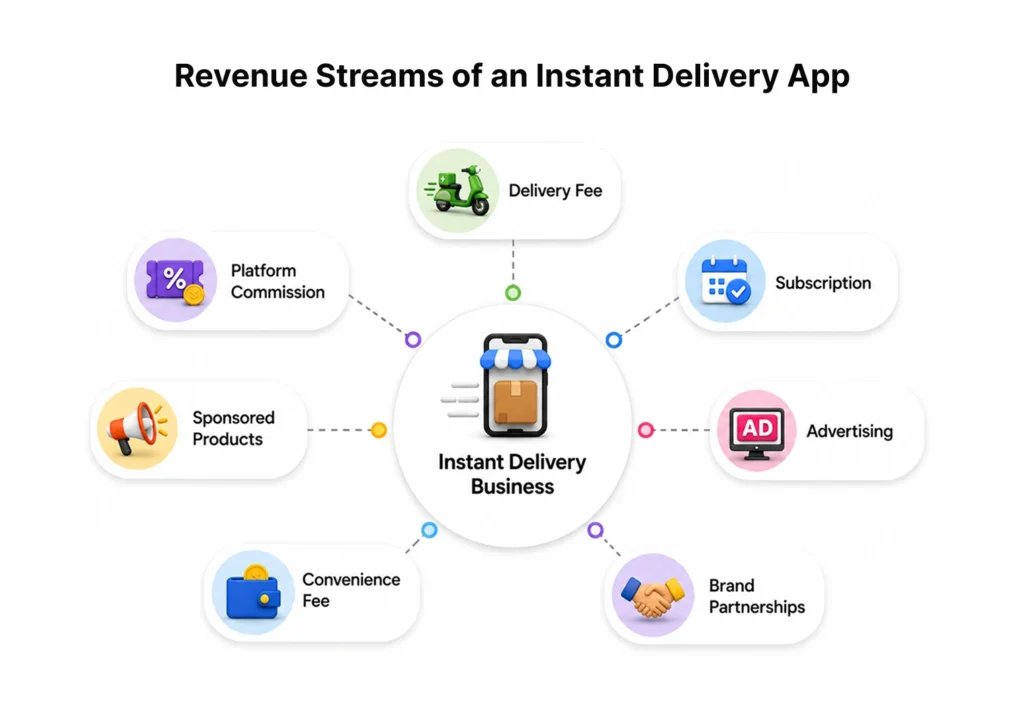
Instant delivery platforms rarely lean on just one revenue source. Most combine several:
| Revenue Stream | How It Works |
| Delivery charges | Usually $1.99 to $3.99 per order, sometimes waived above a minimum basket size |
| Platform commission | A percentage taken from brand partners or private label margins |
| Subscription | Monthly or annual plans offering free or discounted delivery |
| Sponsored listings | Brands pay for placement in search or category pages |
| Brand partnerships | Co-marketing or exclusive product arrangements |
| Advertising | Banner placements and in-app promotions |
| Convenience fees | Small surcharges during peak demand or bad weather |
None of these alone tends to cover the real cost of a fifteen minute delivery. It’s the combination of all of them, stacked over enough order volume, that eventually gets a dark store into profitable territory.
Unit Economics and Profitability
This is where things get genuinely tricky, and it’s worth just being direct about the numbers instead of dancing around them.
Average order values in this category usually land somewhere between $25 and $35. After accounting for product cost, packaging, and delivery itself, gross margins tend to fall in the 25% to 35% range. On paper, that looks workable. In practice, a single dark store often needs 150 to 200 orders a day just to cover rent, staffing, and rider pay before it starts contributing anything to profit.
That threshold is really the reason so many well funded companies didn’t make it. Hitting 150 orders a day in a dense urban core is realistic. Hitting it in a mid sized city with lower population density often isn’t, at least not without subsidizing demand through heavy discounting. Plenty of companies found this out the hard way once investor funding dried up and the subsidies had to stop.
Market Trends Shaping Instant Delivery Apps
Growth of Quick Commerce
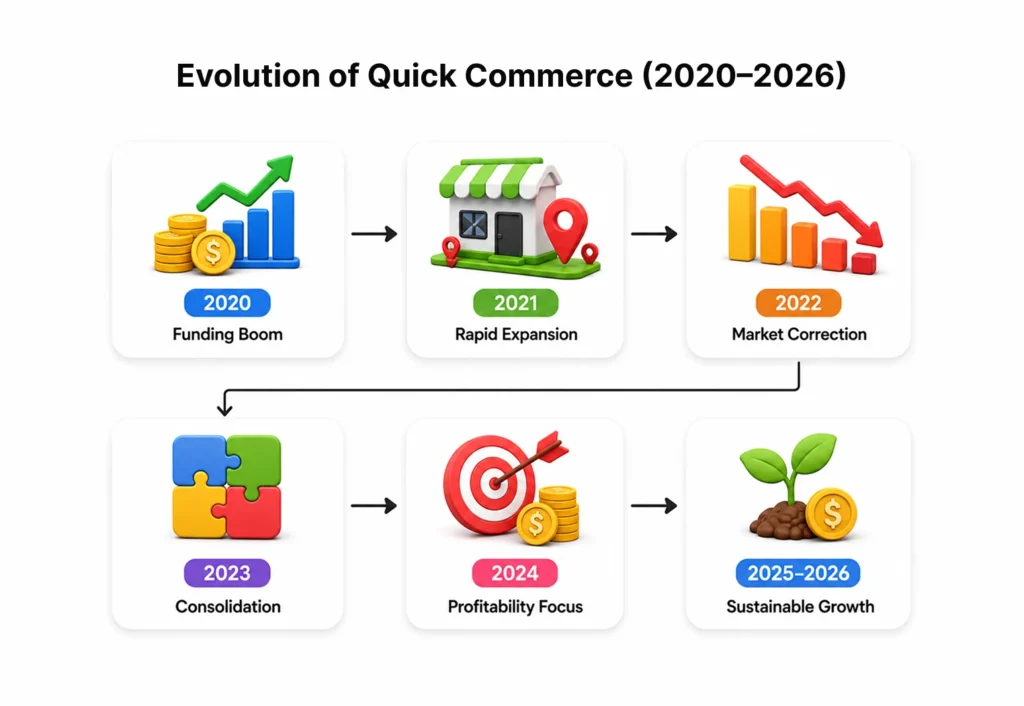
Quick commerce took off between 2020 and 2021, largely because lockdowns pushed a whole generation of shoppers to try grocery delivery for the first time, and a lot of them stuck with it afterward. Venture capital flowed in aggressively during that window, often funding rapid city by city expansion before anyone had actually proven the unit economics in a single one of those cities.
Profitability Over Expansion
That funding environment corrected hard between 2022 and 2023. Investors stopped rewarding growth for its own sake and started asking harder questions about path to profitability, contribution margin, and store level breakeven. The companies that had expanded fastest were often the same ones forced to retreat fastest, shutting down dark stores in cities where order density never got close to sustainable.
The market hasn’t really shrunk since then. It’s matured, if anything. Urban demand for fast fulfillment is still real and still growing, but the companies still standing are the ones that treated operational efficiency as a priority from day one rather than something to fix later.
Global Instant Delivery App Companies Worth Studying
It’s worth looking at who made it through this correction and who didn’t, not to rank anyone as “the best,” but because the pattern says more about the business model itself than any theory could.
Companies That Survived
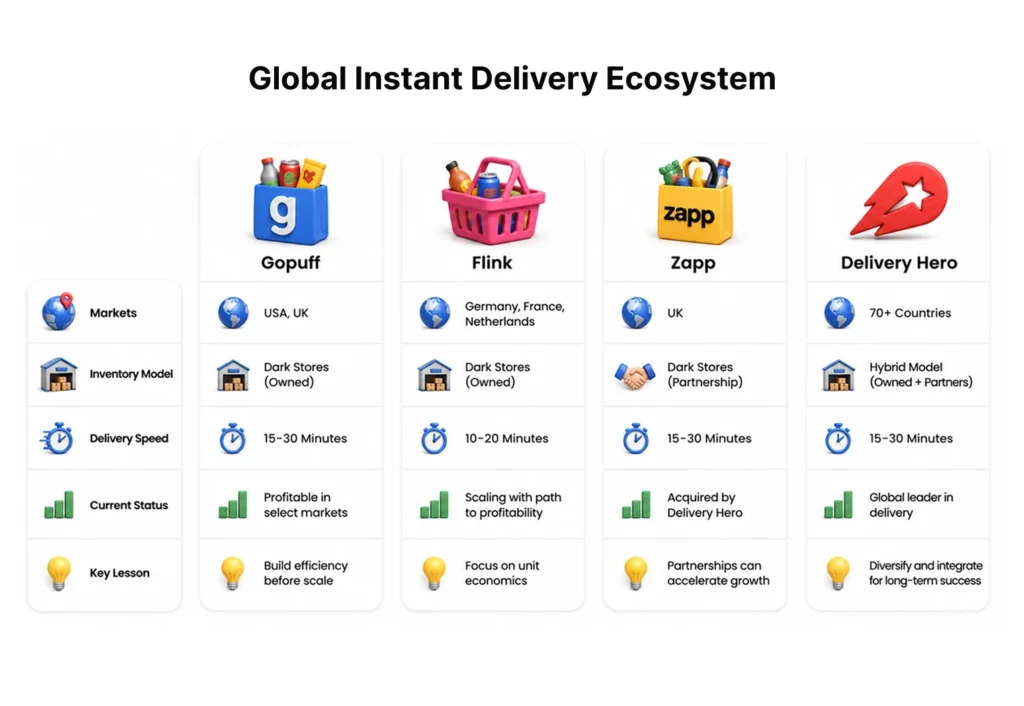
Gopuff scaled in the US partly by leaning on private label products and a category range well beyond groceries alone. Flink and Zapp both found steadier footing in select European markets by tightening their store networks instead of chasing every city at once. Jokr pulled back its geographic focus after overexpanding early, narrowing in on markets with better density. The Delivery Hero ecosystem, through its various quick commerce arms, had the advantage of an existing logistics and restaurant delivery infrastructure it could build grocery fulfillment on top of, rather than starting from zero.
Companies That Exited or Consolidated
Getir bought up several European rivals during the boom, Gorillas among them, but pulled back significantly once outside funding tightened, exiting a number of the markets it had entered quickly. Buyk, Cajoo, and Fridge No More each shut down or got absorbed within a few years of launching, generally after they couldn’t reach store level profitability before their funding ran out.
| Company | Market | Current Status | Key Lesson |
| Gopuff | United States | Operating, diversified categories | Private label and category breadth support margin |
| Flink | Germany, select Europe | Operating, narrower footprint | Density matters more than city count |
| Zapp | UK | Operating in core markets | Tight geographic focus over rapid expansion |
| Jokr | Latin America, select markets | Operating after pivot | Early overexpansion required correction |
| Delivery Hero (quick commerce arms) | Multiple | Operating | Existing logistics infrastructure lowers build cost |
| Getir | Turkey, scaled back elsewhere | Reduced footprint | Acquisition-led growth outpaced sustainable demand |
| Gorillas | Germany | Acquired by Getir, later discontinued | Growth funded by capital without profitability is fragile |
| Buyk | United States | Shut down | Funding runway ran out before breakeven |
| Cajoo | France | Shut down | Store density insufficient for margin |
| Fridge No More | United States | Shut down | Same pattern: scale outpaced unit economics |
Instant Delivery App Market in India
Why India’s Quick Commerce Model Is Different
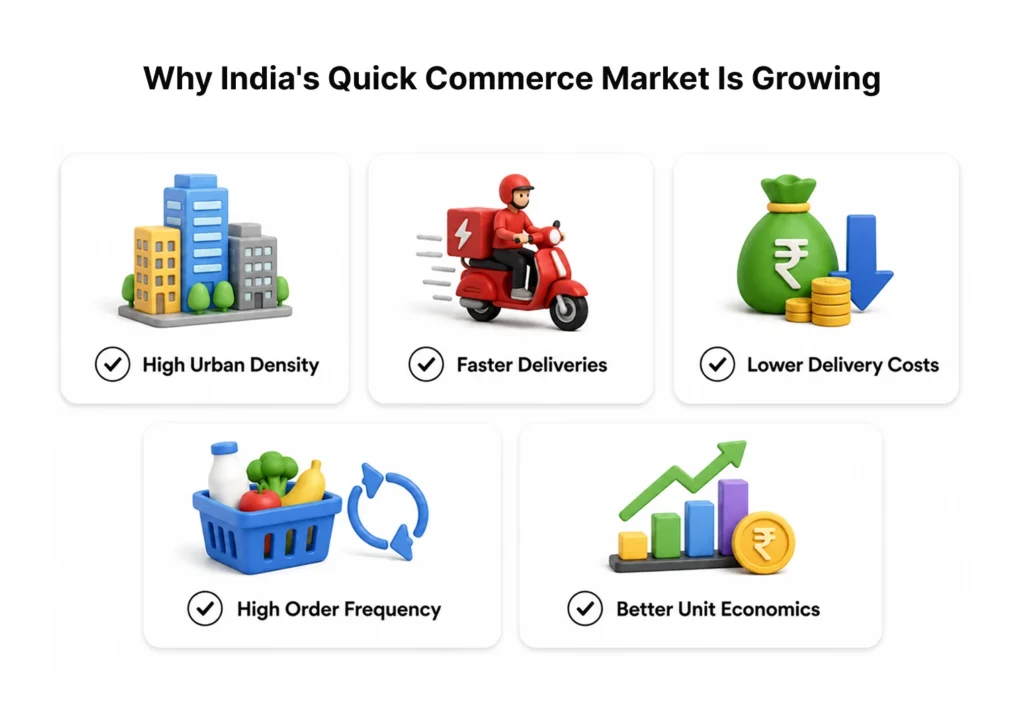
India’s quick commerce market has actually held up better than a lot of Western markets, and the reason mostly comes down to density. Indian cities combine high urban population density with comparatively lower delivery costs per order, which changes the math on that 150 to 200 order per day breakeven threshold. Hitting that number in a packed neighborhood in Mumbai or Bengaluru tends to be more realistic than doing the same in a mid sized US or European city with far lower population density.
That said, it’s not as if India has solved profitability outright. Dark store expansion still eats capital, rider availability during peak hours is a constant headache, and price sensitivity among Indian consumers tends to run sharper than in higher income markets, which puts genuine pressure on margins.
Blinkit, Zepto, and Swiggy Instamart have each carved out meaningful positions here, generally by pairing aggressive dark store expansion with the order density India’s urban geography naturally supports. Their approaches differ in category breadth and store network size, but the underlying playbook, first-party inventory, a tight delivery radius, high order frequency, holds across all three.
Challenges Businesses Should Know Before Building an Instant Delivery App
Operational Challenges
Inventory waste is a constant pressure point, especially with perishables. Overstock a dark store and you’re writing off spoiled goods. Understock it and you lose a customer to a competitor after one disappointing order. Rider availability during peak windows, lunch and dinner especially, is another recurring headache, since demand spikes rarely line up neatly with rider shift schedules.
Financial Challenges
Thin margins are the obvious problem, but customer acquisition cost makes it worse. When several apps are competing in the same city, discount driven acquisition becomes the norm, and it’s not cheap. Add in the capital needed to secure and staff dark store locations, ongoing technology spend, and compliance around food storage and labor, and it’s easy to see why this category has produced more failures than successes worldwide.
None of that means the model is fundamentally broken. It just means it rewards operational discipline over aggressive expansion, which is a different muscle than most consumer app startups are built to flex.
Who Should Invest in an Instant Delivery App?
Not every retail category fits this model naturally, and it’s worth saying that plainly rather than pretending it works for everyone.
Grocery and pharmacy are the clearest fits, since both involve frequent, urgent, small basket purchases, exactly what instant delivery handles best. Pet supplies and bakery items follow a similar pattern, especially for repeat purchases like pet food or fresh bread. Flowers work well too, given how occasion driven and time sensitive those orders tend to be. Convenience stores and local retail chains can extend their existing footprint without opening new physical locations at all. Electronics accessories, phone cases, chargers, cables, also tend to do reasonably well, since they’re often needed on short notice.
D2C brands sit a bit differently. For them, instant delivery usually works best as a complement to existing e-commerce rather than a full replacement, giving customers in dense urban areas a same day option without forcing a rebuild of the entire fulfillment strategy.
How to Build an Instant Delivery App Successfully
Planning the Business Model
Before any development starts, the business model needs to hold up on paper first. That means validating demand in an actual launch neighborhood, not a city as a whole, deciding which features genuinely matter at launch versus which can wait, and mapping out logistics realistically, including where dark stores will sit and how riders will be sourced.
Security and scalability planning matter here too, particularly around payment processing and inventory data, since a backend that can’t scale with order volume tends to hit a wall right when the business starts working.
Choosing the Right Development Partner
This is a logistics platform wearing a consumer app’s interface, and it needs a team that genuinely understands both sides of that. A partner experienced in Best Food Delivery Website Development will already have order routing and rider dispatch patterns that overlap heavily with instant delivery. Early stage founders in particular should look at teams positioned for Mobile App Development for Startups, since the first build usually needs to move fast without overbuilding features a launch market doesn’t need yet.
Launch strategy matters just as much as the build itself. Most successful instant delivery apps started in a single dense neighborhood, proved the unit economics worked there, and only expanded once that was settled, rather than spreading thin across an entire city on day one.
Future of Instant Delivery Apps
The next phase of this category looks less like a race to more cities and more like a race to better margins in the cities already being served. Sustainable growth is likely to define the winners from here, not aggressive land grabs.
Hyperlocal commerce is already expanding beyond groceries into pharmacy, pet care, and even small electronics, which spreads fixed dark store costs across a wider basket mix. Better logistics, smarter route optimization, predictive inventory, demand forecasting by time of day, should keep narrowing the gap between order volume and actual profitability. Customer retention, not just acquisition, is becoming the number investors actually care about, since a subsidized first order doesn’t mean much if that customer never comes back without a discount attached.
Conclusion
The land grab phase of instant delivery is over. The companies still standing are the ones that treated operational efficiency, not city count, as the real measure of success. The technology at this point is mature and genuinely available. The harder question, for anyone considering entering this space, is whether your category, your target neighborhoods, and your order density can actually support the unit economics this model demands. Get that part right first, and building the app itself becomes a far more solvable problem.
Frequently Asked Questions
1. What is an instant delivery app?
It’s a platform that fulfills orders, typically groceries or everyday essentials, within 10 to 30 minutes, using small local warehouses called dark stores instead of centralized fulfillment centers.
2. How does an instant delivery app work?
An order gets routed to the nearest dark store carrying the item, a picker fills it, and a rider already stationed nearby delivers it, with route optimization software cutting down travel time along the way.
3. How fast can instant delivery apps deliver?
Most operate within a 10 to 30 minute window, depending on how far the dark store is, how complex the order is, and what local traffic looks like at the time.
4. Are instant delivery apps profitable?
Some are, generally the ones running high order density per store. Profitability usually requires around 150 to 200 orders per store per day, a number that’s easier to hit in dense urban markets than in lower density ones.
5. What are dark stores?
Small, hyperlocal warehouses, typically stocking 1,500 to 3,000 SKUs, positioned within a short delivery radius of the customers they serve, and not open to walk in shoppers.
6. Which industries can use instant delivery apps?
Grocery, pharmacy, pet supplies, bakery, flowers, convenience retail, and electronics accessories tend to be the strongest fits, given how frequent and urgent those purchase patterns usually are.
7. How much does it cost to build an instant delivery app?
Costs vary quite a bit depending on feature scope, how many markets you’re launching in, and whether logistics infrastructure needs to be built from scratch. A real cost estimate generally requires a proper discovery and planning phase rather than a flat number.
8. Can small retailers compete with larger quick commerce platforms?
In a specific neighborhood or category niche, often yes, especially if they already have a physical store that can double as a fulfillment point without the overhead of building new dark stores.
9. What features should every instant delivery app include?
At minimum, product search, live order tracking, multiple payment options, an admin dashboard for inventory and rider management, and a dedicated rider app with navigation and earnings visibility.
10. What is the future of instant delivery apps?
A shift toward sustainable, margin focused growth, expansion into categories beyond groceries, and smarter logistics aimed at improving profitability rather than just chasing delivery speed.