Key takeaways
- The best AI shopping assistants for ecommerce help improve product discovery and customer experience.
- Different tools serve different goals, including sales growth, customer support, and visual search.
- Small businesses can start with affordable solutions, while enterprises benefit from advanced platforms.
- Choosing the right shopping assistant depends on your platform, budget, and business objectives.
- Continuous optimization and performance tracking are essential for maximizing ecommerce results.
Online retail has shifted a lot in terms of customer expectations. As a result, shoppers demand immediate product guidance, instant responses and a sense of recommendations that are way more personalized than simple keyword matching. Those static product pages and keyword-based search bars, no longer do the job.
But that gap is being filled by AI shopping assistants. This has enabled these intelligent systems to lead customers through product discovery, solve support questions, limit friction at checkout and assist merchants in fine-tuning their stores without requiring headcount additions. They play a fundamental role in the technology stack for ecommerce brands that are competing on experience as much as price.
At Code Neptune, We collaborate with businesses traversing the intricate landscape of digital commerce, including ecommerce website development and AI-powered website development. This comparison utilizes that experience to precisely provide an insight into the tools that work and for what size of business.
You will know which AI shopping assistants dominate the market in 2026; how to evaluate them against your unique objectives; and how to prevent the common mistakes that sink most implementations.
Why Ecommerce Brands Are Investing in Shopping Assistants
How Customer Behavior Has Shifted From Search-Based Shopping to Guided Buying
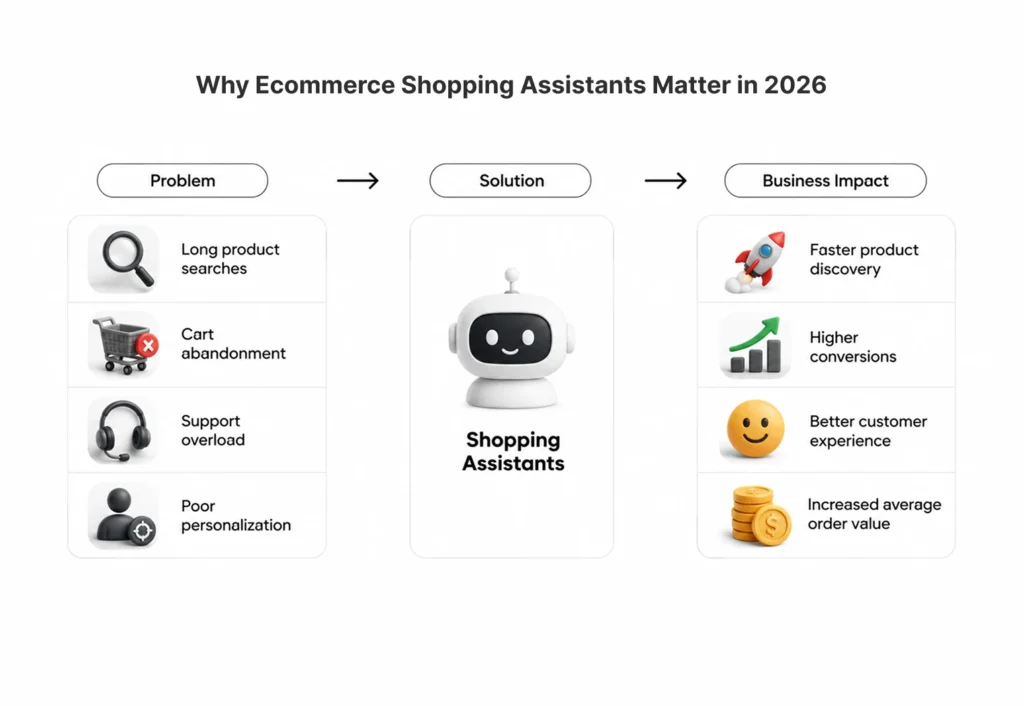
Consumers are fed-up with endless browsing. Salesforce research states that 76% of consumers expect companies to understand their needs before they initiate contact. This has forced ecommerce brands to move from passive catalog browsing to active guides.
This is where intelligent shopping assistants come in, shortening the product discovery path. Rather than having a customer scroll through three searches filtered by size and leaving a page altogether, a good assistant can cut to the options in one conversation. This single change drives a marked improvement in cart abandonment rates.
If they can discover purchases faster, they typically purchase with more confidence. If a shopper sees something like, “based on your love of lightweight fabrics your next jacket is a match,” they’re going to think twice before abandoning it at check out.
Key Benefits for Online Stores
There is plenty of ROI case in some common areas for ecommerce shopping assistants:
Conversion rate improvement: The regular navigation is usually not as efficient as personalized recommendations. Use of AI Assistants generate far higher conversion rates of shoppers than regular normal Search.
Support resolution speed: Quickly resolves tickets regarding order status, returns, and FAQs; reduces volume and response time.
Boost average order value: When assistants recommend complementary products, the frictionless triggers for upsell and cross-sell revenue are effectively leveraged.
Personalized product recommendations: Especially, equipment learning fashions are perfect as they collect greater and extra facts from customers.
Why are the Best AI Shopping Assistants for Ecommerce Sales Effective?
Essential Features in AI Shopping Assistants
You know, not all your online shopping assistants are the same. Here are some features that set high-performing tools apart from basic chatbots, and if you want to see the architectural differences we encourage you to read our full breakdown of ai chatbots vs. traditional chatbots:
Product Discovery: The capability to ask questions, have filters, and contextual relevance to assist consumers in identifying the correct product.
Conversational recommendations: suggestions that come across as helpful rather than canned through natural language processing.
Order tracking: Real-time status updates that reduce inbound support volume.
Automation of customer support: How to solve the common queries without human escalation.
Visual search: Similar to product matching via image; highly useful in fashion and home decor.
Factors That Determine Ecommerce Shopping Assistant ROI
Going for a tool solely for its features tends to lead to disappointment. Here are the top direct factors on ROI:
Platform integration: Will the assistant integrate neatly with your ecommerce platform, or will it require custom development?
Ability to learn: Is the model able to make the recommendations better on the basis of your catalog and the customer behavior over time?
Integrateability: Does it integrate with your CRM, ERP, and marketing stack without complex middleware.
Analytics and reporting: Does the tool expose the metrics you actually need to optimize? Additionally, does it provide insights beyond vanity engagement numbers?
Now, if you want to discuss the conversational interface integrated as the part of your customer experience, reviewing Modern Website UI UX Practices with your assistant selection is going to help.
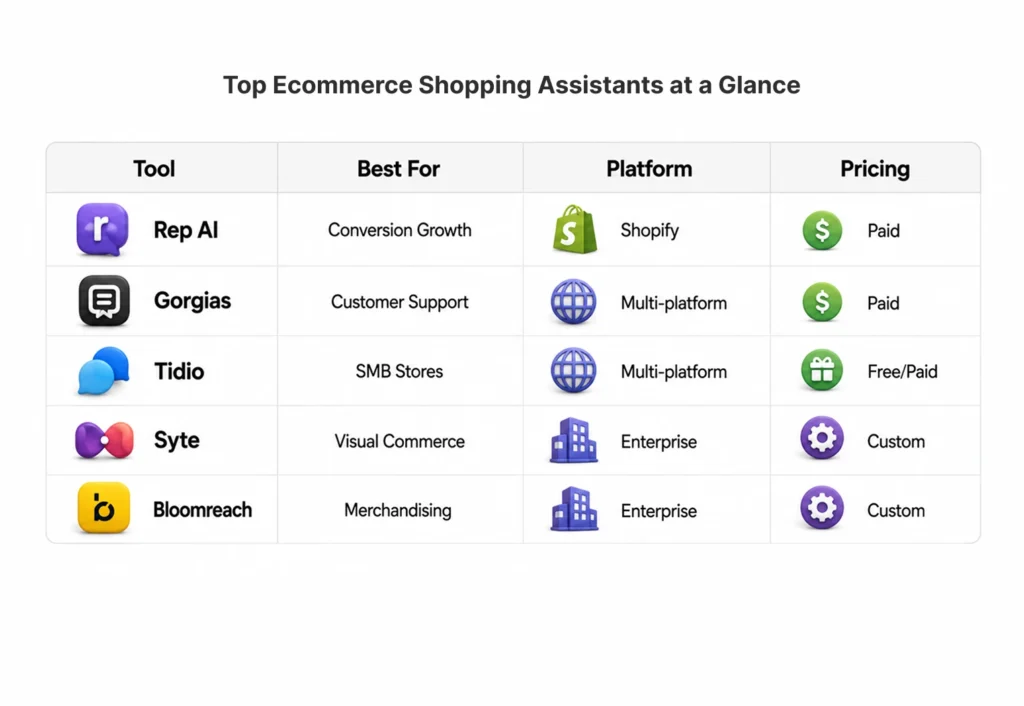
Best AI Shopping Assistants for Ecommerce in 2026
Amazon Rufus Shopping Assistant
Amazon Rufus: The Built-in Amazon Shopping Assistant Amazon Rufus is Amazon’s own in-house AI shopping assistant, built right into the Amazon app and website. It leverages large language model capabilities to respond to product queries, contrasting product comparisons and displaying recommendations based on customer intent.
Ideal use cases: High volume Retailers existing on Amazon Marketplace.
Strengths: Strong contextual purchase intent via contextual signals, trust built-in via Amazon customers are already familiar with our tool, and significant integration with our product catalog.
Restrictions: Restricted to Amazon ecosystem. Well Rufus is of no use to brands that operate on independent storefronts.
Walmart Sparky Shopping Assistant
Walmart Sparky : Walmart’s ai assistant to improve customer experience across Walmart. com and the Walmart app. Sparky helps customers discover products, compare items, and get recommendations across Walmart’s massive commerce ecosystem.
Walmart integration: Sparky pulls in the logistics and inventory data from Walmart so it can provide real-time and accurate information regarding availability and delivery estimates.
Improving the customer experience: Walmart caters to a huge customer base, conversational product guidance will ease the search friction.
Shopify Sidekick for Ecommerce Stores
Shopify Sidekick is an AI assistant for merchants built into the Shopify admin. However, Sidekick is primarily an internal operations tool. Therefore, merchants seeking front-end customer engagement should complement it with another solution.
Merchant-focused question: e.g. Sidekick is ready to answer questions like “What products sold best last month? or “Write a product description for this product.” These tasks can be completed directly within the Shopify dashboard.
Limitations → Sidekick is an internal operations tool and not customer-facing. Merchants looking for front-end customer engagement will have to complement it with a different solution.
Rep AI for Conversion Optimization
Rep AI is a dedicated shopping assistant, designed for conversion-focused ecommerce on Shopify. It employs a behavioral engagement engine that knows when shoppers are about to bounce, and proactively starts a conversation instead.
Unlike many alternatives, Rep AI’s trigger system relies on exit intent and scroll behavior. As a result, interactions feel more relevant to shoppers. This gives the impression that its interventions are helpful rather than obtrusive.
Shopify Compatibility: Deep integration with Shopify keeps the catalog in sync, ensures accurate order data and product recommendations, and requires no manual adjustments.
Manifest AI for Product Recommendations
Manifest AI: a GPT shopping assistant with a specialization in recommendation and fit for the fashion and apparel brands.
Ability to recommend products: Customers can ask Manifest AI clarifying questions that will limit product options based on size, style and preference.
Fit Prediction features are particularly valuable for apparel brands. As a result, they can help reduce return rates, which remain one of the biggest costs in direct-to-consumer ecommerce.
Customer engagement strength: Proactive Messaging Quiz-style interactions that boost average time-on-site and product page engagement.
Gorgias AI for Customer Support
Gorgias AI is mainly a customer support platform with great AI automation on top of its helpdesk backbone. It acts as connects with the top digital shopping assistant for the best post-purchase assistant.
Specialization for Customer support: Gorgias AI answers order status, return policies, shipping delays, and FAQ with high accuracy.
Additionally, Gorgias AI supports omnichannel communication. It manages conversations from email, live chat, SMS, and social media through a unified interface.
Direct integrations with Shopify,Magento and BigCommerce means full order context available to agents (both human and AI) while managing orders.
Tidio for Small Ecommerce Businesses
Tidio: An accessible live chat and AI chatbot platform for SMBs allows easy entry into smarter shopping assistance without enterprise costs.
Cost advantages: One of the most affordable tools, Tidio begins at free and could even end up being the best choice for a new or cash-strapped store.
Set-up time: 5 minutes (if you run a shop with Shopify or WooComerce) No developer resources required.
Limitations: Compared to niche AI-first solutions like Rep AI, these geared towards advanced personalization and behavioral targeting are not as mature.
Syte for Visual Shopping Experiences
Syte is a visual commerce platform for image-based product discovery. It applies selectively to fashion, home decor, and lifestyle brands, where visually similarity drives purchases.
Visual commerce- This allows the customers to upload images or touch (click) on a visual and find similar products in your catalog.
Shop-the-look functionality: Syte allows “complete the outfit” / “style this room” capabilities, driving an increase in basket size (naturally).
Algolia Agent Studio for Enterprise Search
Algolia Agent Studio builds on Algolia’s battle-tested search-first architecture, allowing for enterprise-grade product discovery for the conversational AI realm, including custom assistant development.
Enterprise-level search experience: Algolia’s backend architecture processes huge catalogs almost instantly, under 1 millisecond per search.
Custom assistant development: Brands can create highly specialized shopping agents on top of the Algolia framework. This especially relates to businesses that are looking into Agentic AI Development Services
Bloomreach for Ecommerce Personalization
Bloomreach is a complete commerce experience platform that unifies merchandising intelligence, customer journey optimization, and predictive engagement.
Merchandising intelligence: Bloomreach’s AI utilizes and learns from behavioral data to show products that convert as opposed to products that simply matches a keyword.
Predictive engagement: This identifies customers with high-intent who are next to drop off and sends personalized campaigns on their way out.
Ideal for: Enterprise retailers with advanced catalogs and multi-channel customer journeys.
Comparing the Best AI Shopping Assistants for Ecommerce
Feature and Pricing Comparison
| Platform | Best For | Key Feature | Platform Support | Pricing | Business Size |
| Amazon Rufus | Amazon sellers | In-marketplace guidance | Amazon only | Free (Amazon sellers) | All sizes |
| Walmart Sparky | Walmart sellers | Ecosystem integration | Walmart only | Free (Walmart sellers) | All sizes |
| Shopify Sidekick | Merchant operations | Store management AI | Shopify | Included with Shopify | SMB to mid-market |
| Rep AI | Conversion optimization | Behavioral engagement | Shopify | From ~$39/month | SMB to mid-market |
| Manifest AI | Fashion/apparel | Fit prediction | Shopify | From ~$39/month | SMB |
| Gorgias AI | Customer support | Omnichannel automation | Shopify, Magento, BigCommerce | From ~$10/month | SMB to enterprise |
| Tidio | Budget-friendly chat | Easy setup | Shopify, WooCommerce | Free – $29+/month | Startups, SMBs |
| Syte | Visual discovery | Image-based search | Custom, Shopify | Custom pricing | Mid-market to enterprise |
| Algolia Agent Studio | Search + discovery | Custom AI agents | API-based (all platforms) | Custom pricing | Enterprise |
| Bloomreach | Full commerce experience | Merchandising intelligence | Enterprise platforms | Custom pricing | Enterprise |
Which Ecommerce Shopping Assistant Fits Your Business?
Startups: Tidio: The easiest way to get going with basic automation. Live chat: cheap. Shopify Sidekick absorbs operational whiteboarding questions at no incremental cost for those of you operating Shopify-native startups.
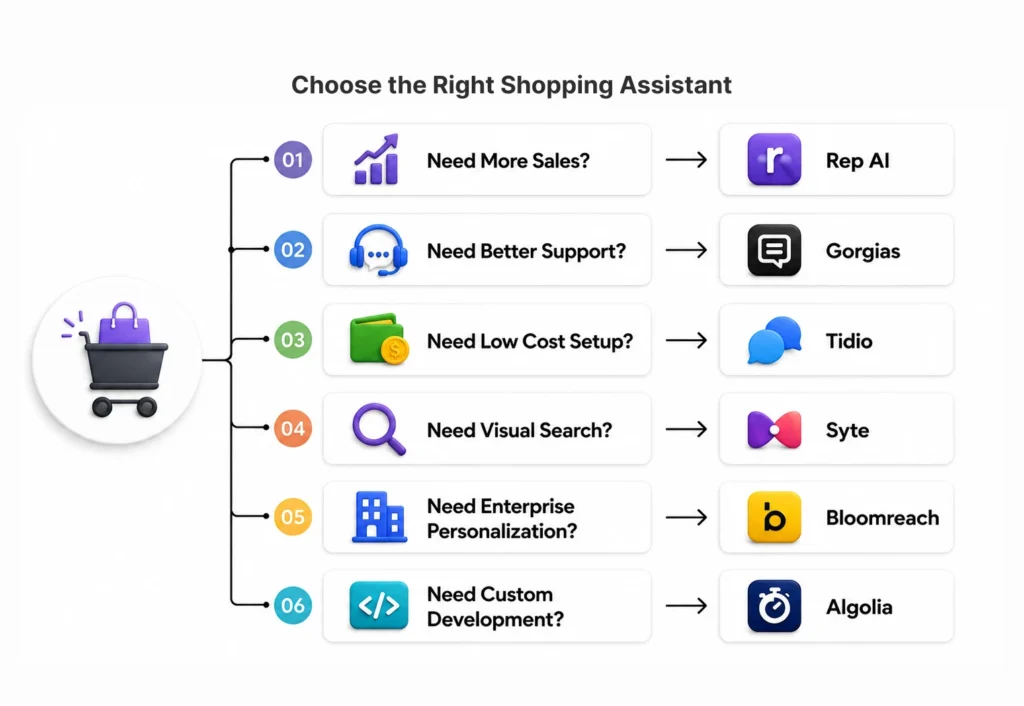
Storefront: The SaaS players of Rep AI and Manifest AI provide mid-market conversion and personalization capabilities, however growth stores are outlined as well. Both are worth considering together with a high-level look at your Ecommerce Website Cost Breakdown as a means of understanding the total investment in context.
Enterprise Retailers: Scale with Bloomreach, Algolia Agent Studio, and Gorgias AI They all have support for complex integrations and are designed for high volume traffic, without a loss in performance. A woocommerce vs shopify comparison could also help you decide the platform that you want to go for which can then have an effect over the tools you use with your assistant.
How to Choose the Right AI Shopping Assistant for Your Ecommerce Store
AI Shopping Assistants for Small Businesses
For small stores, the biggest limits are budget and setup time. Tools providing Shopify plugin installation, ready-made chat flows, and transparent pricing empower fast moving teams.
Scalability matters too. Penny wise and pound foolish: a tool you have to totally rebuild at 10x your current volume will cost you more than paying a little more now for a platform you can grow with. The team at our ai agent development company works with growing stores daily to avoid this expensive migration by choosing the right infrastructure from day one.
Enterprise Ecommerce Shopping Assistant Requirements
Different Evaluation Lens for Enterprise Implementations In the process, the requirement for custom integrations with existing data infrastructure, compliance requirements, and omnichannel support also compound as non-negotiables.
In many cases, the bottleneck is data readiness. A smart AI assistant is only as smart as the product catalog, inventory data and customer history it can access. Brands employing headless ecommerce architecture frameworks have a major advantage here as their API-first structure allows for far cleaner access to data, proving a smooth path to any AI system.
Emerging Trends Shaping Ecommerce Shopping Experiences
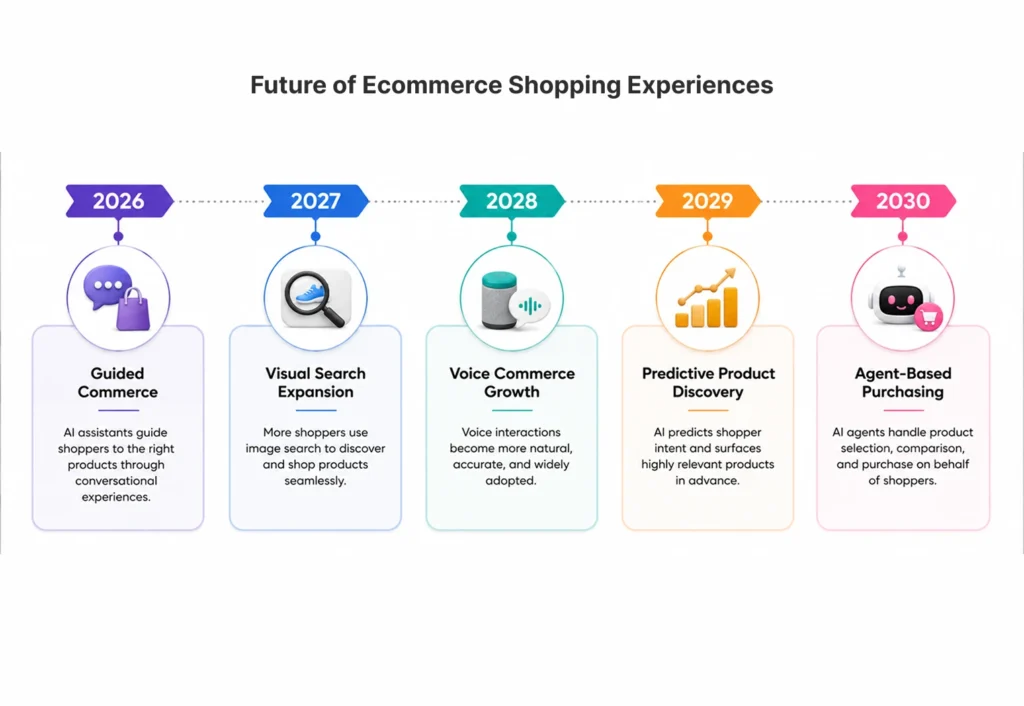
Agent-Based Commerce Experiences
Models such as BERT and T5 primarily focus on answering questions based on learned training data. However, newer agent-based systems are designed to execute actions and complete tasks using real-time information and defined objectives. Looking ahead, future ecommerce buying assistants may independently identify products, compare alternatives, apply discount codes, and complete purchases on behalf of customers.
We are already seeing a movement in this direction with some tools that leverage frameworks like those of Agentic AI Development Services to develop action-specific experiences. Brands that develop this capability now will have a long-term structural advantage as adoption matures.
Voice and Visual Shopping Assistants
From images of discovery of fashion to a world of furniture, beauty, food -> Image based discovery is expanding. Customers expect to take a photo of something they find appealing and have that or something similar available within a matter of seconds.
At the same time, voice-assisted shopping is also on the rise, especially for mobile-first shoppers and smart home device users. The tech at the backend of AI Voice Assistant App Development is advancing rapidly, and brands in the home, grocery, and lifestyle segments must look to integrate voice commerce as soon as possible. Many of the Top AI Development Companies in India are also creating powerful voice commerce solutions for leaders in the space at a very low cost of development.
Challenges of Implementing AI Shopping Assistants for Ecommerce
Product Catalog and Data Quality Issues
Data quality issues are the top root cause of implementation failure. To use AI shopping assistants you need clean, consistent product info. Poor descriptions, inconsistent attribute naming, and inventory information that is not in sync create poor recommendations. As a result, poor recommendations erode customer trust more quickly than not having an assistant at all.
Audit the completeness of product catalog prior to deployment. Data standardization becomes really important. Considering you have size, colour, material, and category attribute to get standardized across the complete listings.
Customer Experience and Shopping Assistant Adoption
Even the most advanced technology can fail if customers do not trust the assistant or find it intrusive. Therefore, conversation design plays a critical role in adoption. Elements such as tone, trigger timing, escalation paths, and overall user experience significantly influence customer engagement and trust.
First step is passive triggers (user starting the conversation) then proactive outreach. See conversation completion rates more than open rates. And always offer an avenue to reach a human for when queries get tricky.
Measuring the Success of Ecommerce Shopping Assistants
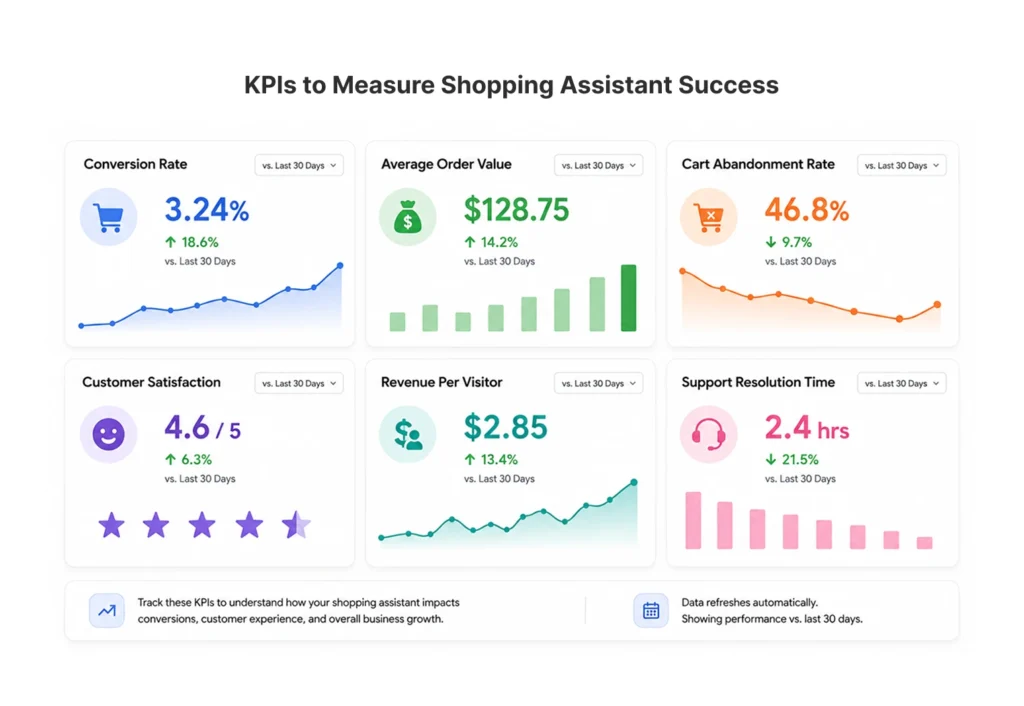
Important KPIs to Track
Start tracking these metrics as of day one:
Conversion rate: Assisted against unassisted sessions
Average order value: Uplift from interactions with recommendations
Cart abandonment rate: Measure how much this metric improved after implementing the assistant
Customer satisfaction score (CSAT): Post-exchange usages
Average response time: For deployments that focus on support
Optimizing Shopping Assistant Performance
Month on month cycle of deploy, measure and refine. A/B test recommendation logic. Look through conversation logs for patterns of unanswered questions that suggest catalog or content gaps. Make trigger timing more accurate with engagement data rather than making assumptions. Stores that treat their AI shopping assistant as a living system, not an install and forget, average 2-3X more sales than stores that do not.
Deciding Which AI Shopping Assistant Is Right For You Is First Deciding What You Want
Choosing the best AI shopping assistants for ecommerce is not about selecting the most feature-rich platform. Instead, it involves finding a solution that aligns with your customer journey and business goals.

If you are sales focused, then Rep AI or Manifest AI should be your priority. Gorgias AI will be of more value for support-heavy operations. For those merchants running store operations, Shopify Sidekick will be an incredible time-saver. Enterprise brands with complex catalogs should consider Bloomreach or Algolia Agent Studio.
Business goals should drive technology choices, and not the other way around. Assess all options against your individual customer journey needs, the state of your current data maturity, and the internal resources to maintain and optimize the tool after it launches.
From choosing, integrating, or building customized AI commerce experiences, the Code Neptune team works end to end spanning the entire stack from Best AI Tools analysis, to ecommerce website development, to ai-powered website development.
Frequently Asked Questions
1. What is the best AI shopping assistants for ecommerce?
The best option depends on your primary goal. Rep AI leads for conversion optimization on Shopify. Gorgias AI is the strongest choice for customer support automation. Shopify Sidekick is best for merchant operations management. Enterprise brands with large catalogs should evaluate Bloomreach or Algolia Agent Studio.
2. Do AI shopping assistants increase ecommerce sales?
Yes. Those who browse through AI powered tailored suggestions and guided product discovery convert at a better rate compared to standard navigation. Assistant Show Complementary Products This also drives up average order value.
3. Are AI shopping assistants suitable for small ecommerce businesses?
Yes. There are some options available from Tidio and Shopify Sidekick for smaller stores; This is very helpful, especially for startups who want to try AI-assisted engagement before investing in a paid tool; Tidio’s free tier is great for this purpose.
4. What is the difference between an AI shopping assistant and a chatbot?
Traditional chatbots answer scripted questions. More than just chatbots, AI shopping assistants assist customers discover products, compare products, get personalized recommendation, etc., and even complete the purchase. This differentiation is most relevant when looking at conversion impact.
5. Can AI shopping assistants work with Shopify and WooCommerce?
Most solutions support Shopify directly. Includes support for WooCommerce, Magento, BigCommerce and others such as Gorgias AI, Tidio and more. The Algolia Agent Studio is powered by Algolia is an API-first platform allowing the platform to integrate with virtually any custom ecommerce stack.
6. Which industries stand to gain the most from an AI shopping assistant?
Fashion and beauty, electronics, furniture and home decor, and grocery brands have good results regardless of season. These categories are characterized by extensive product catalogs, sophisticated purchasing decisions, and consumers who gain the most from guided exploration.
7. How long does it take to implement an AI shopping assistant?
Some simple plug and play solutions like Tidio or Rep AI can be up and running in hours. Enterprise deployments with custom integrations, catalog mapping and conversation design can range from four to twelve weeks based on the complexity of the platform.