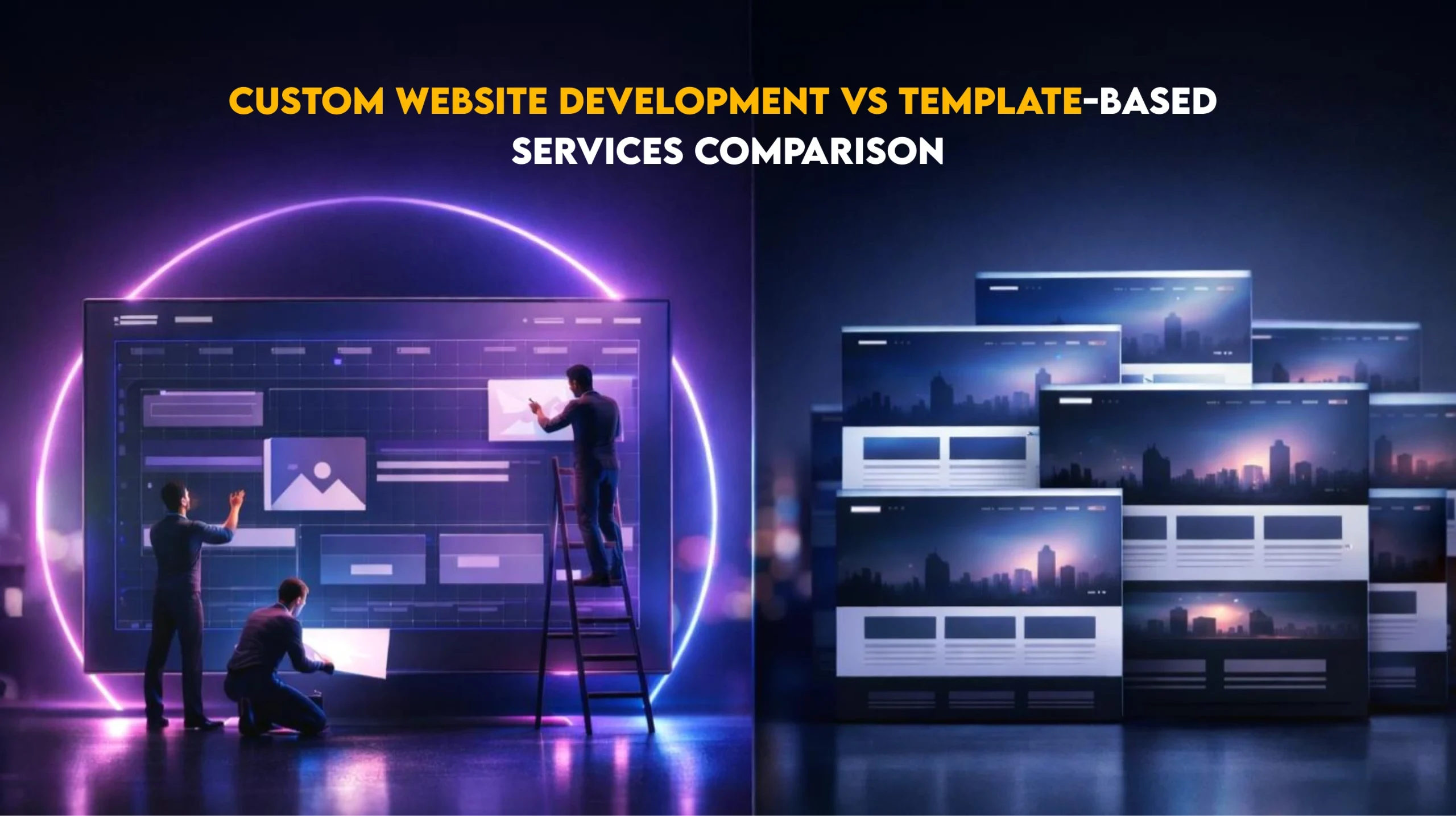
Choosing how a website is built shapes brand perception, performance, and long term growth. Therefore, the Custom website development vs template-based services comparison matters more than many teams expect.
Some businesses move fast and pick ready made layouts. Others invest deeper and request tailored builds from a website development company. Both paths appear similar at first glance. However, their outcomes differ widely over time.
A Custom website development vs template-based services comparison is not about design taste alone. Instead, it reflects control, scalability, security, and how well a site supports evolving business goals.
Some teams ask whether templates limit growth or simply reduce early costs. The answer depends on traffic expectations, integration needs, and brand positioning. These factors often surface only after launch.
Meanwhile, organizations exploring custom website development often look beyond visuals. They prioritize ownership, flexibility, and alignment with internal workflows. As a result, the decision becomes strategic rather than aesthetic.
This comparison helps decision makers understand tradeoffs clearly. It sets the foundation for evaluating costs, timelines, and long term value without leaning toward tools or tutorials.
Understanding the core difference in a custom website development vs template-based services comparison
How structure and planning shape long term outcomes
At a surface level, both approaches aim to publish a functional website. However, the Custom website development vs template-based services comparison reveals deeper structural differences once you examine how sites are planned, built, and evolved.
Template-based services rely on pre-built layouts. These layouts are designed for speed and mass usage. As a result, businesses adapt their content to the structure rather than shaping the structure around business needs.
Custom builds follow a defined website development process. Each phase aligns with brand goals, user behavior, and technical requirements. Therefore, decisions happen before design begins, not after limitations appear.
A common concern is whether templates are enough for serious business growth. Templates often work well for early visibility. However, constraints appear when customization, integrations, or performance tuning become necessary.
In contrast, custom projects involve collaboration between stakeholders and specialists such as website designers in Chennai who design interfaces around real user journeys. This approach prioritizes clarity, control, and adaptability.
The Custom website development vs template-based services comparison becomes clearer when evaluating ownership. Templates offer convenience, while custom builds offer authority over structure, code, and future enhancements.
This foundational difference sets the tone for cost, scalability, and performance discussions ahead.
Cost and timeline realities in a custom vs template website comparison
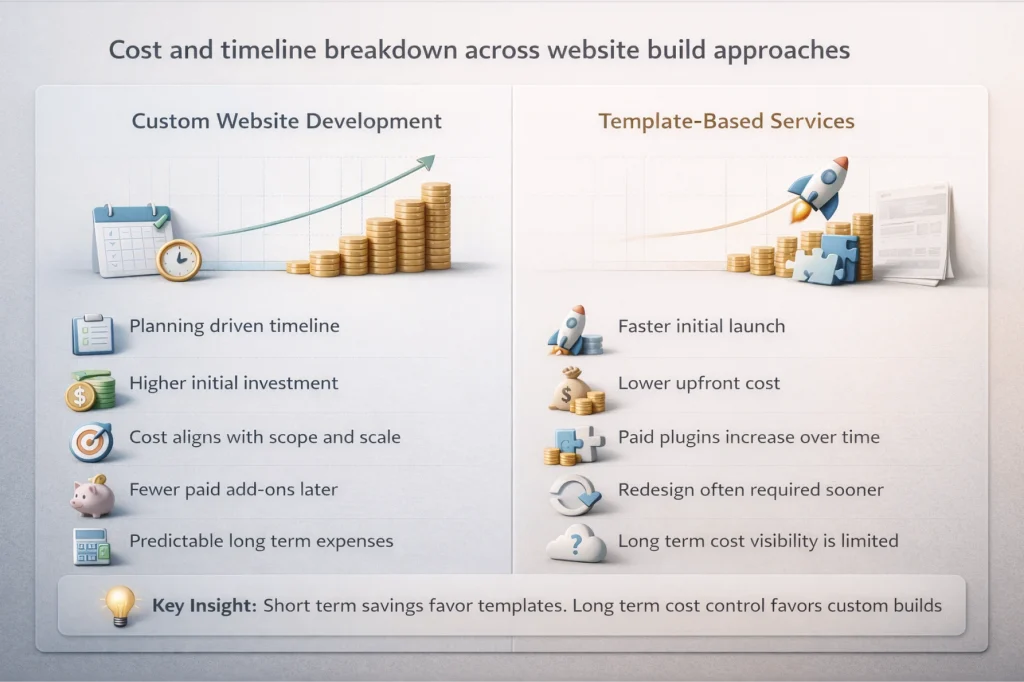
When budgets enter the discussion, the Custom website development vs template-based services comparison often shifts quickly. Templates appear cheaper upfront. However, long term costs usually surface later through upgrades, plugin dependencies, and redesign limitations.
Template services offer fixed pricing and faster launches. Therefore, startups with tight timelines often choose them first. Yet, pricing rarely includes deeper customization, advanced security, or performance tuning.
Decision makers often wonder whether custom websites always cost more. The answer is nuanced. While initial investment is higher, cost control improves over time through optimized architecture and reduced rework. This becomes clear when evaluating the Cost to develop a website beyond year one.
Custom builds also demand longer planning cycles. However, this time supports clarity. Teams avoid rushed compromises and instead align with proven web development frameworks that scale with traffic and features.
The Custom website development vs template-based services comparison shows a clear tradeoff. Templates save time early. Custom solutions save money and effort as business complexity increases.
Understanding this balance helps organizations choose based on growth expectations, not just launch speed.
Flexibility and scalability impact in a custom website development vs template-based services comparison
As businesses grow, website demands rarely stay static. Therefore, flexibility becomes a deciding factor in a Custom website development vs template-based services comparison.
Template platforms limit structural changes. While small edits remain easy, deeper changes often break layouts or require paid extensions. Over time, this creates technical debt and inconsistent user experience.
Custom websites are built for change. Architecture supports new features, integrations, and traffic growth without restructuring the entire site. This is where custom web application development offers a clear advantage for evolving business models.
Adapting website architecture to changing business needs
Decision makers often wonder how scalability affects real operations. A scalable site supports campaigns, analytics tools, and internal systems without friction. Templates usually struggle once complexity increases.
The Custom website development vs template-based services comparison highlights that flexibility is not optional for serious brands. It directly impacts speed of updates, marketing agility, and long term stability.
Teams working with experienced web developers in chennai often plan scalability early. This prevents performance bottlenecks and redesign pressure later.
Flexibility defines whether a website supports growth or restricts it quietly.
Performance and user experience factors in a custom website development vs template-based services comparison
Speed and experience influence trust faster than design alone. Therefore, performance plays a central role in a Custom website development vs template-based services comparison.
Template-based sites often carry unused code, shared scripts, and heavy plugins. As a result, pages load slower, especially on mobile networks. This directly affects engagement and conversions.
Custom websites remove unnecessary components. Developers optimize assets, structure, and requests based on real usage. Consequently, improvements in website loading speed become measurable and consistent.
Some teams ask whether users actually notice these differences. They do. Faster interactions reduce bounce rates and improve perceived reliability. Small delays often translate into lost opportunities.
The Custom website development vs template-based services comparison also impacts accessibility and responsiveness. Custom builds support device specific behavior more cleanly through responsive website development, rather than forcing layouts to adapt imperfectly.
Businesses that prioritize experience usually partner with skilled website developers in chennai who balance performance with usability. This approach protects both brand perception and SEO health.
Performance is not an enhancement. It is a baseline expectation.
Ownership, security, and control in a custom website development vs template-based services comparison
Ownership often gets overlooked until problems appear. Yet, it is central to a Custom website development vs template-based services comparison.
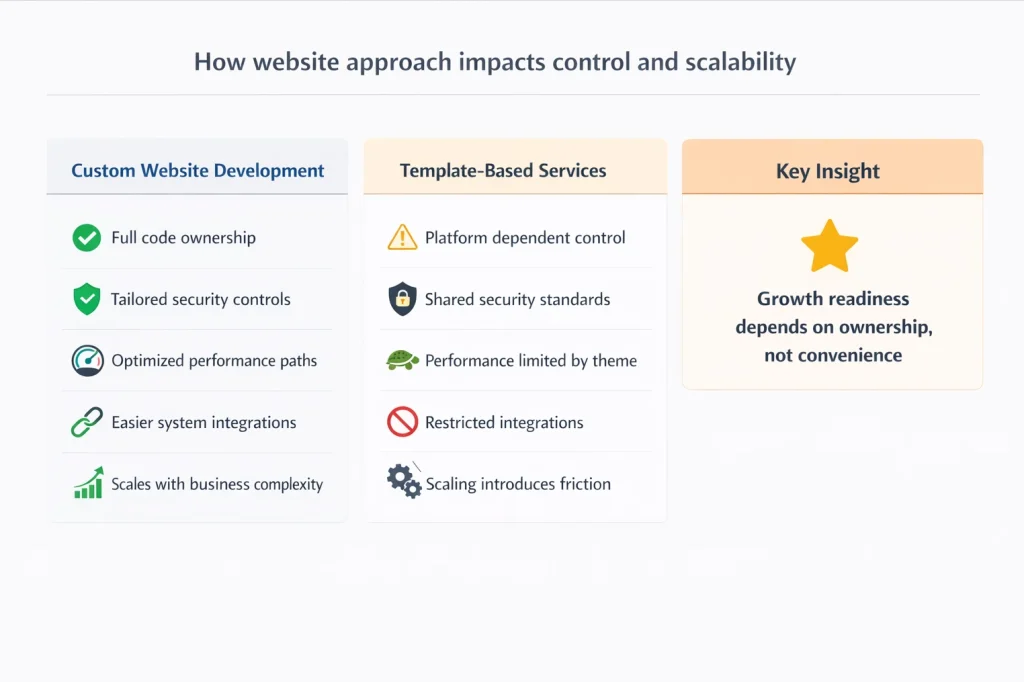
Template-based services operate on shared infrastructure. While this simplifies maintenance, it also limits control. Security updates, platform changes, or pricing shifts remain outside your influence.
Custom websites offer full ownership of code, data, and hosting choices. This control allows teams to apply security policies aligned with internal standards using trusted web development tools rather than generic plugins.
Managing risk, compliance, and platform dependency
A common concern is whether templates are secure enough for business data. They usually meet basic requirements. However, advanced access control, compliance needs, and custom workflows often demand deeper protection.
The custom vs template website comparison shows that control supports confidence. Businesses know where data lives, how it flows, and who manages access.
Organizations working with a reliable website creation company often prioritize governance early. This reduces long term risk and avoids emergency migrations later.
Security and ownership are not technical luxuries. They are business safeguards.
Long term maintenance and evolution considerations
Once a website goes live, real work begins. Therefore, long term upkeep becomes a deciding factor in a Custom website development vs template-based services comparison.
Template platforms simplify maintenance early. Updates arrive automatically, and hosting remains bundled. However, this convenience often limits change. When businesses need structural updates, options shrink quickly.
Custom websites separate maintenance from limitation. Teams can improve features gradually, refine workflows, and adapt architecture as goals shift. This flexibility supports planned website redesign efforts rather than forced rebuilds.
Decision makers often wonder how trends affect future readiness. Industry shifts such as accessibility standards and performance expectations follow clear website development trends. Custom builds adapt faster because code ownership stays internal.
The custom-built websites compared to templates also affects vendor dependency. Templates lock businesses into platforms. Custom sites allow switching partners or scaling teams without starting over.
For long term visibility, many organizations reference external standards from sources like the World Wide Web Consortium for accessibility guidance and Google Search Central for performance expectations. These references shape sustainable decisions rather than short term fixes.
Maintenance is not about fixing issues. It is about enabling evolution without disruption.
Decision criteria businesses use when choosing an approach
When leadership evaluates options, emotional preference matters less than operational fit. Therefore, this section clarifies how teams judge value in a Custom website development vs template-based services comparison.
Templates appeal to teams prioritizing speed and simplicity. Marketing driven sites, early validation projects, and short term campaigns often align with this path. The decision stays practical, not permanent.
Custom websites attract organizations planning scale, integrations, and long term branding. Many decision makers consult a website development company in chennai to assess feasibility before committing resources.
Aligning website strategy with growth intent
Leaders often question how much control they truly need. Control matters when compliance, analytics depth, or system connections influence revenue. In such cases, templates introduce friction rather than efficiency.
The custom vs template website comparison also reflects internal capability. Teams with dedicated technical support gain more value from custom builds. Others prefer managed simplicity.
Businesses evaluating regional expertise often compare vendors like a web site development company in chennai against global template providers. This comparison highlights responsiveness, accountability, and contextual understanding.
The right choice aligns with intent, not popularity.
Brand differentiation and SEO alignment considerations
Brand clarity influences trust before content is read. Therefore, branding becomes a decisive factor in a Custom website development vs template-based services comparison.
Template designs often look familiar because they are reused widely. While this speeds launch, it reduces distinction. Visitors may struggle to remember brands that follow predictable patterns.
Custom websites allow deliberate visual hierarchy, tone, and interaction flow. This depth supports custom website design that aligns with positioning rather than convenience. As a result, branding feels intentional and credible.
SEO alignment also differs. Templates rely on generalized structures. Custom builds shape layout, schema, and internal logic around real search behavior. This supports content discoverability without forcing compromises.
The custom websites versus pre-built templates shows that brand consistency improves organic visibility. Search engines reward clarity, performance, and relevance more than appearance.
Organizations evaluating investment often revisit pricing logic through resources discussing How much does a custom website cost. These insights reinforce that brand equity and SEO impact extend beyond initial budgets.
Brand differentiation is not decoration. It is a competitive signal.
When templates still make sense for specific business scenarios
Not every project requires a custom build. Therefore, balance matters within a Custom website development vs template-based services comparison.
Templates fit well for short term campaigns, internal portals, or validation stages. Businesses testing ideas often prefer speed over structural depth. In such cases, fast deployment reduces risk.
Small teams without technical support also benefit from managed platforms. Updates, hosting, and backups remain handled externally. This simplicity avoids operational overhead during early growth.
However, limitations appear once branding, integrations, or performance expectations rise. Templates rarely support advanced workflows without workarounds. At that point, the tradeoff becomes visible.
The custom and template-based website options helps teams avoid overbuilding. Choosing a template first does not prevent future upgrades. It only delays deeper investment until clarity improves.
Businesses exploring competitive benchmarks often review providers such as a top website development company to understand when transition timing makes sense. This perspective prevents premature complexity.
Templates are tools, not strategies. Their value depends on context and timing.

Final perspective for decision makers
As organizations evaluate digital investments, clarity matters more than trends. Therefore, this closing view frames the Custom website development vs template-based services comparison through long term business impact.
Templates deliver speed and accessibility. They support early momentum and quick validation. However, they also introduce ceilings that appear once growth accelerates.
Custom websites demand higher intent. They require planning, collaboration, and commitment. In return, they deliver control, differentiation, and adaptability. This balance defines the real outcome of a custom vs template website comparison.
Making a context-driven website investment choice
Decision makers often review external benchmarks before committing. Accessibility standards from the
World Wide Web Consortium influence inclusive design planning. Performance expectations outlined by
Google Search Central guide sustainable SEO decisions. These references support informed choices rather than assumptions.
Businesses working with experienced website developers in chennai often find that clarity reduces regret. Likewise, consulting a Best Website Development Company in India helps align technical decisions with commercial intent.
The right approach is not universal. It is contextual, deliberate, and aligned with growth vision.