
Key takeaways
- Ecommerce website costs vary widely because scope, features, and long-term plans differ from one business to another.
- Early planning and clear requirements have a bigger impact on cost control than design or development speed.
- Technology choices influence not just upfront pricing, but how easily the website adapts as the business grows.
- Post-launch maintenance and performance work are part of the real ecommerce website cost, not optional add-ons.
Understanding What Really Goes Into Ecommerce Website Costs
At some point, every business planning an online store runs into the same roadblock. You look up ecommerce website cost breakdown, scan a few numbers, and still feel unsure about what actually drives the cost. Estimates sound neat, but the reasoning behind them often stays unclear.
From our perspective at CodeNeptune, this confusion usually comes from missing context rather than missing numbers. An ecommerce website is not priced as a single unit. It is shaped by choices made at different stages, sometimes without realizing their cost impact at the time. When those choices stack up, budgets start shifting.
An ecommerce website cost breakdown is less about finding a fixed price and more about understanding where effort, time, and complexity enter the picture. Planning decisions influence design. Design affects development. Development decisions affect long term maintenance. None of these stages exist in isolation, even though they are often discussed that way.
Many businesses compare options for ecommerce website development or search broadly for the Cost to develop a website, expecting a clear benchmark. What they usually get instead are ranges without explanation. That gap is where most budgeting mistakes happen. When the reasoning is unclear, it becomes difficult to judge whether a quote is realistic or risky.
This guide is written to walk through the ecommerce website cost breakdown step by step, without oversimplifying or inflating expectations. The aim is to help you recognize which cost factors actually matter for your situation, and which ones only seem important on the surface.
How to Think About Ecommerce Website Costs Before You Budget
What You Should Understand Before Estimating Ecommerce Costs
Before breaking down individual costs, it helps to pause and look at the bigger picture. An ecommerce website cost breakdown is not meant to give you a single number you can lock in immediately. Its real purpose is to help you recognize where money is likely to move, and why it moves in the first place.
One important takeaway is that most ecommerce budgets shift because of decisions made early. Small choices around features, product structure, or integrations often seem harmless at first. Later, those same choices demand more design effort, longer development time, or additional testing. That is how costs quietly grow.
Another point worth noting is that cheaper upfront builds do not always stay cheap. When planning skips clarity, projects tend to rely on fixes after launch. Those fixes usually cost more than doing the work properly at the beginning. A clear ecommerce website cost breakdown helps reduce that pattern.
Where Early Assumptions Start Shaping the Final Cost
It is also useful to understand that not every cost is visible at the same time. Some expenses appear during development, while others show up months later through maintenance, scaling, or performance tuning. When these are ignored, budgets feel inaccurate even though the estimates were technically correct.
Finally, this guide is meant to help you read proposals more confidently. Instead of focusing only on totals, you will be able to see which areas carry risk and which areas are reasonably priced. That shift alone changes how businesses approach discussions with a website development company.
With these points in mind, the next sections move into the actual cost components, starting with the phase where most budgets are either stabilized or quietly set up for trouble.
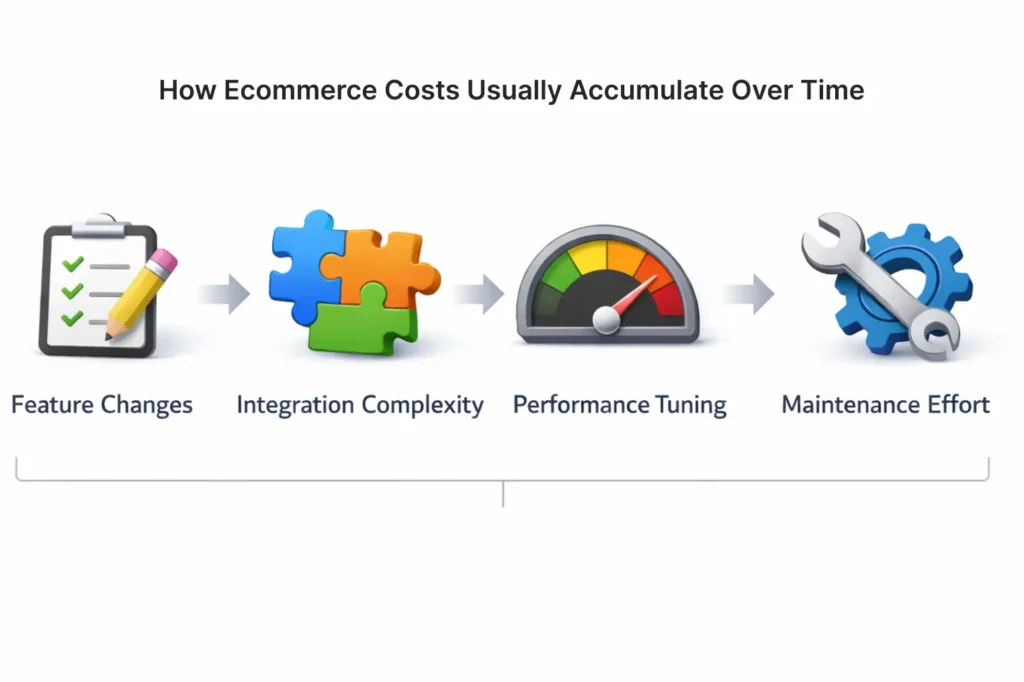
Most ecommerce projects do not become expensive all at once. Costs tend to layer slowly. When early stages are rushed, later stages absorb the pressure. This is why two projects with similar starting estimates can feel very different six months after launch. The ecommerce website cost breakdown reflects accumulated decisions, not a single expensive phase.
Ecommerce Website Cost Breakdown for Planning and Discovery
Where Most Budgets Quietly Take Shape
Planning is the stage many teams rush through, mostly because nothing visible comes out of it. No screens, no features, no working pages. Yet this is where an ecommerce website cost breakdown really starts forming, even if it does not look like it on paper.
During planning and discovery, assumptions get tested. Product volume, user roles, checkout flow, shipping logic, and third party tools all come into focus. Each answer narrows or expands the scope. When these questions are skipped or answered loosely, the project moves forward with gaps. Those gaps almost always resurface later as added cost.
This phase is also where priorities get sorted. Not everything needs to be built at once, but deciding what comes first requires clarity. Without that clarity, development teams tend to build defensively. They add flexibility just in case, and flexibility adds time. Time, as you already know, affects the ecommerce website cost breakdown more than any single feature.
Another overlooked part of planning is alignment. Business owners, marketers, and developers often picture the store differently. Discovery sessions exist to surface those differences early. When alignment happens later, usually during development, changes become expensive instead of simple.
Some businesses treat planning as optional because it looks like overhead. In reality, it acts as a cost filter. Clear requirements reduce rework. Clear scope limits revisions. And clear timelines prevent rushed decisions. All of that keeps the ecommerce website cost breakdown from drifting.
This stage also connects closely to how your website development process is structured. Teams that document decisions early tend to move faster later, even though it feels slower at the start.
Once planning is complete, costs become easier to predict. Design stops guessing. Development stops filling gaps. That is when the budget starts behaving.
Ecommerce Website Cost Breakdown for UI and UX Design
How Visual Decisions Quietly Affect Cost and Conversions
Design is usually the first phase people emotionally react to. It is also one of the easiest places to underestimate cost. In an ecommerce website cost breakdown, UI and UX design sit in the middle, not cheap enough to ignore and not expensive enough to feel risky at first. That balance is misleading.
UX design shapes how users move through the store. It decides what they see first, how quickly they find products, and how many steps it takes to check out. UI design gives that structure a visual form. Colors, spacing, typography, and hierarchy all play a role. When either side is rushed, friction shows up later, often after launch.
Cost rises when design moves beyond simple layouts. A standard product grid is one thing. Personalized sections, dynamic filters, or behavior based recommendations are another. Each additional pattern needs more screens, more states, and more revision cycles. Those cycles are where design cost quietly grows inside the ecommerce website cost breakdown.
Another factor is revision depth. Design rarely gets approved in one round. Feedback loops are normal. What changes cost is not feedback itself, but unclear feedback. When goals are fuzzy, revisions multiply. That pushes timelines and adds pressure on development later.
When Visual Choices Begin Influencing Effort and Time
Design also sets boundaries for development. Clean, consistent design systems are easier to build and maintain. Over designed pages with heavy visuals or inconsistent patterns demand extra effort to make responsive. That directly affects responsive website development, even though the impact is often noticed much later.
Some teams choose to minimize design investment and adjust after launch. That works in limited cases, but redesigning once development is complete usually costs more than refining design upfront. The ecommerce website cost breakdown reflects that difference over time, not immediately.
Good design does not mean complex design. It means deliberate design. When visuals support behavior instead of fighting it, both cost and conversion tend to stay under control.
Ecommerce Website Cost Breakdown for Development and Technology Choices
Where Most of the Budget Actually Gets Spent
This is the stage where the ecommerce website cost breakdown usually peaks. Development turns plans and designs into something real, and once this phase begins, changes stop being simple. Every adjustment now touches code, logic, and testing, which is why costs here feel heavier and harder to reverse.
Development is not one single task. Frontend work handles what users interact with. Backend work manages data, security, rules, and integrations. Even a basic ecommerce site needs product handling, cart logic, checkout flow, payment processing, and admin controls. As soon as you add custom behavior, the effort multiplies.
Technology decisions shape how this effort scales. Some platforms move fast at the start but slow down when customization increases. Others demand more setup early but handle growth better later. That difference plays a big role in how the ecommerce website cost breakdown behaves over time, not just during launch.
A common cost trigger is integrations. Payment gateways, shipping providers, tax tools, inventory systems, and CRM platforms all need configuration and validation. Each integration adds testing effort and edge cases. When integrations are added late, development timelines stretch and budgets follow.
Another factor is build approach. Businesses comparing custom website development options often focus on upfront cost alone. What matters just as much is how easily the system can adapt later. Rigid builds may look affordable early, but modifications become expensive when growth demands change.
The Point Where Technical Decisions Start Feeling Permanent
Development speed can also be deceptive. Faster builds are not always cheaper in the long run. When teams rush, they often skip documentation, optimization, or clean architecture. Those shortcuts surface later as maintenance issues, which quietly expand the ecommerce website cost breakdown beyond the original estimate.
This phase also defines how future updates will feel. Clean, well structured development allows features to be added without rewriting core logic. Poor structure does the opposite. The difference becomes clear months after launch, not during development.
Once development is complete, attention shifts to making sure everything works under real conditions. That brings us to testing, performance, and security.
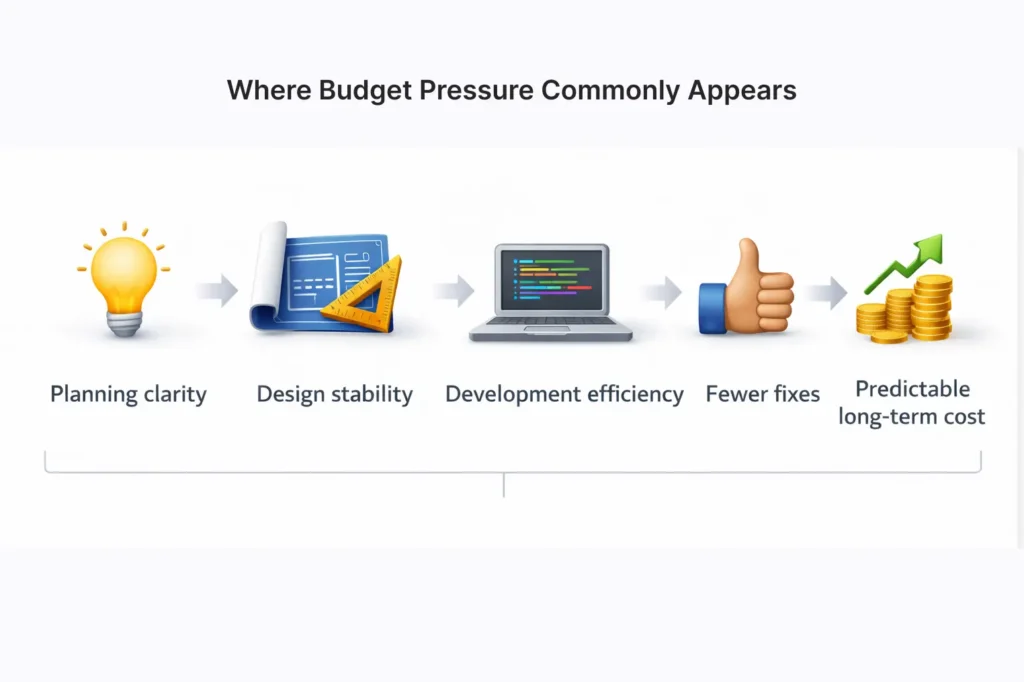
Budget stress rarely comes from one large decision. It usually comes from small adjustments made after the build has momentum. Each adjustment feels manageable on its own. Together, they reshape the ecommerce website cost breakdown more than expected.
Ecommerce Website Cost Breakdown for Testing, Performance, and Security
Where Things Either Hold Together or Start Slipping
This phase rarely gets the attention it deserves, mostly because nothing new appears on the screen. No fresh layouts. No new features. Yet in the ecommerce website cost breakdown, this is the point where earlier decisions finally get tested under pressure.
Testing is not just about checking whether buttons work. It is about seeing how the store behaves when real usage begins to resemble real life. Different browsers. Different devices. Slightly unstable connections. A checkout flow that works perfectly in one scenario can behave differently in another. These gaps are not dramatic at first. They show up as small inconsistencies.
Performance work follows a similar pattern. A site can look fine during development and still feel slow once traffic increases. Pages load, but not comfortably. Filters respond, but with a pause. Improving website loading speed at this stage often reveals issues that were easy to ignore earlier. Addressing them before launch usually costs less than chasing them later.
Security is often treated as a checklist item, yet it behaves more like an ongoing condition. Payment handling, user data storage, and admin access all introduce exposure. This is especially true in custom web app development, where unique workflows and integrations require closer attention. Most problems come from overlooked details rather than dramatic failures.
What makes this phase tricky is timing. Issues discovered here usually trace back to earlier choices. When testing is rushed, unresolved problems carry forward. They resurface later, during updates or maintenance, when fixing them feels heavier than it should.
Handled carefully, this stage stabilizes the entire build. Skipped or compressed, it becomes the reason post launch costs feel unpredictable.
Ecommerce Website Cost Breakdown for Post Launch Maintenance and Ongoing Support
Where Long Term Costs Quietly Take Shape
Once an ecommerce site goes live, the work does not really stop. It simply changes form. In the ecommerce website cost breakdown, post launch maintenance is where short term decisions meet long term reality.
Maintenance covers updates, fixes, performance monitoring, and security patches. Ecommerce platforms rely on evolving tools and services, and over time, those changes create small gaps. Left unattended, those gaps grow into issues that demand urgent attention. Planned maintenance smooths this out and keeps costs more even.
Content and operational changes also play a role. Adding products, adjusting pricing rules, or modifying checkout behavior may seem routine, but each change touches the system. Businesses that expect frequent updates often plan support in advance instead of reacting case by case. That approach keeps the ecommerce website cost breakdown from feeling unpredictable.
Growth introduces another layer. As traffic increases, hosting and infrastructure must adjust. These shifts are part of the cost story, even though they arrive after launch. Teams that work with an experienced ecommerce website development company usually anticipate these changes earlier and avoid rushed upgrades.
Post launch work also reflects how well earlier phases were handled. Clean builds tend to age well. Fragile ones require constant attention. Over time, this difference becomes more visible than the original development cost itself.
Maintenance is not an optional extra. It is the continuation of the build. When it is planned with the same care as development, the ecommerce website cost breakdown stays grounded instead of drifting.
Ecommerce Website Cost Breakdown Summary and Budget Perspective
How Costs Start Making Sense When You Step Back
After walking through each phase, the ecommerce website cost breakdown starts to look less like a list of expenses and more like a pattern. Costs do not rise randomly. They respond to scope, timing, and how much clarity existed when decisions were made.
Projects with similar goals can still land in very different budget ranges. One business invests time early, limits revisions, and plans for growth. Another rushes to launch, fills gaps later, and reacts as issues appear. On paper, both may look similar at the start. Over time, the cost story changes.
What usually surprises teams is not the development cost itself, but how uneven spending feels when planning is skipped. A lower initial estimate feels good. Then adjustments begin. A feature here. A fix there. None of them seem large on their own. Together, they stretch the ecommerce website cost breakdown beyond what was expected.
This is also where comparing quotes becomes easier. Instead of asking why one number is higher, the better question becomes what is included and what is quietly missing. A proposal that allocates time for testing, performance, and post launch support may look expensive. Often, it is simply more honest.
Stepping Back to See How the Numbers Actually Behave
Many businesses revisit earlier research at this stage, especially around how much a custom website cost. The difference now is context. Costs are no longer abstract. They connect back to real phases, real trade-offs, and real effort.
A useful way to think about budgeting is distribution rather than totals. When most of the budget sits in development with little allowance for testing or maintenance, pressure builds later. When spending is balanced across phases, costs tend to feel steadier over time.
This section is not meant to give a final number. It is meant to help you recognize when a budget feels aligned and when it feels artificially compressed. That awareness alone prevents many long term cost issues.
Ecommerce Website Cost Comparison (Real Market Data)
| Project Type / Region | Typical Cost Range | Notes |
| Basic ecommerce setup (DIY / template) | ~$300 – $1,000 first year | For very small stores using builders like Wix, Shopify, etc. |
| Small ecommerce site (simple custom) | ~$1,500 – $5,000 | Simple site with basic UX and minimal custom features. |
| Custom ecommerce (professional) | ~$5,000 – $50,000+ | Professional custom builds for growth oriented stores. |
| Advanced / enterprise ecommerce | ~$50,000 – $250,000+ | Large stores, deeply integrated platforms, high performance. |
| India – basic ecommerce | ₹20,000 – ₹60,000 | Small site with limited products. |
| India – mid range store | ₹60,000 – ₹2,00,000 | Standard ecommerce site with integrations. |
| India – large/custom store | ₹2,00,000 – ₹25+ lakh | Large catalogs or custom workflows. |
| India – freelancer / agency (varied complexity) | ₹30,000 – ₹4,00,000 | Depends on developer type and feature set. |
Next, we’ll look at how technology choices shift both upfront cost and long term flexibility, and why similar feature lists can still behave very differently once the site is live.
Ecommerce Website Cost Breakdown Based on Technology Choices
Why the Same Store Can Cost Very Different Amounts
Technology decisions tend to look abstract at first. Platform names. Framework options. Hosting suggestions. Yet over time, these choices shape how the ecommerce website cost breakdown behaves more than most teams expect.
Two stores can launch with similar features and still feel completely different six months later. One adapts easily. The other resists change. That difference usually traces back to the technology stack chosen early on, often before long term needs were fully clear.
Some platforms prioritize speed of setup. They help stores go live quickly and keep early costs lower. Others demand more effort upfront but offer room to grow without reworking the foundation. Neither approach is wrong. Problems start when the choice does not match the business direction.
This is why comparisons like React vs WordPress for business website builds come up so often. On the surface, both can power ecommerce. In practice, they behave very differently once customization, performance tuning, and integrations enter the picture.
Technology Comparison and Cost Behavior Over Time
| Technology Approach | Early Cost Feel | Flexibility Over Time | Long Term Cost Pattern |
| Template based platforms | Light and accessible | Constrained | Costs rise during customization |
| CMS driven ecommerce builds | Moderate | Balanced | Steady with planned updates |
| Framework based custom builds | Heavy upfront | High | Flattens as scale increases |
| Headless ecommerce architecture | Demanding | Very high | Optimized for growth |
What this table does not show directly is friction. Template based solutions often feel smooth until limits appear. Custom builds feel demanding early, then gradually become easier to work with. That shift is part of the ecommerce website cost breakdown even though it does not show up as a line item.
Technology also affects how maintenance feels. Some stacks encourage frequent updates with minimal effort. Others turn small changes into larger tasks. Over time, this difference shapes how predictable your costs feel month to month.
Businesses evaluating options often look for a clear winner. There usually is not one. The better question is which technology absorbs change more gracefully. Stores that expect frequent updates, integrations, or growth tend to benefit from stacks designed for flexibility, even if the initial investment feels higher.
This section connects closely with custom website development vs template based services comparison, not as a debate, but as a reminder that short term comfort and long term ease rarely come from the same choice.

Final Thoughts on Ecommerce Website Cost Breakdown
A realistic ecommerce website cost breakdown is not about locking a number and moving on. It is about understanding how decisions behave over time. Some costs are visible early. Others arrive later, shaped by how the site was planned, built, and maintained.
What tends to cause frustration is not cost itself, but unpredictability. When expenses show up without context, they feel like overruns. When they are anticipated, they feel like part of the process. That difference comes from clarity, not from cutting corners.
Many businesses begin this process searching for a price. They finish it realizing they were actually searching for confidence. Knowing what affects cost, when it shows up, and why it changes makes budgeting less stressful and planning more deliberate.
If this guide did one thing well, it should make future decisions feel less reactive and more intentional.
FAQs on Ecommerce Website Cost Breakdown
1. Is an ecommerce website cost breakdown ever fully accurate at the start?
It is accurate to the extent that decisions are clear. When scope, features, and priorities are well defined, estimates tend to hold. When those details stay flexible, the numbers usually move with them.
2. Why do two similar ecommerce websites have very different costs?
Similarity is often visual, not structural. Differences in integrations, scalability planning, performance requirements, and future flexibility quietly change the ecommerce website cost breakdown over time.
3. Can post launch costs be avoided with better planning?
Avoided completely, no. Reduced and stabilized, yes. Planning does not eliminate maintenance, but it prevents costs from appearing suddenly and without warning.