
Key Takeaways
- Flutter vs React Native is a critical decision that affects app performance, development speed, and long-term maintenance.
- Flutter is best for businesses that need consistent UI, advanced animations, and a polished cross-platform experience.
- React Native is often better for teams that already use JavaScript and want easier hiring and faster onboarding.
- When evaluating Flutter vs React Native, compare cost, UI flexibility, developer ecosystem, and scalability before choosing.
- The right framework depends on your business goals, product complexity, and future app development roadmap.
Businesses face intense pressure to launch mobile applications quickly while keeping budgets under control. Founders and technical leaders must balance fast time to market with long term maintenance risks and hiring challenges. When product performance expectations are high, selecting the correct technology stack becomes a critical business decision.
The debate surrounding flutter vs react native is not a simple technical disagreement. This choice directly impacts your overall budget, development speed, user experience, and scaling capacity. In our approach, framework selection should match business goals, not just developer preference. You need a technology that aligns with your specific roadmap.
This guide will compare flutter vs react native across the most important business categories. We will examine performance, cost, developer ecosystems, use cases, startup fit, and enterprise readiness. By the end of this breakdown, you will have a clear framework for making the best decision for your upcoming project.
Flutter vs React Native at a Glance: What Matters Most for Business Teams
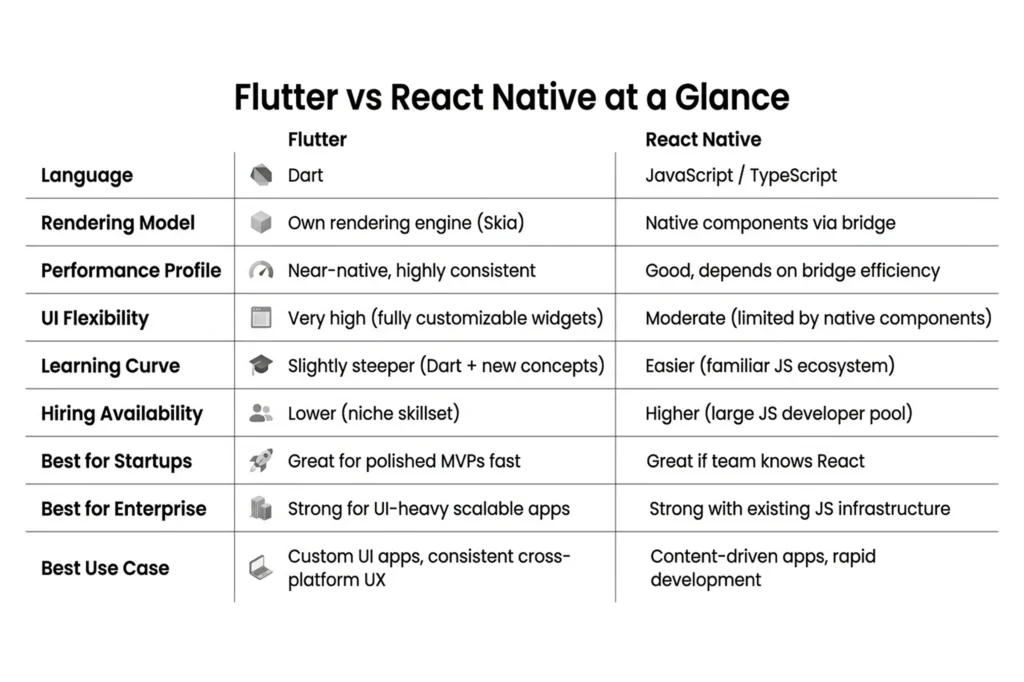
Leaders need a quick snapshot before diving into technical details. Both frameworks allow engineers to write code once and deploy it across multiple operating systems. This reduces development time and cuts costs significantly.
Flutter is a UI toolkit created by Google. It uses the Dart programming language and features its own rendering engine. This makes it an excellent choice for applications requiring highly customized interfaces and flawless animations. React Native is an open source framework built by Meta. It relies on JavaScript and renders using native components. This makes it highly attractive for companies that already have strong web development teams.
If you are looking for a cross platform app development company, you must first understand the fundamental differences between these two solutions. Reading through Cross Platform App Development Explained resources will show you that Flutter often wins on visual consistency, while React Native wins on talent availability.
When Flutter Makes More Sense
Choose Flutter if your product relies heavily on custom branding, complex animations, and consistent visual layouts across every device.
When React Native Is the Safer Choice
React Native is safer when you have an existing JavaScript team and need to launch a standard consumer application quickly.
Flutter vs React Native Architecture Explained for Non Technical Decision Makers
Understanding how each framework works under the hood is vital for non technical decision makers. Architecture affects everything from UI consistency to native device integrations.
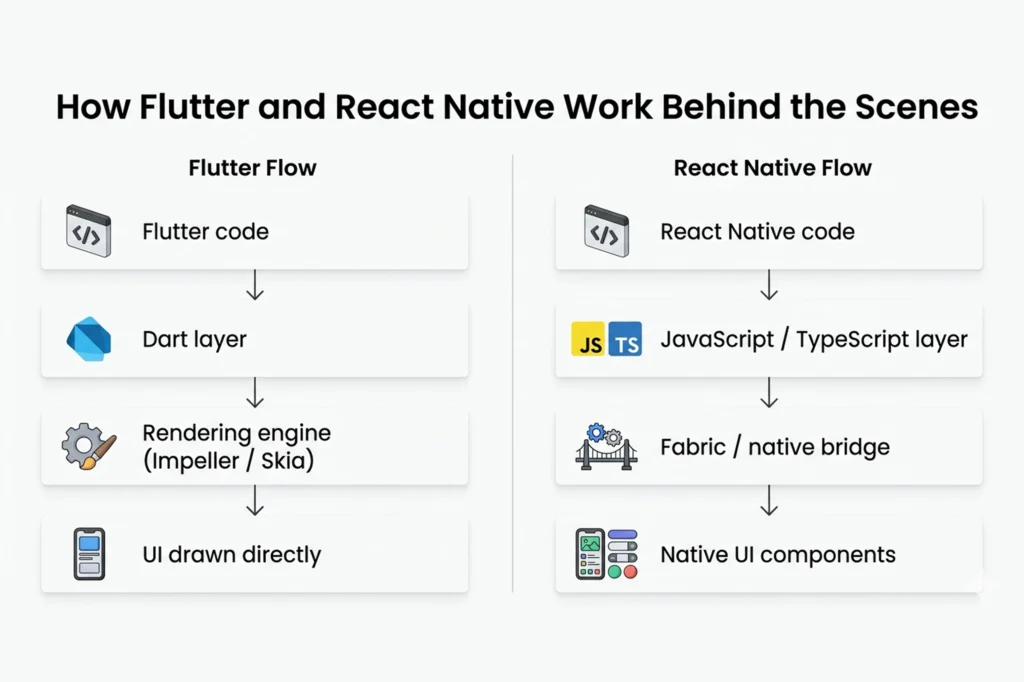
Flutter operates independently of the device native UI components. It draws every pixel on the screen using its own graphics engine called Skia or Impeller. This guarantees that your application looks exactly the same on an older Android device as it does on a brand new iPhone. React Native takes a different path. It uses a bridge or the newer Fabric architecture to communicate with the native components of the device.
This architectural difference places these frameworks right in the middle of discussions around hybrid app development and native app development.
How Flutter Renders UI Across Platforms
Because Flutter paints its own pixels, developers do not have to worry about operating system updates breaking the user interface. The visual experience remains highly stable.
How React Native Uses Native Components
React Native translates JavaScript code into native views. This means buttons and sliders will automatically look like standard iOS or Android components without extra coding.
Flutter vs React Native Performance Comparison: Speed, UI Smoothness, and App Stability
Performance is a top priority for user retention. When comparing flutter vs react native, speed and stability are defining factors.
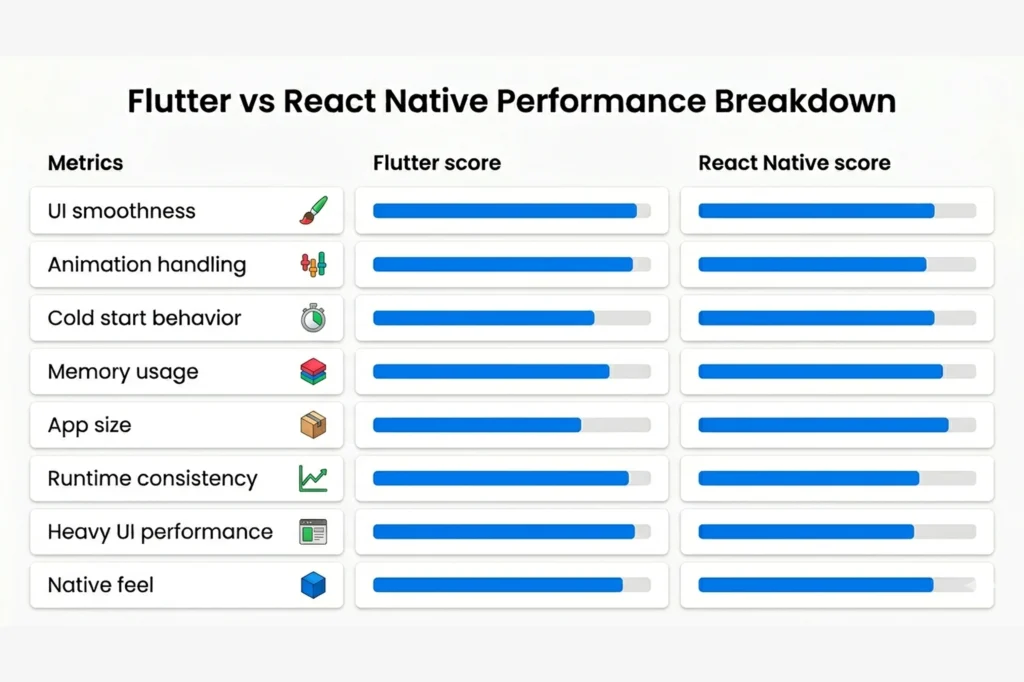
Flutter generally offers better out of the box performance. It compiles directly to native machine code. This allows it to achieve 60 or even 120 frames per second easily. It handles complex animations smoothly and rarely drops frames. React Native has historically struggled with performance bottlenecks due to its JavaScript bridge. However, recent updates have significantly improved its speed.
For teams focused on mobile app performance optimization, profiling tools are essential. Utilizing the Best tools for app development will help you monitor memory usage, cold start times, and runtime responsiveness.
Which Framework Feels Faster in Real World Apps
Flutter feels slightly more fluid when navigating heavy screens and custom graphics. React Native performs perfectly well for standard applications like e-commerce stores and social feeds.
Performance Trade Offs That Affect User Experience
Flutter applications tend to have larger file sizes. React Native applications might experience slight animation stutters on older devices if not optimized correctly.
Flutter vs React Native for Development Speed, Maintenance, and Team Productivity
Shipping products faster gives companies a competitive edge. Both frameworks offer hot reload functionality. This allows developers to see code changes instantly without rebuilding the entire application.
Developer onboarding is generally faster with React Native if your team already knows JavaScript. Flutter requires developers to learn Dart, which can add a slight learning curve. However, Flutter provides a comprehensive set of built in widgets. This reduces reliance on third party libraries. React Native relies heavily on external community packages. These packages can break during major updates, increasing long term maintenance burdens.
Understanding the App development lifecycle explained documentation shows that maintenance is just as important as the initial build. Working with professional mobile app development services ensures your codebase remains healthy as operating systems evolve.
Which Framework Helps Teams Ship Faster
React Native helps JavaScript teams ship MVPs incredibly fast. Flutter helps teams ship visually complex applications faster because they do not have to test UI discrepancies across devices.
Long Term Maintenance and Upgrade Considerations
Flutter offers a more predictable upgrade path. React Native projects often require careful dependency management to avoid version conflicts.
Flutter vs React Native Cost Comparison for Startups and Growing Businesses
Budget constraints dictate many technology decisions. Comparing flutter vs react native reveals different financial implications over a two year product lifecycle.
Initial development costs are similar for both frameworks because they both offer a single codebase. Hiring costs often differ. JavaScript developers are abundant, making React Native talent generally cheaper and easier to find. Dart developers are less common, which might increase recruitment costs slightly.
When planning Mobile App Development for Startups, upfront cost is only one piece of the puzzle. You must also calculate the cost of long term ownership. Investing in custom mobile app development means you need a framework that will not require a total rewrite in three years.
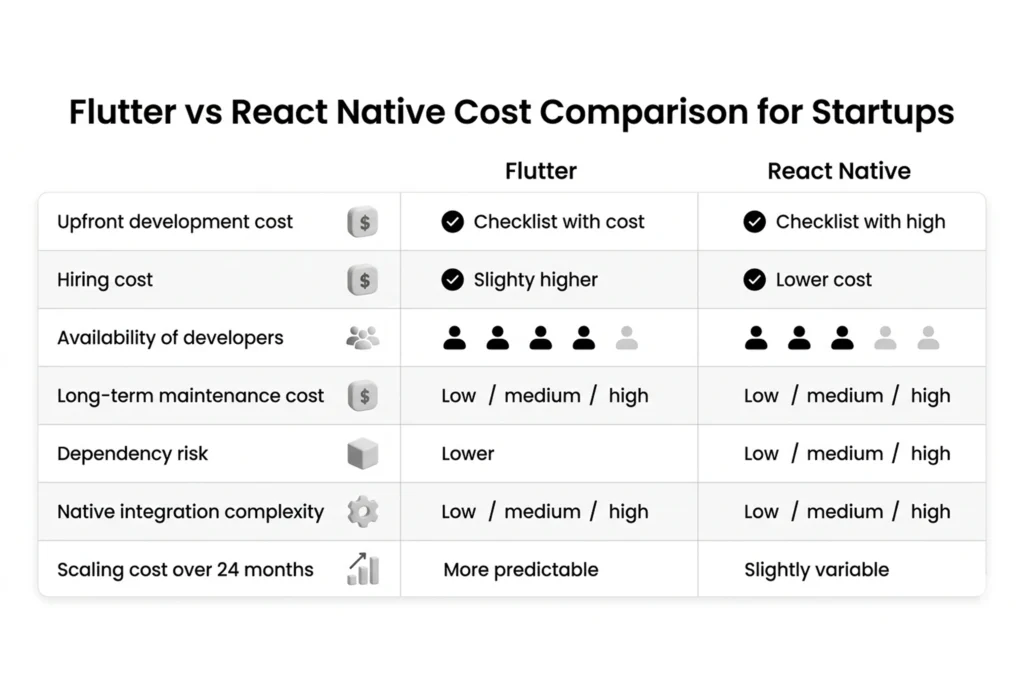
Upfront Development Cost vs Long Term Ownership Cost
React Native might be cheaper to start due to accessible talent. Flutter can be cheaper to maintain because it requires less native module troubleshooting.
Hiring Availability and Talent Market Differences
React Native has a massive global talent pool. Finding a replacement developer is usually faster compared to finding a senior Flutter engineer.
Flutter vs React Native for UI Design, User Experience, and Brand Consistency
A polished user interface builds trust. If pixel perfect design is your top priority, you must weigh these frameworks carefully.
Flutter was built for design flexibility. It gives you complete control over every pixel on the screen. If your brand requires a highly unique look that disregards standard operating system guidelines, Flutter is the absolute winner. React Native focuses on delivering a platform native feel. It automatically adapts to iOS and Android design conventions.
Partnering with an experienced ios and android app development company will help you translate your brand guidelines into a working product.
Why Flutter Is Often Chosen for Consistent UI
Flutter renders everything itself. Your custom fonts, buttons, and shadows will look identical on every single device.
Why React Native Feels More Native on iOS and Android
React Native uses native building blocks. Users interact with familiar interface elements that behave exactly as they expect on their specific device.
Flutter vs React Native for Startup MVPs, Scale Ups, and Enterprise Products
Business stage heavily influences technology choice. A startup building a prototype has very different needs than a large corporation modernizing its internal systems.
For an MVP, speed to market is everything. React Native allows founders to leverage existing web code and launch quickly. As companies scale into enterprise territory, stability becomes paramount. Flutter is increasingly popular for enterprise applications because its strict architecture enforces clean code and prevents UI fragmentation.
A reliable Mobile App Development Company can guide you through this transition.
Best Choice for Startup MVPs
React Native is highly recommended for startups that need to prove product market fit rapidly using widely available JavaScript talent.
Best Choice for Scalable Enterprise Apps
Flutter provides the rigorous structure and reliable performance necessary for large scale enterprise software with complex data flows.
Flutter vs React Native for Hiring, Developer Availability, and Technical Ecosystem
You cannot build great software without great people. The technical ecosystem surrounding a framework determines how easily you can scale your engineering department.
React Native boasts one of the largest developer communities in the world. It benefits from the massive React web ecosystem. Finding solutions to obscure bugs is usually a quick Google search away. Flutter has a younger but fiercely loyal community. Its documentation is widely considered superior to React Native.
If you are looking to outsource, finding a flutter app development company in india is becoming much easier as the technology surges in popularity. You can also explore specialized flutter app development services to augment your existing team.
Is It Easier to Hire React Native Developers
Yes. Millions of developers already know JavaScript and React. Transitioning them to React Native takes very little time.
Does Flutter Offer Better Long Term Stability
Google backs Flutter heavily. Its self contained widget system means it relies less on third party open source maintainers, offering great long term stability.
When to Choose Flutter Over React Native
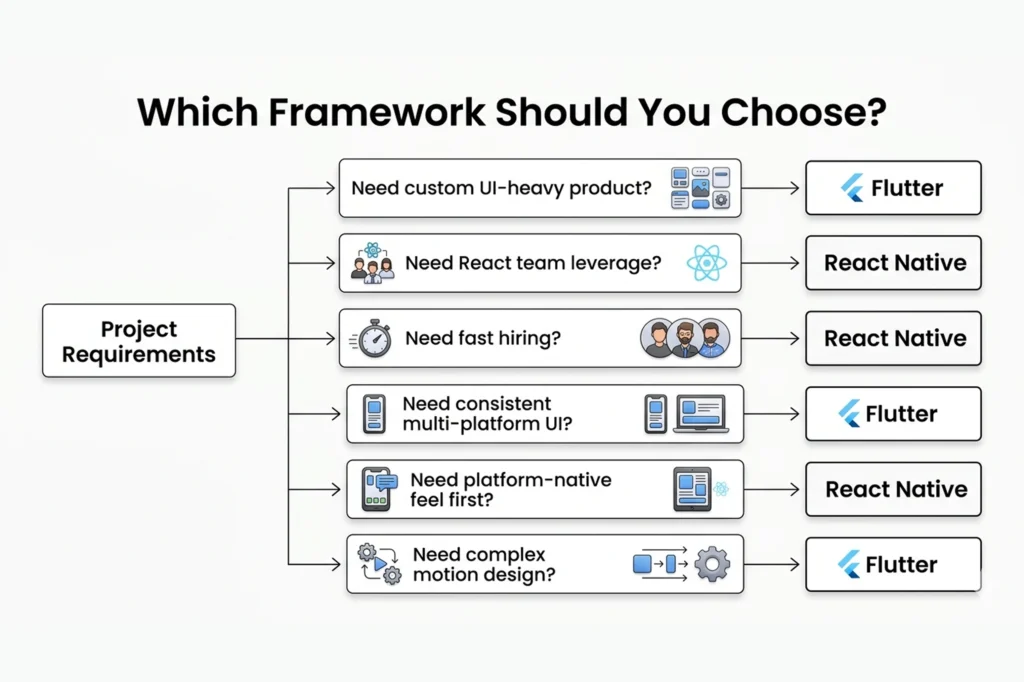
Making a definitive choice requires looking at your specific project requirements. You should heavily consider Flutter if your application fits certain criteria.
Choose Flutter if:
- Your application has a highly customized, brand specific user interface.
- You need complex, smooth animations that run at 60 frames per second.
- You want visual consistency across iOS, Android, Web, and Desktop.
- You have a smaller team and want to avoid testing UI bugs on multiple devices.
If these points match your roadmap, seeking professional ios app development alternatives might not be necessary. Flutter will cover your needs perfectly.
When React Native Is the Better Choice for Your Business
React Native remains a powerhouse for a very good reason. It provides a pragmatic, business friendly approach to mobile software.
Choose React Native if:
- You already have an internal team of React web developers.
- You need to hire new developers quickly and affordably.
- Your application needs to look and feel like a standard iOS or Android product.
- You want to share code directly between your web application and your mobile application.
Leveraging React Native makes android app development incredibly efficient for companies heavily invested in the JavaScript ecosystem.

Final Verdict on Choosing Your Framework
There is no universal winner in the flutter vs react native debate. The best framework is the one that aligns with your current resources, your budget, and your ultimate product vision.
If visual consistency, top tier performance, and broad multi platform ambitions matter most, Flutter is an excellent choice. If you want to leverage existing JavaScript talent, integrate deeply with native platform conventions, and hire quickly, React Native is the smarter path.
Before you commit to a technology stack, map out your product goals and launch timeline. Consulting with mobile app development services can help clarify your technical roadmap. The right choice depends entirely on your business priorities.
Flutter vs React Native FAQ
1. Is Flutter better than React Native in 2026?
It depends on business goals. Flutter is stronger for UI consistency and complex visuals, while React Native is often easier for teams already using React and JavaScript.
2. Which is faster, Flutter or React Native?
Flutter often performs better in animation heavy or highly customized interfaces. React Native has improved significantly, especially with its newer architecture, and is fast enough for most business apps.
3. Which framework is better for startups?
React Native can be ideal for startups with React talent, while Flutter suits startups that want polished UI and broader multi platform potential from day one.
4. Is Flutter more expensive than React Native?
Not always, but Flutter specialists can be harder to hire in some markets. React Native may reduce hiring friction if JavaScript talent is already available.
5. Which is easier to maintain long term?
Flutter often offers more predictable UI consistency. React Native can be easier if the business already relies on React based workflows and frontend teams.