
Key takeaways
- Mobile app monetization strategies must be planned during product architecture, not added after launch.
- Hybrid revenue models combining ads, subscriptions, and in-app purchases often deliver stronger lifetime value and reduce revenue risk.
- Platform behavior differs significantly between Android and iOS, requiring tailored monetization execution.
- Cost modeling, CAC, LTV, and churn tracking are essential to building scalable and sustainable app revenue systems.
Revenue generation is no longer an afterthought in app planning. Many businesses invest heavily in product design and acquisition, yet struggle to convert usage into predictable income. The issue is rarely traffic. It is structure.
Effective mobile app monetization strategies must align with user intent, pricing psychology, and operational costs. Without a clear framework, even high-download apps fail to scale profitably.
Monetization should be defined at the product planning stage rather than added later. This ensures pricing, experience, and growth tactics work together from day one. When revenue models are retrofitted, they often clash with existing UX patterns, leading to user frustration and churn.
From our perspective, monetization is not a growth tactic layered on top of a finished product. It is a strategic decision that shapes architecture, user journeys, and long-term scalability.
This guide explores proven approaches to app monetization, platform-specific considerations, and the role of strategic planning throughout the development lifecycle. Whether you’re building your first app or scaling an established product, these insights will help you design revenue systems that align with both user expectations and business goals.
Understanding the Core Mobile App Monetization Strategies
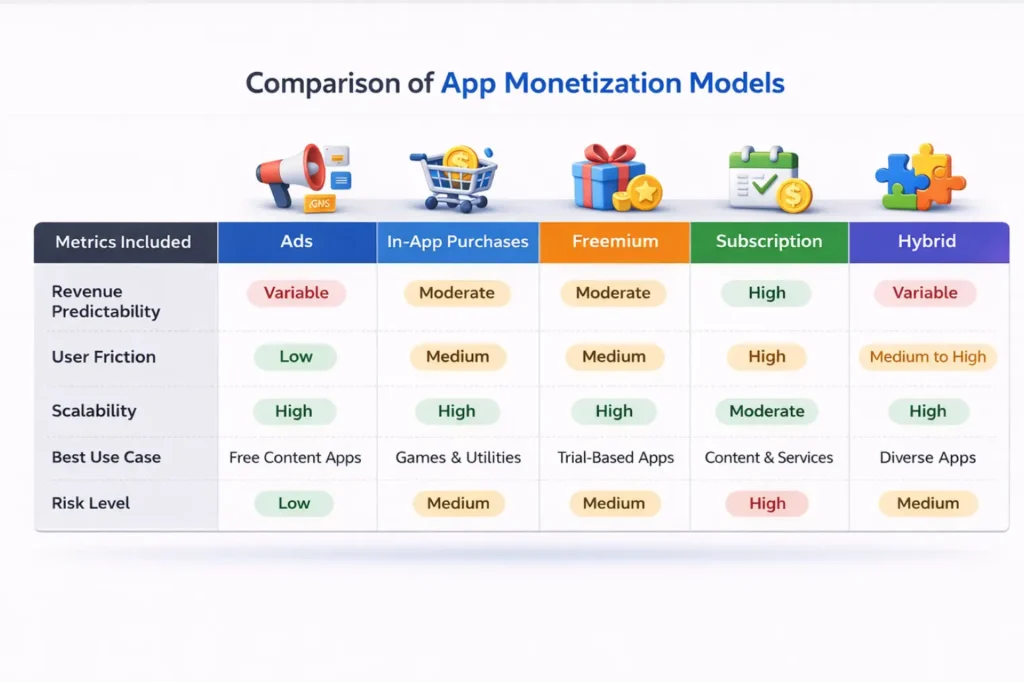
Selecting the right monetization model begins with understanding how users engage with your product. Different strategies suit different use cases, and alignment between user behavior and revenue structure determines long-term viability.
Advertising-Based Mobile App Revenue Strategies
This model generates revenue through impressions, clicks, or rewarded placements. It works well for high engagement and free-to-use products where users return frequently but may resist upfront costs.
Best suited for:
- Social platforms
- Casual gaming
- Utility apps with daily usage
Ad-based monetization requires careful UX integration. Poorly placed ads disrupt experience and accelerate churn. When planning with a mobile app development company, ad placement must be built into design rather than layered afterward. Teams experienced in android app development and ios app development can optimize ad density, placement timing, and format selection to balance revenue with retention.
Rewarded video ads, for example, allow users to opt in for value exchanges, like extra lives or premium features, which creates a more positive interaction. Banner and interstitial ads require strategic positioning to avoid interfering with core functionality.
In-App Purchases and Virtual Goods
This approach allows users to buy digital items, upgrades, or unlock features. It is common in gaming and content platforms where value can be delivered incrementally.
Key considerations include:
- Pricing tiers: Offering multiple price points increases conversion by catering to different spending capacities.
- Conversion triggers: Identifying moments when users are most likely to purchase, such as when they hit a difficulty spike or unlock new content, can improve conversion rates.
- Psychological anchoring: Displaying higher-priced options alongside lower ones influences perceived value.
If working with mobile app development services, ensure purchase flows are seamless across both platforms. Teams specializing in ios and android app development company solutions can optimize store compliance and payment flows early. Frictionless checkout, localized pricing, and clear value communication all impact conversion performance.
Native app development often delivers superior purchase experiences due to tighter integration with platform-specific payment systems and UI conventions.
Freemium Models and Feature Gating
Freemium strategies offer core functionality for free while charging for advanced features. This lowers acquisition barriers and allows users to experience value before committing financially.
Success depends on identifying which features to gate. The free tier must provide enough value to retain users, while premium features must be compelling enough to justify payment. Gating too early frustrates users. Gating too late reduces conversion potential.
Effective freemium design balances accessibility with scarcity, creating natural upgrade moments without compromising the core experience.
Subscription and Hybrid Mobile App Monetization Strategies
Recurring revenue improves predictability. However, subscription fatigue is real. Users now compare value more critically than ever, especially as subscription services proliferate across categories.
Hybrid models combine ads, purchases, and subscriptions to maximize lifetime value. Many leading apps now rely on layered mobile app monetization strategies rather than a single revenue source. This diversification reduces dependency on any one income stream and captures value from users with different preferences and spending behaviors.
When Subscription Monetization Works Best
Subscription models excel when apps deliver ongoing, evolving value. They are ideal for:
- Productivity apps that improve workflows over time
- SaaS tools with continuous updates
- Education platforms offering regular content
Partnering with a best mobile app company can help define tier logic, trial periods, and retention triggers. Subscription success hinges on clear value delivery, transparent pricing, and effective onboarding that demonstrates benefits early.
Trial periods should be long enough to establish habit formation but short enough to create urgency. Offering annual plans alongside monthly options improves cash flow and reduces churn. Many apps also introduce grace periods or win-back campaigns to recover lapsed subscribers before they fully disengage.
When building apps for startups, Mobile App Development for Startups and Building MVP Mobile Apps require careful monetization planning to validate pricing hypotheses early.
Designing Hybrid App Revenue Models
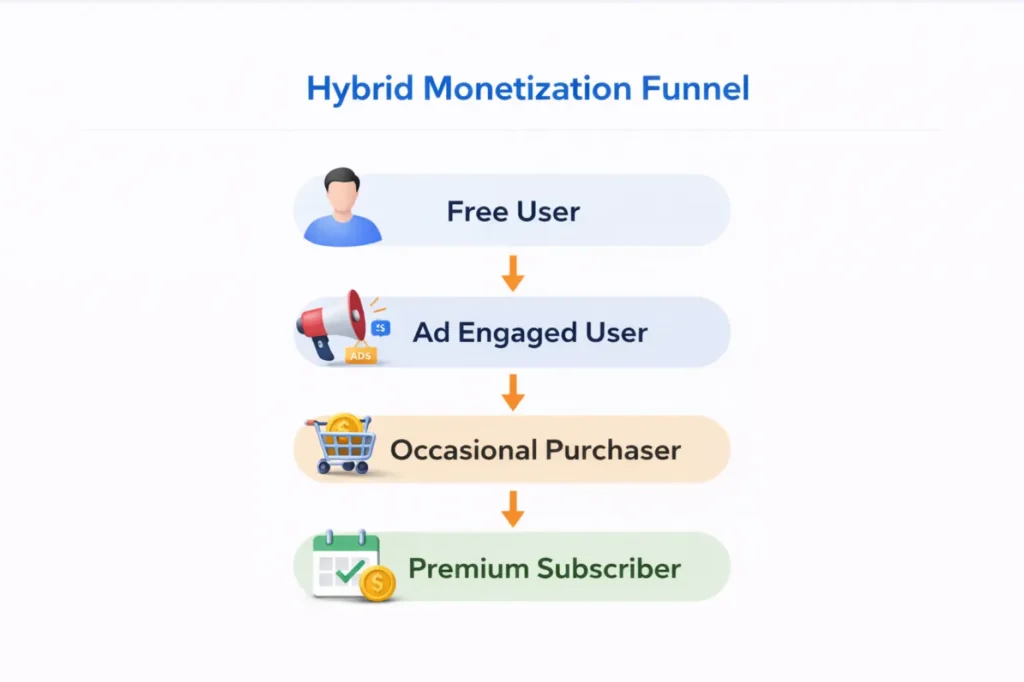
Hybrid design captures value from different user segments. Free users may watch ads, engaged users purchase upgrades, and power users subscribe. This segmentation allows apps to monetize across the entire user base rather than relying on a small percentage of paying customers.
Strategic hybrid systems recognize that not all users will convert to paid tiers, but they can still generate revenue through alternative channels. Ad-supported free tiers subsidize product access while premium options remove ads and unlock features.
If planning custom mobile app development, revenue architecture should be tested during MVP phase. Early validation reduces the risk of building monetization systems that users reject. Hybrid app development and cross platform app development company approaches can accelerate testing across multiple platforms simultaneously. For further insight, explore Cross Platform App Development Explained.
Integrating Mobile App Monetization Strategies Into the Development Lifecycle
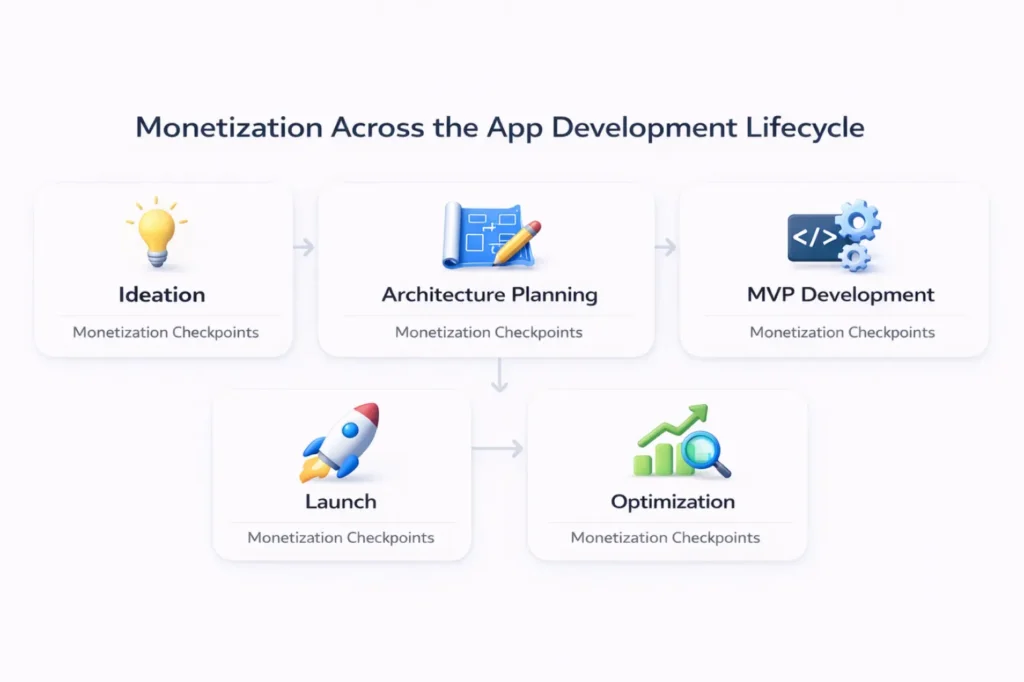
Revenue decisions should not wait until post-launch. They influence infrastructure, UI decisions, and scalability. Apps built without monetization in mind often require expensive refactoring later to support payment systems, subscription management, or ad integrations.
Well-defined mobile app monetization strategies reduce rework later in development. They also ensure that user experience design accounts for monetization touchpoints from the beginning, creating more seamless and less intrusive implementations.
Planning Monetization During Product Architecture
Early planning impacts:
- Database design: Subscription status, purchase history, and ad impression tracking require specific data structures.
- Payment integration: Selecting payment gateways and ensuring compliance with platform policies takes time.
- Feature gating logic: Determining which features are free or paid influences app architecture and access control.
Reviewing the App development lifecycle explained framework ensures monetization checkpoints exist at each stage. This prevents last-minute scrambles to add revenue systems and reduces technical debt.
Cloud-based app development can simplify backend monetization infrastructure by leveraging managed services for billing, authentication, and analytics. Native app development provides tighter integration with platform payment systems, reducing friction during checkout.
Revenue Forecasting and Cost Modeling for App Monetization
Understanding app development cost is incomplete without forecasting revenue streams. Financial planning must account for customer acquisition cost (CAC), lifetime value (LTV), and break-even timelines.
Decision makers should evaluate:
- Customer acquisition cost: How much it costs to acquire a paying user
- Break-even timelines: When revenue will offset development and marketing expenses
- Revenue per active user: Average income generated per user, accounting for both paying and non-paying segments
Businesses undergoing mobile apps digital transformation initiatives must align monetization goals with long-term digital strategy. Revenue models should support scalability rather than constraining it. For organizations evaluating development partners, understanding the Benefits of hiring a mobile app development company includes assessing their ability to integrate monetization into technical planning.
Platform-Specific Mobile App Monetization Strategies
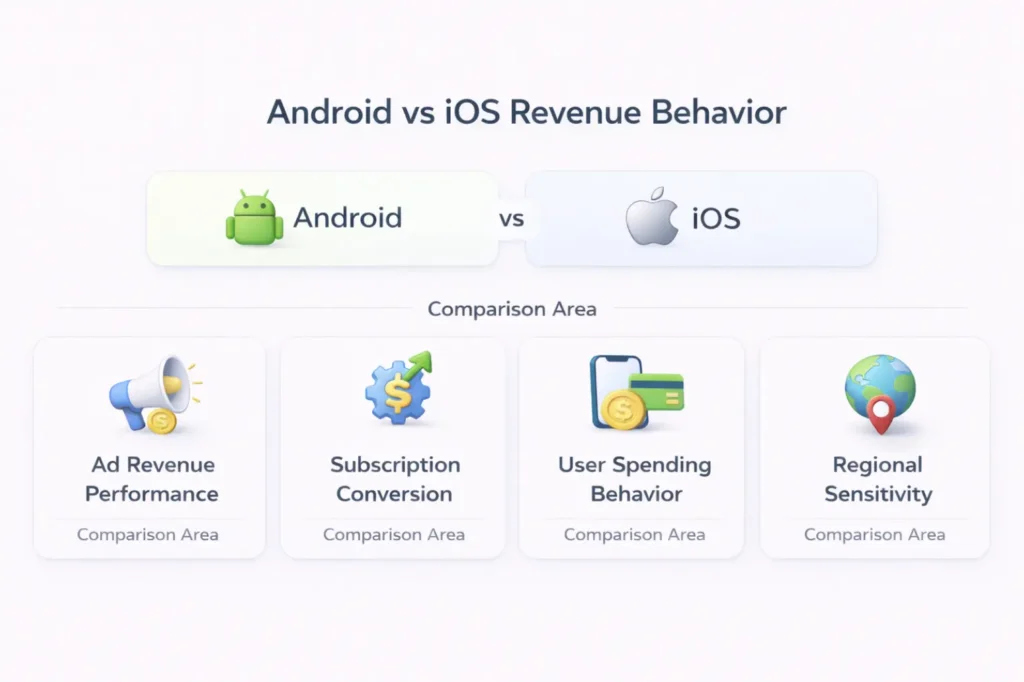
Not all monetization mechanics behave the same across ecosystems. Platform policies, user demographics, and purchasing behaviors differ significantly between Android and iOS.
Android App Monetization Strategy Considerations
Android markets often support ad-heavy strategies due to user behavior and geographic distribution. Many Android users, particularly in emerging markets, prefer free apps with ads over upfront purchases.
In-app purchases and freemium models also perform well, but pricing must account for regional purchasing power. Localized pricing strategies increase conversion by aligning cost with local economic conditions.
When selecting from the Top 10 Android app development companies in Chennai, businesses should evaluate monetization expertise, not just coding capability. A strong portfolio should demonstrate successful revenue integration, not just feature delivery. Experience with android app development monetization nuances, such as Google Play billing policies and ad network optimization, directly impacts profitability..
iOS App Revenue and Subscription Models
iOS users traditionally show stronger purchase intent. Subscription and premium tiers may perform better compared to ad-supported models. Apple’s ecosystem also supports higher price points, as users are more willing to pay for quality experiences.
However, Apple’s App Store policies are stricter regarding in-app purchases and subscriptions. Apps must comply with specific guidelines around pricing transparency, trial periods, and subscription management.
Organizations evaluating the top 10 mobile app development company in chennai landscape should assess portfolio evidence of monetization execution. Case studies demonstrating successful subscription implementations, optimized conversion funnels, and compliance with Apple’s policies indicate deeper expertise. Teams skilled in ios app development understand these platform-specific requirements and can design monetization systems accordingly.
Choosing the Right Revenue Model for Your Market
There is no universal answer. Industry, region, and user maturity matter. Apps targeting enterprise users may succeed with premium pricing, while consumer apps in competitive markets may need freemium strategies to drive adoption.
Businesses exploring partnerships with a mobile app development company in India or reviewing the Best Mobile app development company in india should prioritize monetization case studies over feature lists. Revenue expertise separates competent developers from strategic partners.
Strategic selection depends on:
- Market purchasing power: Regional income levels influence willingness to pay and preferred payment methods.
- Engagement frequency: Daily-use apps can leverage ads or subscriptions, while infrequent-use apps may rely on one-time purchases.
- Competitive saturation: Crowded markets may require aggressive freemium strategies to gain traction.
Before finalizing a partner, decision makers should evaluate how to choose mobile app development company criteria including monetization expertise. Ask potential partners about their approach to revenue modeling, retention strategies, and platform-specific optimization. Review past projects for evidence of successful monetization implementation and long-term revenue performance.

Measuring and Optimizing Monetization Performance
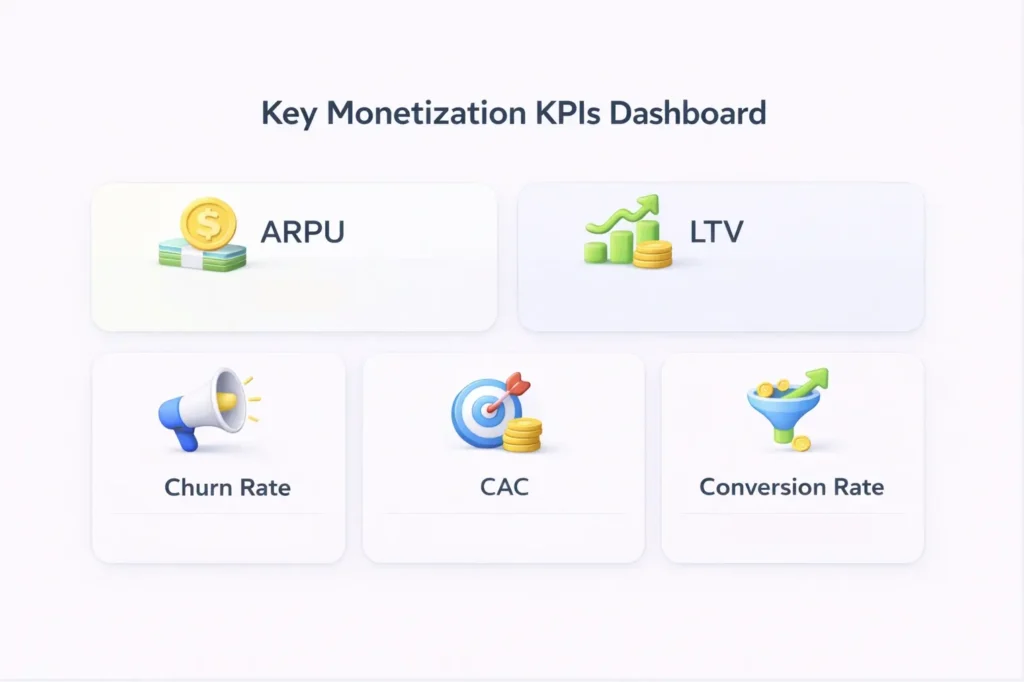
Launching with a monetization model is only the beginning. Continuous measurement and optimization drive sustainable growth. Key metrics include:
- Average revenue per user (ARPU): Total revenue divided by active users
- Lifetime value (LTV): Total revenue generated by a user over their entire engagement period
- Conversion rate: Percentage of users who complete a purchase or subscribe
- Churn rate: Percentage of subscribers who cancel within a given period
Regular A/B testing of pricing, feature gating, and promotional offers reveals what resonates with users. Even small adjustments to things like trial length, price point, or onboarding flow can significantly impact conversion and retention.
Analytics platforms integrated during development provide visibility into user behavior and revenue performance. This data informs iterative improvements and helps identify opportunities to increase monetization without degrading experience.
Building Revenue Systems That Scale
Monetization is not a one-time decision. It is an evolving system that adapts to market conditions, user feedback, and business goals. Apps that succeed financially do so by treating revenue as a core product feature rather than an add-on.
Strategic planning during development reduces technical debt and enables faster iteration. Partnering with experienced teams ensures monetization logic is built with scalability in mind, avoiding costly refactoring as your app grows.
Whether you choose ads, purchases, subscriptions, or a hybrid approach, alignment between user value and revenue structure determines long-term viability. Apps that deliver clear value and respect user preferences build sustainable income streams that support continued innovation.
FAQ Section
1. What are the most effective mobile app monetization strategies?
The most effective mobile app monetization strategies combine subscriptions, in-app purchases, and advertising. Hybrid models help capture revenue from different user segments while reducing dependence on one income stream.
2. When should monetization be planned in app development?
Monetization should be defined during product architecture. Early planning reduces rework, aligns UX with revenue goals, and supports scalable growth.
3. Are subscriptions better than ad-based models?
It depends on the app category. Productivity and SaaS apps often benefit from subscriptions, while high-engagement consumer apps may perform better with ad-supported models.