
Key takeaways
- Native vs hybrid app development is a strategic choice that impacts performance, cost, and scalability.
- Native apps deliver superior performance, smooth UX, and full device access.
- Hybrid apps reduce initial cost and speed up time to market.
- Native development is ideal for complex, scalable, and security-focused apps.
- Hybrid works best for MVPs, content-driven apps, and internal tools.
Businesses constantly face the challenge of balancing speed, cost, and long-term performance when launching a mobile product. Choosing the wrong mobile architecture can lead to sluggish user experiences, skyrocketing maintenance costs, and a restricted ability to scale as your user base grows. Leaders must view their app architecture not just as a technical preference, but as a strategic business decision that impacts the bottom line.
The debate around native vs hybrid app development is central to this decision. Each approach offers distinct advantages and trade-offs regarding scalability, user experience, and budget. While one path might offer a rapid time to market and lower initial costs, the other provides unparalleled performance and deep integration with device hardware. Understanding these differences early in the planning phase is critical for safeguarding your investment.
Our approach to helping organizations navigate this choice involves aligning technical capabilities with overarching business goals. This article will guide you through the intricacies of native vs hybrid app development, helping you determine which strategy aligns with your product roadmap and budget. Partnering with a skilled Mobile App Development Company can further clarify these options, ensuring your final decision supports your long-term vision.
What Is Native vs Hybrid App Development and Why Does It Matter?
Setting a clean foundation is essential before comparing the technical and commercial merits of each approach. The architectural choice you make directly affects how your application performs, how users interact with it, and how much it will cost to maintain over the next several years.
What native app development means for modern mobile products
Native app development involves creating separate applications specifically for iOS and Android platforms. Developers use platform-specific programming languages, Swift or Objective-C for Apple, and Kotlin or Java for Android. Because these apps are written in the native language of the operating system, they have direct access to device hardware and APIs, resulting in highly responsive and robust applications.
How hybrid app development works across platforms
Hybrid app development, conversely, relies on a single shared codebase written in web technologies like HTML, CSS, and JavaScript. This code is then wrapped in a native container, allowing the app to be deployed across multiple platforms from a single foundation. While this method streamlines the initial build process, it adds an abstraction layer between the code and the device hardware, which can influence overall performance and user experience.
Native vs Hybrid App Development: Key Differences at a Glance
Comparing these two methodologies at a high level helps clarify the immediate trade-offs. The decision usually boils down to the priorities of platform approach, development time, initial budget, and long-term costs.
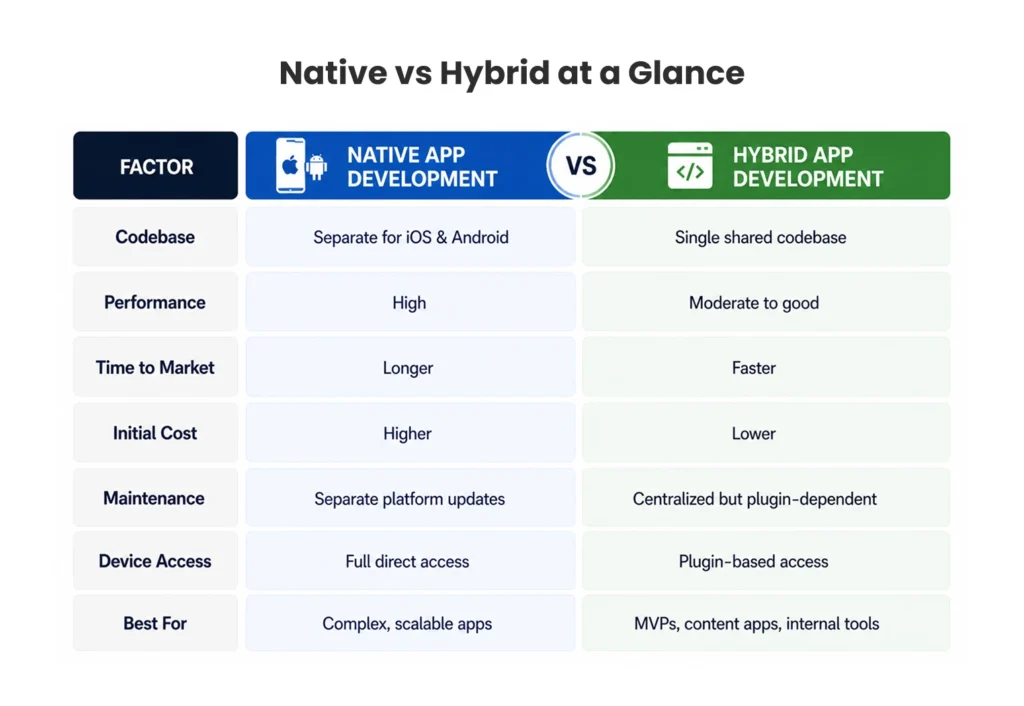
A quick comparison of cost, speed, performance, and maintenance
Native applications require separate development teams for iOS and Android, which naturally extends development time and increases the initial budget. However, this investment yields superior UI smoothness, direct device API access, and simpler app store compliance. Hybrid applications offer a faster development cycle and lower upfront costs due to the shared codebase, but they often face higher long-term maintenance complexities, especially when dealing with platform-specific updates and plugin dependencies. Engaging with custom mobile app development experts can help clarify these exact cost and speed metrics for your specific project.
How business goals change the right choice
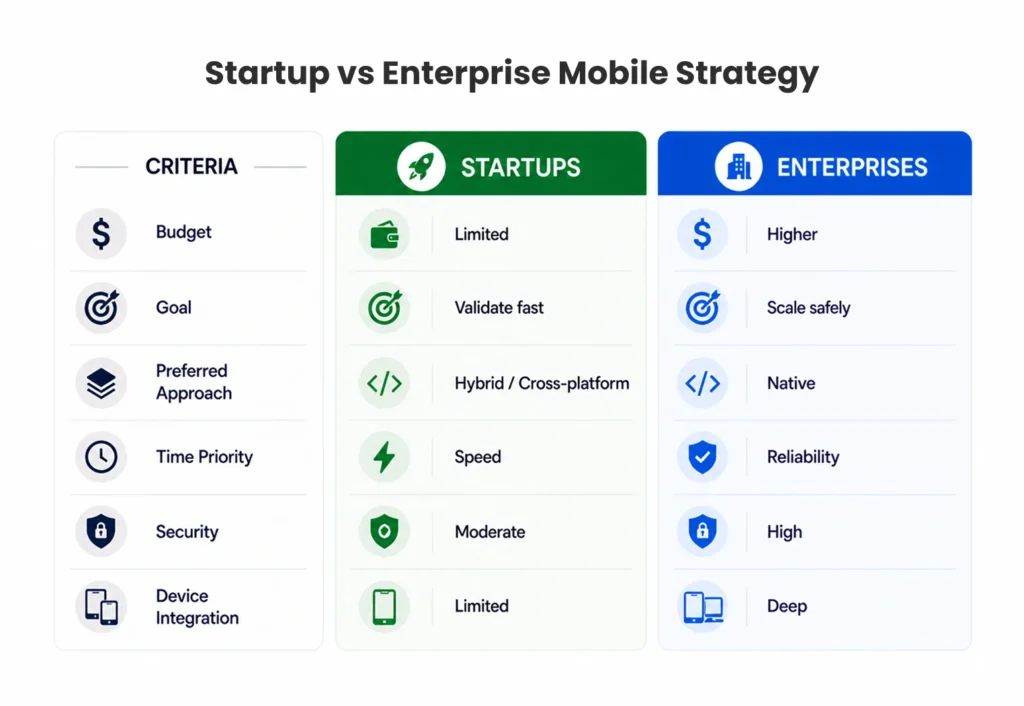
Your overarching business objectives dictate the correct path. A startup looking to validate an MVP quickly might favor the speed of hybrid. An established enterprise launching a complex, security-heavy financial tool will likely demand the reliability of native. Consulting an experienced ios and android app development company can provide the necessary context to map your business goals to the right technical strategy.
Performance and User Experience in Native vs Hybrid App Development
Performance and user experience (UX) are often the deciding factors for consumer-facing businesses. A sluggish app can lead to high abandonment rates, directly impacting revenue.
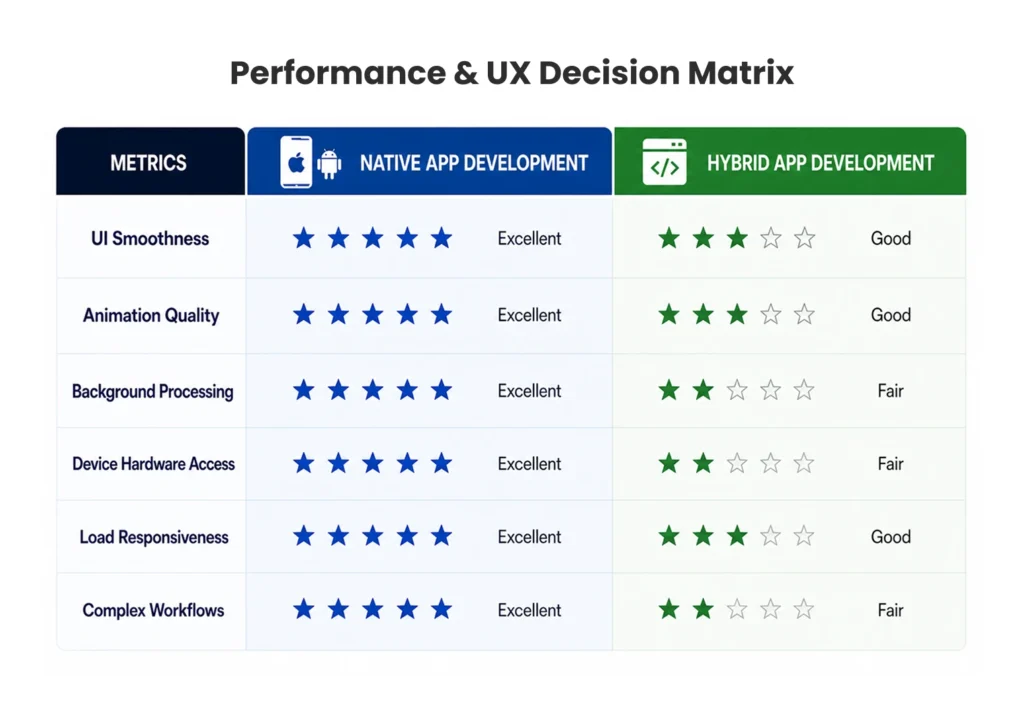
Why native apps feel faster and more responsive
Native applications communicate directly with the operating system. This lack of an intermediary layer means that rendering performance is exceptional and complex animations run smoothly. For heavy logic, background tasks, and seamless transitions, native is unmatched. If you are pursuing ios app development specifically for a high-traffic consumer product, the native route guarantees the fluid experience Apple users expect.
Where hybrid apps perform well and where they struggle
Hybrid apps are perfectly capable of delivering great experiences for content-driven applications, internal business tools, and simple utility apps. However, they can struggle with motion-heavy interfaces and tasks requiring intensive background processing. While android app development using hybrid frameworks has improved vastly, noticeable lags can still occur when rendering highly complex data or rapid UI changes.
Cost Comparison in Native vs Hybrid App Development
Budget is a universal constraint, but looking only at the initial price tag can be a costly mistake. Total cost of ownership (TCO) over a two- to five-year period paints a much more accurate picture.
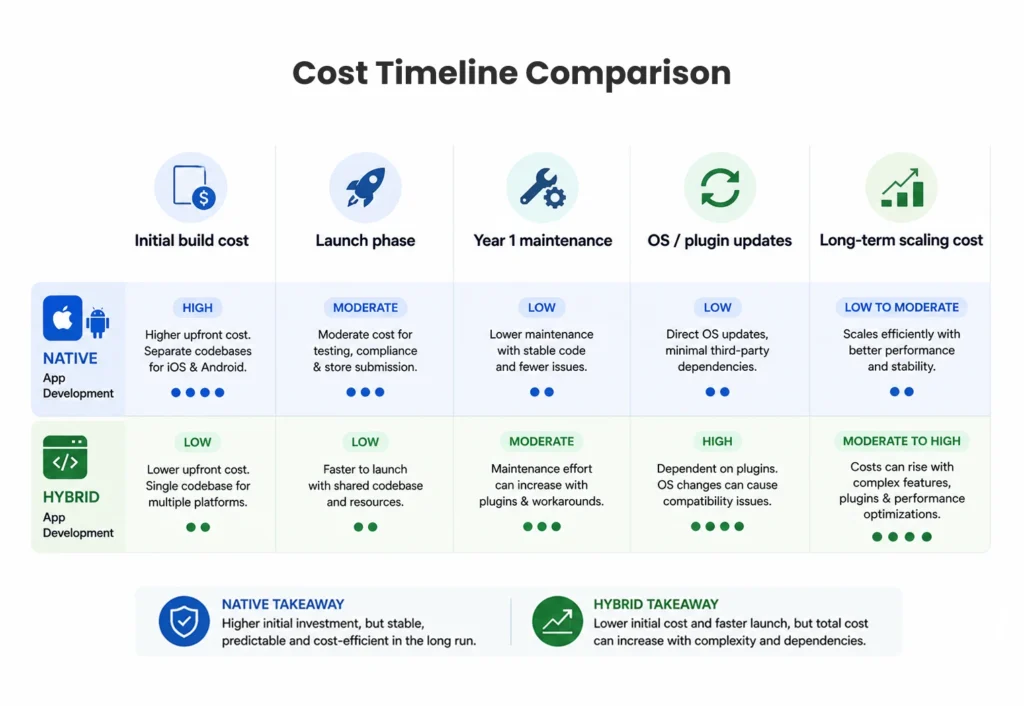
Upfront development cost differences
Hybrid architecture typically presents a significantly lower initial cost because a single team builds one codebase. Native development requires a higher upfront investment since you are essentially building two separate products. Depending on the complexity of the features, app development cost can double if you choose to go fully native from day one.
Long-term maintenance and upgrade costs
The cost paradigm often shifts post-launch. Native apps generally have straightforward maintenance paths when Apple or Google release OS updates. Hybrid apps, heavily reliant on third-party plugins to access device features, can experience breakage when those plugins become outdated. Over time, maintaining a complex hybrid app can become more expensive than maintaining two native apps. The Benefits of hiring a mobile app development company include having a dedicated team to manage these long-term maintenance hurdles efficiently.
Development Time and Time to Market: Which Approach Launches Faster?
Speed to market is critical for capturing early adopters and outpacing competitors. The architectural choice dramatically influences release cycles.
Why hybrid is often faster for MVPs
Writing a single codebase fundamentally reduces the time required to get a product into the hands of users. Startups needing to prove a concept to investors frequently rely on hybrid frameworks to launch across iOS and Android simultaneously. For organizations focused on Mobile App Development for Startups, the hybrid approach accelerates the feedback loop and early validation phases.
When native development saves time later
While hybrid is faster initially, native development can save time during subsequent update cycles. Achieving feature parity in a hybrid app sometimes requires writing custom native code anyway to bridge gaps in plugin functionality. Understanding the entire App development lifecycle explained by your engineering team will reveal that native builds often require less rework when scaling up features down the line.
Device Access, Security, and Scalability Considerations
Enterprise buyers and companies operating in regulated industries must prioritize security, data compliance, and deep device integration above all else.
How native apps handle advanced device integration
Native architecture provides unhindered access to device features like the camera, GPS, NFC, advanced sensors, and biometric security. This is non-negotiable for apps that rely on real-time location tracking or complex hardware interactions. Native ios and android app development chennai teams often highlight how direct OS access guarantees stability when implementing cutting-edge device capabilities.
Security and scalability trade-offs in hybrid apps
Hybrid apps add an extra layer of vulnerability due to the web technologies they employ. Furthermore, their reliance on plugins can introduce third-party security risks. For businesses offering android app development services in sectors like healthcare or banking, native’s ability to leverage OS-level security features makes it the safer, more scalable choice for the future.
When Native App Development Is the Better Choice
Certain business scenarios and use cases heavily favor the performance and reliability of platform-specific code.
Use cases that demand native performance
Fintech platforms, high-end mobile games, real-time messaging services, and health apps requiring complex animations and immediate data processing thrive on native architecture. The flawless execution required to retain users in these highly competitive sectors makes the native investment worthwhile.
Business scenarios where long-term ROI favors native
If your product roadmap includes integrating advanced AR/VR, heavy machine learning models, or IoT connectivity, native is the logical choice. Working with an android app development company in chennai or a top-tier mobile app development company in India ensures that your high-retention app is built on a foundation capable of supporting aggressive, long-term technical growth.
When Hybrid App Development Makes More Sense
Hybrid architecture is not inherently inferior; it simply serves a different strategic purpose. Many highly successful products utilize hybrid frameworks effectively.
Best fit use cases for hybrid apps
Applications focused on delivering content, such as news readers, e-commerce storefronts, and internal enterprise dashboards, are excellent candidates. Because these apps rely primarily on fetching and displaying data rather than complex device processing, hybrid frameworks handle them with ease.
Why startups and internal tools often choose hybrid
Startups needing to validate an idea on a tight budget benefit immensely from the dual-platform reach of a single codebase. Similarly, enterprises building B2B tools for their own employees often use low code app development or hybrid strategies because platform-specific polish is less critical than functional utility. Reputable mobile app development companies frequently recommend hybrid solutions for budget-conscious launches prioritizing faster validation cycles.
Native vs Hybrid vs Cross-Platform: What Businesses Often Confuse
The terminology surrounding mobile development is frequently misused, leading to misaligned expectations between business stakeholders and engineering teams.
Why hybrid and cross-platform are not always the same
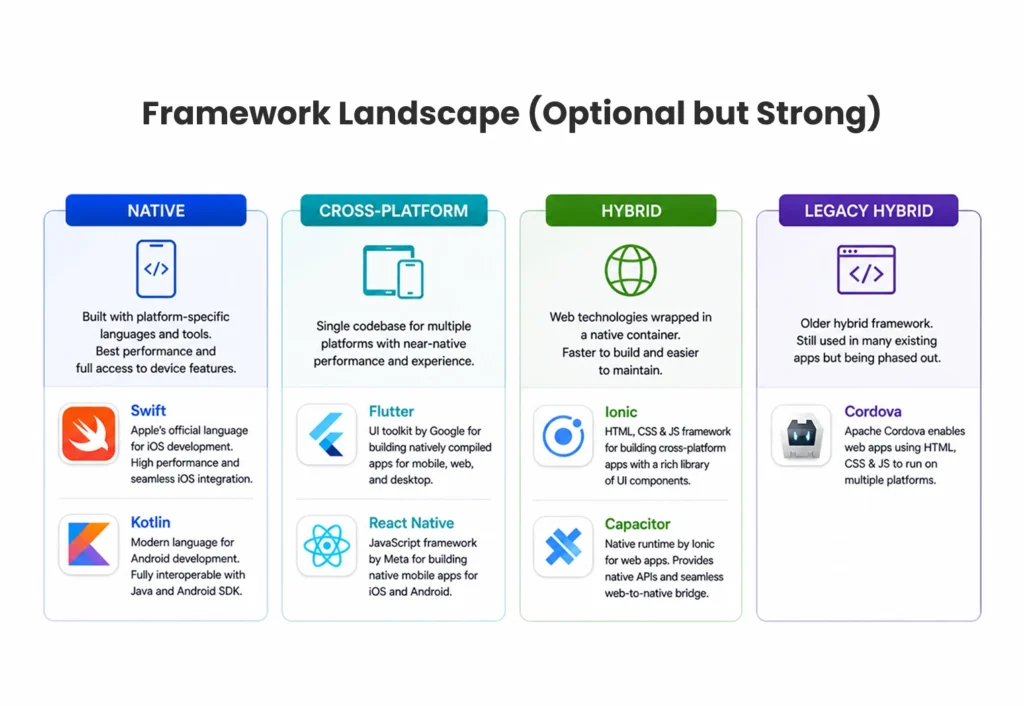
Traditionally, “hybrid” referred to apps using web views (HTML/CSS) wrapped in a native shell. “Cross-platform” apps, while also using a single codebase, are compiled into native code, offering better performance than web-view hybrids. Getting Cross Platform App Development Explained properly helps decision-makers realize that modern solutions blur these lines but possess distinct performance profiles.
Where Flutter and React Native fit into the conversation
Many businesses use the term “hybrid” loosely to include modern cross-platform frameworks. When evaluating flutter vs react native, you are looking at compiled cross-platform tools that deliver near-native performance. They do not rely on slow web views, making them vastly superior to legacy hybrid tools.
Best Frameworks and Tools Used for Hybrid or Cross-Platform Apps
Selecting the right underlying technology is just as important as choosing the overarching architecture.
Popular frameworks businesses consider today
React Native and Flutter currently dominate the cross-platform space, offering robust communities and excellent performance. Ionic and Capacitor remain popular for web-view based hybrid apps. Legacy tools like Cordova are generally being phased out. Exploring the Best tools for app development ensures your tech stack won’t become obsolete in a few years.
How tool choice affects performance and maintenance
The framework you select dictates your hiring pool and maintenance overhead. Flutter offers high performance through its own rendering engine, while React Native uses native components. Engaging flutter app development services can streamline complex UI development, heavily influencing your app’s long-term maintainability.
How to Choose Between Native vs Hybrid App Development for Your Business
Making the final call requires a structured approach that weighs immediate constraints against future ambitions.
A simple decision checklist before you start
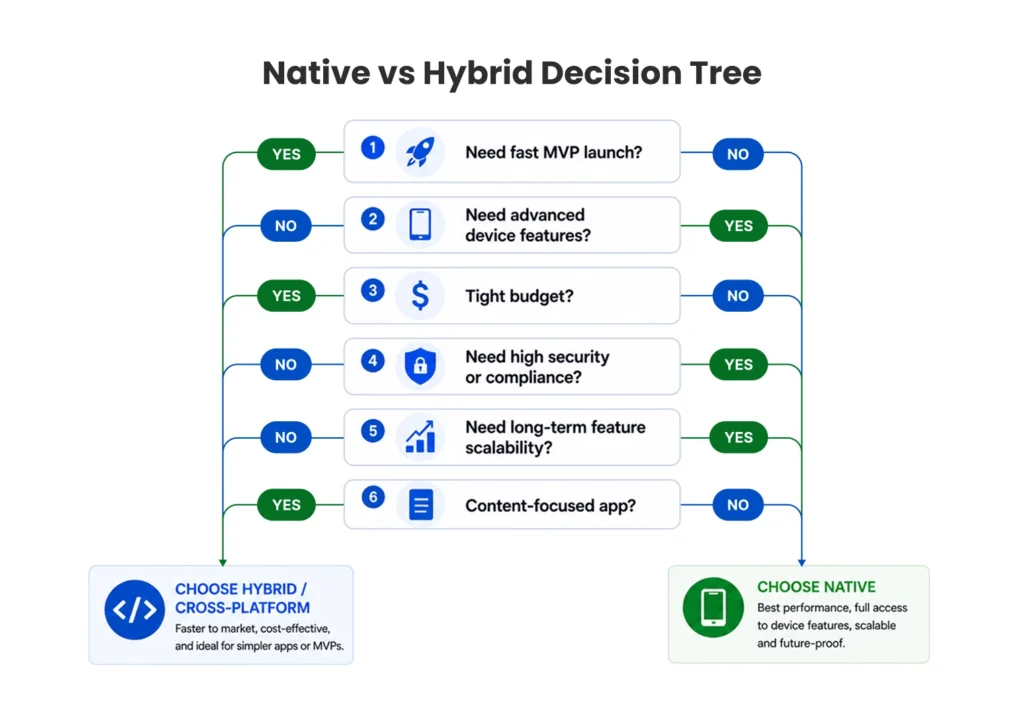
Before committing to a path, evaluate your project against these criteria:
- Budget and Timeline: Do you need to launch fast on a tight budget?
- Required Performance: Does your app feature complex animations or heavy background processing?
- Device Access: Do you need deep integration with hardware like NFC or biometrics?
- Security Level: Are you operating in a highly regulated industry?
Questions to ask your development partner
Challenge your agency to justify their recommendations. A reliable cross platform app development company or a specialized flutter app development company in India should be able to clearly articulate how their chosen maintenance model aligns with your growth roadmap and team expertise.
Native vs Hybrid App Development for Startups vs Enterprises
The size, maturity, and financial backing of a company heavily influence the right architectural choice.
What startups should prioritize first
Startups must validate their market rapidly while controlling burn rate. Reaching both iOS and Android users simultaneously is often crucial for securing early traction. Therefore, hybrid or cross-platform strategies are incredibly popular. As they scale, some startups eventually migrate to native, but hybrid gets them through the critical early stages. Top 10 Ionic App Development Companies in India frequently cater to these agile, fast-moving requirements.
What enterprises should optimize for long term
Enterprises have different priorities: compliance, maximum performance, scalable architecture, and deep integrations with existing legacy systems. They can afford the higher initial investment to protect their brand reputation and ensure flawless user experiences. Consulting the Top 10 iPhone App Development Companies in Chennai will reveal that large corporations almost exclusively favor native builds for their flagship consumer products.
Common Mistakes Businesses Make When Choosing Between Native and Hybrid
Avoiding common pitfalls can save organizations hundreds of thousands of dollars in wasted development effort.
Why cost alone can lead to the wrong decision
Choosing an architecture based solely on the cheapest initial quote often leads to disaster. Underestimating long-term maintenance costs and ignoring the future product roadmap typically results in an app that cannot support new features.
How to avoid rebuilding your app later
Assuming all hybrid apps perform poorly is a mistake, just as confusing legacy hybrid with modern cross-platform is. To avoid having to scrap your code and start over, thoroughly evaluate your user expectations. Partnering with professional mobile app development services ensures you select an architecture robust enough to handle your projected growth without requiring a total rebuild in two years.

Final Thoughts on Native vs Hybrid App Development
There is no universal, one-size-fits-all answer to the native vs hybrid debate. Native vs hybrid app development is ultimately a strategic business choice driven by your specific product roadmap, user expectations, and budget constraints. Native architecture remains the gold standard for performance, scalability, and deep device access. Conversely, hybrid and modern cross-platform approaches are exceptional for faster launches, budget-friendly MVPs, and content-focused applications.
Choosing the right architecture early can reduce rework, protect budget, and improve long-term app performance. Take the time to evaluate your long-term goals, and don’t hesitate to seek expert guidance to ensure your mobile strategy sets your business up for sustained success.
FAQs About Native vs Hybrid App Development
1. What is the difference between native and hybrid app development?
Native development involves building separate apps for iOS and Android using platform-specific languages, offering maximum performance. Hybrid development uses a single, shared codebase (often web technologies) wrapped in a native container to deploy across multiple platforms.
2. Which is better for startups: native or hybrid app development?
For most startups, hybrid or cross-platform is preferred because it allows for a faster time to market and lower initial costs, making it easier to validate an MVP on both platforms simultaneously.
3. Is hybrid app development cheaper than native app development?
Upfront, hybrid is generally cheaper because you are funding one codebase instead of two. However, long-term maintenance costs can sometimes eclipse native if the app requires complex custom integrations.
4. Do hybrid apps perform as well as native apps?
Legacy hybrid apps do not perform as well due to the web view layer. Modern cross-platform frameworks like Flutter approach near-native speeds, but true native still holds the edge for highly complex, computationally heavy tasks.
5. Can hybrid apps access device features like camera and GPS?
Yes, they access these features through third-party plugins. However, this access is occasionally less stable or slower to update than the direct API access native apps enjoy.
6. Is Flutter considered hybrid or cross-platform?
Flutter is considered a modern cross-platform framework because it compiles to native code, bypassing the slow web views used by traditional hybrid applications.
7. When should a business choose native app development?
Businesses should choose native when building high-performance games, complex financial platforms, apps requiring heavy background processing, or when strict security and deep hardware integration are paramount.
8. Can a hybrid app be converted to native later?
You cannot simply press a button to convert a hybrid app to native. Migrating requires completely rewriting the application from scratch using native languages.