
Cloud based website hosting explained in simple business terms often helps teams evaluate stability, scalability, and long term digital readiness without getting lost in infrastructure jargon.
Unlike traditional hosting, this model distributes resources across multiple servers. As a result, uptime improves, performance stays consistent, and risk from single server failure reduces.
From a business lens, cloud-based website hosting clearly shows why modern brands prioritize flexibility over fixed hosting limits. Growth rarely follows linear patterns anymore.
Some decision makers ask whether cloud hosting truly impacts revenue outcomes or only technical metrics. The reality is that hosting reliability directly affects conversions, trust, and website loading speed during peak demand.
For organizations working with a reliable website development company, hosting choices often influence architecture decisions early. Therefore, cloud environments support faster iterations, cleaner deployments, and measurable performance stability.
However, cloud hosting is not only for large enterprises. Even mid sized businesses now adopt it to avoid sudden downtime and unpredictable traffic spikes.
Teams partnering with a website development company in Chennai increasingly evaluate cloud readiness as part of broader digital planning. This shift reflects changing expectations around performance, security, and user experience.
What Cloud Hosting Means for Modern Businesses
Cloud-based website hosting explained from a business perspective focuses less on servers and more on operational continuity, scalability, and predictable performance outcomes.
Instead of relying on one physical machine, cloud hosting pulls resources from a shared environment. Therefore, websites remain stable even during traffic fluctuations or sudden demand spikes.
Decision makers often wonder whether cloud hosting fits only tech heavy companies or applies across industries. In practice, brands using custom website development benefit because cloud platforms adapt easily to changing feature requirements.
This hosting approach also aligns closely with evolving website development trends. Businesses now expect faster deployments, real time updates, and smoother integrations without rebuilding infrastructure repeatedly.
From a navigation standpoint, cloud-based website hosting clearly shows how teams gain flexibility. Resources scale up or down automatically, which protects performance during campaigns or seasonal surges.
A common concern is whether cloud hosting increases complexity for non technical teams. However, managed cloud environments simplify operations while allowing agencies to focus on product experience and business growth.
For companies planning long term digital investments, hosting decisions are no longer isolated. They connect directly with platform choices, architecture planning, and overall site resilience.
Why Traditional Hosting Models Are Losing Relevance
Cloud-based website hosting explained through comparison highlights why fixed server hosting no longer supports modern digital expectations. Traditional hosting locks resources, which often limits performance during unpredictable traffic.
By contrast, cloud environments adjust dynamically. Therefore, businesses avoid downtime while maintaining consistent user experiences across devices and regions.
A frequent question raised by stakeholders is whether traditional hosting still makes sense for stable websites. For growing platforms, especially those using custom web application development, cloud hosting provides room to evolve without restructuring systems.
Another advantage lies in deployment speed. Cloud platforms integrate smoothly with modern web development frameworks, enabling faster releases and safer updates.
This model also supports distributed teams. Developers, designers, and operations teams collaborate without environment conflicts or version mismatches.
Some leaders worry about vendor dependency when adopting cloud platforms. However, most providers now support flexible configurations that reduce long term lock in risks.
As expectations rise around reliability and responsiveness, cloud hosting becomes less of an upgrade and more of a baseline requirement.
Performance and Reliability Expectations in Cloud Environments
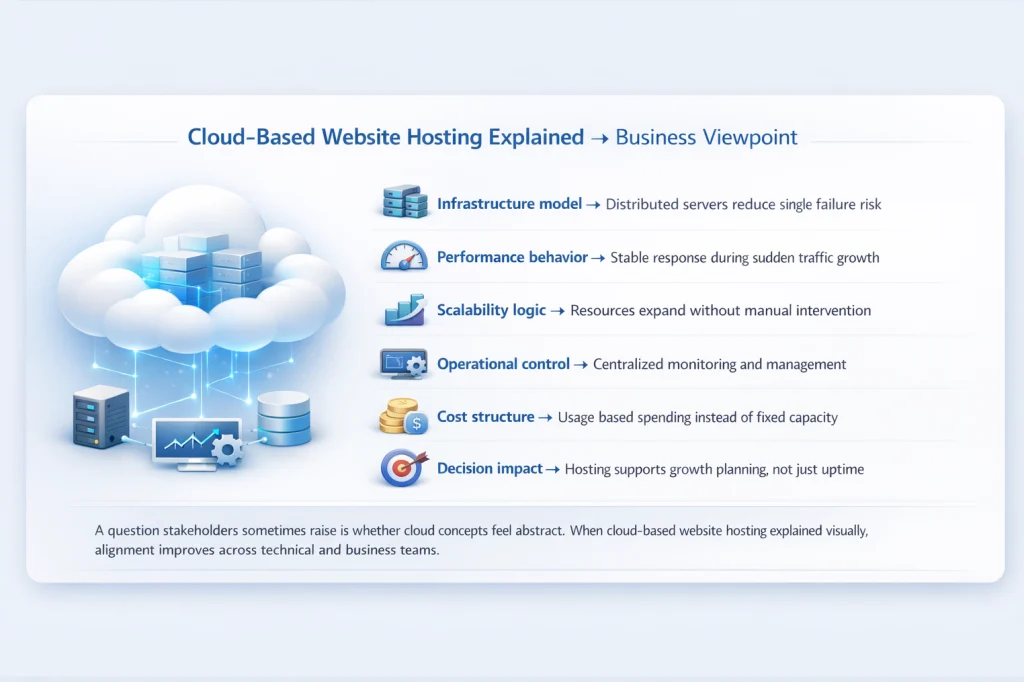
Cloud-based website hosting explained through performance metrics shows why reliability has become a competitive differentiator rather than a technical bonus. Websites now compete on speed, consistency, and user trust.
Because resources distribute across servers, failures rarely cause outages. Therefore, uptime improves while response times remain stable during peak activity.
One operational concern leaders raise is whether cloud hosting truly improves measurable results. The answer appears clearly when tracking website loading speed across high traffic campaigns and regional access points.
Cloud platforms also integrate seamlessly with modern web development tools. As a result, teams deploy updates faster while maintaining stability across staging and production environments.
Reliability also extends to security and backups. Automated redundancy protects data without manual intervention, which reduces operational stress during unexpected events.
However, performance gains depend on configuration quality. Poor planning still causes issues, even on cloud infrastructure. That is why strategic alignment between hosting and development matters.
For decision makers, cloud hosting reliability is no longer abstract. It directly influences user engagement, conversion consistency, and long term brand credibility. This reliability approach aligns with widely accepted cloud infrastructure reliability standards that emphasize redundancy, fault tolerance, and automated recovery.
Scalability Advantages for Growth Focused Platforms
Cloud-based website hosting explained from a growth planning angle highlights how scalability removes friction during expansion phases. Businesses rarely grow at a steady pace anymore.
Cloud infrastructure supports sudden traffic increases without service disruption. Therefore, marketing campaigns, product launches, and regional expansions remain stable under pressure.
Strategy leaders sometimes question whether scalability matters before growth happens. In reality, platforms built with responsive website development benefit early because cloud hosting adjusts automatically as user behavior changes.
This adaptability also supports advanced personalization and automation. When combined with ai-powered website development, cloud environments process data faster and deliver consistent experiences across channels.
Growth planning also becomes more predictable. Instead of over investing in infrastructure, businesses pay for resources based on actual usage patterns.
However, scalability works only when hosting aligns with architecture decisions. Poor planning still leads to bottlenecks, even with elastic resources.
For decision oriented teams, cloud hosting supports growth without forcing premature technical commitments. That flexibility often becomes a strategic advantage.
Security, Compliance, and Risk Management Considerations
Cloud-based website hosting explained through a security lens focuses on risk reduction rather than technical fear. Modern businesses prioritize continuity, data protection, and regulatory alignment.
Cloud providers distribute data across secured environments. Therefore, single point failures rarely compromise entire systems. This structure improves resilience against outages and localized threats.
A recurring concern among leadership teams is whether cloud hosting increases exposure to breaches. In reality, platforms supporting enterprise grade Corporate website development often include automated backups, encryption, and compliance monitoring.
This shared accountability follows the cloud security responsibility model, where providers secure infrastructure while businesses manage data and access controls.
Security also improves through centralized updates. Patches apply consistently, which reduces vulnerabilities caused by outdated software or human oversight.
Risk control extends beyond attacks. Disaster recovery, version rollback, and redundancy protect operations during unexpected events. These safeguards support long term digital confidence.
However, security strength depends on governance. Access control and monitoring still require clear policies to avoid internal risks.
For organizations evaluating digital maturity, cloud hosting strengthens trust while reducing operational uncertainty.
Cost Efficiency and Budget Control in Cloud Infrastructure
Cloud-based website hosting explained from a financial standpoint often changes how leadership teams view infrastructure spending. Costs shift from fixed investments to usage based allocation.
Instead of paying upfront for unused capacity, businesses spend only on resources they consume. Therefore, budgeting becomes more predictable during fluctuating demand cycles.
Finance teams frequently ask whether cloud hosting actually reduces total ownership costs. When aligned with realistic planning around Cost to develop a website, cloud models often eliminate waste tied to idle servers.
This flexibility also supports experimentation. Businesses can launch features, test markets, or scale campaigns without committing to long term infrastructure expenses.
Another concern relates to transparency. Cloud dashboards now provide granular cost visibility, which helps teams understand how hosting ties back to revenue activities.
However, unmanaged scaling can inflate expenses. Clear monitoring and governance remain essential for sustainable cost control.
For organizations evaluating digital investments, cloud hosting offers financial agility that traditional hosting structures rarely match.
Decision Factors That Make Cloud Based Website Hosting Relevant for Platform Choice
Choosing a hosting model increasingly influences how platforms are selected and maintained. Business websites now depend on stability, integration, and long term adaptability rather than raw server ownership.
One common question raised by product owners is whether hosting affects platform flexibility. When aligned with scalable architecture, cloud hosting supports smoother integrations across systems and services.
Platform decisions also connect closely with website development process planning. Cloud environments simplify staging, testing, and deployment without interrupting live user experiences.
This structure benefits teams handling ecommerce website development, where traffic patterns change quickly during promotions and seasonal demand. Cloud infrastructure absorbs these shifts without performance degradation.
Another strategic factor is future proofing. As technologies evolve, cloud hosting allows platforms to adapt without forced migrations or downtime heavy rebuilds.
However, hosting alone does not guarantee success. Platform selection still requires alignment with business goals, user behavior, and operational maturity.
For decision makers, cloud hosting relevance lies in its ability to support evolving platforms without adding technical friction.
Business Scenarios Where Cloud-Based Website Hosting Fits Best
Certain business environments naturally align with cloud hosting because flexibility and uptime directly influence revenue performance. These scenarios often involve unpredictable demand and continuous platform evolution.
Retail brands scaling through ecommerce website development services benefit because cloud infrastructure handles traffic surges without checkout slowdowns or service interruptions.
Another situation appears during brand repositioning or digital transformation. Teams planning a website redesign often prefer cloud hosting since environments allow parallel testing without disrupting live users.
A practical concern executives raise is whether cloud hosting suits conservative industries. In many cases, regulated sectors still adopt cloud platforms with controlled access and compliance focused configurations.
Cloud hosting also fits multi location businesses. Distributed teams manage content, updates, and integrations without relying on centralized physical servers.
However, static websites with no growth plans may see limited advantages. Cloud hosting delivers the most value where change and scale are expected.
For evaluators comparing hosting relevance, real alignment comes from business velocity rather than company size alone.
Industry Adoption Patterns Where Cloud Based Website Hosting Gains Momentum
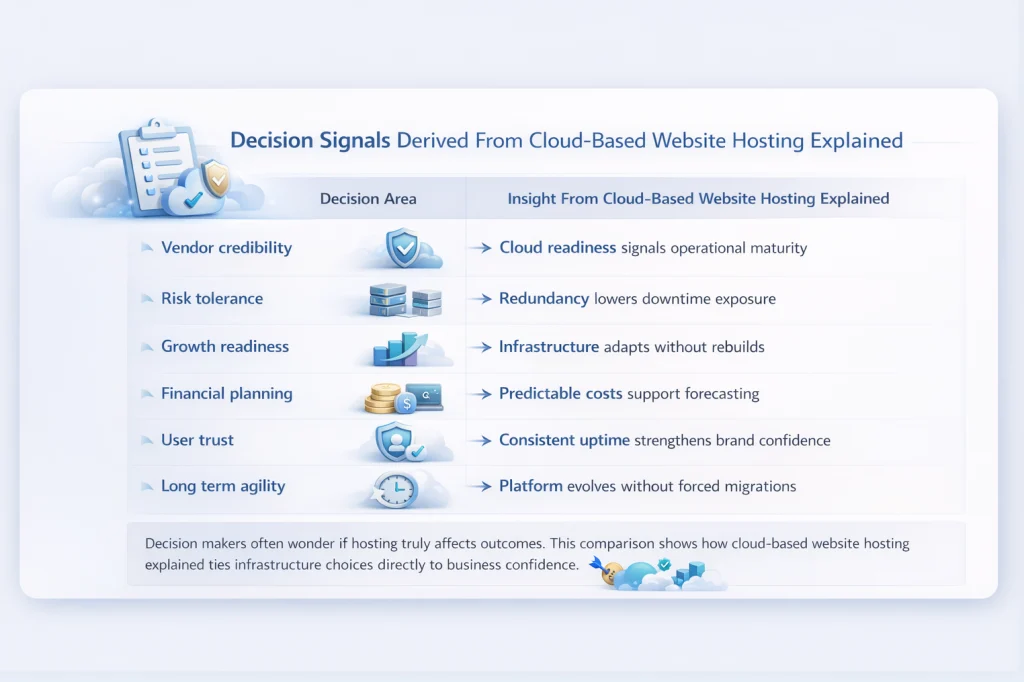
Across industries, adoption patterns reveal why cloud-based website hosting explained matters beyond technical teams. Businesses increasingly align hosting decisions with customer experience and operational agility.
A frequent question from leadership is whether cloud hosting adoption signals maturity or trend following. In practice, organizations choosing a top website development company often prioritize cloud readiness to support long term digital scaling.
Industries like logistics and mobility also adopt cloud models rapidly. Platforms built by a Transportation website development company rely on elastic infrastructure to manage real time data and service availability.
Cloud-based website hosting explained through these use cases highlights its role in supporting high availability rather than experimental innovation. Reliability remains the central driver.
Another visible pattern involves service based businesses expanding across regions. Cloud environments simplify localization, performance tuning, and centralized governance without infrastructure duplication.
However, adoption speed varies. Heavily regulated sectors move cautiously, while consumer focused platforms accelerate faster due to direct performance impact.
For evaluators mapping industry benchmarks, cloud hosting adoption often reflects operational ambition more than company size.
Market Signals Showing Why Cloud-Based Website Shapes Vendor Selection
Market behavior increasingly shows hosting choices influencing how businesses evaluate digital partners. Infrastructure stability now ranks alongside design and delivery capability during vendor shortlisting.
Decision makers often ask whether hosting discussions matter when selecting agencies. When cloud-based website hosting is explained clearly during early conversations, it signals technical maturity and risk awareness.
Companies engaging a Best Website Development Company in India frequently notice cloud readiness embedded into solution planning rather than treated as an afterthought. That alignment reduces future migration risks.
Hosting strategy also affects creative execution. Teams focused on custom website design benefit from cloud flexibility, since performance testing and visual experimentation occur without production instability.
Cloud-based website hosting explained in this context highlights its role as a trust indicator. Vendors confident in scalable hosting usually demonstrate stronger operational discipline.
However, hosting alone does not validate expertise. It works best when paired with clear communication, governance, and long term support models.
For buyers navigating crowded markets, hosting conversations often reveal which partners think beyond immediate delivery.
Regional Demand Trends Where Cloud-Based Website Influences Decisions
Regional market behavior shows how hosting expectations differ based on competition, infrastructure maturity, and buyer awareness. Businesses increasingly evaluate hosting reliability before shortlisting service partners.
A practical concern raised by regional founders is whether cloud hosting adds value in local markets. When cloud-based website hosting explained clearly, it often reassures buyers about uptime, scalability, and future expansion readiness.
In competitive hubs, companies engaging a Best Website Development Company in Chennai frequently expect cloud aligned delivery as a baseline requirement rather than an optional upgrade.
Market visibility also plays a role. Listings and comparisons such as Top 10 Website Development Companies in Chennai often highlight performance stability and hosting capability as decision signals for buyers.
Cloud-based website hosting explained through regional demand reflects changing buyer literacy. Clients now understand that hosting quality affects user trust and brand perception directly.
However, demand maturity varies. Emerging markets prioritize affordability, while mature regions focus on resilience and long term scalability.
For vendors and buyers alike, regional hosting expectations increasingly shape how digital credibility is assessed.
Buyer Navigation Patterns Where Cloud Based Website Hosting Shapes Shortlisting
Buyer navigation behavior has evolved as hosting awareness increases across business segments. Evaluation no longer stops at design samples or feature lists alone.
A typical question raised during comparisons is whether hosting affects long term partnership value. When cloud-based website hosting explained transparently, buyers gain confidence in scalability, uptime, and risk preparedness.
Businesses browsing Top 10 website development companies in India often scan beyond portfolios. They assess infrastructure choices as signals of operational maturity and future readiness.
For many decision makers, engaging a website development company now involves understanding how hosting supports performance under growth pressure. Cloud environments communicate preparedness for traffic spikes and system resilience.
Cloud-based website hosting explained in buyer journeys also reduces friction. Clear hosting narratives simplify vendor comparison and shorten decision cycles.
However, hosting clarity alone does not close deals. Buyers still evaluate communication quality, governance approach, and strategic alignment.
In competitive markets, hosting transparency increasingly becomes a differentiator rather than an afterthought.
Sector Specific Evaluation Contexts Where Cloud-Based Website Hosting Matters
Different industries interpret hosting value through their own operational pressures. Cloud-based website hosting explained within sector contexts often reveals why one size hosting decisions rarely work.
A common question from operators is whether cloud hosting delivers equal value across verticals. For platforms built by a Best Food Delivery website development partner, uptime and peak hour stability directly influence order completion.
Similarly, property platforms working with a Top Real Estate Website Development Company rely on cloud hosting to support media heavy listings and sudden traffic from campaigns.
Cloud-based website hosting explained through these sector needs highlights how performance tolerance varies. Some industries demand zero downtime, while others prioritize scalability during short bursts.
Another factor involves user trust. Sectors handling transactions or sensitive data cannot afford instability, which makes cloud redundancy a strategic requirement rather than a technical upgrade.
However, sector alignment still requires cost awareness. Hosting decisions must reflect revenue models, usage patterns, and expected growth cycles.
For evaluators, understanding industry context clarifies when cloud hosting becomes essential instead of optional.https://www.codeneptune.com/contact-us/

Final Perspective on Why Cloud-Based Website Hosting Supports Confident Decisions
As digital ecosystems mature, hosting decisions increasingly reflect business intent rather than technical preference. Cloud-based website hosting explained across performance, cost, and scalability reveals why it has become a strategic baseline.
A closing question leaders often consider is whether cloud hosting still offers advantage once adoption becomes common. The value now lies in how well it supports growth planning, resilience, and measurable outcomes.
For organizations evaluating long term investments, clarity around cloud-based website hosting reduces uncertainty during budgeting, vendor selection, and roadmap alignment. Hosting becomes part of strategic governance.
Financial planning also benefits from this clarity. When teams understand usage based infrastructure alongside how much does a custom website cost, decision making becomes more grounded and predictable.
Cloud hosting does not replace strategy. Instead, it strengthens execution by removing infrastructure constraints that slow momentum or introduce avoidable risk.
For decision oriented businesses, cloud hosting relevance is no longer debated. It is assessed by how confidently teams can scale, adapt, and compete without disruption.