
Business website development is no longer about having an online presence alone. It defines how prospects judge credibility, clarity, and operational maturity within seconds of landing.
For many organizations, the website becomes the first decision checkpoint. It signals whether the business is structured, reliable, and ready to engage. Because of that, strategy, content flow, and performance matter more than surface visuals.
It also shapes how teams scale marketing, sales, and partnerships. When aligned correctly, it supports conversions, brand authority, and long term growth. When misaligned, it quietly creates friction across every digital touchpoint.
Most companies begin this journey by evaluating a website development company that understands business intent, not just design delivery. At the same time, decision makers often look for custom website design that reflects positioning, not templates.
This blog explores scalable business website from a decision focused perspective. It breaks down how structure, intent, and execution influence outcomes across industries.
Why business website development defines digital credibility
Business website development directly influences how stakeholders measure trust before conversations even start. Visitors form judgments within seconds, based on structure, clarity, and message flow.
A business site works as a digital headquarters. It communicates seriousness, operational scale, and long term intent. If navigation feels unclear or content lacks depth, confidence drops quietly.
Some teams ask whether business websites really impacts buying decisions when sales happen offline. The reality is simple. Buyers still validate credibility online before engaging, even for high value deals.
It also supports internal alignment. Sales teams rely on it for validation. Partners review it before collaboration. Investors assess maturity through content depth and presentation.
Many growing brands rely on a website development company in Chennai when they want local market understanding combined with execution reliability. Others prioritize custom website development to align brand voice with business objectives.
When structure, messaging, and performance work together, the website stops being passive. Instead, it becomes an active credibility engine.
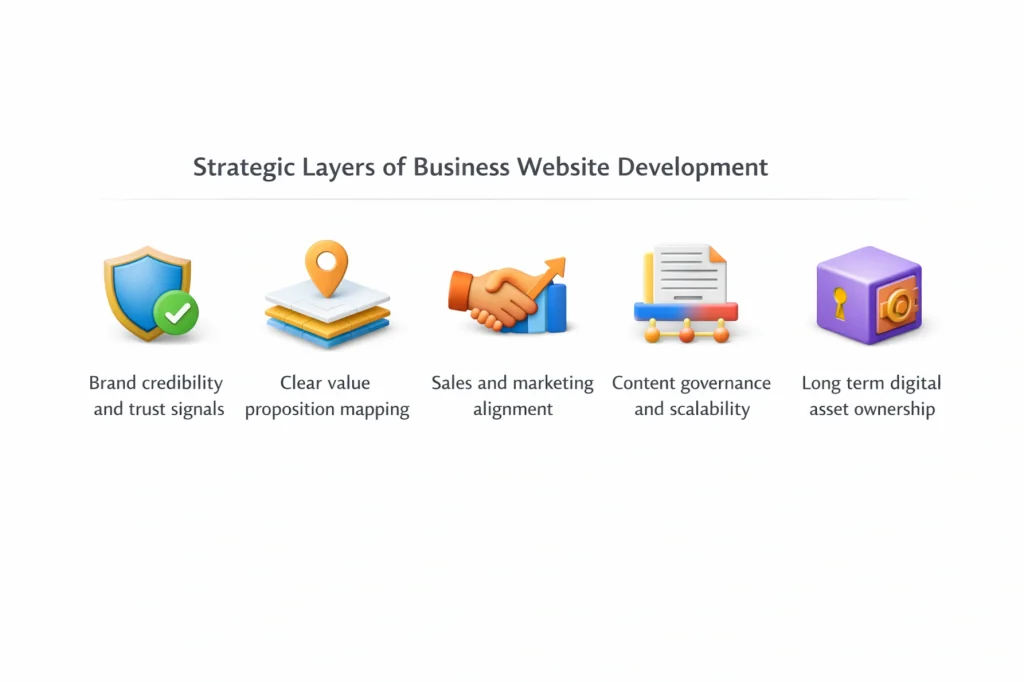
Strategic impact of a well structured business website
Business website development plays a strategic role beyond visibility. It influences how clearly a company communicates value, scale, and differentiation across every growth stage.
A well structured site supports multiple business goals at once. It helps marketing teams qualify traffic. It helps sales teams shorten trust cycles. It also helps leadership present consistency to partners and stakeholders.
Decision makers often wonder if website development on business should evolve as the company grows. The answer leans toward yes. As offerings expand, the website must reflect clarity instead of complexity. Otherwise, growth creates confusion.
Strategic alignment also depends on execution depth. Following a defined website development process ensures content hierarchy, performance benchmarks, and governance stay consistent over time. At the same time, awareness of website development trends helps brands avoid outdated patterns that weaken perception.
Business website development becomes most effective when strategy guides structure, not the other way around. That is when the site starts reinforcing business intent instead of just describing it.
The role of technology choices in business website development outcomes
Technology decisions quietly shape how business website development performs over time. They influence scalability, maintenance effort, and how easily teams adapt to change.
A common concern is whether the underlying stack really matters once the site looks polished. It does. Performance, security, and future integrations depend on technology choices made early.
Business website stratergy benefits when teams select stable web development frameworks that support long term growth. At the same time, modern web development tools improve collaboration, testing, and release consistency.
Performance also carries strategic weight. Search engines and users both react strongly to website loading speed. Slow pages reduce engagement, while fast experiences reinforce professionalism.
When technology aligns with business goals, the website stays flexible instead of fragile. That balance helps organizations scale without repeated rebuilds.
User experience signals that affect business decisions
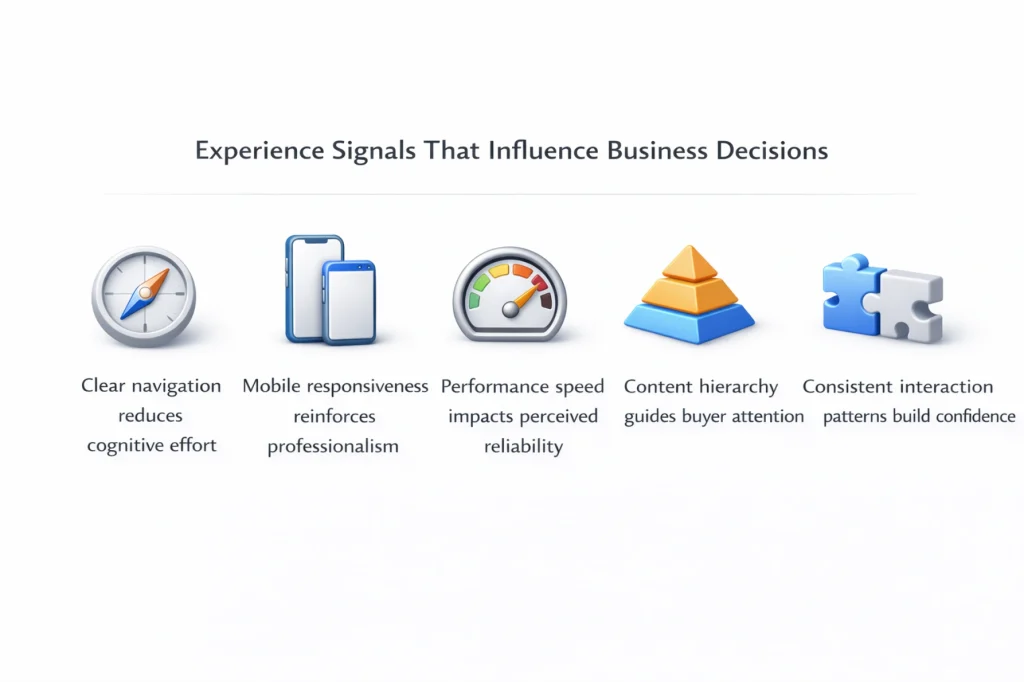
User experience influences how visitors interpret clarity, effort, and reliability. Even strong offerings lose impact when the experience feels fragmented or hard to navigate.
Business website development succeeds when layout, content flow, and interaction patterns feel intentional. Visitors should understand value quickly, without searching or second guessing.
Mobile behavior reinforces this expectation. With decision makers browsing across devices, responsive website development becomes a baseline requirement rather than a feature. Poor responsiveness quietly signals neglect.
For product driven and transactional brands, ecommerce website development adds another layer of expectation. Speed, clarity, and checkout confidence directly affect revenue perception and trust.
External performance benchmarks also matter. Tools like Google PageSpeed Insights help teams understand how experience and performance intersect in real conditions. Reviewing such benchmarks helps justify experience investments to stakeholders.
When experience aligns with business intent, engagement improves naturally. The site starts working as a value filter instead of a distraction.
Scalability factors every growing business website needs
Scalability determines whether business website development supports growth or restricts it. As teams add services, regions, or integrations, the site must expand without friction.
Many organizations underestimate how fast requirements change. Content grows. Lead sources diversify. Systems need integration. Without flexibility, every update becomes expensive and slow.
Modern approaches like ai-powered website development help businesses personalize experiences and automate insights without rebuilding foundations. At the same time, structured custom web application development supports advanced workflows, dashboards, and internal tools.
Business website development works best when scalability is planned early. That mindset protects budgets while allowing innovation to happen steadily.
External research from platforms like HubSpot highlights how scalable digital systems improve conversion efficiency across growing organizations. Such insights reinforce the value of long term planning.
Industry alignment and sector specific website expectations
Business website development becomes more effective when industry context shapes structure and messaging. Generic layouts often miss the nuances buyers expect in specific sectors.
Decision makers often wonder whether industry focused structure really influences trust. It does. Buyers look for familiar signals that reflect how their market operates, communicates, and measures value.
For example, Corporate website development emphasizes governance, clarity, and leadership messaging. Meanwhile, ecommerce website development services focus on transaction confidence, catalog structure, and conversion flow.
Real estate, logistics, and consumer platforms demand different credibility markers. A property brand may evaluate a Top Real Estate Website Development Company, while consumer platforms often review examples like Best Food Delivery website development or a Transportation website development company for relevance cues.
Business website development aligned with industry expectations reduces friction. It helps visitors feel understood before conversations even begin.
Evaluating partners for business website development execution
Choosing the right partner shapes how business website development translates from strategy into reality. Execution quality often reflects the partner’s understanding of business priorities, not just technical delivery.
Some teams ask how to differentiate between similar sounding agencies. The difference usually appears in discovery depth, communication clarity, and post launch ownership. Strong partners focus on outcomes, not pages delivered.
enterprise website planning benefits when organizations assess credibility through proven benchmarks. Reviewing a top website development company portfolio helps identify consistency across industries. Others compare recognition lists such as Top 10 website development companies in India to understand market standards.
Regional trust also influences decisions. Many enterprises evaluate options like Best Website Development Company in Chennai or Best Website Development Company in India when balancing scale with accountability.
Independent validation from sources like Clutch provides insight into delivery reliability and long term support patterns. Such platforms help decision makers reduce risk during partner selection.
When expectations and capabilities align, business website development moves faster with fewer revisions and stronger outcomes.
Cost clarity and investment logic in business website development
Business website development decisions often pause when cost enters the discussion. Budgets matter, although clarity matters more than raw numbers.
A frequent concern is whether higher investment guarantees better outcomes. It does not always. Value depends on alignment, scalability, and long term ownership rather than initial spend.
Evaluating the Cost to develop a website helps leadership teams frame expectations around scope, complexity, and future expansion. At the same time, questions like How much does a custom website cost usually surface when businesses compare flexibility against short term savings.
Business website development works best when viewed as a digital asset investment. Clear cost logic reduces friction between finance, marketing, and technology teams. It also prevents compromises that create expensive fixes later.
When cost decisions align with business goals, confidence improves across stakeholders.
When website development on business requires redesign and realignment
Business website development does not end at launch. Over time, misalignment appears as offerings evolve, markets shift, and customer expectations change.
Decision makers often wonder how to recognize when change is necessary. Signs usually surface quietly. Conversion slows. Messaging feels outdated. Navigation grows cluttered. These signals indicate the need for website redesign rather than surface updates.
Redesign decisions also connect to brand maturity. As positioning sharpens, earlier assumptions no longer fit. Investing in custom website design helps businesses realign structure, tone, and credibility without disrupting continuity.
Business website development stays effective when redesigns follow strategy, not trends. Controlled evolution protects brand equity while restoring clarity.

Conclusion
Business website development works best when treated as a strategic asset, not a one time project. It shapes credibility, supports growth, and influences decisions long before conversations begin.
Across structure, technology, experience, and scalability, alignment remains the constant factor. When each element supports business intent, the website becomes a dependable growth channel rather than a maintenance burden.
Business focused website also creates internal confidence. Teams rely on it for validation, partners use it for evaluation, and leadership uses it to signal maturity. That collective impact explains why thoughtful investment consistently outperforms shortcuts.
Decision makers often wonder whether refining the website still delivers value once core operations are stable. The answer remains clear. A well aligned digital presence continues to compound trust, clarity, and opportunity over time.
FAQs on business website development
Some teams ask whether business website development is still relevant when marketplaces and social platforms drive traffic.
Yes. A business owned website remains the most controlled and credible digital asset. It anchors trust while external platforms support discovery.
A common concern is how often business website development should be reviewed for alignment.
Periodic evaluation matters. Most organizations reassess structure and messaging every one to two years to stay aligned with growth and market shifts.
Decision makers often wonder what defines success in business website development beyond traffic.
Success appears in clarity, engagement quality, lead confidence, and reduced friction across sales and partnership conversations.