Key Takeaways
- The cost to build lottery app platforms depends heavily on features, compliance, and scalability requirements.
- Lottery app MVP development can significantly reduce initial investment and market risks.
- Payment integration, wallet systems, and security layers are major contributors to lottery app development costs.
- Choosing cross-platform or native development directly impacts lottery app pricing and maintenance expenses.
- Ongoing maintenance, licensing, and infrastructure costs should always be included in lottery app budgeting.
The cost to build lottery app platforms can vary widely depending on features, compliance requirements, security layers, and platform scalability. Some businesses start with a lightweight minimum viable product focused strictly on basic ticket purchases and simple result announcements. Others invest heavily in enterprise-grade ecosystems that feature complex payment systems, real-time draws, and advanced fraud prevention mechanisms.
For startups and established gaming operators alike, budgeting for these platforms often becomes challenging. Lottery applications are uniquely complex because they combine high-volume finance, rigorous user authentication, rapid payment processing, and strict regulatory compliance. Even a small feature change or a new compliance requirement can significantly affect the overall development timeline and your underlying infrastructure expenses.
Businesses exploring digital gaming products must evaluate factors like scalability, monetization methods, and user retention mechanics long before development officially begins. From our perspective, understanding the complete app development lifecycle is vital, especially when you need to accurately estimate infrastructure, security, and ongoing maintenance costs over the coming years.
What Is the Average Cost to Build Lottery App Solutions?
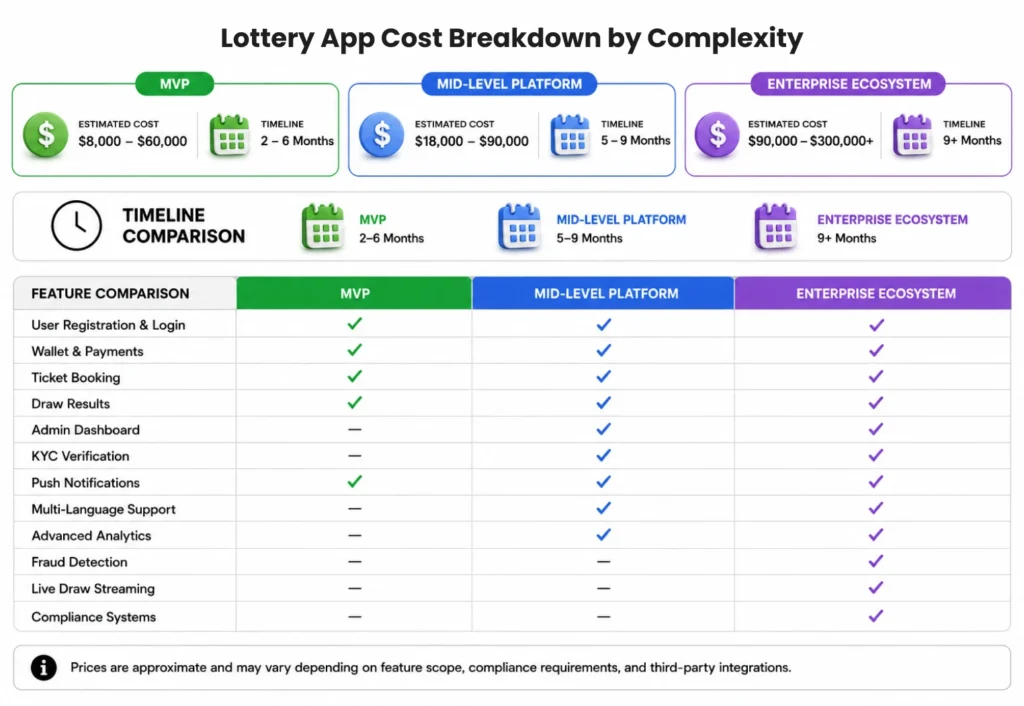
The cost to build lottery app products usually falls into three distinct development tiers. These tiers are determined by the application’s overall complexity, third-party integrations, and long-term scalability goals.
| App Type | Estimated Cost | Timeline |
| Basic MVP | $8,000 to $60,000 | 2 to 6 months |
| Mid-Level Platform | $18,000 to $90,000 | 5 to 9 months |
| Enterprise Lottery Ecosystem | $90,000 to $300,000+ | 9+ months |
A basic version is highly suitable for validating a business idea quickly and cost-effectively. It usually includes straightforward user registration, simple wallet functionality, standard ticket booking, a payment integration, and result announcements. If you are focused on Building MVP Mobile Apps, this tier helps you test the market without risking massive upfront capital.
Mid-range platforms support multiple lottery games, automated referral systems, analytics dashboards, multilingual experiences, and improved security layers. Businesses planning aggressive user growth and looking to capture a broader demographic typically enter this category.
Enterprise applications require advanced, custom architecture. These heavy-duty systems support large concurrent traffic volumes, real-time transactional processing, live draw video streaming, complex prize distribution logic, and deep compliance integrations across multiple jurisdictions.
Businesses comparing budgets often review numerous factors related to the overall app development cost before selecting a technical roadmap that perfectly aligns with their specific revenue goals.
Key Factors That Affect the Cost to Build Lottery App Platforms
Several technical and operational decisions will directly affect your final development budget. Understanding these factors early on helps prevent scope creep and budget blowouts.
Lottery App Platform Selection and Development Costs
Choosing between Apple, Android, or cross-platform development changes both your initial costs and your long-term maintenance requirements. Developing two separate applications requires dual resources, which doubles your engineering efforts.
Businesses wanting broader market reach frequently choose a cross platform app development company because sharing a single codebase significantly lowers overall expenses. However, gaming apps requiring deep device optimization or hardware-level performance may still prefer dedicated builds. Depending on your audience, you might focus heavily on ios app development for Apple users, or prioritize android app development to capture international markets. Ultimately, native app development provides the smoothest performance, but it comes with a steeper price tag.
Lottery App Features That Increase Development Pricing
A simple lottery application is relatively affordable compared to expansive platforms that support a wide variety of advanced features. The more capabilities you introduce, the higher your budget climbs. Features that drive up costs include:
- Real-time jackpot updates and dynamic prize pools
- Live streaming for ticket draws
- Multi-wallet systems supporting fiat and crypto
- Gamified referral programs
- Geo-restricted access and GPS tracking
- Multi-language support for global users
- Advanced reporting and administrative dashboards
- Complex push notification engines
The more transactional workflows you add to the system, the more backend infrastructure, server capacity, and rigorous quality assurance testing become necessary.
Security and Compliance
Lottery applications process large volumes of financial transactions and highly sensitive personal identity data. Because of this reality, businesses must invest heavily in fraud prevention algorithms, data encryption, and Know Your Customer (KYC) verification systems.
Following strict Mobile App Security Best Practices becomes absolutely essential when handling user wallets, processing payment credentials, and storing unalterable draw records. Cutting corners on security can lead to massive fines, loss of gaming licenses, and permanent damage to your brand reputation.
Feature-Wise Cost to Build Lottery App Modules
The total cost to build lottery app systems increases incrementally based on feature depth, user interaction complexity, and backend requirements.
Lottery App User Registration and KYC Costs
User onboarding sets the tone for the entire application experience. This module usually includes mobile or email login, one-time password (OTP) authentication, identity verification, and geo-location restrictions to ensure users are legally allowed to play.
Estimated Cost: $800 to $1,500
Lottery businesses operating in strictly regulated regions may also require complex document verification workflows and Anti-Money Laundering (AML) compliance support.
Lottery App Wallet and Payment Integration Pricing
Digital wallets act as the financial heart of your platform. They are one of the most critical modules because users purchase tickets and receive their winnings directly through the application. Typical integrations include credit and debit cards, UPI, net banking, localized e-wallets, and automated refund systems.
Estimated Cost: $1,200 to $3,000
Many sophisticated operators explore Cloud-based app development approaches to ensure highly secure payment processing and scalable transaction handling during major lottery events.
Ticket Booking System
This module handles the core functionality of the business. It manages random number selection, manual number picking, automated digital ticket generation, purchase confirmation notifications, and historical purchase tracking.
Estimated Cost: $1,000 to $2,500
User experience matters heavily here. Any friction, confusion, or lag during the ticket booking process will directly affect your overall conversion rates and user retention.
Admin Dashboard and Analytics
Administrators need complete operational visibility to run the business effectively. A strong backend portal allows for user management, automated draw scheduling, real-time fraud monitoring, detailed revenue tracking, and promotional campaign management.
Estimated Cost: $1,000 to $2,000
Highly advanced admin dashboards may also include predictive market insights and deep behavioral tracking to help optimize user retention and increase lifetime value.

How Development Models Change Lottery App Development Cost
The methodology your engineering team uses fundamentally affects the cost to build lottery app products.
Native vs Hybrid Lottery App Development Cost
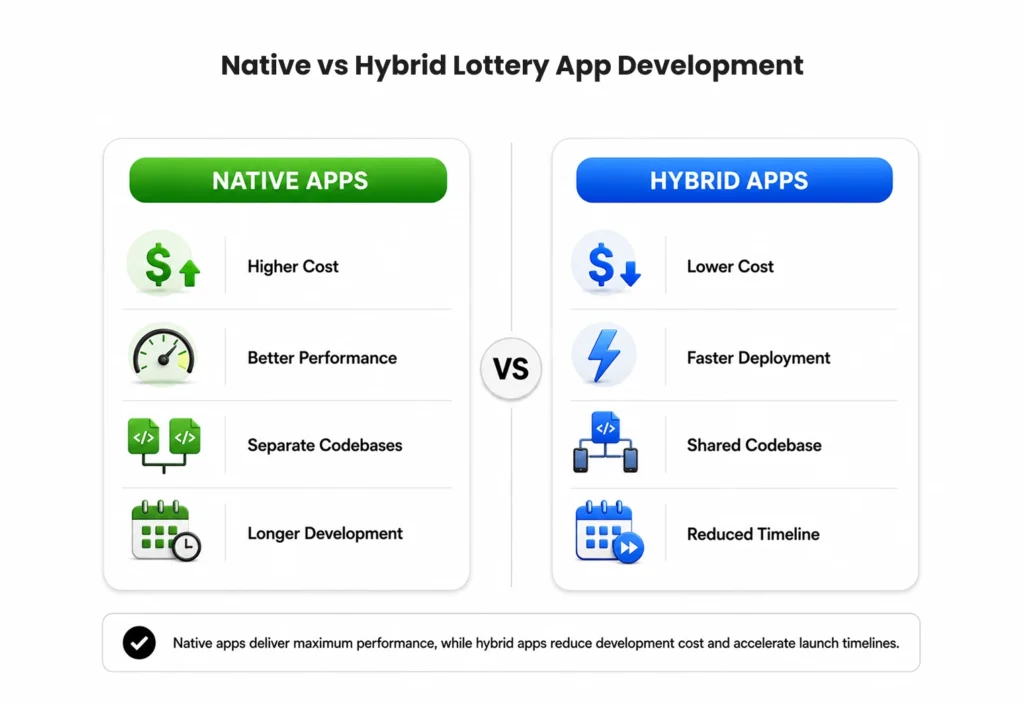
Native applications deliver stronger performance and noticeably smoother animations, especially during real-time data updates and rapid payment processing. However, they require you to hire separate Android and iOS development teams, essentially doubling your initial build costs.
Hybrid frameworks reduce costs and dramatically accelerate deployment timelines. Businesses often compare leading technologies to find the right fit for their specific product. Those researching modern solutions frequently leverage hybrid app development frameworks or seek out specialized flutter app development services to achieve near-native performance while maintaining a single codebase.
MVP Strategy for Reducing Lottery App Development Cost
Launching with a Minimum Viable Product significantly reduces your financial risk. Instead of building every possible feature initially, successful businesses validate market demand before scaling their operations.
A startup might release just one lottery format, a basic digital wallet, limited payment gateways, and minimal administrative controls. This phased strategy works particularly well for companies interested in Mobile App Development for Startups, allowing them to gather user feedback and iterate based on actual market data.
Regional Cost to Build Lottery App Platforms Worldwide
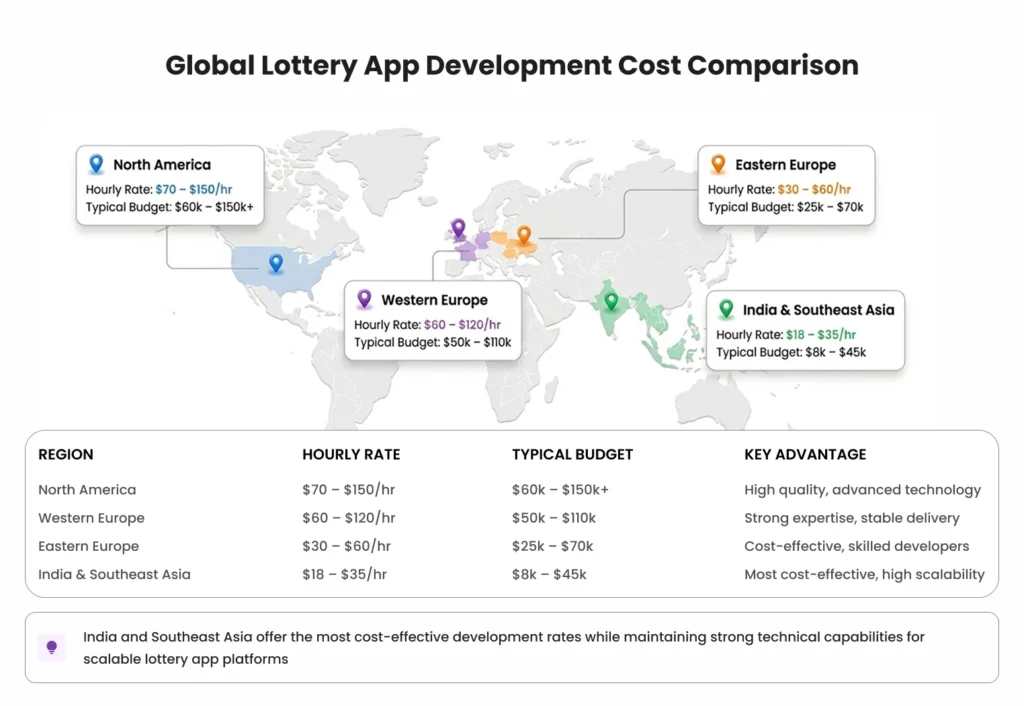
Software engineering rates differ significantly based on geographic location and the availability of technical expertise.
| Region | Hourly Rate | Typical Budget Range |
| North America | $70 to $150 | $60k to $150k+ |
| Western Europe | $60 to $120 | $50k to $110k |
| Eastern Europe | $30 to $60 | $25k to $70k |
| India & Southeast Asia | $18 to $35 | $8k to $45k |
Many forward-thinking businesses choose to work with a mobile app development company in India because development costs remain highly competitive while technical capabilities and communication standards continue improving globally.
Choosing the right outsourcing partner requires careful evaluation. You must know how to choose mobile app development company partners based on their communication protocols, scalability potential, and the quality of their post-launch support. The Benefits of hiring a mobile app development company include access to specialized talent, faster time to market, and the ability to scale your engineering team up or down as project demands change.
Hidden Expenses in Lottery App Development Projects
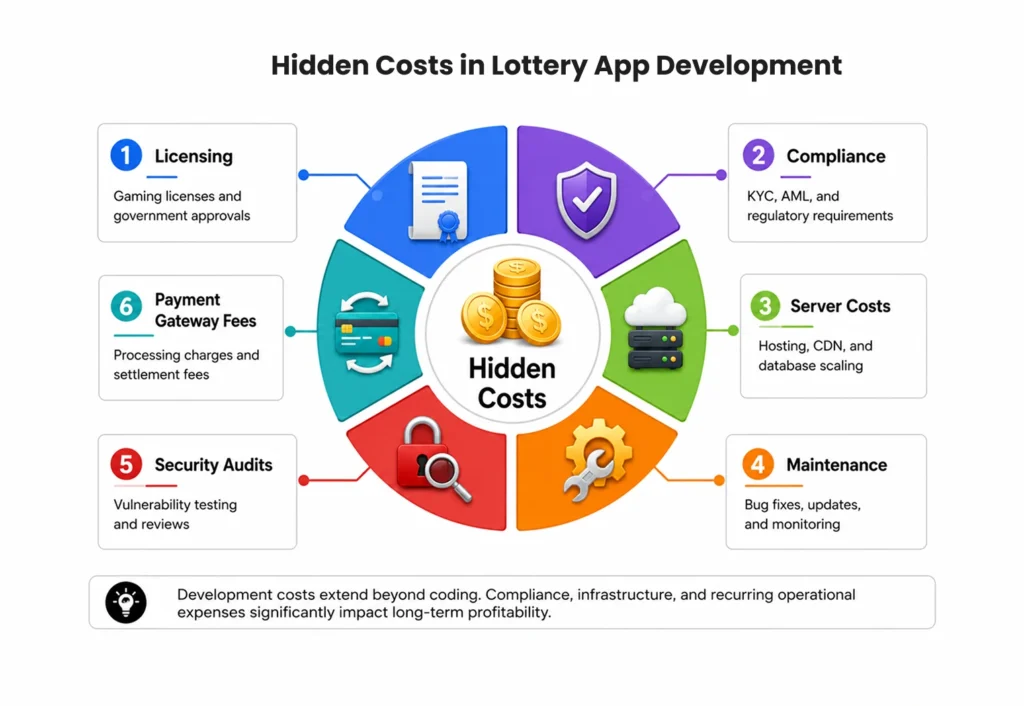
The total cost to build lottery app platforms extends far beyond the initial development and design phases.
Licensing and Legal Expenses
Legitimate lottery operations require extensive government approvals, official gaming licenses, third-party financial audits, and strict compliance documentation. Legal consultation can become a major, recurring expense depending on the specific country or state of operation.
Ongoing Maintenance
Post-launch maintenance generally costs between 15% to 20% of your original project budget annually. This crucial ongoing expense covers mandatory bug fixes, vital security patches, continuous server monitoring, third-party API updates, and ongoing UX refinements. Businesses focused on scaling consistently invest in Mobile app performance optimization strategies to maintain absolute platform stability during peak lottery draws when traffic spikes aggressively.
Infrastructure and Server Costs
Real-time gaming systems require highly scalable infrastructure capable of handling massive, sudden transaction volumes. Cloud hosting, Content Delivery Network (CDN) services, robust database optimization, and automated backup systems all contribute significantly to your monthly operational expenses.
Advanced Technologies That Increase Lottery App Development Cost
Modern digital gaming applications increasingly include enhanced user engagement tools and sophisticated verification systems to stay ahead of the competition.
AI-Based Fraud Detection
Behavioral analysis systems help detect suspicious financial transactions and automated bot abuse attempts instantly. Businesses exploring highly intelligent gaming ecosystems actively research the role of ai in mobile apps for deep personalization and automated fraud prevention workflows.
Chat Support Systems
Accessible customer support modules dramatically improve user retention and issue resolution speed. Many businesses carefully compare ai chatbots vs traditional chatbots when planning their support automation, looking to balance cost efficiency with a natural, helpful user experience.
Predictive Analytics and Recommendation Systems
Advanced reporting tools help gaming operators clearly understand user retention, individual spending patterns, ticket format popularity, and promotional campaign performance. Some ambitious development teams integrate modern resources inspired by the Best AI Tools available to power operational analytics and high-level business intelligence.
Choosing the Right Lottery App Development Company
Selecting the right technical partner has a direct, undeniable impact on your project quality, system scalability, and overall compliance readiness.
When evaluating potential partners, businesses must deeply review portfolio relevance, cybersecurity expertise, complex payment integration experience, and a firm understanding of legal compliance. Working with a highly experienced Mobile App Development Company helps drastically reduce long-term operational risks, especially for finance-heavy applications like digital lottery platforms.
Furthermore, companies needing highly advanced conversational systems or automated customer support integrations may also collaborate with a specialized ai agent development company to perfect their user engagement workflows.
Lottery App Development Timeline and Project Phases
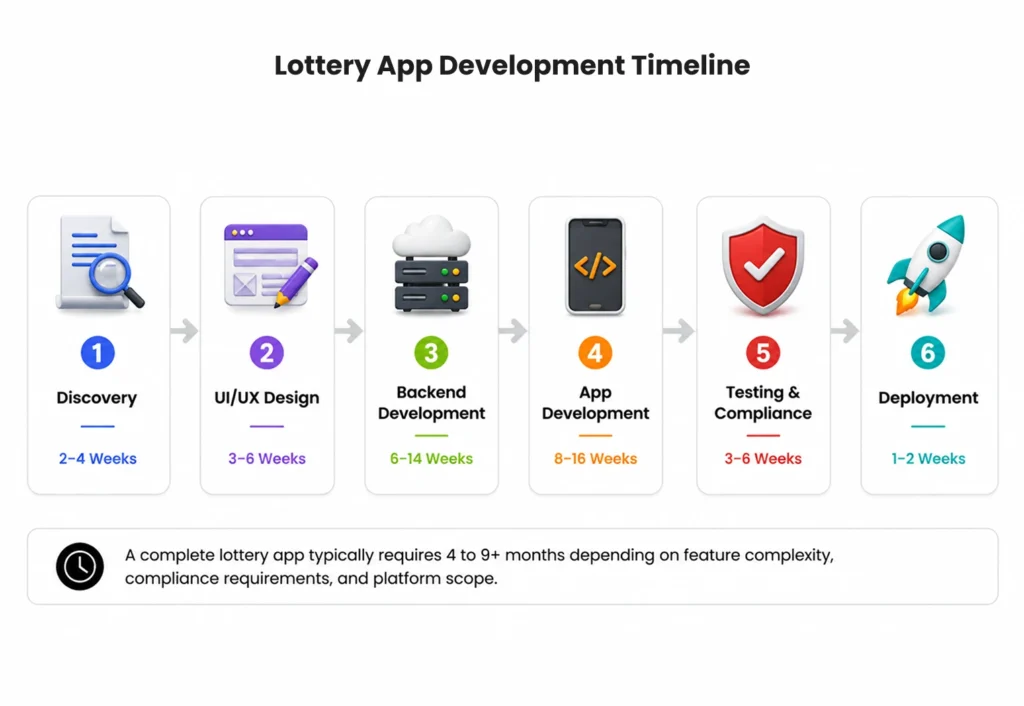
The cost to build lottery app products is intimately connected to the overall duration of the development process. Time is money, and complex features take more time to build, test, and deploy.
| Development Phase | Estimated Timeline |
| Discovery & Planning | 2 to 4 weeks |
| UI/UX Design | 3 to 6 weeks |
| Backend Development | 6 to 14 weeks |
| Mobile App Development | 8 to 16 weeks |
| Testing & Compliance | 3 to 6 weeks |
| Launch & Deployment | 1 to 2 weeks |
Businesses investing in premium custom mobile app development usually spend significantly more time during the initial planning and discovery phases. Doing so ensures the workflow architecture will easily support long-term scalability without requiring a total system rewrite a year after launch.
Is the Cost to Build Lottery App Platforms Worth the Investment?
Digital lottery apps can generate substantial recurring revenue through multiple monetization channels. These include flat ticket commissions, premium subscription plans, promotional brand partnerships, gamified referral systems, and VIP premium memberships.
However, long-term profitability depends heavily on strict legal compliance, an effective user retention strategy, absolute transaction reliability, and maintaining operational trust with your audience. Many smart operators start with lean MVP models before gradually expanding into large-scale ecosystems. This strategic, phased rollout approach reduces initial financial risk while simultaneously improving market validation accuracy.
Securing Your Digital Lottery Success
The cost to build lottery app platforms depends on far more than just a slick interface design or a long feature count. Strict compliance requirements, unbreakable payment security, resilient backend architecture, global scalability, and continuous maintenance all contribute heavily to the final required budget.
Businesses entering the digital lottery industry should begin the process with crystal-clear product goals, highly realistic compliance planning, and scalable server infrastructure decisions. Starting with a streamlined MVP often provides the absolute best balance between tight investment control and accurate market validation.
Whether you plan to launch a simple digital lottery product for a local market or a massive, large-scale gaming ecosystem for a global audience, careful upfront planning significantly reduces your operational risk and keeps your long-term development costs firmly in check.
FAQ
1. How much does it cost to build lottery app platforms for startups?
A startup MVP generally costs between $8,000 and $60,000 depending on features, platform support, and compliance requirements.
2. What are the biggest cost drivers in lottery app development?
The largest expenses usually include payment systems, security infrastructure, real-time processing, compliance integration, and backend scalability.
3. How long does lottery app development take?
Basic apps may take 2 to 6 months, while enterprise-grade platforms can require 9 months or more.
4. Is cross-platform development suitable for lottery apps?
Yes, cross-platform frameworks can reduce development costs and speed up launch timelines, especially for MVP products.
5. Why is compliance important in lottery applications?
Lottery apps handle financial transactions and identity verification, making compliance essential for legal operation and fraud prevention.