Key Takeaways
- Understanding how to build an MVP app starts with validating a real user problem before development begins.
- Focus on essential features only to launch faster and gather meaningful user feedback.
- Choose the right development approach based on your budget, timeline, and scalability goals.
- Use prototypes and early testing to identify usability issues before investing in full development.
- Track user behavior after launch and continuously improve the product based on real-world feedback.
Building a product without validating market demand can quickly drain both your time and your development budget. That is exactly why smart founders now focus entirely on launching smaller, testable versions of their ideas before investing heavily in large-scale software development. Understanding how to build an MVP app helps startups reduce their financial risk while learning exactly what users actually want from the product.
An MVP, or Minimum Viable Product, focuses strictly on the core functionality needed to solve one specific, clearly defined problem. Instead of spending months building dozens of speculative features, businesses can launch quickly, gather immediate feedback, and improve the underlying product based on real usage patterns. This lean approach helps companies avoid expensive development mistakes and drastically improves decision-making during the early stages of a business.
Many successful startups also refine their initial product planning through partners like Code Neptune and structured discovery processes long before any actual development begins. A highly focused, well-researched roadmap often makes the difference between a severely delayed launch and a highly successful market test.
Why Learning How to Build an MVP App Matters
Startups fail for many different reasons, but one of the absolute biggest causes is building products that users simply do not need. Taking the time to learn how to build an MVP app allows businesses to validate true market demand before scaling their development efforts and burning through early capital.
A well-executed MVP also helps companies achieve several critical business objectives. It allows founders to radically reduce initial investment risks by keeping scopes small. It empowers teams to launch products faster, testing user engagement early in the process. Furthermore, having a working prototype with active users can significantly improve investor confidence, proving traction over mere theory. Finally, it allows product managers to prioritize future features based on real data rather than internal assumptions.
For example, a new food delivery startup might begin with only core ordering and payment features. They would deliberately exclude complex loyalty systems, live customer chat, and advanced merchant analytics from the first release. This highly focused approach speeds up the validation process while keeping initial costs firmly under control.
If you want to dive deeper into this specific approach, consider exploring our guides on Building MVP Mobile Apps and Mobile App Development for Startups.
Step 1: Validate the Problem Before Development
The absolute first step in understanding how to build an MVP app is validating the actual business problem. Far too many founders rush straight into coding without confirming whether target users truly need the proposed solution.
Research Real User Pain Points
Start your journey by speaking directly with potential users. Customer surveys, one-on-one interviews, competitor product reviews, and niche online communities can quickly reveal recurring frustrations.
A robust and honest validation process should explicitly answer a few foundational questions. You need to know exactly who experiences the problem and how often it occurs in their daily lives. You must determine if people are currently paying for alternative solutions. Finally, you should identify the exact gaps that exist in those current market solutions.
For example, independent freelancers who struggle constantly with manual invoice tracking represent a very real, tangible market opportunity for a lightweight, highly automated finance application.
Define One Clear Outcome
Your initial release should solve one primary issue beautifully. Avoid the common trap of trying to satisfy every potential user need in the very first release.
Creating a simple, guiding statement helps your entire team maintain strict focus. A great example looks like this: “Help local restaurant owners manage their nightly reservations without relying on chaotic spreadsheet tracking.”
To understand how this fits into the broader picture, review the complete app development lifecycle explained.
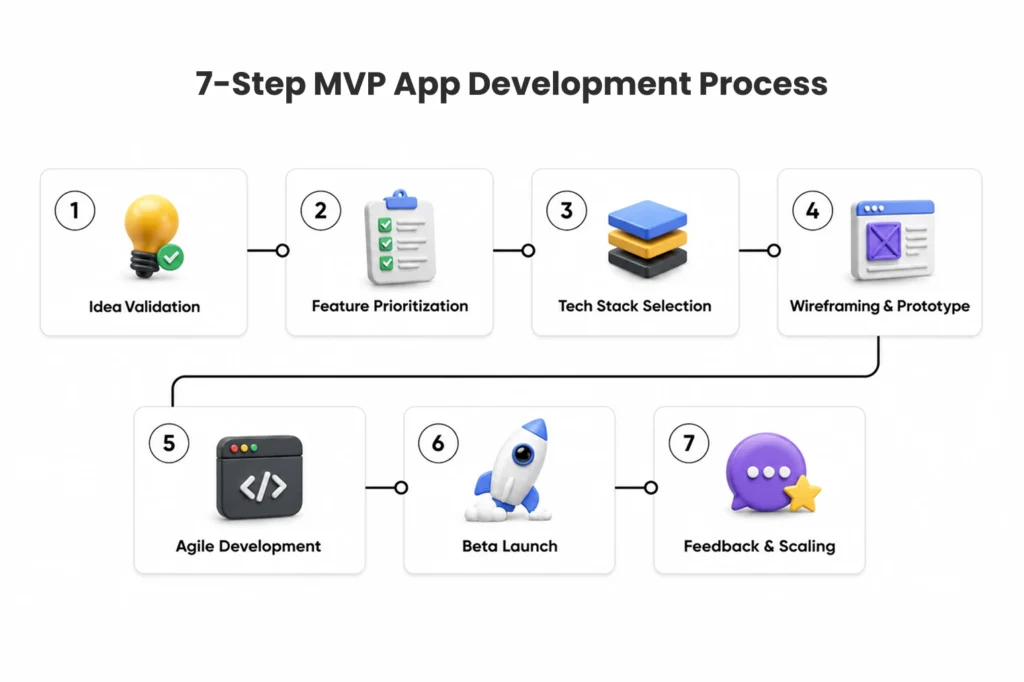
Step 2: Prioritize Only Essential Features
One of the most valuable lessons you will learn regarding how to build an MVP app is understanding what not to build.
Countless startups fail simply because they overload their very first version with entirely unnecessary functionality. Instead of building everything, you must focus entirely on the smallest possible feature set that delivers real, measurable value to the end user.
Use Feature Prioritization Frameworks
Product teams rely on structured frameworks to make these difficult feature decisions objectively. Popular methods include MoSCoW prioritization, RICE scoring, extensive user story mapping, and impact versus effort analysis.
Using the MoSCoW method, you can clearly divide requested features into strict categories:
- Must Have: Core functionality required for the app to function.
- Should Have: Highly useful elements that are not immediately critical.
- Could Have: Future enhancements for later versions.
- Won’t Have: Items officially removed from the MVP scope.
For example, a medical appointment booking app must initially include user registration, a functioning booking calendar, and a secure payment gateway. Features like recurring patient loyalty rewards or advanced clinic reporting can absolutely wait for later phases.
Getting this step right is crucial before moving into full custom mobile app development.
Step 3: Choose the Right Development Approach
Choosing the absolute correct development model significantly affects your overall project cost, technical scalability, and total launch speed. When modern businesses research how to build an MVP app, they usually compare three very common technical approaches.
No-Code and Low-Code Platforms
No-code and low-code tools work exceptionally well for rapid market testing and simple internal business applications. The core benefits include much faster launch timelines, significantly lower upfront financial investment, and vastly easier experimentation for non-technical founders.
However, severe scalability limitations often appear as the product grows and custom functionality is required. You can read more about this route in our guide to low code app development.
Cross-Platform Development
Cross-platform software frameworks allow businesses to build applications for both iOS and Android using one single, shared codebase.
The primary advantages include heavily reduced development time, lower ongoing maintenance effort, and much faster feature deployment across platforms. This particular option works especially well for lean startups targeting multiple device platforms from the very beginning. For a deeper dive, read Cross Platform App Development Explained.
Full Custom Development
Native, full custom development provides the absolute greatest technical flexibility and superior performance for highly complex software products.
It is most commonly used for heavy SaaS platforms, secure Fintech products, dynamic marketplace apps, and compliant healthcare solutions. Although this premium approach requires a much higher initial investment, it offers massively stronger long-term technical scalability.
Step 4: Design User Flows Before Coding
Long before developers write a single line of code, businesses should create detailed wireframes and comprehensive user journey maps. This critical visual stage helps design teams identify severe usability issues early, completely reducing expensive engineering rework later in the project.
Build Clickable Prototypes
Simple, interactive prototypes allow project stakeholders and early test users to physically experience the proposed app flow before costly development starts. Popular modern design tools include Figma, Adobe XD, and Sketch.
A strong prototype helps answer foundational UX questions. It reveals whether the core navigation is genuinely intuitive. It shows if users become confused during the onboarding sequence. Most importantly, it demonstrates if the primary user flow actually solves the intended problem quickly.
This specific process radically improves product clarity and entirely minimizes costly technical revisions during the engineering phase. If you need external help with this phase, learn how to choose mobile app development company partners carefully.
Step 5: Build the MVP in Agile Sprints
Once the visual designs are thoroughly validated, active development begins in smaller, highly manageable sprint cycles. Teams mastering how to build an MVP app almost universally use Agile workflows because they directly support rapid iteration and significantly faster release schedules.
A typical early-stage MVP sprint involves multiple disciplines. It includes frontend interface development, robust backend architecture setup, secure database integration, user authentication, and rigorous QA testing.
Focus on Analytics Early
Data analytics must be fully integrated from the very beginning of the coding phase. You cannot improve what you do not measure.
Your team should meticulously track key product metrics. Monitor total user retention, average session duration, specific feature engagement, and exact user drop-off points. These critical data insights help businesses confidently decide whether to systematically improve, entirely pivot, or aggressively scale the core product immediately after the initial launch.
Understanding these metrics also heavily influences your total app development cost moving forward.
Step 6: Launching Your MVP App to Early Users
A strategic MVP launch should aggressively target a much smaller, highly defined audience first, instead of launching to the entire global market simultaneously.
Passionate early adopters consistently provide much faster feedback and help engineering teams identify hidden usability problems long before a wider, more expensive public expansion.
Highly useful MVP testing methods include running private beta testing groups, building exclusive waitlist communities, executing closed access launches, or utilizing landing page validation campaigns. For instance, a smart startup might invite exactly 100 targeted users to thoroughly test a new fitness app before opening broad registrations to the general public.
This highly controlled software release drastically improves technical stability while simultaneously generating incredibly actionable product insights.
Step 7: Improving an MVP App Through User Feedback
True product learning actually begins immediately after the launch. Businesses studying how to build an MVP app must fundamentally understand that rapid iteration is a mandatory part of the core process, not an optional secondary phase.
Incoming user feedback should be strictly grouped into actionable categories:
- Critical software bugs
- Core feature improvements
- General user experience issues
- Brand new functionality requests
Deploying regular software updates based entirely on documented user behavior almost always leads to a much stronger product-market fit over time.
Common Mistakes When Building an MVP App
Even with a solid plan, founders often fall into predictable traps. Avoid these common pitfalls to protect your budget and timeline.
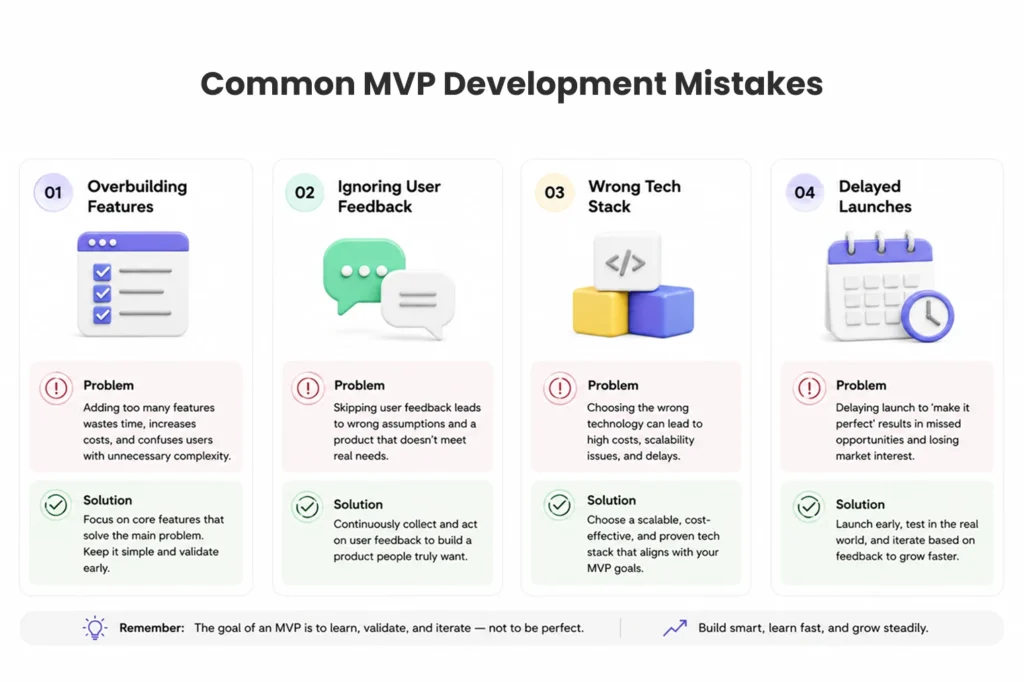
Building Too Many Features
Overbuilding fundamentally delays critical launch timelines and massively increases development costs unnecessarily. Always focus entirely on validating the single core business hypothesis first.
Ignoring User Feedback
Founders sometimes stubbornly rely on their own assumptions instead of listening to real usage data. Documented user behavior always provides significantly clearer direction than internal boardroom opinions.
Choosing the Wrong Technology Stack
Using massive, enterprise-level server architecture for a very simple validation app frequently creates totally unnecessary technical complexity and soaring costs. Technology decisions must closely align with current, immediate business goals, not hypothetical future assumptions.
Delaying Launches
Waiting endlessly for absolute software perfection actively prevents businesses from learning quickly. A slightly unpolished, smaller release paired with strong customer feedback is virtually always more valuable than a heavily delayed, full-feature product that misses the market window.
MVP App Development Costs in 2026
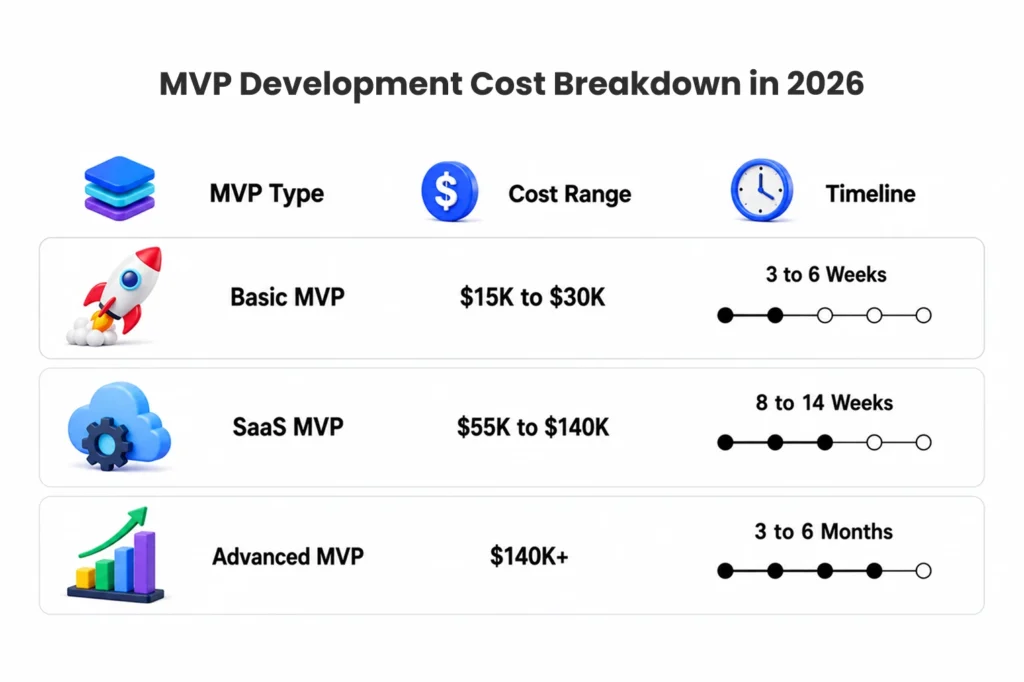
Financial costs vary drastically depending on total app complexity, required third-party integrations, and target platform requirements.
| MVP Type | Estimated Cost | Estimated Timeline |
| Basic MVP | $15,000 to $30,000 | 3 to 6 weeks |
| Standard SaaS MVP | $55,000 to $140,000 | 8 to 14 weeks |
| Advanced Scalable MVP | $140,000+ | 3 to 6 months |
Founders must also budget for completely necessary additional costs. These routinely include professional UI/UX design, rigorous QA testing, secure cloud hosting, external API integrations, and ongoing post-launch technical maintenance.
How to Build an MVP App That Can Scale Successfully
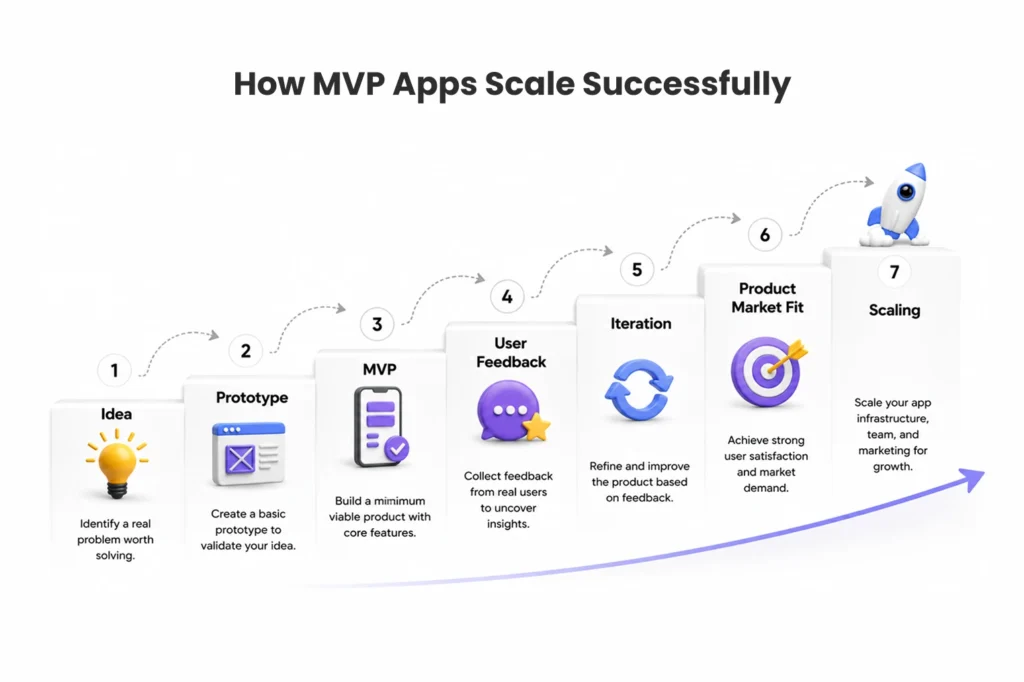
Fully understanding how to build an MVP app is far less about launching a flawless, perfect software product and vastly more about validating core business ideas efficiently. Startups that maintain strict focus on solving one very clear problem, systematically prioritizing core features, and actively collecting early customer feedback almost always make vastly superior product decisions over time.
A highly structured MVP development process actively helps smart businesses completely reduce wasted financial investment, dramatically accelerate their market learning, and create significantly stronger technical foundations for massive long-term growth. Whether your ultimate goal involves launching a massive SaaS platform, a two-sided marketplace, or a sleek mobile application, starting small and staying focused consistently leads to much smarter scaling later.
FAQ
1. What is an MVP app?
An MVP app is a simplified version of a product built with only essential features needed to validate a business idea with real users.
2. How long does it take to build an MVP app?
Most MVP apps take between 3 weeks and 4 months depending on complexity, integrations, and development approach.
3. How much does MVP development cost?
Basic MVP apps may start around $15,000, while scalable SaaS products can exceed $100,000 depending on features and architecture.
4. Why is MVP development important for startups?
MVP development helps startups validate demand early, reduce financial risks, and improve products based on actual user feedback.
5. Should startups use cross-platform development for MVPs?
Cross-platform development is often a practical option because it reduces development time and supports both iOS and Android from one codebase.