Key Takeaways
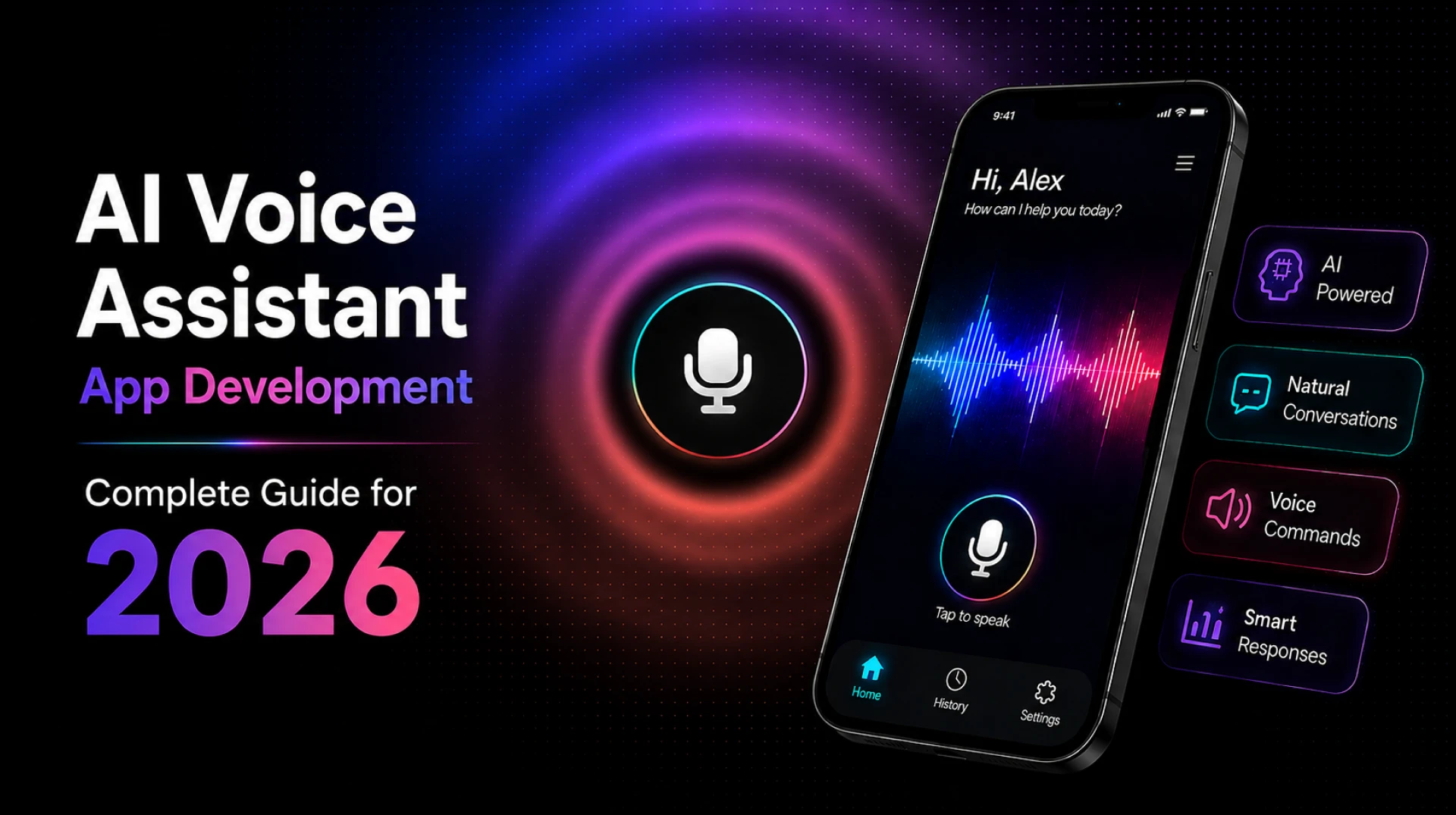
- AI Voice Assistant App Development helps businesses deliver faster, more natural customer interactions across mobile and web platforms.
- Choosing the right architecture, whether composable or managed, directly impacts scalability, flexibility, and long-term costs.
- Core technologies such as speech recognition, language understanding, and voice synthesis form the foundation of successful voice applications.
- Security, compliance, and low-latency performance should be prioritized from the earliest development stages.
- Starting with an MVP allows businesses to validate use cases, control budgets, and scale based on real user feedback.
Voice-based applications have transitioned from basic command-based tools to advanced conversational systems. These now support horizontal enterprise use cases including customer service, healthcare, retail, logistics, and enterprise operations. Rise in user expectations-moving an increasing number of businesses to invest in ai voice assistant app development for faster interactions, accessibility and to streamline engagement process.
Perhaps you are planning a customer support assistant. Could be an appointment booker, could be a sales assistant or may be an enterprise productivity app. Either way, you will have to know our development process, technology, costs, and trade-offs in deployment before you commit. The smart way of digital product engineering prioritises scalability, user experience and long-term maintainability.
The following guide provides what decision-makers need to know about AI voice assistant app development, including market trends, architecture choices, development costs, security requirements, and implementation best practices.
Why Is AI Voice Assistant App Development Growing So Fast?
Voice technology has gone from novelty to necessity. B2B has now adopted it as part of their core channel rather than an experiment.
What Do the Market Growth and Adoption Trends Show?
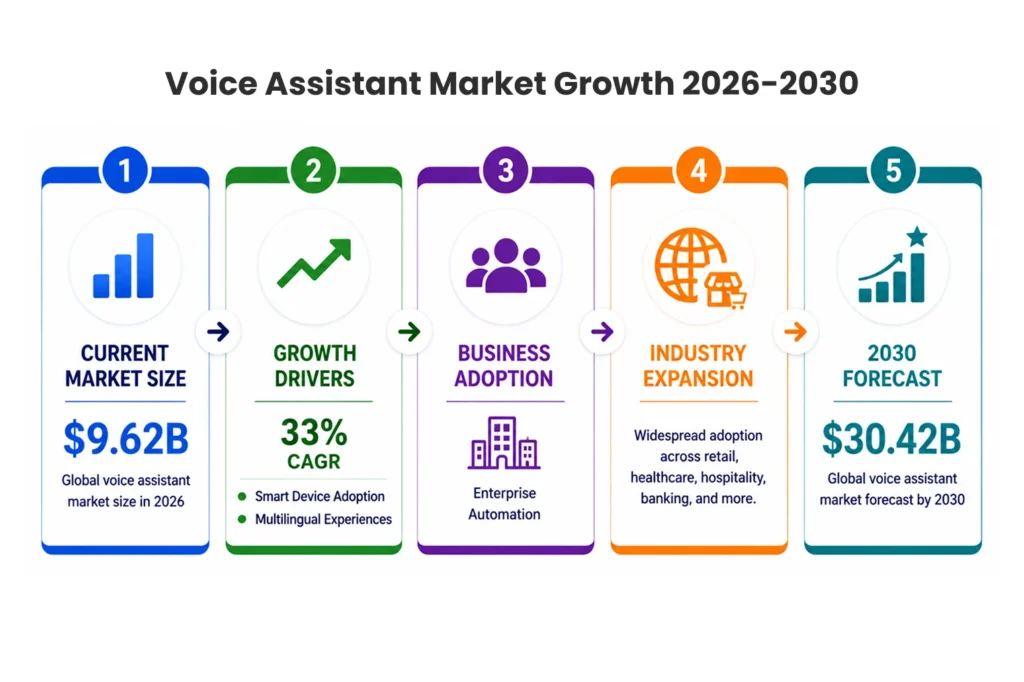
The signals of momentum are difficult to overlook:
- By the year 2030, the voice assistant applications market is forecast to surpass the $30 billion mark.
- Hands-free interactions are also becoming more common across both consumer and enterprise environments.
- Moreover, adoption is expanding across healthcare, finance, retail, and logistics.
- Language coverage for conversational experiences is becoming a table stakes, not a nice-to-have.
This growth ties closely to the broader role of AI in mobile apps, where voice is now one of the most visible AI features users encounter daily.
What Business Problems Do Voice Applications Solve?
Most importantly, voice assistants continue to gain popularity because they solve real and costly business problems. The most common include:
- Extended customer wait times during peak hours
- Staff who can place appointments by hand
- High volumes of requests type of repetitive that devour agent bandwidth
- Slow sales teams – lead qualification bottlenecks
- These could be challenges accessing for users who have a hard time typing or tapping
These pain-points show why so many companies consider the AI chatbots vs traditional chatbots differences before ultimately concluding that a voice-first approach better sets them up for success.
UI / UX Architecture of AI Voice Assistant App Development
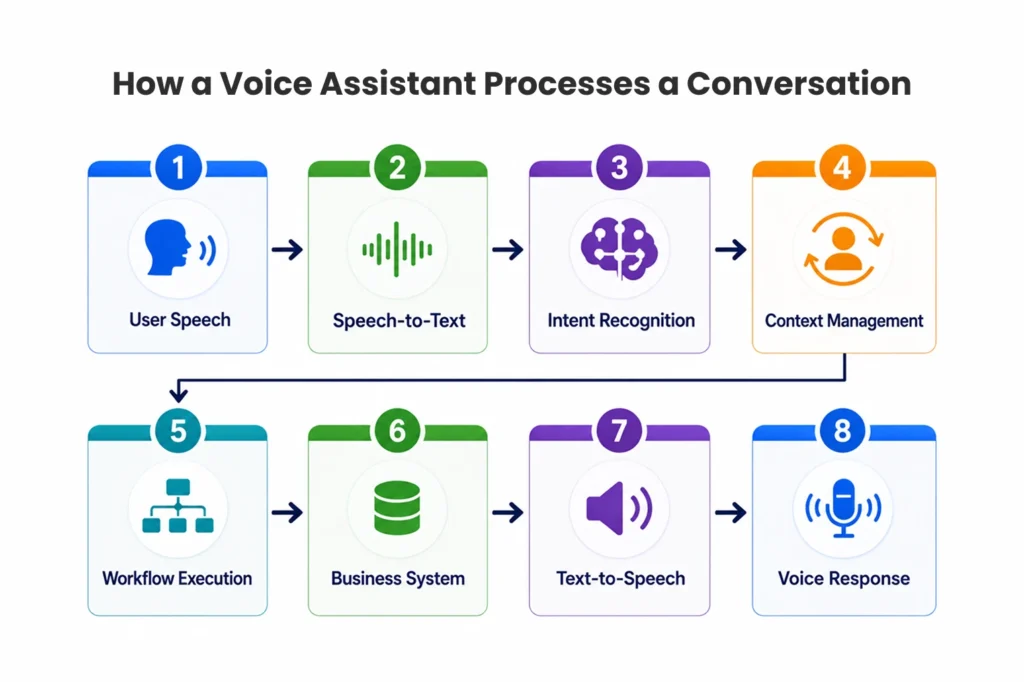
At first glance, a voice assistant appears simple. However, it operates through multiple interconnected layers. As a result, understanding these layers helps organizations make better development decisions.
The Key Building Blocks of a Modern Voice Assistant
All capable voice assistants depend on six core components working in collaboration:
- Speech-to-Text (STT): Converts spoken audio into text, which is the entry point of the audio that can be further processed by the system.
- Natural language understanding (NLU): it understands the intent and brings a meaning to the words.
- Context Management: Keeps the conversation context, like what was said before so that the assistant can remember it.
- Workflow Execution Layer: Handles executions such as booking, payments, or ticket creation.
- Text-to-Speech (TTS): Converts the response from the system into a human-like audio output again.
- Analytics Layer captures performance data across different inputs to ensure better precision and outcomes over time.
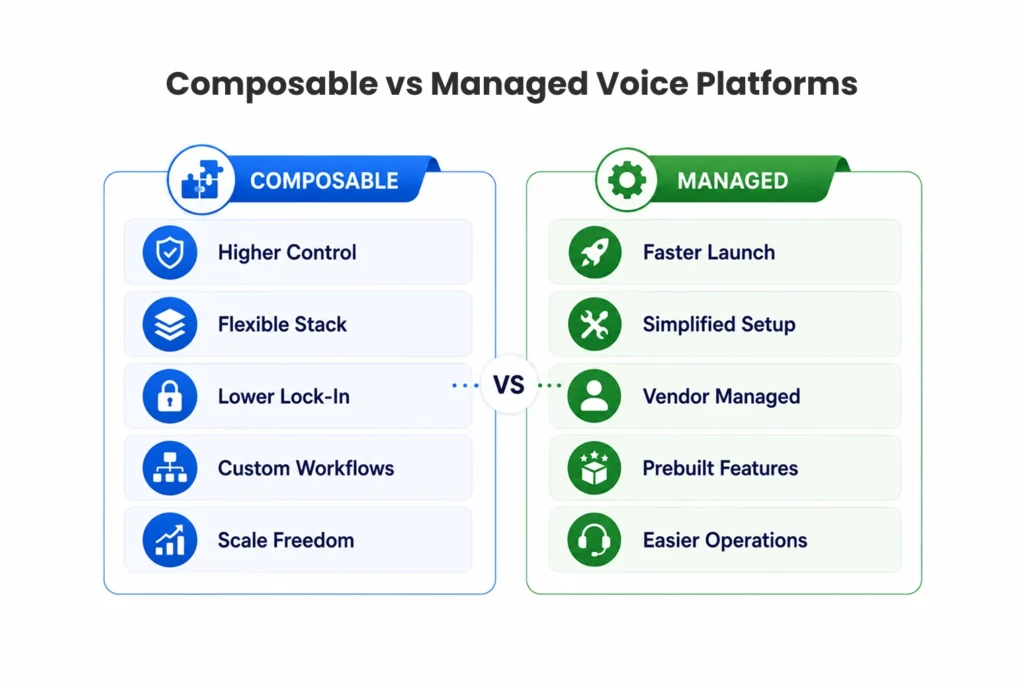
Composable or all-in-one architectures: where to go?
You will typically choose between a self-assembled composable stack, or a managed all-in-one platform. Each suits a different priority.
| Factor | Composable Stack | Managed Platform |
| Flexibility | High | Medium |
| Speed to Launch | Medium | High |
| Customization | High | Limited |
| Vendor Dependency | Low | High |
| Scaling Control | High | Medium |
Opt for a composable stack if control once launched matters more than speed to launch. If you need to get something out the door fast and can live with some vendor lock-in, choose a managed platform. To keep the performance aspect stable at scale, teams building complex, autonomous flows tend to build custom architecture adapted to the specific flows which combined with Agentic AI development services and strong cloud-based app development backgrounds.
Key Features To Incorporate in AI Voice Assistant Applications
Ultimately, the ideal feature set depends on your target audience. The most successful projects strike the right balance between user-facing polish and backend workflow power.
Which User-Focused Features Matter Most?
For example, these features directly influence how natural and trustworthy the experience feels:
- Natural conversations that handle interruptions and follow-up questions
- Multi-language support for diverse user bases
- Personalization based on user history and preferences
- Voice biometrics for secure, password-free identification
- Context retention so users don’t repeat themselves
Enterprise Workflow Features That ROI-Payoff
These integrations answer the question of real value behind the scenes — how conversations become done tasks:
Integrate CRM to Record and Take Advantage of Customer Data
Appointment scheduling without human involvement
Creating tickets for any support & service requests
Payment assistance for secure transactions
Usage and outcomes tracking dashboard of reports
Pairing these features with thoughtful custom mobile app development and solid mobile app security best practices ensures the assistant is both useful and safe to deploy.
How Does the AI Voice Assistant App Development Process Work?
Having a structured process mitigates risk and ensures business alignment from the project’s inception till the end.
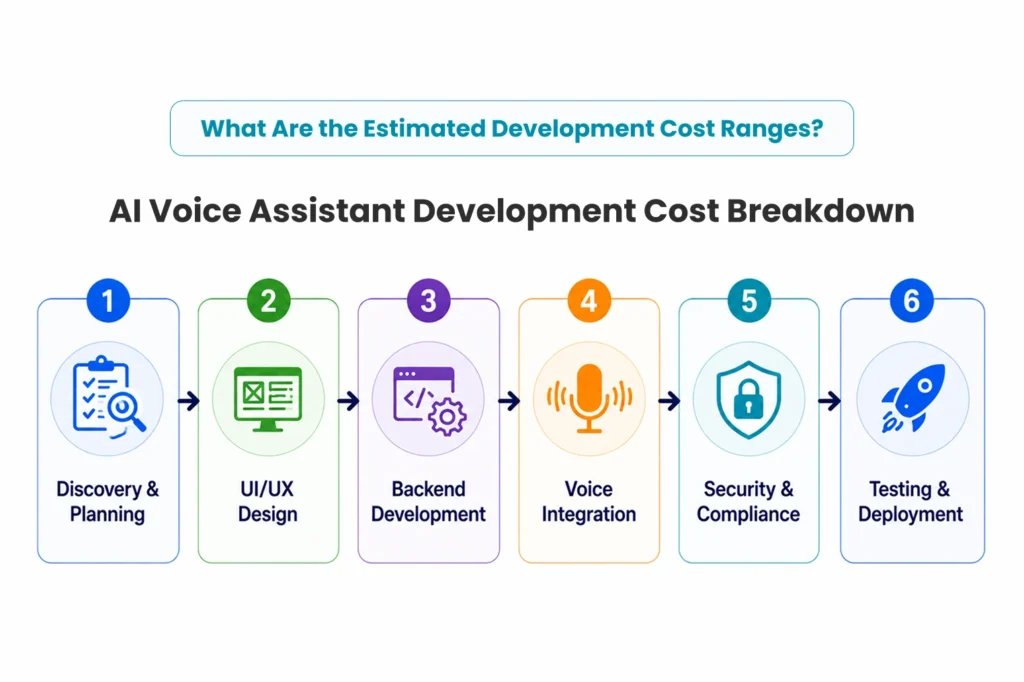
What happens in Discovery and Requirement Analysis?
To begin with, the discovery phase establishes the foundation for the entire project. During this stage, teams define:
- Business objectives the assistant must support
- User personas to clarify who will use it and how
- Conversation mapping to plan dialogue flows and edge cases
- Success metrics to measure whether the project delivers
How Do Design, Development, Testing, and Deployment Fit Together?
Once requirements are finalized, the project moves through the following development stages:
- UX design focused on voice-first interaction
- Voice flow creation to script natural dialogue paths
- Backend development to power logic and actions
- API integrations with CRMs, calendars, and payment systems
- Testing across accents, devices, and noisy environments
- Production launch with monitoring in place
Adhering to a transparent app development lifecycle explained and commencing with building MVP mobile apps with smaller budgets allows teams to test the waters before expansion.
Costing of AI Voice Assistant app development
Cost is one of the first questions decision-makers ask. The honest answer: scope, complexity, and infrastructure are everything.
Factors Affecting Voice Assistant Development Cost
In general, several factors can increase or decrease overall development costs:
- Feature complexity and the number of conversation flows
- Language support for multilingual audiences
- Integrations with existing business systems
- Security requirements tied to your industry
- Real-time processing needs for low-latency responses
- Hosting infrastructure to handle expected call volumes
AI Voice Assistant App Development Cost Estimates
The below ranges allow for a realistic baseline for planning purposes:
| Project Type | Estimated Cost |
| MVP Voice Assistant | $15,000–$40,000 |
| Business Assistant | $40,000–$100,000 |
| Enterprise Voice Platform | $100,000+ |
Therefore, early-stage companies often benefit from launching a focused MVP before investing in a larger platform. Guidance on mobile app development for startups can help you decide which features are worth funding in version one.
Technology Stack for AI Voice Assistant App Development
The technology decisions you make will impact the accuracy, latency, and scaling of the app in future.
Speech Technologies Used in Voice Assistant Development
The Conversational Load Three layers account for the majority of the conversational load:
- Speech recognition engines that handle diverse accents and noise
- Language understanding models that accurately read user intent
- Voice synthesis systems that produce natural, on-brand speech
Infrastructure Requirements for Voice Assistant Applications
Additionally, robust infrastructure helps maintain consistent performance as user demand grows. Key considerations include:
- Cloud deployment for elastic, on-demand scaling
- Edge deployment to cut latency for time-sensitive responses
- Real-time communication to keep conversations fluid
- Monitoring and observability to catch issues before users do
By comparing the best AI tools along with utilizing the mobile app performance optimization techniques, you will be able to achieve balance across the stack between speed, cost, and quality.
Security Requirements for AI Voice Assistant Applications
Above all, voice data should be treated as sensitive information. Usually laced with personal, financial, or medical data, security cannot be an afterthought.
Protecting Data in Voice Assistant Applications
To protect user information, organizations should prioritize several essential security measures:
- Data encryption for audio in transit and at rest
- Secure storage with strict access controls
- Identity verification through voice biometrics or multi-factor checks
- Consent management so users know how their data is used
Compliance Standards for Voice Assistant Development
These standards have the most frequent occurrence, however, it all depends on your vertical in terms of compliance.
- HIPAA for healthcare applications
- GDPR for treatment of data users in the EU
- (SOC) 2 for Service Organization Controls
- PCI DSS for processing payments
Embedding mobile app security best practices early prevents costly rework and protects user trust.
Common Challenges in AI Voice Assistant App Development
Nevertheless, even experienced development teams encounter challenges during implementation. Having a sound understanding of them in advance enables you to plan around them.
Improving Accuracy in Voice Assistant Applications
Real-world conditions test any voice system. The toughest issues include:
- Accent variations that confuse speech recognition
- Background noise in busy environments
- Context switching when users change topics mid-conversation
- Real-time processing delays that break conversational flow
Scaling Enterprise Voice Assistant Applications
Enterprise demand introduces a different set of pressures:
- High call volumes during peak periods
- Infrastructure costs that grow with usage
- Monitoring to maintain quality at scale
- Reliability to keep uptime high
Working with an experienced AI agent development company and a mature approach to cloud-based app development makes these challenges far more manageable.
How to Select an AI Voice Assistant App Development Company
The right partner can be the difference in a successful launch and a delayed project.
Voice Assistant Development Company Evaluation Checklist
Things to check before signing on with the partner:
- Voice technology expertise with proven STT, NLU, and TTS experience
- Integration capabilities across your existing systems
- Security practices that match your compliance needs
- Scalability planning for future growth
Choosing a vendor only after analyzing its custom mobile app development portfolio and verifying their credentials as an AI agent development company instills confidence in you before you allocate the budget.
Future Trends in AI Voice Assistant App Development
Looking ahead, voice technology continues to evolve at a rapid pace. Planning for the next steps, safeguards your investment.
Next-Generation Voice Assistant Experiences
Next generation assistants understand much more than single commands. Expect:
- Multi-step conversations that complete complex tasks
- Personalized interactions shaped by user behavior
- Memory-driven workflows that recall past sessions
Emerging Voice Assistant Applications Across Industries
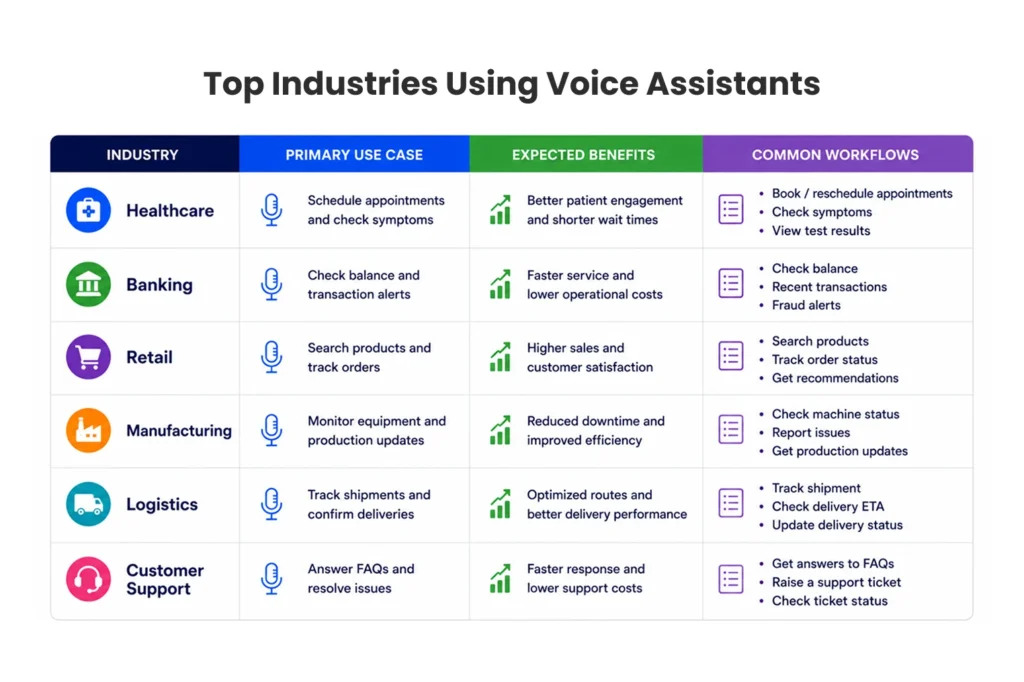
Adapting more vertical solutions is emerging across sectors:
- Healthcare: Patient intake and appointment reminders
- Banking: Secure account access and transactions
- Retail: Voice-driven shopping and support
- Manufacturing: Hands-free equipment guidance
- Logistics: Real-time tracking and dispatch
A lot of this progress relies on the availability of Agentic AI development services, in which assistants can perform autonomously to fulfil goals, rather than just responding to prompts.

Turning Voice Strategy Into a Working Product
AI voice assistant app development has become a strategic investment for organizations that want more natural interactions and greater operational efficiency. Succeed by getting the architecture right, choosing low-latency performance, solid security enforcement and business outcomes over conversation shape or 1-to-1 conversations.
Ideal answer: Before moving forward, organizations should evaluate long-term scalability, integration requirements, and total cost of ownership. In combination with a sound approach to development, voice enabled applications can deepen customer engagement, automate workflows, and create destination digital experiences.
The most intelligent next step, you might be inclined to think, is to start slow. Pinpoint a high value use case, create a narrow MVP, measure and scale.
Frequently Asked Questions
1. How long does it take to build an AI voice assistant app?
On average it takes around two to four months to develop a basic MVP voice assistant. Business-grade assistants take four to eight months, enterprise voice platforms nine months or more, based on integrations, language coverage, and compliance specs.
2. What is the difference between a voice assistant and a chatbot?
Chatbot gives reply in text and voice assistant reply in speech with speech-to-text technology and vice versa. Voice assistants are also dealing with an additional layer of complexity over and above chatbots for text use which have to do with audio quality regards, accents and latency.
3. How much does AI voice assistant app development cost?
On average, the costs will be between $15,000–$40,000 for MVP,$40,000–$100,000 for business assistant, and $100,000+for enterprise voice platform. Most final pricing is determined by specific features or integrations, security requirements, and scalability options.
4. Which industries benefit most from voice assistant applications?
They also boast the strongest return on investment in healthcare, banking, retail, manufacturing and logistics. Voice automation is well suited for these sectors due to the high volume of interactions, the repetitive nature of the tasks, and the accessibility requirements that they face.
5. What security standards apply to voice assistant apps?
Common standards are: HIPAA for healthcare, GDPR for EU user data, SOC 2 for service controls, and PCI DSS for payment processing. This includes encryption, secure storage, identity verification, and consent management among others.
6. Should startups build an MVP or a full voice platform first?
Just build an MVP, right → Most startups have to build an MVP. The MVP, an MVP validates demand, mitigates upfront outlay and provides real usage data before committing platform funding and meaning eliminates budget waste and risk.