Key Takeaways
- Understanding AI shopping assistant development costs helps businesses estimate budgets and select the right implementation strategy.
- Development costs depend on factors such as personalization, integrations, feature complexity, and scalability requirements.
- Businesses can choose between SaaS solutions and custom development based on their goals, timelines, and long-term ROI.
- A phased rollout approach helps control costs while minimizing implementation risks.
- Prioritizing essential features first enables ecommerce businesses to maximize value and scale efficiently.
Retailers are under increasing pressure to offer better digital product discovery, customer experiences, and purchase experiences. As the business landscape continues to be reshaped by fast-changing customer expectations, companies of all sizes and niches are weighing ai shopping assistant development costs to gauge the investment outlay and the business return such expenditure can generate.
The reality is that costs vary widely. A small ecommerce store and a large retail marketplace face completely different requirements. Customization complexity, integration depth, data volume, and scalability all push the budget in different directions. Getting a clear picture of ai shopping assistant development costs early helps decision-makers avoid expensive surprises and choose an implementation approach that actually fits their goals.
Drawing on our insights from digital commerce projects, this guide covers everything from pricing models and major cost drivers to feature tiers, the build versus buy dilemma, and tactics to reinforce your budget. Whether you’re considering your first investment or scaling an existing commerce platform, this breakdown will provide a framework for making informed decisions.
AI Shopping Assistant Guide: Why Businesses are Investing in One?
An AI shopping assistant acts as a conversation-driven or recommendation-driven assistant that takes customers from product discovery to checkout. Unlike static search boxes or rule-based filtering mechanisms, next-gen AI shopping assistants leverage machine learning, natural language processing, and behavioral data to deliver contextual and personalized experiences.
This is important to understand how these types of tools differ from some of the older models. Check our ai chatbots vs traditional chatbots guide to get a more detailed view of the technical differences.
What Are The Fundamental Functions Driving Customer Engagement?
The best AI shopping assistants are multi-talented, offering the following in a single experience:
- Personalized product recommendations based on browsing history, purchase patterns, and customer preferences
- Conversational product discovery that allows customers to describe what they’re looking for in natural language
- Inventory-aware suggestions that surface only available products
- Order tracking support integrated with fulfillment systems
- Cart recovery assistance that re-engages customers who abandon without purchasing
- Product comparison guidance that simplifies high-consideration purchase decisions
Furthermore, the addition of any of those functions creates increased complexity and cost in the construction of such an app.
A Brief Overview Of The Benefits Of AI Shopping Assistants
Though the latter point is only addressed with an investment in an AI shopping assistant, the first two drivers are driven by measurable pain points.
- Product search abandonment, where customers fail to find what they’re looking for and leave
- Low conversion rates caused by poor product discovery experiences
- High support volumes from repetitive pre-purchase questions
- Cart abandonment driven by decision friction
- Limited product discovery, especially across large catalogs
Explore more in our article on how ai improves website development. Additionally, discover how broader digital commerce initiatives can benefit from intelligent automation.
AI Shopping Assistant Development Costs Breakdown
Among the frequent questions heard by development teams is: «How much will this actually cost? The honest answer is very much based on whether you are using an out of the box Software as a Service solution, or whether you are building a completely bespoke platform.
How Much Do Development Approaches Cost
SaaS-Based Deployment
SaaS solutions offer a faster path to market. These platforms are designed for quick deployment with minimal technical overhead.
- Monthly subscription models reduce upfront capital requirements
- Implementation is faster, often measured in days or weeks
- Upfront investment is significantly lower
- Customization is limited to what the vendor’s platform supports
Typical range:
- Small-to-mid-sized businesses typically pay between $29 and $199 per month.
- Enterprise pricing starts from usage, user volume and tier
Custom Development
Custom development provides wholly personalized experiences that meet the only requirements that your particular brand, catalog, and customer base presents.
- Provides greater ownership and flexibility over data and architecture
- Allows unique customer experiences not possible with off-the-shelf tools
- Requires longer implementation cycles and a dedicated development team
Typical range:
- $50,000 to $300,000+ for mid-market projects
- Enterprise platforms can exceed $500,000 depending on scale and integration complexity
How Are AI Shopping Assistant Development Costs Distributed Across Components?
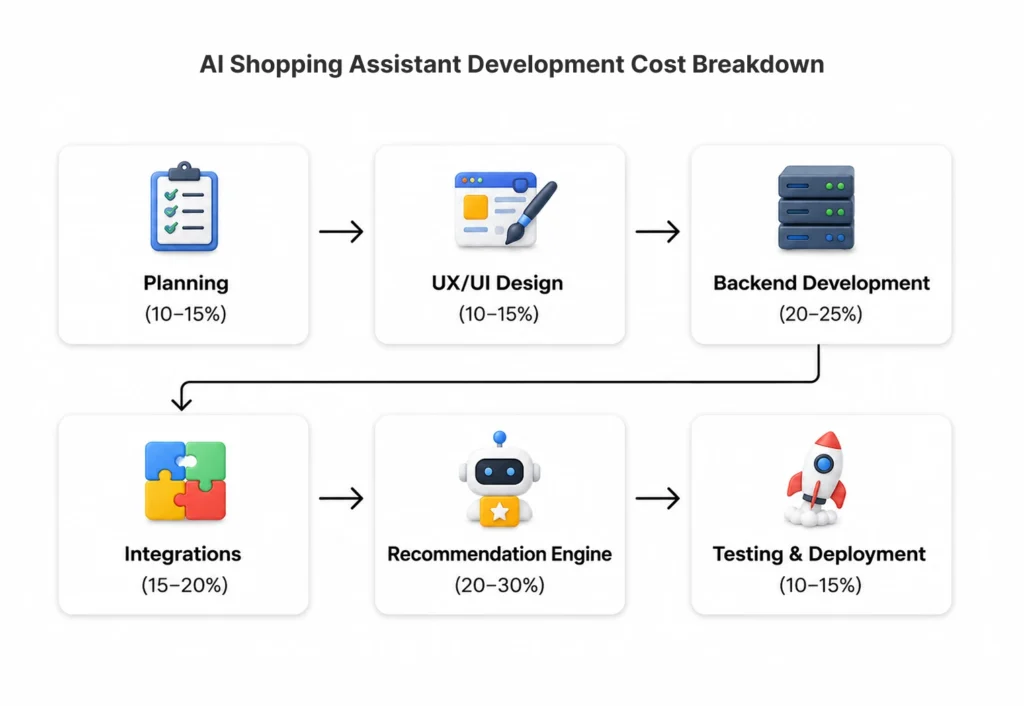
Budgets often stretch across phases of development, the better you can understand how the budget is likely to break down per phase, the better your teams can allocate resources. Lee had a few strong theories as to why, but that is probably a blog post for a different day. Interested in more overarching digital commerce budgeting context? Check out our Ecommerce Website Cost Breakdown
| Cost Area | Estimated Share of Total Budget |
| Discovery & Planning | 10–15% |
| UX/UI Design | 10–15% |
| Backend Development | 20–25% |
| Ecommerce Integrations | 15–20% |
| Recommendation Engine | 20–30% |
| Testing & Deployment | 10–15% |
The recommendation engine typically commands the largest share of the budget because it serves as the core differentiator between a functional chatbot and an intelligent shopping assistant.
Key Factors Affecting AI Shopping Assistant Development Costs
Once you have an idea of the high level range based on the biggest cost influencers, the next thing to do is understand what drives those costs higher/lower for you. AI shopping assistant development costs are not fixed. Instead, they shift significantly based on your technical requirements and business objectives.
How Does the Level of Personalization Affect Development Costs?
The largest cost factor is personalization The more complex the recommendation logic, the more development required.
- Rule-based recommendations: Lowest cost. Works on the basis of pre-configured rule (for example, “customers who purchased X also purchased Y”).
- Behavioral recommendations: Mid-range. By using real-time browsing and click data to surface the most relevant products.
- Customer profile analysis: Higher cost. Account data with preferences and the segmentation models.
- Purchase history modeling: Highest cost. Deep data pipelines, model training, and constant re-optimization is mandatory.
Shifting from rule-based to purchase-history modeling can increase the backend dev budget by 2–3X.
What is the impact of the Integration complexity on the Total Cost of Ownership?
Early assumption: Integrations take a back seat. For every platform connection, you have to invest time and effort to develop it, test it, and keep it up-to-date.
Common integrations include:
- Shopify and WooCommerce for SMB ecommerce
- Magento for mid-to-enterprise retail
- ERP systems for inventory and fulfillment data
- CRM platforms for customer history and segmentation
- Payment gateways for checkout assistance
To read the comprehensive consideration of integration in ecommerce builds, check out our ecommerce website development guide.
Other cost drivers to factor in:
- No of SKUs in the product catalog
- Languages and regions supported
- Expected number of customers and concurrent sessions
- Analytics and reporting requirements
- Security and compliance requirements (especially for regulated markets)
Build vs Buy: Which Option Offers Better ROI?
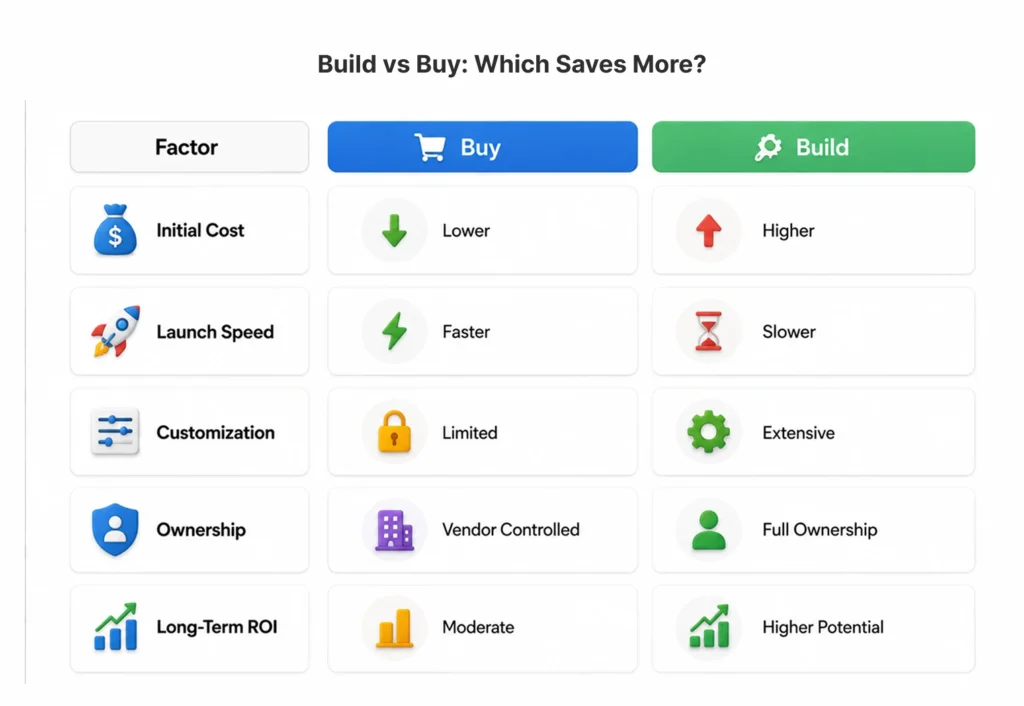
The build versus buy decision is arguably the most impactful one to make during the planning stage. However, there is no universal answer. Instead, the right choice depends on your specific business requirements and goals.
Advantages of purchasing an existing SaaS solution
Pros:
An unprecedented time to market. In most cases, deployment takes days rather than months.
Just monthly price plan makes budgeting easy
Less technical overhead and you do not need an in house development team
Cons:
The reliance on a vendor can be risky if the pricing changes, or they decide to no longer service your needs
Limited customization constrains differentiation
Continuous subscription costs build up over time
How Is A Custom AI Shopping Assistant Development Beneficial?
Pros:
Total ownership over your data, architecture and IP
The competitive differentiation : Exceptional Customer Experiences only your company can offer.
More flexibility in the long term as your business grows
Cons:
Upfront Cost is Higher (Especially for Mid-Market and Enterprise Builds)
Longer deployment timelines means careful project management
| Factor | Buy (SaaS) | Build (Custom) |
| Initial Cost | Lower | Higher |
| Time to Launch | Faster | Slower |
| Customization | Limited | Extensive |
| Scalability | Vendor Dependent | Business Controlled |
And for companies that are assessing potential development partners, our overview of AI agent development company options can help you get a better sense for what to seek out.
Feature-Based Cost Estimation for AI Shopping Assistants
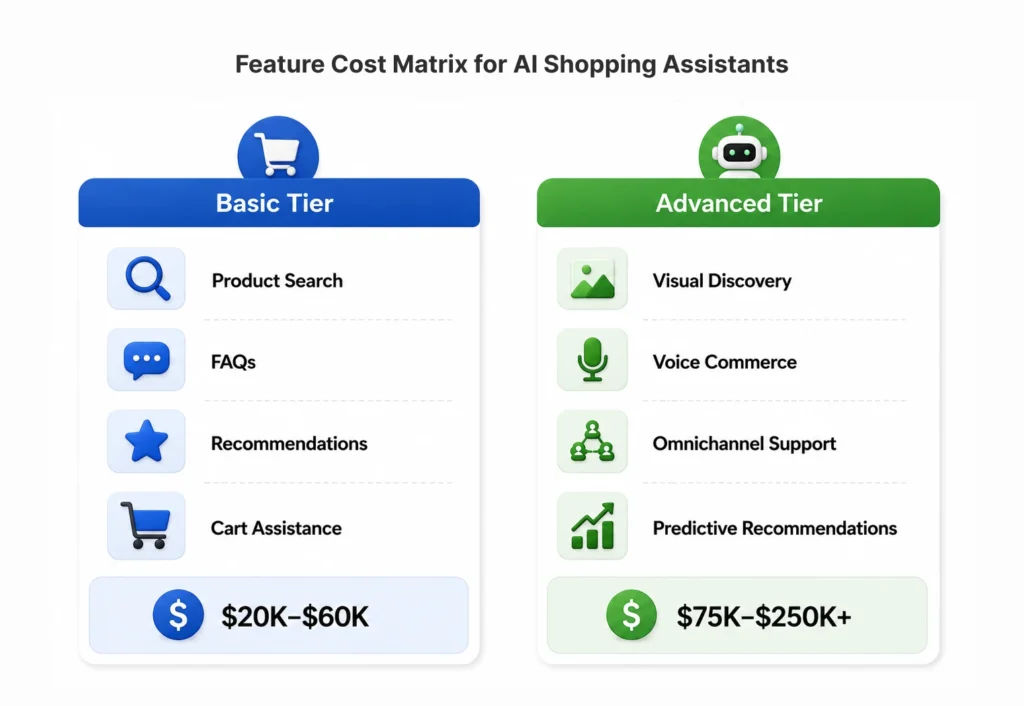
Another helpful angle for budgeting is feature scope. Tightly defined feature sets make the final product much easier to estimate and manage.
How Much Does It Cost to Develop Necessary Features for an AI Shopping Assistant?
Core functionality encompasses the features that you necessitate from any productive shopping assistant:
- Support for natural language in product search
- Personalized product recommendations
- Customer FAQ handling
- Cart assistance and checkout guidance
- Basic analytics and reporting
Estimated cost: $20,000 to $60,000
This is ideal for early-stage deployments or minimum viable products, or for businesses who would like to experiment with AI commerce capabilities before making a larger investment.
How much does it cost to develop advanced commerce features?
Advanced implementations move past the foundational components to provide compelling customer experience differentiation:
- Visual product discovery using image recognition
- Omnichannel support across web, mobile, and in-store touchpoints
- Predictive recommendations powered by machine learning models
- Voice interaction support for hands-free shopping
- Customer behavior insights with real-time analytics dashboards
Estimated cost: $75,000 to $250,000+
If your team is thinking about voice-enabled commerce, check out our guide for a breakdown of technical and cost considerations for AI Voice Assistant App Development. For instance, businesses building in the direction of full automation should also check out our overview of Agentic AI Development Services.
Development Timeline and Resource Requirements
In the software world, budget and timeline are inseparable. At this point of time in your project scope creep is being taken care of by a structured development plan which makes sure stakeholder expectations have been managed.
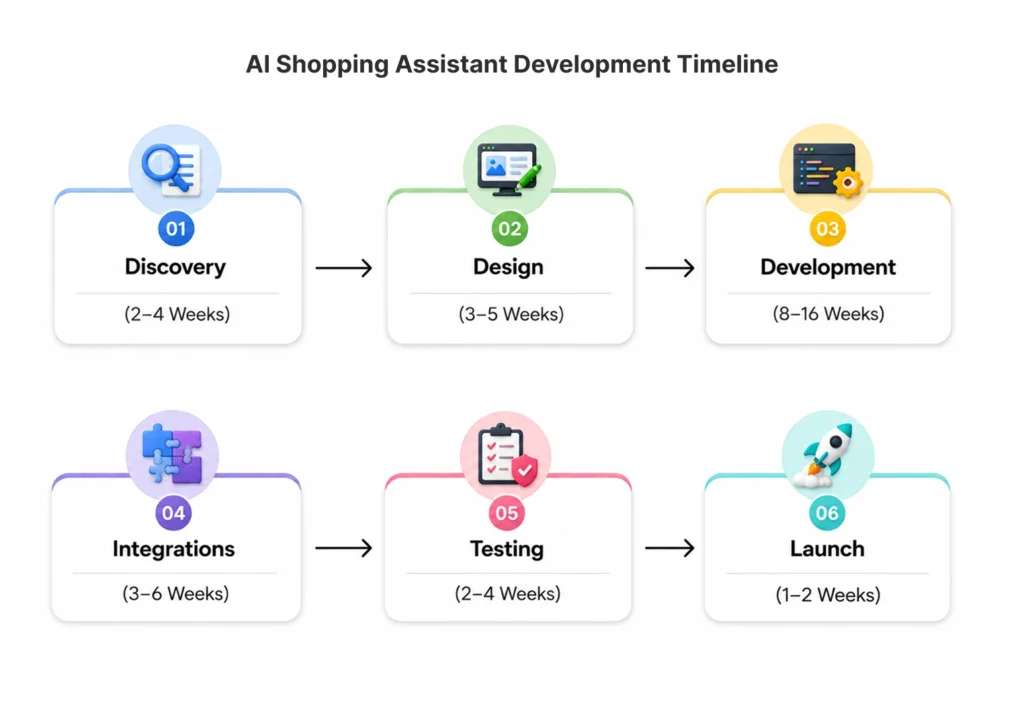
What Is the Typical Project Timeline for AI Shopping Assistant Development?
| Stage | Duration |
| Discovery & Planning | 2 – 4 Weeks |
| UX/UI Design | 3 – 5 Weeks |
| Development | 8 – 16 Weeks |
| Integration | 3 – 6 Weeks |
| Testing & QA | 2 – 4 Weeks |
| Launch | 1 – 2 Weeks |
From kickoff to launch, most projects run between 19 and 37 weeks. Integrations tend to have the least predictable phase. Third-party APIs that are poorly documented or legacy systems can add weeks to the timeline, to name a few.
What kind of team structure is needed when building it custom?
To build a custom AI shopping assistant, you need a full development team that usually covers:
Project Manager: You own the timeline, scope, and stakeholder communication
Business Analyst: Responsible on translating into technical specifications the requirements of the commerce
UI / UX Designer: Designing intuitive interfaces Designed for conversion
Frontend Developer: Implementallumnio the front end that the alumnio user interacts with
Backend Developer: Builds APIs, data pipelines, and recommendation logic
QA Engineer: Validate features on devices and browsers in edge cases
If your teams are building more broadly on commerce infrastructure, our custom web application development guide has more detail on structure and process.
Comparing against a set of modern AI shopping assistant platforms
AI shopping assistants have evolved significantly over the past few years. Today, businesses can choose from lightweight SaaS tools, enterprise-grade commerce platforms, and highly customized solutions. While many platforms offer similar core capabilities, their differences extend far beyond pricing.
How do current market solutions differ from each other?
Key differentiation factors include:
- Personalization capabilities: Some platforms rely on collaborative filtering, while others incorporate deep behavioral modeling and customer profile analysis
- Product recommendation quality: The best solutions combine real-time signals with historical purchase data to surface genuinely relevant products
- Retail integration depth: Enterprise solutions typically offer native integrations with Shopify, Magento, and major ERP systems, while lighter tools may require custom connectors
- Real-time inventory awareness: Critical for high-SKU catalogs where availability changes frequently
- Checkout assistance: Advanced platforms guide customers from product selection through payment, reducing abandonment at every step
The most advanced platforms have conversational purchasing experiences where users can tell the system what they want using everyday speech, and appropriate recommendations are made in context. In contrast, search-first models are suited for customers who know what they want, but need help traversing extensive catalogs. Retail ecosystem integrations determine how seamlessly a platform connects with existing commerce infrastructure and also how much custom development is required to fill the gaps.
Read our guide to best ai shopping assistants for ecommerce for a selected overview of current tools.
How Can You Reduce AI Shopping Assistant Development Costs Without Sacrificing Quality?
AI shopping assistant development costs don’t have to spiral out of control. Generally, the most effective levers that can be used to manage budget without compromising on critical features are smart scoping and phased delivery.
Which Features Should You Prioritize First to Control Costs?
Begin with the capabilities with the most obvious and quantifiable business impact:
- Product recommendations: Directly impact conversion rates and average order value.
- Search Assistance: minimises abandonment due to product discovery failures
- FAQ Helpdesk: Prevents repeated requests for support, decreases operating costs
All three functions target the highest-volume customer use cases and provide a fast return on investment. Consequently, they are the natural basis for any AI shopping assistant development.
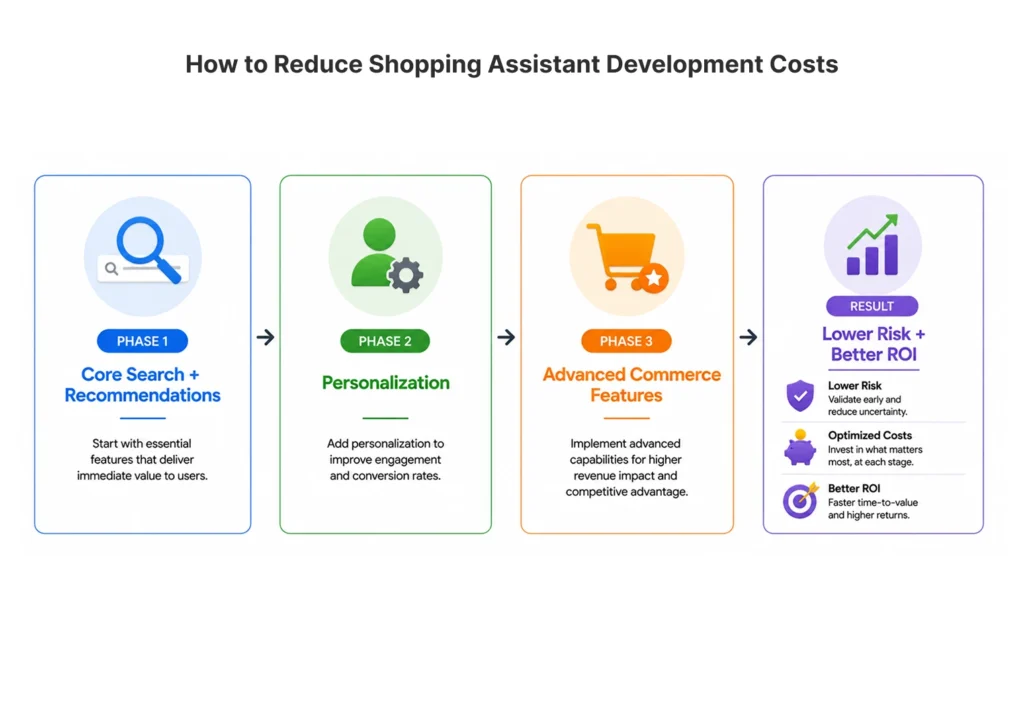
What Is a Phased Rollout Strategy and How Does It Reduce Risk?
With the phased approach, the project is divided into smaller parts, with value flowing from one part of the project to another before moving to the next.
Phase 1: Basic Shopping Experience: Implement basic product search, recommendations and FAQ handling. Validate performance before expanding scope.
Phase 2: Personalization: Enrich with behavioral data, customer profile analysis, and purchase history modeling It relies on already tested infrastructure, meaning less rework.
Phase 3: Advanced Commerce Automation (305): Voice interactions, visual discovery, omnichannel (to call, to text, chat, interactive calling and text), predictive analytics The business case is proven at this stage and it is now so much easier to justify decisions to invest.
Our compilation of Top AI Development Companies in India mentions some essential factors for teams aiming to find experienced development partners to assist in this process.
Plan Your AI Investment with Confidence
Understanding ai shopping assistant development costs requires looking beyond the initial build price. Long-term maintenance, integration complexity, scalability requirements, and expected return on investment all shape the true cost of ownership.

There is no one approach to fit all, it depends on Ecommerce Maturity, Plans for Growth and your customer service experience goals. By maintaining a structured roadmap, phased rollout plan, and disciplined feature prioritization, we will extract the most value for every dollar spent, while also ensuring the project stays on schedule and within budget.
Start by prioritizing the features that address your most critical business challenges. Next, validate their performance using real customer data. Once proven effective, you can gradually expand functionality based on business needs. That discipline differentiates the projects that create sustainable business value from those that spend budgets without generating a commensurate return.
Frequently Asked Questions About AI Shopping Assistant Development Costs
1. What is the average cost of developing an AI shopping assistant?
The cost for basic implementations starts at about the price of a sedan, at $20K or so, and includes core features such as product search, recommendations, and FAQ support. Enterprise platforms with extensive personalization, multi-language and deeper integrations may rise to over $250K. For small businesses, SaaS options are available from PHP 1,500 a month.
2. What factors influence AI shopping assistant development costs the most?
There are several main factors such as customization level, ecommerce integrations, size of product catalog, user volume, analytics requirements and deployment architecture. In most systems, the biggest single cost driver for backend development work is how deeply you personalize, and whether you model purchase history or not.
3. Is custom development better than buying a SaaS solution for AI shopping assistants?
It depends on what you are trying to achieve for your business.SaaS solutions have low upfront costs and faster time to market. Therefore, they are often suitable for businesses validating new concepts with limited technical resources. Moreover, custom development provides greater flexibility, complete data ownership, and stronger opportunities for differentiation. For complex requirements or ambitious growth, therefore, it becomes the better long-term option for businesses.
4. How long does AI shopping assistant implementation typically take?
Depending on the nature and complexity of the project, the full cycle from discovery to launch will take typically 19 to 37 weeks. In fact, simpler SaaS deployments can often go live within a few days. For enterprise custom builds with multiple integrations and high-level personalization, six months (or longer) is typically expected.
5. Can small ecommerce businesses afford an AI shopping assistant?
Yes. So many small businesses start with SaaS based tools in the $29–$199 a month range that deliver a powerful set of capabilities without needing custom development. They may evolve to custom platforms with a definitive use case and pre-existing data informing the build as business requirements around personalization and integration depth grow.
6. How do ongoing maintenance costs factor into the total investment?
This may include model retraining, platform/third-party integrations, maintenance and monitoring for model drift, and performance over time. For custom builds, allow 15–20% of initial dev costs per year for maintenance. For SaaS platforms, some maintenance costs are typically included in the subscription fee. However, access to advanced features may depend on the selected pricing tier.